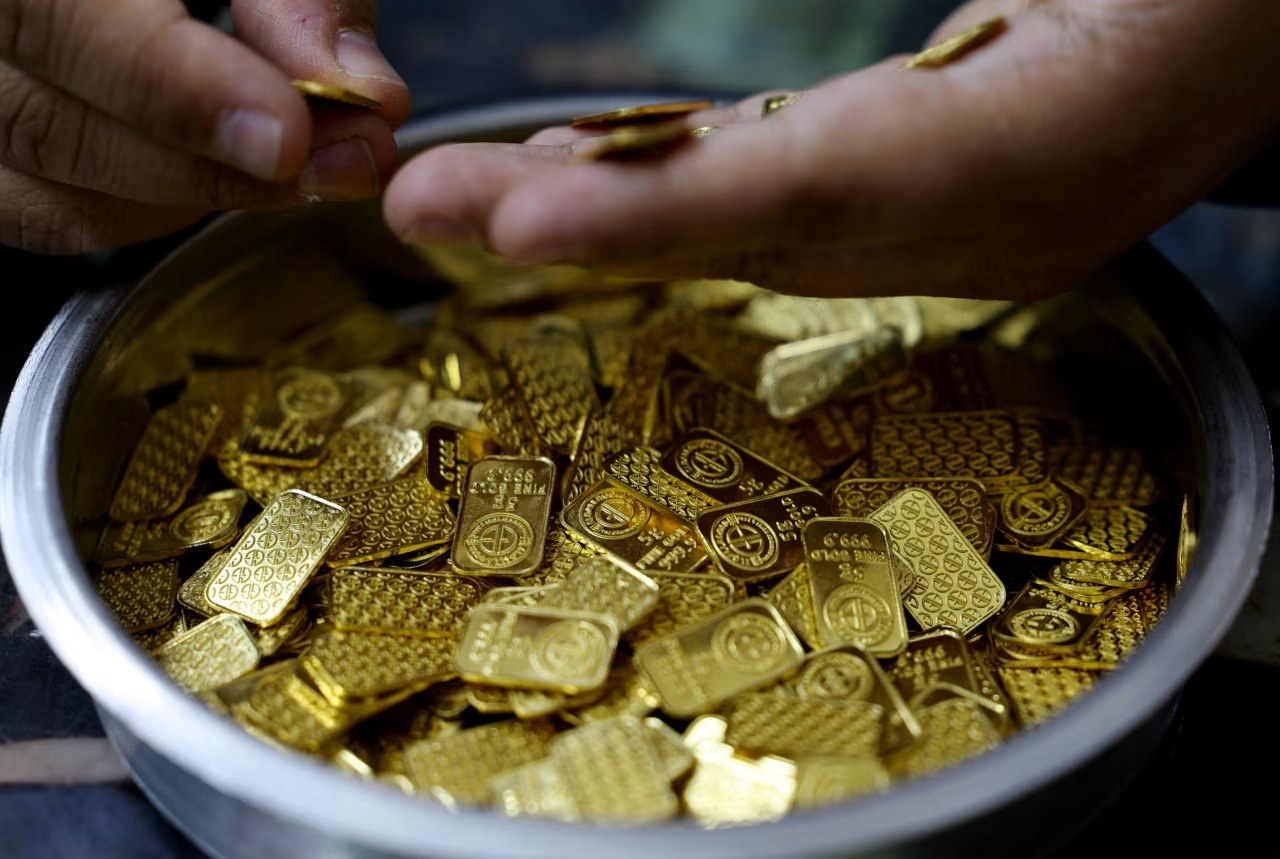
Gold Crashes $289 in Six Days—Silver Down 20% as Funds Flee Precious Metals
- Gold futures lost 5.9% Thursday, extending a six-day slide that has shaved $289 off the price per ounce.
- Silver futures dropped 8.2% overnight, bringing their seven-session decline to roughly 20%.
- The rout ranks among the worst daily declines on Comex records, surpassing March 2020 margin-call liquidations.
- Surging U.S. dollar and rising real yields triggered algorithmic selling by trend-following funds.
Investors abandon inflation hedges as Fed signals higher-for-longer rates
FEDERAL RESERVE—Gold and silver markets buckled under a historic wave of selling Thursday, with bullion recording one of its steepest daily drops since exchange data began. Gold for June delivery settled down $289.20 an ounce, a 5.9% slide that marked the sixth decline in the past seven trading days. Silver fared even worse, plummeting 8.2% and extending a week-long tail-spin that has now erased one-fifth of its value.
Exchange operators confirmed that the moves rank among the largest single-day percentage losses on record, eclipsing the Covid-driven commodity crash of March 2020. Volume surged to three-times the 20-day average as commodity funds liquidated long positions that had swelled to near-record levels earlier this year.
The liquidation underscores a dramatic reversal in sentiment. Precious metals had rallied to all-time highs as recently as last month, lifted by central-bank purchases and retail buying in Asia. Now, a resurgent U.S. dollar and a spike in real Treasury yields have flipped the cost-of-carry calculus, prompting algorithmic traders to flip from net long to net short in a matter of days.
Liquidation Tsunami: How Trend-Following Funds Turbo-Charged the Selloff
CTA selling accelerates as volatility targets breach risk limits
Commodity Trading Advisors (CTAs) entered the week with their largest net-long exposure to gold since October 2022, according to CFTC positioning data compiled by Citigroup. When prices sliced through the 100-day moving average late Monday, systematic funds began hitting sell buttons indiscriminately. By Thursday’s close, CTA net length had fallen to the 30th percentile of its five-year range, a shift that equates to roughly 300 tonnes of gold futures being off-loaded in four days.
‘Momentum strategies are agnostic to fundamentals—they respond to price,’ said Carly Garner, derivatives strategist at DeCarley Trading. ‘Once gold violated $1,950, algorithms treated it as a stop-loss level and selling begat selling.’ Silver, which carries a smaller, more volatile market, amplified the dynamic. Open interest in silver futures dropped 7% overnight, the steepest single-session decline since the meme-stock squeeze of early 2021.
Exacerbating the downdraft, margin requirements were raised mid-week by CME Clearing, forcing leveraged players to post additional collateral or unwind positions. The exchange lifted initial margins on Comex 100-oz gold futures by 9%, the first hike since July 2022. For a trader holding 50 contracts, that translated into an extra $1.1 million in cash calls—enough to tip weaker hands into forced selling.
The speed of the liquidation caught even seasoned floor brokers off guard. Average daily volume across precious-metals futures surged to 1.4 million contracts, triple the year-to-date mean, while the gold-silver ratio spiked above 86, its highest since November. Historically, such violent compressions in silver relative to gold have preceded broader commodity routs, according to a 2023 study by the World Gold Council that examined 30 years of futures data.
Looking ahead, positioning data suggest the unwind may not be over. Money-manager net length in gold remains in the 70th percentile of its decade range, implying room for further long squeezes if the dollar or yields resume their climb. Silver’s small float and concentrated futures book make it particularly vulnerable: one additional 5% down-day would trigger another tranche of CTA stop-losses, Garner warned.
Dollar Dominance: Why Currency Strength Is Crushing Non-Yielding Bullion
Greenback hits 10-month peak as Fed signals higher terminal rate
The U.S. Dollar Index advanced 1.3% Thursday to 107.4, its highest close since last November, propelled by a hawkish repricing of Federal Reserve policy. Futures markets now imply a 70% probability that the Fed lifts its benchmark rate above 5.5% by December, up from 35% a week earlier, according to CME’s FedWatch tool. Because gold is priced in dollars overseas, a strengthening greenback mechanically inflates the metal’s cost of carry for foreign buyers, sapping demand.
‘We estimate that every 1% rise in the trade-weighted dollar shaves roughly 0.6% off gold demand from non-U.S. consumers,’ said Suki Cooper, precious-metals strategist at Standard Chartered. With the index up 4% in five sessions, the currency effect alone accounts for roughly $60 of gold’s $289 slide, her model shows.
Parallel moves in real yields compounded the pressure. The 10-year Treasury Inflation-Protected Security (TIPS) yield leapt to 2.18%, its highest since 2009. Gold, which offers no coupon, becomes less attractive relative to TIPS when real rates climb, a relationship the St. Louis Fed finds explains 70% of the metal’s price variance since 2008. Thursday’s 18-basis-point surge in TIPS yields translated into a model-implied $40 headwind for gold, according to Bloomberg’s fair-value regression.
Currency weakness in key consuming nations amplified the downdraft. The Indian rupee slid to a record low versus the dollar, lifting local gold prices to an all-time high of 66,800 rupees per 10 grams and prompting jewellers in Mumbai to shutter stores in protest. China’s onshore gold premium briefly turned negative for the first time since 2022 as the yuan breached 7.3, a level authorities had previously defended.
Forward markets signal more pain. One-month dollar index implied volatility jumped to 9.2%, a six-month high, suggesting traders are bracing for additional currency swings that could further undercut bullion demand. Unless the Fed pushes back against current rate expectations, the dollar’s gravitational pull on precious metals is unlikely to fade, Cooper concluded.
What History Says: 1980, 2008 and 2020 Crashes Offer a Road-Map
Previous selloffs show velocity, not magnitude, determines recovery time
Thursday’s 5.9% gold plunge is the 11th largest since Comex futures began trading in 1974, but it pales next to the 14% crash of January 1980 when the Hunt brothers’ silver scheme unravelled. What stands out today is the speed: six consecutive down-days have not occurred since March 2020, when Covid lockdowns forced a global dash for cash. In that episode gold rebounded 15% within six weeks once central banks flooded markets with liquidity.
‘The common denominator in prior selloffs is a funding squeeze,’ said Peter Hug, global trading director at Kitco Metals. ‘When margin calls spread across asset classes, gold gets sold because it’s the most liquid commodity book.’ Hug notes that in 2008 bullion fell 29% from peak to trough even as the Fed cut rates to zero, but ended the year higher in dollar terms as quantitative easing took hold.
Data compiled by the World Gold Council show that episodes where gold drops more than 5% in a single day are followed, on average, by a 7% gain over the next 60 trading days. However, when the slide extends beyond five straight sessions—the current streak—the median recovery time stretches to 90 days, implying any snap-back may wait until late summer.
Silver’s history is more sobering. The metal’s 20% seven-day drubbing matches the 2011 collapse that followed exchange-mandated margin hikes. After that event silver took two years to reclaim its pre-crash high. Given today’s macro headwinds of rising real yields, a repeat multi-year lull cannot be ruled out, analysts at Metals Focus warned clients Friday.
Policy responses will be key. In 1980 the Fed under Paul Volcker hiked rates to 20%, slamming gold from $850 to $485 within months. By contrast, the 2020 recovery was powered by zero rates and $3 trillion of Fed asset purchases. Investors now must weigh whether sticky inflation persuades the Fed to keep policy tight, extending the slump, or whether credit stress forces a dovish pivot that reignites bullion demand.
Is the Bullion Bull Market Dead or Just Pausing?
Central-bank buying and Asian retail demand still underpin long-term thesis
Despite the rout, the structural case for gold remains intact, according to the IMF’s latest quarterly review. Official-sector purchases hit 228 tonnes in the first quarter, the strongest start to a year since 2013, driven by Poland, Turkey and the People’s Bank of China. Those flows are politically motivated and less sensitive to dollar moves, suggesting a price floor near $1,850, said Louise Street, senior analyst at the World Gold Council.
Retail appetite in Asia has also shown resilience. India’s gold imports reached a 10-month high of 56 tonnes in March even as local prices rose, while China’s onshore Au9999 contract remains in mild backwardation, a sign of tight physical supply. Street estimates that Asian consumers account for 55% of global jewellery offtake, a segment that cushions price drops once futures-driven selling abates.
Mine supply offers another buffer. Global output fell 1% last year and is forecast to plateau through 2026 as reserve grades decline and environmental permits harden. AISC—All-in Sustaining Costs—for the top 15 producers now averages $1,380 an ounce, according to Metals Focus. Prices below that level risk supply curtailments that would tighten the market within quarters, not years.
ETF flows, however, tell a different story. Holdings in bullion-backed exchange-traded products have shrunk by 120 tonnes since mid-April, erasing the entire first-quarter accumulation. ‘ETF investors are momentum driven; they chase price, not value,’ said Joe Foster, portfolio manager at Van Eck’s Gold Strategy. Until the dollar peaks, ETF redemptions could offset central-bank buying, capping any rebound to the $2,050–$2,100 range.
Bottom line: the bull market is bruised, not broken. Historical precedents show that six-day losing streaks are rare and typically followed by above-average returns over the next quarter. Yet with real yields at 15-year highs and the dollar surging, the path back to March’s $2,080 peak will likely be measured in months, not weeks, and contingent on a dovish pivot from the Federal Reserve.
Frequently Asked Questions
Q: Why did gold and silver fall so sharply?
Gold sank 5.9% Thursday—its sixth drop in seven days—while silver slid 8.2%, extending a seven-session rout to 20%. The trigger was a wave of fund liquidation as the U.S. dollar leapt to multi-month highs and real Treasury yields spiked, eroding the opportunity cost of holding non-yielding bullion.
Q: Is this the worst daily loss on record?
Thursday’s $289 tumble in gold and 8.2% plunge in silver rank among the steepest single-day declines since Comex records began, eclipsing the Covid-era margin-call selloffs of March 2020.
Q: What does a 20% silver drop mean technically?
A 20% retreat from recent peaks places silver in official bear-market territory, breaking key moving-average support and triggering CTA trend-following funds to flip from long to short, amplifying downside momentum.
📰 Related Articles
- Oil Markets Struggle to Price War Damage as Persian Gulf Strikes Accelerate
- Fertilizer Shares Surge as Mideast Crisis Chokes 20% of Global Supply
- Crude Caps 11% Weekly Surge as Hormuz Tanker Routes Remain Paralyzed
- Steel, Chemicals and Aluminum Face Crossroads as Costs, Breakup Calls and Supply Risks Collide
