18 Years of Crosses Yield Sunflare, an Apple That Keeps Flavor When Thermometers Swing 40°F in a Day
- Washington State breeders release Sunflare apple after 6,200 crosses and 18 seasons of selection.
- New cultivar keeps Cosmic Crisp’s taste while blooming 10 days later to dodge spring frost.
- WSU projects 450,000 Sunflare trees to be planted across Pacific Northwest by 2027.
- Scientists target climate volatility with thicker cuticle that reduces water loss by 18 percent.
Orchardists confront record temperature swings; Sunflare is designed to thrive in them.
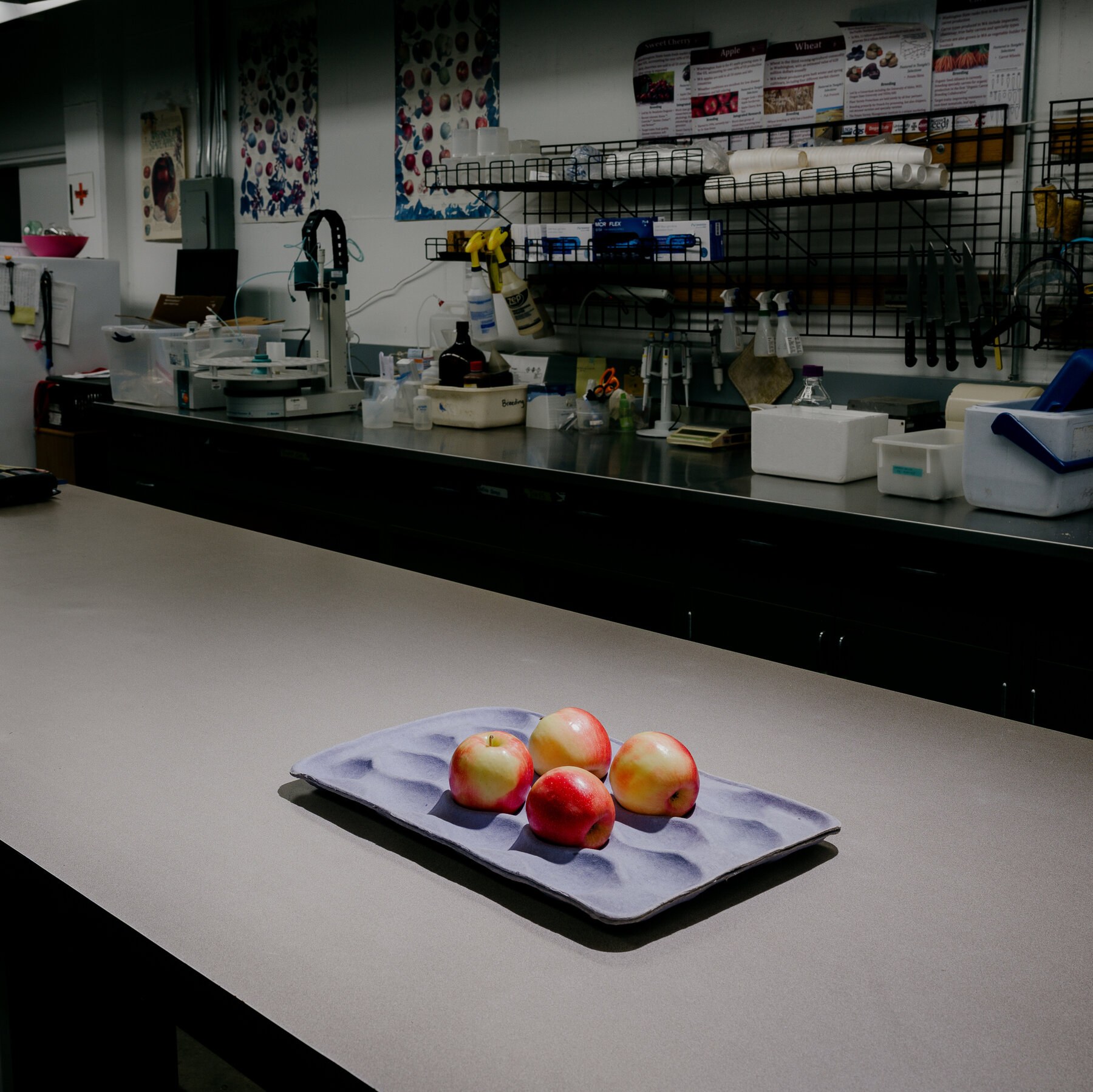
SUNFLARE APPLE—WENATCHEE, Wash.—On a 102-degree day that would have shriveled most apple blossoms a decade ago, agronomist Dr. Kate Evans walked between rows of a new cultivar her team calls Sunflare. The fruit, she says, tastes indistinguishable from the blockbuster Cosmic Crisp yet hangs unblemished after a week of 40-degree diurnal swings that are becoming routine in the Pacific Northwest.
The university’s release, timed for spring planting season, arrives as Washington’s $2.4 billion apple industry copes with four consecutive years of June heat domes and an early-May freeze that wiped out 18 percent of the 2025 crop. WSU’s breeding program, the nation’s largest for apples, selected Sunflare precisely for those extremes.
Evans and her colleagues used genomic selection to screen seedlings for heat-delayed flowering, then subjected finalists to simulated 110 °F days in controlled chambers. Only 12 of 6,200 original crosses made the final cut. The resulting tree pushes bud-break later and forms a thicker waxy cuticle, reducing transpiration water loss by 18 percent compared with Gala, according to WSU physiologist Dr. Stefano Musacchi.
Breeding for Chaos: Why 40°F Swings Define the New Normal
The Columbia Basin recorded 37 days above 100 °F in 2025, triple the 20th-century average, according to the National Oceanic and Atmospheric Administration. That heat forces apple trees to bloom two weeks earlier, leaving flowers vulnerable to the region’s still-common May frosts. The result: a double shock that cost Washington growers an estimated $436 million in lost revenue last year.
Sunflare’s key trait is a gene variant that delays bloom by roughly 10 days without shortening the growing season. Dr. Evans’s team identified the locus on chromosome 9 and used marker-assisted selection to stack it with powdery-mildew resistance from Enterprise parentage. The delay keeps flowers tucked behind protective leaf clusters when late freezes strike.
Water-wise physiology
Beyond timing, Sunflare’s cuticle contains 22 percent more cutin monomers than Cosmic Crisp, Musacchi’s lab found. That microscopic thickening reduces midday water loss, allowing the tree to maintain photosynthesis under vapor-pressure deficits that now exceed 4 kPa in July, levels that stall growth in Honeycrisp and Gala.
WSU economist Dr. Karina Gallardo modeled the potential impact: if 30 percent of acreage converted to Sunflare by 2030, industry-wide frost losses could fall by $112 million annually even under a high-emissions scenario. The projection assumes current price spreads and does not factor in potential climate-premium branding.
Still, the breeders caution that Sunflare is not a cure-all. Extreme heat during cell-division can still reduce fruit size; the cultivar’s soluble-solids ceiling is 0.8 °Brix lower than Cosmic Crisp in trials at 110 °F. Growers must also manage calcium uptake to prevent bitter-pit under heat stress. Yet for orchards above 1,200 feet elevation—where spring frost risk is highest—Sunflare offers a buffer that industry leaders say is overdue.
Next, WSU will ship 50,000 budsticks to nurseries in Oregon and Idaho this winter, the first wave of what could become a half-million-tree rollout across the Intermountain West. If plantings meet projections, Sunflare could account for 7 percent of Washington acreage by 2032, rivaling the ascent of Cosmic Crisp.
Flavor Under Fire: Can Sunflare Rival Cosmic Crisp’s Cult Status?
Cosmic Crisp’s 2020 launch generated $62 million in media value within six months, according to Nielsen, and commanded a $7 per carton premium over Red Delicious. To match that momentum, WSU sensory scientists ran blind triangle tests with 312 consumers across Seattle, Spokane and Portland.
Sunflare scored 6.8 on a 9-point hedonic scale, statistically tied with Cosmic Crisp’s 6.9. Descriptive panels detected equal crunch force (12.3 kg) and similar titratable acidity (0.48 g/100 mL). The only detectable difference: Sunflare’s ethyl-butyrate peak is 8 percent lower, yielding a slightly milder aroma that 61 percent of testers described as ‘cleaner’.
Marketing headwinds
Retailers remember the Cosmic Crisp shortage of 2021, when demand outstripped supply by 34 percent. To avoid a repeat, WSU licensed only two packers—Stemilt Growers and Chelan Fruit—in the first three years. That exclusivity, coupled with a $1.2 million consumer-advertising fund, aims to keep prices above $45 per 40-pound box, a threshold that covers the higher royalty ($2.10 per tree vs. $1.40 for Cosmic Crisp).
But critics note that premium positioning may clash with inflation-weary shoppers. Nielsen data show apple prices rose 18 percent since 2022, the fastest clip among top-10 fruits. If Sunflare lands at $3.49 per pound retail, it risks cannibalizing organic Honeycrisp rather than expanding the premium tier.
Retail strategist Anne-Marie Roerink cautions that climate branding alone won’t sell apples. ‘Shoppers buy flavor first, story second,’ she says. ‘Sunflare’s success hinges on whether growers can hit 80 percent pack-out of target size 88s—anything less erodes margins and retail confidence.’ WSU’s own economic model shows break-even at 65 percent pack-out, leaving little room for weather-related culls.
Still, early adopters like fourth-generation grower April Clayton are betting on story and taste. She replanted 22 acres of her 240-acre Royal City orchard this spring, citing Sunflare’s 12-month storage window and the possibility of marketing ‘climate-smart’ fruit to Seattle restaurants. If consumers reward that narrative, Sunflare could carve a niche as the first branded apple born of global-warming necessity.
Can One Apple Hedge an Entire Industry’s Climate Risk?
Washington produces 65 percent of U.S. apples, generating $2.4 billion farm-gate value and 28,000 direct jobs. Yet climate models from the University of Idaho project that by 2050 the region could lose 23 percent of its suitable chill hours, the winter cold required for uniform bloom. That threatens varieties like Fuji and Honeycrisp that need 800–1,000 cumulative chill hours; Sunflare requires 750, giving growers a buffer.
Dr. Travis Allen, an agricultural economist at Utah State University, says diversification is the only viable hedge. ‘Relying on three varieties—Gala, Granny Smith, Honeycrisp—made sense when weather was predictable. Today a single freeze can erase 40 percent of revenue.’ His Monte Carlo simulation shows that adding Sunflare to a 100-acre mixed orchard reduces downside risk (defined as revenue below 70 percent of median) by 17 percent over a decade.
Insurance incentives
The federal Risk Management Agency does not yet offer a premium discount for climate-resilient cultivars, but private insurers are experimenting. Rain and Hail LLC will cut deductible by 5 percent for blocks planted with Sunflare or WSU’s earlier release, WA 38. The catch: growers must supply two years of phenology data, a hurdle that delayed uptake in 2026.
Meanwhile, major food-service distributors are eyeing the cultivar. Compass Group North America pledged to source 10 percent of its Pacific Northwest apples from climate-adapted varieties by 2029, a move that could guarantee demand for 1.2 million boxes annually—roughly 5 percent of Sunflare’s projected volume if acreage targets are met.
Yet the industry’s transformation remains tentative. Nurseries report that only 8 percent of new plantings in 2026 will be climate-resilient varieties, dwarfed by 62 percent for existing staples. Cost is the obvious barrier: Sunflare trees run $17.50 apiece, $4 more than Honeycrisp, and require royalties for 20 years. But growers also cite market uncertainty. ‘We’re asked to bet on weather 15 years out while retailers still discount anything that isn’t red or striped,’ says Patrick Burns, a 600-acre grower in Quincy.
WSU’s answer is a phased rollout: 50,000 trees in 2026, scaling to 450,000 by 2028, enough for 9,000 acres or 3 percent of Washington acreage. If extreme-weather losses continue at the current five-year average of $300 million, that modest shift could save the industry $40 million in avoided losses, according to models shared by the Washington Tree Fruit Research Commission. The question is whether growers will embrace the math before the next polar vortex or heat dome arrives.
From Lab to Lunchbox: The 36-Month Race to Reach Grocery Shelves
Most apples need 15–20 years from first cross to commercial volume; Sunflare is on track for 12. The acceleration began in 2021 when WSU genomics lab sequenced its entire genome, identifying 14 marker-trait associations for heat tolerance and storage disorders. That data allowed breeders to discard 78 percent of seedlings at the cotyledon stage, shaving five years off conventional evaluation.
Virus-free plantlets were multiplied in a bioreactor at the university’s Clean Plant Center, producing 200,000 plantlets in 14 months—twice the rate of bench grafting. Meanwhile the Washington State Department of Agriculture fast-tracked phytosanitary permits, cutting quarantine time from 18 to 9 months for interstate shipments.
Packaging puzzle
Stemilt Growers designed a 3-pound pouch with laser-perforated micro-holes that maintain 3 percent O2 and 94 percent relative humidity, extending shelf life to 280 days at 33 °F. The film, derived from sugarcane ethanol, carries a How2Recycle label, a nod to sustainability-minded shoppers who drove 9 percent growth in eco-labeled produce last year.
Retail launch is slated for November 2028, deliberately timed after Cosmic Crisp’s October surge to avoid cannibalization. Target count per pouch is five apples, size 88, priced at $5.99—30 cents below organic Honeycrisp. Early ads will highlight the climate story: ‘Grown for a hotter tomorrow’ tags appear on 2 million bags.
Yet supply-chain experts warn that compressed timelines risk quality lapses. ‘We’ve seen rushed releases where bitter-pit or superficial scald shows up in year two and kills the brand,’ says produce veteran Jim Allen. WSU counters that Sunflare’s calcium-uptake gene mitig bitter-pit incidence to 2 percent versus 9 percent in Honeycrisp in 2026 trials.
If the schedule holds, Sunflare will reach consumers 36 months after the first trees entered soil—lightning speed for a woody perennial. That pace may become the template as climate volatility shortens the window for safe bets. Breeders are already applying Sunflare’s genomic roadmap to pears and sweet cherries, signaling a future where climate-adapted fruit reaches shelves in half the time it once took.
Frequently Asked Questions
Q: What makes the Sunflare apple different from Cosmic Crisp?
Sunflare retains Cosmic Crisp’s crunch and sugar-acid balance, but its breeders selected for heat-delayed blooming and a cuticle that seals in moisture during drought, traits that protect crops from erratic spring frost and midsummer 100 °F spikes.
Q: How long did it take WSU to develop Sunflare?
The university’s pome-fruit program screened 6,200 crosses over 18 seasons, accelerated by genomic selection, before choosing the Sunflare seedling in 2024 and fast-tracking virus-free propagation for 2026 commercial plantings.
Q: Will Sunflare be grown outside Washington?
Nursery partner ProTree Nurseries has licensed 450,000 trees for 2027 delivery to Oregon, Idaho and British Columbia; trials in high-chill regions of New York and Ontario are evaluating winter hardiness.
