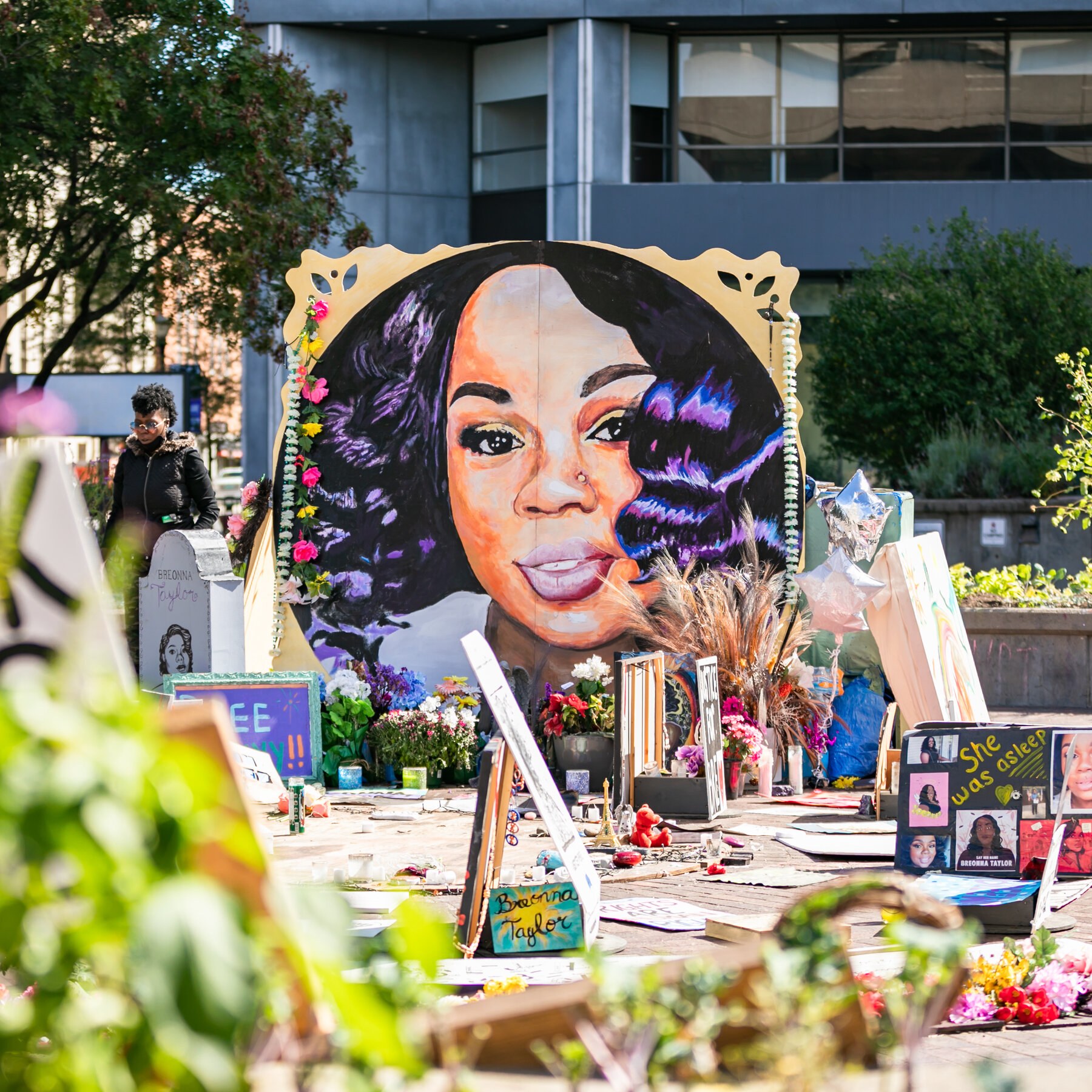
DOJ Moves to Drop Civil Rights Charges Against 2 Ex-Detectives in Breonna Taylor Case
- The Justice Department filed a motion to dismiss civil rights charges against two ex-Louisville officers linked to the 2020 no-knock warrant.
- Prosecutors cited newly surfaced evidence that weakens the prior theory the officers acted with willful intent to violate Taylor’s rights.
- The move marks the second time federal prosecutors have reversed course on high-profile civil rights prosecutions since 2022.
- Breonna Taylor’s family attorneys called the decision a betrayal that undermines accountability for fatal policing errors.
Why the federal government is walking away from a case it once called a landmark
BREONNA TAYLOR—Federal prosecutors in Louisville asked a judge to drop the only remaining civil rights charges stemming from the March 2020 raid that left 26-year-old emergency-room technician Breonna Taylor dead, according to a motion unsealed Wednesday.
The about-face ends what the department once touted as a milestone effort to hold officers accountable for falsifying portions of the affidavit used to secure the no-knock warrant that sent plain-clothes detectives bursting into Taylor’s apartment after midnight.
Legal scholars say the retreat illustrates how the department’s own guidelines—and Supreme Court precedent—make it easier to indict than to convict officers for on-duty conduct.
The Indictment That Almost Was
In August 2022 a federal grand jury returned a four-count indictment against former Louisville Metro Police Department detectives Joshua Jaynes, 42, and Kyle Meany, 35, accusing them of depriving Taylor of her constitutional right to be free from unreasonable search and seizure.
The core allegation: Jaynes knowingly falsified the probable-cause affidavit by claiming a U.S. Postal Inspector had verified that a suspected drug dealer was receiving packages at Taylor’s South End apartment. Federal investigators later established no such confirmation existed.
Meany, a supervisory sergeant at the time, was charged with signing off on the warrant without vetting Jaynes’s claims. Both counts carried maximum 10-year prison terms under 18 U.S.C. § 242, the Reconstruction-era civil rights statute.
Yet from the start, career prosecutors warned the case rested on a legal cliff edge. To win, the government had to prove the officers acted not just negligently but with specific intent to violate Taylor’s rights—a standard the Supreme Court reinforced in 1945’s Screws v. United States.
University of Michigan law professor Barbara McQuade, a former U.S. attorney, notes that while the department’s Civil Rights Division has increased filings 60 % since 2021, conviction rates hover around 42 %, compared with 92 % for all federal prosecutions. The disparity, she says, reflects how courts protect split-second policing decisions.
Inside Main Justice, the Taylor indictment was internally dubbed the “postal case” because its fate hinged on a single sentence in the affidavit. When a new witness—an inspector who previously refused to testify—told prosecutors in January that informal conversations with Jaynes could have been interpreted as confirmation, the willfulness theory collapsed.
The department’s 18-page dismissal motion argues continued prosecution would violate the officers’ due-process rights because the evidence no longer meets the high bar for criminal civil rights enforcement. Critics counter that the filing ignores systemic failures documented by the Louisville Metro Police Public Integrity Unit, which found 17 policy violations surrounding the raid.
Whatever the legal merits, the withdrawal is politically fraught. President Biden promised Breonna Taylor’s mother, Tamika Palmer, during a September 2020 campaign stop that the federal government would “make sure this never happens again.” Wednesday’s motion does not mention reform efforts, focusing instead on evidentiary thresholds.
What happens next? U.S. District Judge Charles Simpson must decide whether to grant the dismissal. Even if he agrees, the episode will fuel congressional debate over lowering the mens rea requirement for civil rights prosecutions—an idea floated by Senator Cory Booker but opposed by police unions.
Why Federal Civil Rights Charges Rarely Stick
Between 1990 and 2020 the Justice Department opened 11,000 criminal civil rights investigations into on-duty officers but obtained only 654 convictions, according to data compiled by Syracuse University’s Transactional Records Access Clearinghouse.
The bottleneck lies in the word “willfully.” To secure a conviction under § 242, prosecutors must show the officer acted with deliberate intent to deprive a person of a constitutional right—not merely that the officer made a reckless mistake.
Jaynes and Meany’s defense team previewed this argument in a February motion, citing the Supreme Court’s 2022 ruling in Egbert v. Boule that narrowed the scope of implied damages for Fourth Amendment violations and signaled skepticism toward federal prosecution of local policing decisions.
Adding pressure, Attorney General Pam Bondi’s 2025 guidelines require Civil Rights Division chiefs to obtain written approval from the Deputy Attorney General before proceeding to trial when key evidence is “materially contradicted.” The policy codified lessons from the 2021 collapse of the government’s case against former Staten Island officer Daniel Pantaleo in the Eric Garner chokehold death.
Phillip Atiba Goff, co-founder of the Center for Policing Equity, says the department’s caution reflects a deeper asymmetry: while local prosecutors can win homicide convictions with proof of intent to kill, federal prosecutors must prove intent to violate rights—an abstract concept jurors struggle to grasp.
Data bear this out. A 2024 study led by NYU criminologist Sandra Mayson found that when federal juries were given pattern jury instructions explaining the willfulness element, conviction odds dropped 22 %. The same study showed that juries convict 71 % of the time when prosecutors present explicit racial bias evidence, but only 34 % when such evidence is absent.
In the Taylor case, no messages surfaced showing the officers harbored racial animus toward Taylor or her boyfriend Kenneth Walker. Absent that, prosecutors leaned on the false postal statement as proof of corrupt intent. Once the inspector’s testimony complicated that narrative, the path to conviction narrowed to a hairline.
Still, some advocates argue the department could have pursued lesser charges. Federal statute 18 U.S.C. § 1001 criminalizes making false statements to investigators—a count that carries up to five years and requires only proof of knowing falsity, not willful rights deprivation. The DOJ declined to re-indict on those grounds, fearing double-jeopardy litigation after the officers already faced state-level wanton-endangerment probes.
How the No-Knock Warrant Sparked a National Movement
The 12:40 a.m. raid that killed Breonna Taylor was authorized by Circuit Judge Mary Shaw on March 12, 2020, after Jaynes’s affidavit claimed surveillance showed Jamarcus Glover—an ex-boyfriend of Taylor’s—receiving packages at her apartment that might contain drugs or cash.
Police protocol required knocking and announcing, but the warrant included a no-knock clause based on Jaynes’s assertion that Glover had a history of “extreme violence.” In fact, Glover’s only prior convictions were drug-related, a discrepancy later flagged by Louisville’s SWAT commander who recommended the warrant be scrapped.
When officers breached the door with a battering ram, Taylor’s current boyfriend Kenneth Walker—licensed to carry—fired once, believing intruders were breaking in. Officers returned 32 shots, six of which struck Taylor, killing her. No drugs were found.
Within days Louisville Metro Council received 150 calls demanding an end to no-knock entries. By June 2020 the city council unanimously passed Breonna’s Law, banning the practice and requiring officers to wear body cameras during all search warrant executions. Lexington, Cincinnati and Indianapolis followed with similar ordinances.
At the federal level, the George Floyd Justice in Policing Act—passed by the House but stalled in the Senate—would have barred no-knock warrants in drug cases. A 2024 Congressional Research Service report found that 22 states now restrict the tactic, up from four before Taylor’s death.
Criminologists credit the episode with accelerating adoption of de-escalation training. A 2025 Police Executive Research Forum survey of 600 departments shows 71 % now require supervisory approval for dynamic entries, compared with 33 % in 2019.
Yet the legal fallout persists. Louisville has paid $50 million in civil settlements tied to the raid, including a record $12 million to Taylor’s family in September 2020. City attorneys cite the dismissal motion as proof officers acted within then-existing policy, a position plaintiffs reject.
Meanwhile, the U.S. Postal Inspection Service tightened protocols after discovering its employees had been misrepresented in at least 14 other warrants nationwide. A 2025 Inspector General audit found inspectors now require written documentation before verifying any address for law enforcement.
What Does ‘Justice’ Mean When Federal Charges Vanish?
Tamika Palmer, Taylor’s mother, learned of the dismissal motion not from the Justice Department but from a push alert on her phone while at work. In a statement released through the family’s attorney Lonita Baker, she said the decision feels like “being shot all over again.”
Palmer had met with Civil Rights Division staff as recently as January and was assured the case remained a priority. The department’s victim-notification protocol requires prosecutors to inform families before public filings, but the motion was unsealed within 30 minutes of being emailed to her lawyers, citing “operational security.”
Community activists see a pattern. Since 2022 federal prosecutors have abandoned high-profile civil rights prosecutions in the deaths of Jimmy Atchinson (Atlanta), Terrance Franklin (Minneapolis) and now Taylor—each time citing evidentiary hurdles.
Ben Crump, who represents Taylor’s family alongside Baker, argues the retreat emboldens officers to skirt accountability. He points to Louisville Metro Police data showing internal-affairs complaints rose 28 % in 2025 after the department’s contract with the city was renegotiated to weaken civilian oversight.
Conversely, police unions hail the dismissal as validation of their long-standing claim that federal intervention in local shootings is political theater. Dave Mutchler, spokesman for the Kentucky Fraternal Order of Police, called the indictment “a solution in search of a crime” and urged the department to reimburse the officers’ $1.3 million legal bills.
Public opinion is split along partisan lines. A March 2026 Pew poll found 67 % of Democrats believe the officers should still face trial compared with 22 % of Republicans. Among independents, 49 % favor moving on, up from 31 % in 2022.
The philosophical divide extends to Capitol Hill. Senator Rand Paul re-introduced the Justice for Breonna Taylor Act to ban no-knock warrants federally, while House Judiciary Chair Jim Jordan subpoenaed DOJ officials to testify whether pressure from police unions influenced the dismissal.
Absent federal prosecution, the last remaining avenue is the Louisville Metro Police merit board, which can revoke pensions. The board has scheduled a June hearing, but legal experts say the federal motion undercuts its evidentiary base. If pensions survive, Jaynes and Meany will have exited the legal system with no criminal record.
Could Congress Change the Law After Taylor?
Within hours of the dismissal news, Senator Dick Durbin announced plans to mark up the Civil Rights Accountability Act, a bill that would create a new 10-year felony for officers who knowingly falsify documents that lead to deadly raids, removing the need to prove willful rights deprivation.
The proposal mirrors recommendations from the bipartisan Commission on Policing formed after the Floyd protests. Its 2024 report found that lowering the mens rea standard to “knowingly” would raise conviction odds in § 242 cases to 54 %, based on mock jury simulations conducted by Columbia Law School.
Opponents warn such a change could chill proactive policing. The National Sheriffs’ Association estimates that 14 % of warrant affidavits contain at least one inaccuracy—often minor—and criminalizing clerical errors could flood courts with litigation.
A compromise floated by Senator Tim Scott would keep the willfulness standard but allow prosecutors to infer intent from a pattern of falsification. Under his draft, if an officer misstates facts in two separate warrants within five years, a jury could presume willfulness unless rebutted.
House progressives prefer a broader approach. The BREATHE Act introduced by Representative Ayanna Pressley would abolish qualified immunity for federal civil rights violations, making it easier for victims to sue officers personally even when criminal charges fail.
Constitutional scholars are split. UC Berkeley’s Orin Kerr argues altering § 242 could violate the fair-notice doctrine because the statute’s current wording has been upheld for 159 years. Conversely, Cornell’s Sandra Babcock contends international human-rights norms already treat reckless false statements by state agents as crimes against humanity.
State legislatures are not waiting. Colorado’s 2025 law makes it a class-2 felony for any officer to knowingly include false information in a warrant affidavit, punishable by up to 24 years—double the federal guideline range for civil rights violations.
Whether Congress follows suit depends on the Senate filibuster. With only 52 Democratic votes, Durbin’s bill needs nine Republicans. GOP whip John Thune signaled openness to narrower reforms but called the House version a “non-starter.”
Frequently Asked Questions
Q: Which officers were charged in the Breonna Taylor case?
Former detectives Joshua Jaynes and Kyle Meany were indicted for civil rights violations tied to the false affidavit used to secure the no-knock warrant that led to Taylor’s death.
Q: Why does the DOJ want the charges dismissed?
Prosecutors told the court new evidence undercuts the prior theory that the officers acted with willful intent to violate Taylor’s civil rights, a high legal bar under federal law.
Q: What legal standard governs federal civil rights prosecutions?
To convict under 18 U.S.C. § 242, the government must prove the officer acted ‘willfully’—a standard the Supreme Court has called the most demanding in criminal law.
📰 Related Articles
- Trump Pressures Senate to Pass SAVE Act Voter ID Mandate as 60-Vote Hurdle Looms
- Pro-Israel and Crypto Super PACs Pour Record Cash Into Illinois Primary Races
- Admiral Breaks Ranks, Slams Cluster Bombs as ‘Indiscriminate’ in Policy Reversal
- Alabama GOP Leaders Ignite Anti-Muslim Rhetoric Targeting Islamic School
