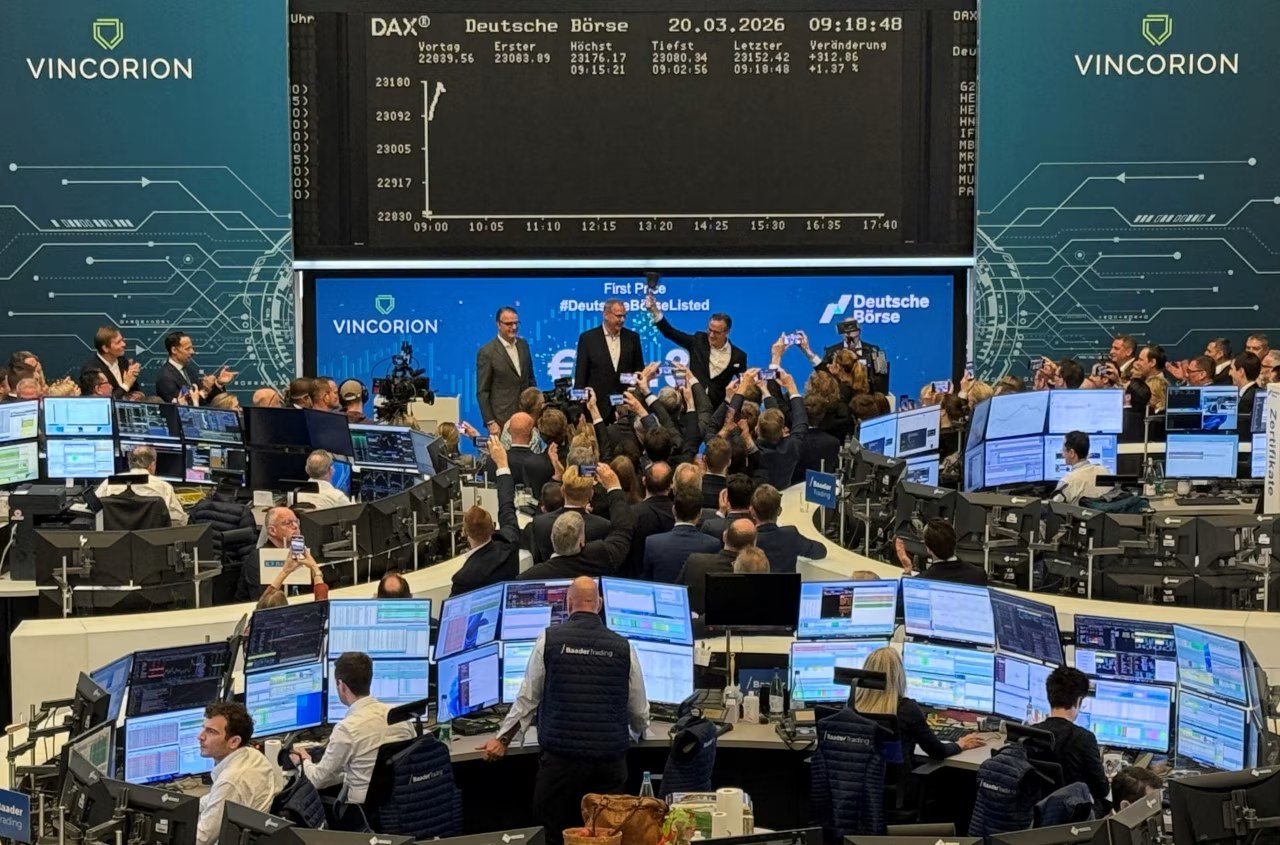
Vincorion IPO Closes Up 15% at €19.59, Securing €345 Million for Defense Expansion
- Vincorion’s Frankfurt debut priced at €17 per share, opened at €18.40 and peaked at €19.59, a 15% first-day gain.
- The Stuttgart-based defense supplier sold 20.3 million new shares, raising €345 million to fund capacity expansion and R&D.
- Order backlog already exceeds €1.1 billion, driven by Leopard tank upgrades and NATO helicopter programs.
- Europe’s military spending is set to hit a record €350 billion in 2024, creating a multi-year tailwind for tier-two suppliers.
Investors bet Germany’s newest listed defense firm can outgrow its midsize peers as EU rearmament accelerates.
VINCORION IPO—Vincorion, the 1,200-employee spin-off from engine-maker MTU Aero Engines, began unconditional trading on the Frankfurt Stock Exchange at 9:00 a.m. local time. Within 90 minutes the stock touched €19.59, translating into a market capitalisation of about €850 million and validating management’s decision to go public while Western governments are rewriting defense budgets.
The offering, led by joint bookrunners Deutsche Bank, Goldman Sachs and Berenberg, was multiple-times oversubscribed, according to people close to the deal. Roughly 60% of allocations went to long-only funds that specialise in European industrials, with sovereign-wealth funds from Norway and the Gulf taking cornerstone positions.
Chief Executive Dr. Stefan Stenzel told analysts on the listing day that proceeds will double capacity at the company’s Polish plant and finance a €70 million R&D push into hydrogen auxiliary power units for next-generation armored vehicles. “We are not raising money to survive; we are raising money to scale,” Stenzel said.
From MTU Side-Project to Stand-Alone Defense Pure-Play
Vincorion’s roots trace back to 1974 when what was then Klöckner-Humboldt-Deutz began producing auxiliary power units for the Leopard 1 main battle tank. The business passed through a succession of industrial owners—Deutz AG, Daimler-Benz, MTU—before being carved out as a stand-alone entity in 2022 to sharpen strategic focus.
Today the company occupies a niche that larger primes avoid: complex electromechanical subsystems that must survive sand, vibration and electromagnetic pulses. Its portfolio spans 4,500 active part numbers, from 400-watt turbine starters for the NH90 helicopter to 150-kilowatt hybrid drives for the Boxer armored fighting vehicle. According to defense-consultancy Frost & Sullivan, Vincorion holds a 38% share of the European market for auxiliary power units below 200 kilowatts, making it the largest independent supplier after France’s Safran.
The spin-off was engineered by MTU’s private-equity backer, Carlyle Group, which wanted to unlock value from non-core activities. In the 12 months before IPO, Vincorion booked revenue of €478 million and EBITDA of €71 million—margins that exceed those of many tier-one defense contractors. Analysts at Baader Bank attribute the profitability to a modular product architecture that slashes engineering hours by 30% on derivative programs.
Why independence matters for investors
As a stand-alone, Vincorion can now court customers that compete directly with MTU, such as Rolls-Royce and Safran. “The Chinese wall is gone,” said Christian Rothe, aerospace analyst at Baader. “That alone adds €150 million to the addressable order funnel over the next five years.”
Looking ahead, management is targeting organic revenue growth of 8% annually through 2027, driven by NATO’s 3% annual procurement uplift and Germany’s €100 billion special defense fund. If achieved, that trajectory would outpace the 5% compound rate projected for Europe’s top-five defense integrators.
IPO Proceeds Target €70 Million R&D Sprint and Polish Capacity Doubling
Of the €345 million raised, €120 million is earmarked for capital expenditure, €70 million for next-gen R&D and the balance for debt repayment and working capital. The centerpiece is a 17,000-square-meter expansion of the plant in Mielec, Poland, that will double output of auxiliary power units and hybrid drives by 2026.
The Polish facility is strategic: labor costs are 40% below the German average, and the site sits within 200 kilometers of Rheinmetall’s tank assembly hall and Bumar’s armored-vehicle hub. According to advisory firm McKinsey, locating capacity close to OEM final-assembly lines can shave 8% off logistics expenses for heavy, vibration-sensitive components.
Vincorion’s R&D roadmap focuses on hydrogen-fueled APUs that could extend silent-watch time for armored vehicles from four to 12 hours. The German army’s future “Leopard 3” program lists a 48-volt hydrogen APU as a mandatory subsystem. Winning that contract could add €300 million in lifecycle revenue, estimates defense analyst Thomas Obendrauf at Bankhaus Lampe.
Financial cushion against cyclical downturns
Post-IPO net cash of €180 million gives the company a 0.4× debt-to-equity ratio, well below the European aerospace-and-defense median of 0.9×, providing headroom if procurement cycles slow. CFO Inka Stuiber told investors the firm will “never again carry net debt above 1.5× EBITDA,” a pledge that could appeal to income funds in a rising-rate environment.
Management projects a 2024 free-cash-flow conversion of 65%, enough to self-fund the capex program even if EBITDA margins compress by two percentage points. That resilience was highlighted during pre-marketing, when equity analysts asked how the firm would cope if Germany’s special €100 billion fund were re-allocated; scenario analysis showed breakeven cash generation at a 9% EBITDA margin, 3.5 points below target.
Europe’s Defense Budget Surge Creates Multi-Year Order Visibility
NATO data show European allies will spend a combined €350 billion on defense in 2024, the first time the aggregate has crossed the €350 billion mark. Germany alone is adding €30 billion annually through its special fund, while Poland, the Baltic states and the Nordics are lifting procurement budgets by double-digit percentages.
Vincorion is already a beneficiary: its order backlog rose to €1.1 billion in the March quarter, up 34% year-on-year, equivalent to 2.3 times annual revenue. About €650 million of those orders are scheduled for delivery after 2026, giving management unusual visibility for a midsize components supplier.
Consultancy Deloitte estimates the European market for land-vehicle subsystems will grow at 9% CAGR through 2028, outpacing the 4% global defense-industry average. The drivers are replacement of Soviet-era armor and integration of hybrid-electric drives to reduce fuel consumption—both areas where Vincorion holds certified products.
Export controls and supply-chain chokepoints
While the demand picture is robust, risks lurk in export licensing. Roughly 18% of Vincorion’s backlog comes from non-NATO customers, including Qatar and Australia. A tightening of German arms-export rules could defer revenue recognition; every month of delay on a €50 million Qatar order would trim 2% from annual EBITDA, calculates Barclays defense analyst James Crawford.
Supply-chain constraints are another wildcard. Micro-controllers used in APUs are dual-sourced from Infineon and NXP, but both fabs run on 180-nanometer nodes that auto makers also demand. Lead times have stretched to 26 weeks from 12, prompting Vincorion to build a six-month chip buffer, tying up €18 million in inventory.
Can Vincorion Sustain Its Margin Premium Over Larger Peers?
Vincorion’s 14.8% EBITDA margin in 2023 sits well above the 10-11% posted by Rheinmetall’s vehicle systems division and the 9% recorded by France’s Safran across its equipment unit. Analysts attribute the gap to two factors: a higher share of spare-parts revenue (38% of total) and lower customer concentration—no single program accounts for more than 12% of sales.
Yet maintaining that premium could prove tough. Labor inflation in Germany is running at 6.5%, and the company’s skilled-worker workforce is 94% based in high-cost Baden-Württemberg. Every one-percentage-point rise in German labor expense slices roughly 30 basis points off group EBITDA margin, according to a sensitivity analysis published in the prospectus.
Competitive moat versus low-cost challengers
Eastern European competitors such as Poland’s WB Electronics and the Czech firm Excalibur Army are bidding 15-20% below Vincorion on recent Polish and Romanian tenders. While those rivals lack NATO certification for certain vibration standards, price remains decisive in 40% of land-vehicle procurements, says Tomasz Klukowski, defense procurement expert at the Center for European Policy Analysis.
To defend pricing, Vincorion is migrating production of standardized APUs below 100 kilowatts to Mielec while keeping engineering in Germany. The move is projected to cut unit cost by 11%, enough to match Polish bids without impairing margins. If successful, management believes it can hold EBITDA margin above 13% through 2027 even under a worst-case labor-cost inflation of 4% per annum.
Valuation Gap Opens to Smaller Peers but Discount to Primes Persists
At €19.59, Vincorion trades at 12.5× 2024 consensus EBITDA, a discount to Europe’s defense primes—Rheinmetall at 14×, BAE Systems at 15×—but a premium to smaller component makers such as Germany’s Renk (10×) or France’s Safran Electrical & Power (11×). Analysts at Berenberg justify the midpoint rating by pointing to Vincorion’s faster order growth and net-cash balance sheet.
The free-float is 55%, with MTU retaining a 12% stake and Carlyle holding 18%. High retail interest on the first day pushed turnover to 3.2 million shares, 160% of the free-float, indicating multiple round-trips by algorithmic traders. Liquidity should improve when the stock joins the SDAX mid-cap index after the September quarterly review, assuming market capitalisation remains above €800 million.
Upside from ESG-driven mandates
Because Vincorion’s hydrogen and hybrid-electric products align with the EU’s Green Deal for defense, the stock was added to a new “EU Defense Transition” basket created by BNP Paribas. Passive inflows tied to ESG variants of the STOXX Europe 600 could add 5–7% to the share price over the next 12 months, estimates JPMorgan European mid-cap strategist Sébastien Tamarzians.
Still, some fund managers remain on the sidelines. A survey by Scope Investor Relations shows 42% of German institutions avoid mid-cap defense names on ethical grounds. If that sentiment spreads, Vincorion’s valuation multiple could compress toward the lower end of its 10-16× historical range, erasing the current 12% premium to net-asset value.
Frequently Asked Questions
Q: What does Vincorion produce for the defense sector?
Vincorion builds mission-critical aviation and ground-vehicle subsystems—power packs, actuators, environmental controls—used in Leopard tanks, Boxer armored vehicles, Eurofighter jets and NH90 helicopters.
Q: How much did Vincorion raise in its IPO?
The Stuttgart-based supplier priced 20.3 million primary shares at €17 each, raising €345 million before greenshoe options, giving the company an equity value of roughly €850 million.
Q: Why are European defense IPOs suddenly attractive?
The EU’s €500 billion rearmament plan, Germany’s €100 billion special fund and NATO’s 2%-of-GDP floor create a multi-year order pipeline, lifting margins and visibility for tier-two suppliers like Vincorion.
