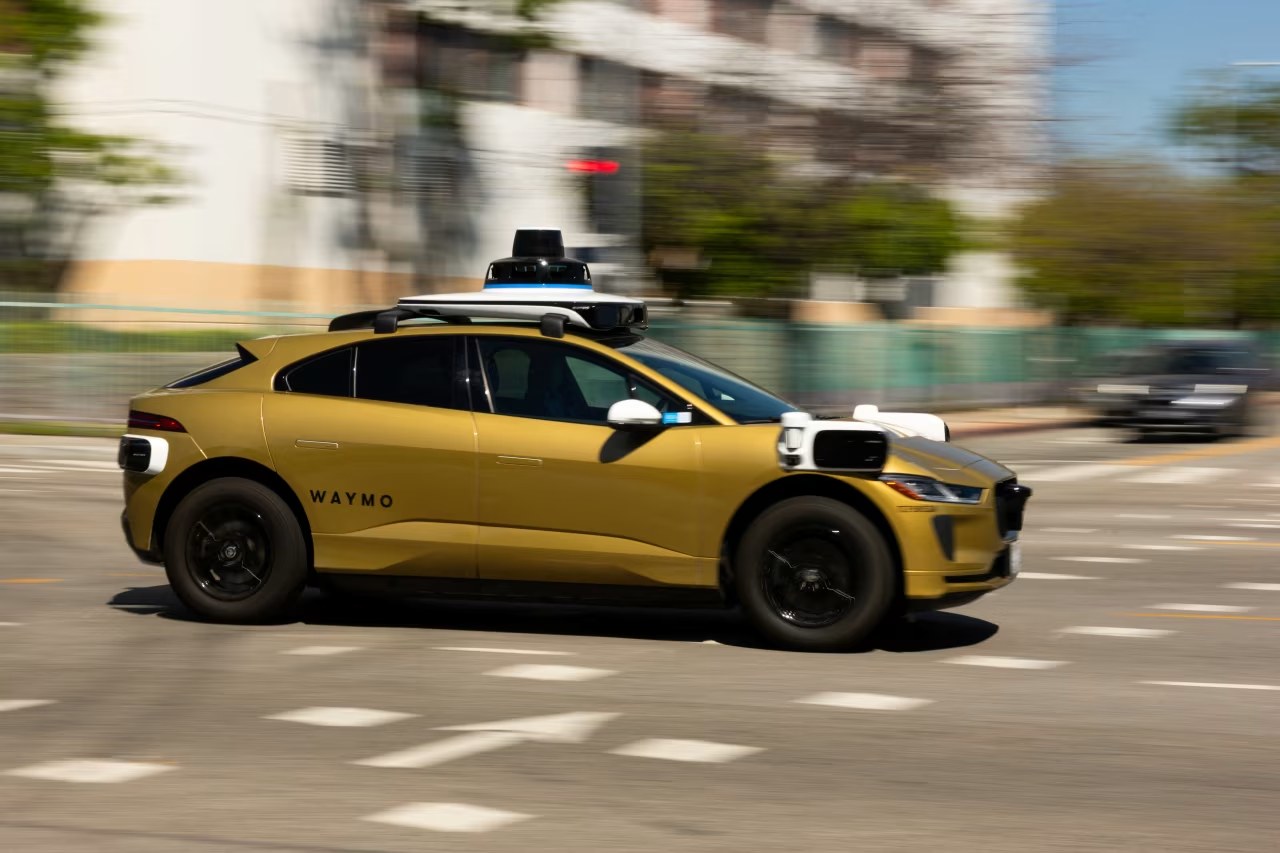
Uber Pours Up to $1.25 Billion Into Rivian in Largest Robotaxi Bet Since 2016
- Uber commits up to $1.25 billion to Rivian for exclusive autonomous electric vehicle supply.
- Partnerships also signed with Amazon’s Zoox and Motional to integrate robotaxis into Uber’s network.
- Deal volume revives memories of 2016’s AV hype cycle—but investors now demand commercial readiness.
- Analysts say ride-hailing platform strategy lowers Uber’s capital risk compared with owning vehicle fleets.
The stakes: control of a ride-hailing market projected to hit $200 billion globally by 2030.
UBER—Uber Technologies this week announced a sweeping set of alliances that together represent the largest financial commitment to autonomous vehicles since the first wave of hype eight years ago. Anchoring the blitz is a non-binding agreement to invest as much as $1.25 billion in Rivian, the electric-truck maker that plans to build purpose-built robotaxis for Uber’s network.
The announcement follows separate deals with Amazon’s Zoox and Hyundai-backed Motional, signaling that the ride-hailing giant is pivoting from cautious experimentation to a supplier-agnostic platform model. Wall Street analysts immediately upgraded Uber’s 12-month price target, arguing that asset-light exposure to autonomy could expand its take-rate without the capital burden of owning fleets.
Yet the memories of 2016—when Ford, General Motors and tech start-ups poured more than $10 billion into AV ventures only to retreat after fatal crashes and regulatory gridlock—loom large over boardrooms and regulators. The critical difference this time, according to a dozen interviews with executives, suppliers and safety officials, is that the current crop of partnerships demands proof of commercial viability before vehicles carry paying passengers.
From Hype to Hard Cash: Uber’s $1.25 Billion Rivian Wager
Uber’s pledge to Rivian is structured in three tranches tied to technical milestones, according to people familiar with the term sheet. An initial $500 million equity purchase will be executed at a 5% discount to Rivian’s 30-day volume-weighted average price once the start-up delivers a fleet of at least 100 Level-4 capable vehicles that complete 50,000 driverless miles on Uber’s platform. A further $500 million in convertible notes can be triggered when Rivian achieves a safety case validated by a third-party auditor approved by the National Highway Traffic Safety Administration (NHTSA). The final $250 million is optional and earmarked for joint manufacturing of a wheelchair-accessible robotaxi variant.
By pegging disbursements to regulatory sign-offs rather than calendar dates, Uber is attempting to avoid the capital-burn pitfall that plagued prior AV investors. In 2017, SoftBank Vision Fund sank $9.3 billion into companies including Nuro and Cruise only to see valuations plummet as safety setbacks delayed revenue. “The lesson we learned is to never pre-pay for science experiments,” said Kristin Sverchek, Uber’s head of corporate development, during a call with reporters.
Risk Transfer Architecture
The deal architecture shifts manufacturing risk to Rivian while giving Uber preferential supply rights across North America for seven years. Rivian, which posted a $5.4 billion net loss last year on 50,000 vehicle deliveries, gains a guaranteed customer and a pathway to amortize its $5 billion Illinois assembly plant expansion. RBC Capital Markets analyst Joseph Spak estimates that a successful robotaxi program could lift Rivian’s annual revenue by $3 billion at 20% gross margin by 2028.
Uber’s own balance sheet, which holds $5.2 billion in cash and equivalents, can absorb the first two tranches without jeopardizing its share-buyback program, according to a sensitivity analysis by Morgan Stanley. If Rivian misses milestones, Uber retains the option to redirect capital to other AV partners, creating a competitive dynamic reminiscent of smartphone suppliers vying for Apple orders.
The arrangement underscores a broader industry pivot away from vertically integrated autonomy. “We don’t need to own the cars; we need to own the customer interface and the data layer,” said Uber CEO Dara Khosrowshahi at the MIT Mobility Summit last month. That philosophy contrasts sharply with Tesla, which is betting that selling both hardware and ride-hailing services maximizes profit capture.
Regulatory watchers warn, however, that Uber’s milestone-based payments could incentivize Rivian to rush testing. “When capital is disbursed on technical achievements, companies sometimes game metrics,” said Bryant Walker Smith, a law professor at the University of South Carolina who advises the Department of Transportation on AV policy. He pointed to the 2022 Cruise incident where engineers allegedly withheld video footage from regulators after a pedestrian injury.
Still, investors responded enthusiastically. Uber shares jumped 7% in after-hours trading, while Rivian surged 11%, adding $4.2 billion to its market capitalization. The market signal suggests that after eight years of false dawns, autonomous mobility may finally offer near-term earnings accretion rather than perpetual R&D expense.
Amazon’s Zoox and Motional Join the Fray—But Under Uber’s Rules
Alongside the Rivian headline, Uber separately announced that Amazon’s Zoox will deploy “a limited number” of its bespoke cube-like vehicles on the Uber app in Las Vegas and San Francisco beginning next summer. Unlike Rivian, Zoox will operate under its own brand, but Uber receives a 15% revenue share in exchange for routing, customer support and payment processing. The deal marks the first time Amazon has allowed a third party to control the customer interface for Zoox since acquiring the company for $1.2 billion in 2020.
Motional, the Hyundai-Aptiv joint venture, will contribute 30 Ioniq 5 electric crossovers retrofitted with autonomous sensors to Uber’s Dallas network this winter. The vehicles will run under Uber’s new “Premier Autonomy” tier priced at 1.3× standard UberX fares. Executives say the premium reflects insurance costs and a mandatory in-vehicle safety operator during the pilot phase. If rides meet a 4.9-star average rating over 10,000 trips, Uber will remove the operator and split revenue 50/50 with Motional.
Platform Power Play
The flurry of alliances illustrates how ride-hailing platforms are leveraging network effects to commoditize vehicle suppliers. By aggregating demand, Uber can pit Zoox, Motional and Rivian against one another for rider miles. “We’re creating a marketplace where the best AV wins,” said Andrew Macdonald, Uber’s senior vice president of mobility and business operations. That dynamic flips the 2016 narrative, when automakers feared being reduced to ‘dumb metal’ suppliers to Silicon Valley.
Amazon, for its part, gains a capital-efficient way to monetize Zoox’s estimated $3.5 billion in cumulative R&D without building a competing ride-hailing app. The e-commerce giant is already piloting Zoox staff-shuttles at its Seattle headquarters, but commercializing with Uber accelerates payback. “We’re an AI company, not a taxi firm,” said Zoox Chief Executive Aicha Evans on a podcast last month, explaining the strategic rationale for partnerships.
Consumer adoption remains the wild card. A 2023 Pew Research survey found 63% of Americans are “very or somewhat worried” about sharing roads with driverless cars, unchanged since 2017. Yet Uber’s internal data from 1.2 million Phoenix rides using Waymo vehicles shows a 2% cancellation rate—identical to human drivers—once passengers complete three autonomous trips. The company plans to replicate that familiarity playbook nationwide through promotional credits and in-app education modules.
Regulators are cautiously accommodating. Nevada’s Department of Transportation approved Zoox’s application to operate on public roads without pedals or a steering wheel last quarter, provided speeds remain below 35 mph and geofenced to downtown Las Vegas. California’s Public Utilities Commission is expected to vote in December on expanding Zoox’s passenger service beyond the current 1,600 employees authorized to ride. Approval would pave the way for Uber to list Zoox rides publicly in San Francisco by mid-2025.
What Makes 2024 Different From the 2016 AV Gold Rush?
In 2016, Ford CEO Mark Fields predicted “fully autonomous vehicles” would be deployed en masse by 2021. The forecast triggered a venture-capital frenzy: start-ups raised $9.3 billion in a single year, according to PitchBook, while GM paid $1 billion for Cruise and Intel paid $15.3 billion for Mobileye. Yet by 2020, high-profile fatalities in Arizona and California forced nationwide shutdowns, valuations cratered, and Ford quietly replaced Fields. The bubble’s collapse became a Harvard Business School case study on techno-hubris.
Eight years later, the funding mix has flipped. Corporate strategic investors—Uber, Amazon, Hyundai—now supply 62% of AV capital versus 28% in 2016, according to BCG analysis. The shift aligns incentives toward near-term unit economics rather than moon-shot research. “Venture money wants 10× returns in seven years; corporates want 1.5× in three,” said Asad Hussain, mobility analyst at PitchBook. The shorter horizon disciplines technical roadmaps.
Technical Maturation
Sensor costs have plummeted 83% since 2016, a McKinsey teardown shows. A single Velodyne lidar unit that cost $75,000 in 2016 now retails at $4,500, while Nvidia’s Orin AV processor delivers 254 trillion operations per second—ten times its 2018 predecessor at half the power draw. These cost curves make robotaxi unit economics viable at $1.05 per mile in suburban use cases, undercutting human-driven UberX at $1.30 per mile, according to an AlixPartners model.
Equally important, artificial-intelligence stacks have migrated from hand-coded rules to end-to-end neural networks that learn from billions of real-world miles. Waymo’s fleet alone logs 1.5 million autonomous miles monthly, up from 50,000 in 2016. The data flywheel shrinks disengagement rates—when a human engineer must grab the wheel—to one every 48,000 miles in California testing, a 37× improvement versus 2016.
Regulators have also professionalized. The federal AV START Act stalled in 2018, leaving a patchwork of state rules. Since then, NHTSA has issued mandatory crash-reporting guidelines and updated Federal Motor Vehicle Safety Standards to accommodate vehicles without steering wheels. “We’re no longer writing policy on a blank page,” said Transportation Secretary Pete Buttigieg at a Bloomberg conference last year. The clarity reduces legal uncertainty for investors.
Consumer attitudes, however, remain stubbornly binary. Polls by the Insurance Institute for Highway Safety reveal that Americans who feel “very safe” sharing roads with AVs inched up only four percentage points since 2016. Bridging the trust gap will determine whether 2024 marks an inflection point or another false dawn.
Can Uber’s Asset-Light Model Win Where Tesla Wants to Own Everything?
Tesla’s “robo-taxi-as-a-service” vision, laid out at Autonomy Investor Day in 2019, envisions individual owners adding their Full Self-Driving (FSD) enabled Teslas to a shared fleet from which Tesla keeps 25–30% of gross revenue. Elon Musk forecast that a Model 3 owner could earn $30,000 annually in profit once autonomy scales. The integrated model mirrors Apple’s control of hardware, software and services, capturing the entire profit pool.
Uber’s contrasting approach bets that neutrality will aggregate more supply than vertical integration. By welcoming Zoox, Motional and Rivian, Uber aspires to become the Android of mobility—ubiquitous, open and scalable. “We’re not in the business of stamping metal,” said CFO Prashanth Mahendra-Rajah during Uber’s third-quarter earnings call. The platform strategy caps capex while preserving optionality as standards evolve.
Economics at Scale
Morgan Stanley models that Tesla could achieve 50% gross margin on its in-house robotaxi service by vertically integrating battery, software and insurance. Uber, by contrast, is projected to generate 18% take-rate on AV rides, modestly above its current 14% for human drivers. Yet because Uber avoids depreciation and financing costs, its return on invested capital could reach 35% versus Tesla’s 20% under a 10-million-vehicle fleet scenario.
The wildcard is data ownership. Tesla harvests billions of real-world miles from its customer fleet, feeding iterative FSD updates. Uber must rely on partners to share perception and routing data, potentially blunting its machine-learning edge. To compensate, Uber is developing a federated-data platform that aggregates anonymized sensor feeds from Zoox, Motional and Rivian in exchange for lower service fees.
Investors remain split. Tesla bulls argue that owning the full stack maximizes optimization and brand control. Uber bulls counter that capital-light platforms historically outcompete integrated models in network industries—think Microsoft Windows versus IBM mainframes. The next three years of real-world deployment will test which philosophy delivers safer, cheaper miles at scale.
What’s Next for Regulators and Riders?
The National Highway Traffic Safety Administration is expected to publish its final rule on autonomous-vehicle occupant protection by March 2025. The regulation will clarify crash-test standards for vehicles that lack traditional steering wheels and pedals, removing a key barrier to mass production. Sources close to the agency say the rule is likely to adopt performance-based metrics—such as collision-avoidance capability—rather than prescriptive design requirements, benefiting companies like Zoox whose bi-directional vehicles don’t fit conventional safety templates.
State-level momentum is also accelerating. Texas and Arizona already allow driverless operations without a human safety operator, while Florida and Michigan have passed legislation inviting AV manufacturers to establish headquarters. California, historically the toughest jurisdiction, is considering a new category of “autonomous carrier” that would permit companies to charge fares for rides without human drivers present. The California Public Utilities Commission has scheduled evidentiary hearings for February 2025, with a final vote expected by summer.
Consumer Rollout Roadmap
Uber’s internal timeline, viewed by The Wall Street Journal, projects limited commercial service in Las Vegas and Dallas during the second half of 2025, expanding to 2,000 autonomous vehicles across five cities by 2026. The company plans to subsidize early rides to parity with UberX pricing, spending an estimated $150 million in marketing credits. If regulators approve, “Premier Autonomy” could account for 5% of Uber’s U.S. gross bookings by 2027, translating to $2.8 billion in incremental revenue, according to JP Morgan estimates.
Safety remains the ultimate gatekeeper. The National Transportation Safety Board has opened 45 investigations into AV crashes since 2017, each exerting outsized influence on public perception. A single high-profile fatality could spook regulators and slam the brakes on deployment, as happened in Tempe in 2018. Companies are therefore pouring resources into transparency tools: Uber will publish quarterly safety reports disclosing disengagements, near-misses and third-party audits, mimicking the airline industry’s approach.
For riders, the transition promises cheaper fares but also new etiquette. Zoox vehicles feature inward-facing seats arranged like a subway car; passengers must fasten seatbelts facing opposite directions. Motional’s Ioniq 5 retains traditional forward-facing seats but replaces rear-view mirrors with interior screens displaying 360-degree sensor views. Early focus groups convened by Uber show a 20% drop in ride anxiety after two autonomous trips, suggesting familiarity breeds acceptance.
The next 18 months will therefore be decisive. If Uber, Zoox and Rivian can collectively log 100 million incident-free autonomous miles, regulators and riders may endorse rapid expansion. A single catastrophic failure could reset the narrative to 2018 skepticism. The industry is balanced on a knife-edge between transformative scale and another winter of discontent.
Frequently Asked Questions
Q: Is the current wave of self-driving car deals bigger than 2016?
While 2016 saw peak VC funding, the 2024 round is dominated by strategic corporates like Uber pledging up to $1.25B in Rivian and integrating Amazon’s Zoox at scale—signalling revenue-focused deployment rather than pure experimentation.
Q: Why is Uber investing in Rivian instead of building its own robotaxis?
Uber aims to become the neutral ride-hailing network; by partnering with Rivian it avoids billions in R&D and factory capex while securing an exclusive supply of purpose-built electric AVs for its platform.
Q: When will consumers actually ride in an Uber robotaxi?
Uber and Rivian say initial pilot fleets could launch in limited geofenced zones within two years, contingent on regulatory approval and achieving Level-4 safety benchmarks validated by third-party auditors.
