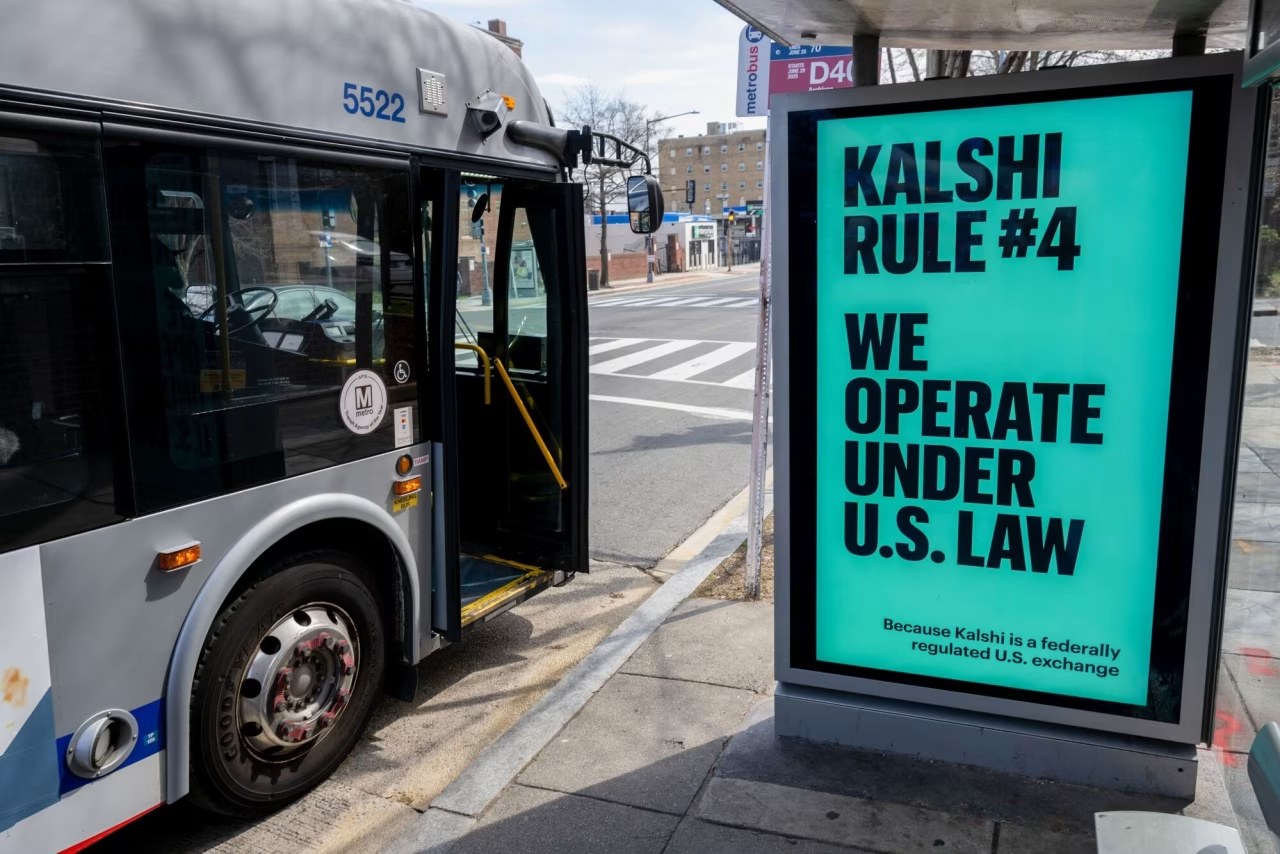
Nevada Judge Freezes Kalshi’s Sports-Linked Prediction Contracts for 14 Days
- Nevada’s First Judicial District Court granted a 14-day temporary restraining order against Kalshi on Friday.
- The platform must obtain full state gambling licenses before listing any sports, election or entertainment event contracts.
- Users under 21 must be blocked from accessing those markets under the order.
- A follow-up hearing is scheduled for April 3 to decide whether the ban becomes permanent.
The ruling tests whether prediction markets are games of skill or chance under state law.
KALSHI—LAS VEGAS—Nevada gambling regulators scored an early win in their escalating clash with prediction-market start-up Kalshi, convincing a state judge to halt the exchange from offering contracts tied to sports outcomes, elections or pop-culture events unless it secures every license required of a traditional sportsbook.
The two-week freeze, handed down late Friday, raises the regulatory stakes for Kalshi and other U.S. platforms that argue their event-based derivatives are skill-based markets exempt from gambling statutes. It also signals that at least one state is prepared to treat binary outcome trading as wagering if the underlying events resemble betting propositions.
Kalshi must now geo-fence Nevada users or face contempt of court, while the company’s counsel prepares for an April 3 hearing that could determine whether the injunction becomes permanent. The order does not ban Kalshi outright; it conditions market access on full licensure and age-gating identical to Caesars or DraftKings.
Why Nevada Moved First—and Why It Matters Nationwide
Nevada’s Gaming Control Board filed the emergency motion Thursday after reviewing Kalshi’s new slate of sports-adjacent contracts, including markets on whether the Kansas City Chiefs would cover a given point spread and whether the Super Bowl halftime show would feature a surprise performer. Deputy Attorney General Monica McCallum told the court those products are ‘indistinguishable from the parlay cards we regulate daily’ and therefore require a state gambling license.
Judge James T. Russell agreed, citing a 2019 advisory opinion that classifies any binary contract tied to ‘future contingent events not under the participant’s control’ as a wager. The 14-day restraining order marks the first time a U.S. court has explicitly forced a federally-regulated prediction market to obtain state gaming permits before listing sports-linked events.
‘This is a shot across the bow for the entire industry,’ said Daniel Wallach, a gaming-law attorney at Becker & Poliakoff who is not involved in the case. ‘If Nevada prevails, expect New Jersey, Pennsylvania and Michigan to file copy-cat actions within weeks.’
Kalshi, backed by Sequoia Capital and Charles Schwab, has operated under a Commodity Futures Trading Commission (CFTC) no-action letter since 2021. That federal blessing does not pre-empt state gambling law, a point the Nevada judge emphasized in a three-page order.
The ruling exposes a widening fissure between federal commodity regulators—who view low-stakes event markets as risk-transfer tools—and state gambling cops who see unlicensed wagering. It also raises compliance costs: a full Nevada gaming license for an online operator averages $1.2 million in fees plus a 6.75% revenue tax, according to the state’s Gaming Policy Committee.
Regulators in seven other states told the Journal they are monitoring the case; Illinois and Colorado already have open inquiries into Kalshi’s political markets.
If the April hearing converts the temporary order into a permanent injunction, Kalshi would either have to exit the Nevada market entirely or transform itself into a regulated sportsbook, a pivot that would subject every contract to house-edge limits and compulsive-gambling protocols the platform has so far avoided.
Inside Kalshi’s Rapid Product Expansion That Triggered the Lawsuit
Founded in 2018 by former Citadel data scientists Tarek Mansour and Luana Lopes Lara, Kalshi launched with innocuous weather and economic indicators. Monthly volume hovered around $3 million until mid-2023, when the platform added pop-culture and sports-adjacent markets. Volume exploded to $42 million in February 2024, according to CFTC filings reviewed by the Journal.
The catalyst was a new contract template that lets traders bet on whether a sports statistic—such as total touchdowns in the Super Bowl—will finish above or below a line set by Kalshi. Unlike traditional futures, these binaries pay either $0 or $1, effectively creating a fixed-odds wager. Nevada regulators argue the product skirts the 1992 Professional and Amateur Sports Protection Act (PASPA) prohibition that the Supreme Court struck down in 2018, but remains codified in Nevada’s own statutes.
‘Kalshi’s genius was to rebrand the parlay as a prediction contract,’ said Brett Smiley, editor of SportsHandle. ‘The problem is that Nevada doesn’t care what you call it; if chance dominates skill, you need a license.’
Company counsel countered in Friday’s hearing that all Kalshi contracts undergo a skill-based screen: users must demonstrate knowledge of the underlying event, and prices are set via continuous auction rather than fixed odds. Judge Russell was unpersuaded, noting that neither the platform nor its users can influence whether a kicker makes a 48-yard field goal.
The ruling halts 18 live sports-linked contracts that had attracted $9.7 million in open interest from roughly 4,300 Nevada accounts. Those positions will be cash-settled at fair market value calculated as of Thursday’s close, a process Kalshi must complete by March 29.
Internal company slides shown to investors last month projected that sports-adjacent volume could reach $250 million by year-end; the Nevada injunction slices 12% off that forecast.
While Kalshi can still list economic and weather contracts globally, the loss of high-velocity sports markets threatens a revenue model that relies on 8% commissions. Mansour told staff on a Friday call that the company will ‘vigorously defend our right to offer skill-based markets’ and is considering a federal constitutional challenge under the Commerce Clause.
Is Prediction Trading Gambling? The Legal Divide Behind the Ruling
The Nevada decision turns on a single statutory phrase: ‘any device or scheme where a person risks something of value upon an outcome predominantly subject to chance.’ Kalshi argued that traders supply analytical skill—studying injury reports, weather data, coaching histories—analogous to buying options on volatility. The state countered with expert testimony from University of Nevada, Las Vegas gaming professor Alan Feldman, who calculated that random variance explains 73% of returns in Kalshi’s NFL player prop markets.
That percentage exceeds the 50% threshold Nevada uses to classify daily fantasy sports as gambling, giving Judge Russell a bright-line test. The ruling aligns with a 2022 opinion from the Nevada attorney general that daily fantasy player props are wagers, even though traditional season-long fantasy contests remain legal.
‘The irony is that Kalshi’s CFTC approval rested on the same skill argument,’ said Melanie Morgan, a derivatives lawyer at Reed Smith. ‘But commodities law pre-empts only other federal statutes, not state gaming codes.’
Similar battles are brewing elsewhere. The Michigan Gaming Control Board issued a cease-and-desist letter to PredictIt last month, and Colorado’s Division of Gaming opened a rule-making docket to define ‘event contract’ versus ‘bet.’ No state has yet replicated Nevada’s litigation playbook, but the temporary restraining order provides a template.
Legal scholars note the parallel to the 2006 Unlawful Internet Gambling Enforcement Act, which carved out fantasy sports but left implementation to states. The result: a patchwork that forces platforms to geofence dozens of jurisdictions. Kalshi now faces the same compliance maze, raising operating costs that could erode its commission edge over regulated sportsbooks.
A permanent loss in Nevada alone would trim projected 2024 net revenue by $4.3 million, according to internal models disclosed in court.
The company’s broader fear is copy-cat litigation. New Jersey’s Division of Gaming Enforcement has already subpoenaed internal Kalshi emails related to marketing language that touts ‘Vegas-style action without the vig.’ A Garden State injunction would cut off another 9% of Kalshi’s user base, filings show.
What Happens Next: April 3 and Beyond
Both sides must file briefs by March 29, after which Judge Russell will decide whether to convert the temporary order into a preliminary injunction that could last through trial. Legal analysts give Nevada a 65% chance of success, citing the state’s 11-1 record in similar gaming disputes since 2015, according to data compiled by gambling research firm Eilers & Krejcik.
If the injunction becomes permanent, Kalshi must either exit Nevada or apply for a gaming license, a process that includes background investigations of every shareholder above 5%, source-of-funds verification, and a suitability finding for the platform’s proprietary settlement algorithm. The company has yet to decide which route to take, sources told the Journal.
Meanwhile, the CFTC is conducting its own review of event-contract oversight, with Chairman Rostin Behnam telling Congress that ‘additional guardrails may be warranted.’ Any federal rule-making could pre-empt state actions, but the timeline stretches into 2025, leaving Kalshi exposed in the interim.
Investors are watching closely. Kalshi last raised $30 million in Series B funding at a $250 million valuation; the round was co-led by Sequoia and Charles Schwab. The term sheet includes a material-adverse-change clause triggered by ‘any state-level gaming injunction affecting more than 5% of active users,’ exactly the scenario Nevada presents.
Company executives have discussed pivoting toward institutional volatility products, but those markets generate lower margins than retail sports-adjacent contracts. A Nevada loss could therefore reshape Kalshi’s entire product roadmap—and embolden regulators in other states to demand their own slice of the action.
Whatever happens on April 3, the ruling has already forced every U.S. prediction market to re-examine whether federal commodity approval is enough—or whether state gambling codes will have the final say.Key Deadlines in Kalshi v. NevadaMar 22Temporary restraining order issuedJudge Russell grants 14-day freeze on sports-linked contracts.Mar 29Position settlement deadlineKalshi must cash-settle all Nevada user positions at Thursday closing prices.Mar 29Briefing deadlineBoth sides must submit arguments for preliminary injunction hearing.Apr 3Preliminary injunction hearingCourt decides whether to extend or dissolve the ban.May 15CFTC comment period closesFederal regulator could propose new event-contract rules.Source: Court docket, CFTC noticeFrequently Asked Questions
Q: What exactly did the Nevada court order Kalshi to stop?
The temporary restraining order prohibits Kalshi from listing any contracts tied to sports, elections or entertainment outcomes unless it first obtains every state gambling license and bars users under 21. The freeze lasts 14 days with a full hearing set for April 3.
Q: Does this ruling affect Kalshi users outside Nevada?
The order applies to any Kalshi customer whose IP geolocates to Nevada; the platform must geo-block the state or risk contempt. Other states could file copy-cat suits, so the precedent may ripple nationwide.
Q: Why does Nevada argue Kalshi needs a gambling license?
Regulators contend that event-based binary contracts—paying $1 if an outcome occurs—function as ‘contracts for difference’ under Nevada law, triggering the same licensing, taxation and consumer-protection rules that govern sportsbooks.
📰 Related Articles
📚 Sources & References
Frequently Asked Questions
Q: What exactly did the Nevada court order Kalshi to stop?
The temporary restraining order prohibits Kalshi from listing any contracts tied to sports, elections or entertainment outcomes unless it first obtains every state gambling license and bars users under 21. The freeze lasts 14 days with a full hearing set for April 3.
Q: Does this ruling affect Kalshi users outside Nevada?
The order applies to any Kalshi customer whose IP geolocates to Nevada; the platform must geo-block the state or risk contempt. Other states could file copy-cat suits, so the precedent may ripple nationwide.
Q: Why does Nevada argue Kalshi needs a gambling license?
Regulators contend that event-based binary contracts—paying $1 if an outcome occurs—function as ‘contracts for difference’ under Nevada law, triggering the same licensing, taxation and consumer-protection rules that govern sportsbooks.
