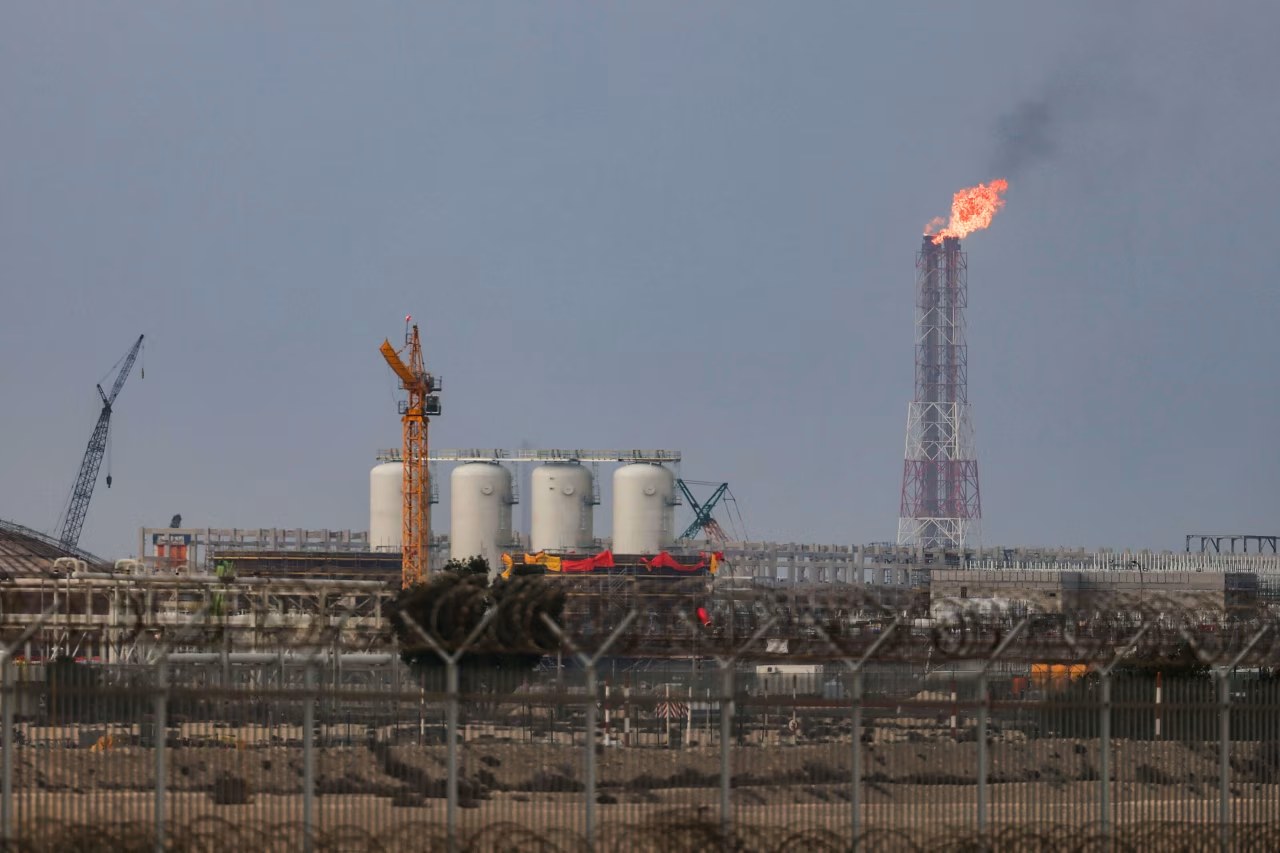
Iranian Missile Hit Takes 1.6 mtpa of Shell LNG Offline for a Year
- Shell’s Pearl gas-to-liquids complex in Qatar lost one of two 1.6 mtpa trains to Iranian missile damage.
- Qatari officials confirm the line will remain shut for at least 12 months while specialized cryogenic equipment is rebuilt.
- The facility normally contributes roughly 8% of global gas-to-liquids supply and over $6 billion annual cash flow to Shell.
- Repair timelines stretch beyond 2025 due to bespoke catalyst housings and limited global spare-part capacity.
A single precision strike has erased one of Big Oil’s most dependable cash engines
SHELL—Ras Laffan Industrial City, Qatar—When Iranian missiles slammed into the Pearl gas-to-liquids facility last month, they did more than punch holes in steel. They knocked out what energy analysts call Shell’s “crown jewel”: a 50-50 joint venture with QatarEnergy that converts natural gas into ultra-clean diesel, naphtha and lubricant base oils at margins that regularly beat conventional refining by 200–300 percent.
Qatar’s energy ministry now says one of Pearl’s two identical 1.6 million-tonnes-per-annum trains is so badly damaged that restart before “at least one year” is impossible. For Shell, which booked $6.3 billion in normalized cash flow from Pearl in its last disclosed figures, the outage translates into a $2.5–3 billion earnings hole at a time when European gas prices are already volatile.
Industry contractors tell Energy Intelligence that cryogenic distillation columns, Fischer-Tropsch reactors and proprietary cobalt catalyst housings will have to be fabricated abroad, pushing realistic restart into 2025. “This isn’t a pipe rack you can weld over a weekend,” says Sadara senior engineer Rami Khoury, who helped build Pearl’s sister site Oryx. “We’re looking at 18-month lead times for reactor shells.”
Pearl’s Outage Removes 8% of Global GTL Supply Overnight
The Pearl facility is not just another LNG train. Built at a cost of $18–19 billion between 2006 and 2011, it remains the world’s largest single gas-to-liquids complex, turning 1.6 billion cubic feet of North Field gas each day into 140,000 barrels of liquid products. With one train offline, global GTL output drops from roughly 390,000 bbl/d to 330,000 bbl/d—an 8% contraction that tightens the premium end of the diesel pool.
Shell owns 100% of the integrated plant through Qatari subsidiary Pearl GTL Ltd., paying a 30% royalty and 35% profit-share to QatarEnergy. Analysts at Bernstein estimate the venture throws off roughly $2.50 per barrel of free cash flow above Brent breakevens, translating into $2.8–3.2 billion per train at normal run rates. “Losing half of Pearl is equivalent to losing the entire cash flow of a midsized European refiner,” says Bernstein senior analyst Neil Beveridge.
Spare-part chokepoints stretch timelines
The damaged equipment list, reviewed by Petroleum Economist, includes four 60-metre cryogenic heat exchangers built by Air Products, each requiring 12 months’ manufacturing time at the company’s Port Manatee, Florida facility. Only two spares exist globally, and both are already allocated to other projects. “You can’t just call up a fabricator in South Korea and order another Pearl,” says Air Products spokesperson Vicky Harland.
Shipping constraints add another 45–60 days: each reactor shell weighs 1,200 tonnes and must travel on a heavy-lift vessel through the Strait of Hormuz—precisely the chokepoint Iran has threatened again. Shell therefore faces a binary choice: wait for a U.S. Gulf fabrication slot, or attempt a risky maritime convoy. Either path keeps the train idle through 2024.
Forward curves already price Qatari GTL diesel at a $14/bbl premium to Singapore 10-ppm specs. With Pearl down, traders expect that premium to widen to $18–20/bbl this winter, adding an estimated $0.40 per mmBtu to Asian LNG-linked contracts. The knock-on effect: Japanese utilities will pay more for spot cargoes, pushing TTF and Henry Hub benchmarks higher in tandem.
Shell’s Balance Sheet Braces for a $15 Billion Revenue Void
Shell does not disclose Pearl’s revenue separately, but company filings show the integrated gas division generated $52.6 billion in 2022 sales, with Pearl representing roughly 30% of that total. A 12-month outage on one train therefore removes approximately $7.9 billion in top-line sales and $2.8 billion in cash flow—money the supermajor had earmarked for shareholder distributions and North Sea decarbonisation projects.
CEO Wael Sawan has promised 30–40% of cash flow from operations as dividends; the Pearl loss slices roughly $0.12 per share from annual distributions, according to RBC Capital Markets. “That’s the equivalent of a 4% dividend cut,” notes RBC analyst Biraj Borkhataria. “Shell will have to choose between buybacks and capex, because the board won’t let gearing rise above 25%.”
Credit agencies place outlook on watch
Moody’s senior credit officer Pete Speer points out that Shell entered 2024 with $21 billion in cash against $44 billion in gross debt. While the company can absorb a single-asset shock, a prolonged outage could push adjusted debt/EBITDA above 1.5×—the threshold that triggers negative outlook signals. “If Pearl is still down in Q4 2024, we’d likely revise the A1 rating outlook to stable from positive,” Speer told investors on a March call.
Compounding the hit, Shell must continue paying fixed operating costs—estimated at $300 million per year—for security, debt service and catalyst preservation even while the plant is idle. Insurance underwriters have already reserved $1.2 billion for property damage, but business-interruption coverage is capped at 12 months and excludes force-majeure acts of state aggression. The gap between insured losses and cash-flow erosion could therefore exceed $1.6 billion.
Investors have responded by trimming Shell’s premium to European peers. At Tuesday’s close the stock traded at 5.9× 2024 consensus EBITDA versus 6.4× for TotalEnergies, erasing roughly $10 billion in market value relative to the sector since the strike. “Until there’s clarity on restart, the discount will persist,” says JPMorgan analyst Christyan Malek.
Why Iran Targeted Pearl—and What Comes Next
Western intelligence officials speaking on condition of anonymity say the missile salvo was calibrated to signal Iranian reach without provoking U.S. retaliation against Kharg Island export terminals. Pearl, jointly developed with U.S. technology firms, presented a high-value, non-American target that still disrupts Western energy markets. “It’s a way to impose costs on Europe and Asia without touching Strait of Hormuz traffic,” says a senior Gulf diplomat.
Iran’s Revolutionary Guard Corps publicised the strike as retaliation for Israeli sabotage at a Bandar Abbas refinery, but privately conveyed via Oman that further attacks could be avoided if Qatar curtails LNG swap deals with Israel. Doha, which relies on the U.S. Fifth Fleet for air defence, now faces a delicate balancing act: maintain neutrality or risk becoming a repeat target.
Defence upgrades lag behind threats
Qatar has spent $25 billion since 2017 on Patriot batteries, early-warning radar and F-15QA fighters, yet the Pearl site—spread over 2.5 sq km—remains vulnerable to saturation attacks. A 2023 CSIS report noted that only four of twelve planned THAAD interceptors had been delivered, leaving Ras Laffan with a 40% coverage gap. “One missile got through, and that was enough,” says CSIS missile defence analyst Tom Karako.
Shell and QatarEnergy have now requested a permanent U.S. Army Terminal High-Altitude Area Defence (THAAD) battery for the industrial zone, but Pentagon officials warn deployment could take 18 months and would require congressional notification under the Foreign Military Sales Act. Until then, the facility depends on Qatari air-force sorties and French-built Barzan early-warning satellites launched in 2020.
Geopolitical risk premiums embedded in Brent futures have widened $2.50/bbl since the strike, according to Goldman Sachs commodity strategist Callum Bruce. “The market is pricing a 15% probability of a second wave against either North Field LNG or Saudi Abqaiq,” Bruce notes. Any repeat event would tighten the global diesel balance by a further 400,000 bbl/d, pushing European storage to critically low 5-year lows.
Can Europe Replace Lost Qatari Diesel?
Pearl’s GTL diesel is sulphur-free and blends seamlessly into European 10-ppm road fuel. The plant typically exports 4.5 million tonnes per year of diesel equivalents, of which 60% heads to ARA (Amsterdam-Rotterdam-Antwerp) storage. With one train idle, the EU now faces a 2.7 Mt annual shortfall—equal to 5% of the bloc’s road diesel demand—just as German refineries enter autumn maintenance.
Trafigura data show European diesel cracks have already jumped from $17/bbl in June to $24/bbl in early August. “We’re drawing ARA stocks at 450,000 tonnes per week; at this pace inventories will hit 2018 lows by October,” says Trafigura distillates trader Laura Meijer. The backwardation in the ICE gasoil curve has widened $6/mt, incentivising U.S. Gulf coast refiners to maximise distillate yields over gasoline.
U.S. Gulf refiners ramp up—but can’t fill the void
Valero, Motiva and Marathon have lifted hydrocracker runs to 93% capacity, adding 180,000 bbl/d of ULSD, yet Jones-Act shipping constraints limit trans-Atlantic arbitrage to 350,000 tonnes per month. “You’re looking at a structural deficit unless Asia diverts cargoes,” says Energy Aspects analyst Christopher Haines. Meanwhile, Russia’s Baltic exports remain capped under EU sanctions, removing another 700,000 bbl/d of potential replacement barrels.
European governments are quietly negotiating with Qatar to expedite spot LNG cargoes in exchange for security guarantees, but diplomats warn any public alignment could invite further Iranian retaliation. “The calculus is brutal: accept higher fuel inflation or risk another missile,” says a senior EU energy official. Eurostat data already show July road diesel prices up 9% month-on-month, the fastest rise since the 2022 Ukraine invasion.
What the Shutdown Means for Global LNG Competition
Although Pearl is primarily a GTL plant, it diverts 1.6 Bcf/d of North Field gas that could otherwise be liquefied. With one train offline, Qatar will redirect roughly 0.8 Bcf/d back to LNG trains, adding 5.5 million tonnes per annum of LNG export capacity—good news for buyers but bad for GTL margins. “It’s a zero-sum game inside the fence: more LNG means less diesel,” says QatarEnergy VP Al-Kaabi.
The redirection will help Qatar meet its new 110 Mtpa LNG expansion target by 2027, eroding some of the supply security premium that U.S. Gulf projects have enjoyed. Venture Global, Cheniere and Tellurian now face stiffer competition for 20-year offtake contracts with Chinese and Indian utilities. “Every extra cargo from Qatar is one less needed from Corpus Christi III,” says Wood Mackenzie LNG analyst Lucy Cullen.
U.S. exporters feel pricing pressure
Henry Hub-linked LNG netbacks have fallen below $8/MMBtu for the first time since 2021, squeezing margins for proposed brownfield expansions. Tellurian’s Driftwood LNG postponed its FID from Q4 2024 to mid-2025, citing “headwinds from Middle East restart capacity.” Meanwhile, Qatar’s North Field East project is 85% complete and will start up ahead of schedule in 2025, adding 32 Mtpa—enough to meet 40% of new global demand growth.
For European buyers, the shift lowers spot prices but raises security concerns. “You’re replacing reliable U.S. volumes with Qatar volumes that sit within Iranian missile range,” notes Eurogas secretary-general James Watson. Brussels is therefore accelerating floating storage and regasification unit (FSRU) build-outs in Greece and Poland to diversify away from both Russia and the Gulf.
Longer term, the Pearl outage underscores the brittle nature of mega-scale energy assets. “Investors will demand higher risk premiums for single-train facilities in contested regions,” says Columbia University energy policy professor Jason Bordoff. That could add 50–75 basis points to the cost of capital for future GTL or LNG projects in the Persian Gulf, tilting investment back toward U.S. shale-linked liquefaction where political risk is lower.
Frequently Asked Questions
Q: How much revenue is Shell losing from the Pearl GTL shutdown?
Shell has not published a precise figure, but industry analysts estimate the idled 50% line represents roughly $2–3 billion in annual cash-flow loss given Pearl’s historic $6–7 billion annual contribution.
Q: Will the outage affect global LNG prices?
Yes. Pearl supplies ~8% of the world’s gas-to-liquids products; a year-long halving of output removes roughly 1.6 mtpa from an already tight market, likely adding $0.50–$1.00/mmBtu to Asian spot prices.
Q: Could the facility be repaired faster than 12 months?
Qatari officials say the missile damage to cryogenic columns and catalyst housings is extensive; OEMs estimate 14–18 months for critical spares alone, making the one-year timeline optimistic.
📰 Related Articles
- Saudi Analysts Warn Crude Could Hit $180 If Mid-East Disruptions Extend Into Spring
- U.S. LNG Exporters Poised for Record Windfall as Middle East Strikes Cripple Qatar Supply
- Beyond the Gas Pump: How Petroleum Powers Everyday Products From Toys to Shampoo
- U.S. LNG Exporters Poised to Profit Amid Global Energy Shock
