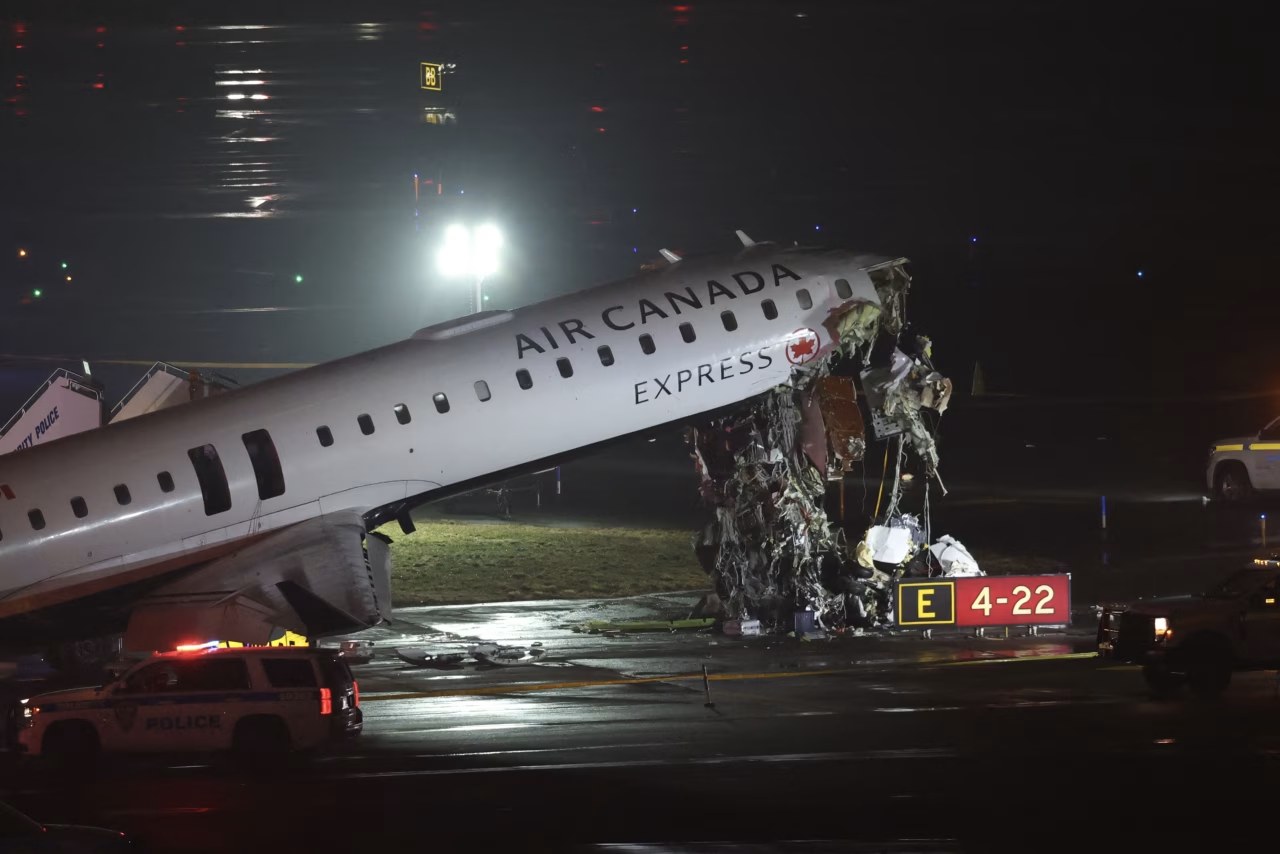
Two Pilots Killed in LaGuardia Runway Collision That Grounded 400+ Flights
- An Air Canada Express jet arriving from Montreal struck a Port Authority fire truck late Sunday, killing both pilots on board.
- The FAA imposed an immediate ground stop that remained in effect Monday afternoon, cancelling or diverting more than 400 scheduled flights.
- LaGuardia’s single operating runway was closed while investigators mapped wreckage and recovered cockpit voice and flight-data recorders.
- The crash is the first multi-fatality U.S. runway accident since 2009, reviving debate over vehicle proximity rules during active landings.
A routine landing turns fatal when an emergency truck crosses an active runway
LAGUARDIA AIRPORT—New York’s LaGuardia Airport, the busiest origin point for business travellers in the United States, became the scene of the nation’s deadliest runway accident in 15 years late Sunday when an Air Canada Express regional jet slammed into a firefighting vehicle, killing both pilots and shutting the airfield for more than 18 hours.
The Federal Aviation Administration issued a full ground stop at 23:17 local time after the collision, stranding an estimated 38,000 passengers and forcing airlines to cancel 268 departures and divert 143 inbound flights to JFK, Newark and airports as far away as Boston, according to flight-tracking service FlightAware.
Port Authority officials said the aircraft, identified by Transport Canada as a 76-seat De Havilland Dash 8-400, had just touched down on Runway 31 and was decelerating when it collided with a Rosenbauer Panther 6×6 crash truck positioned near the high-speed exit taxiway. The impact sheared off the aircraft’s left wing and ignited a fuel-fed fire that was extinguished within seven minutes, but not before the cockpit area was destroyed.
The Final Seconds: What Investigators Have Reconstructed
Preliminary radar data released by the National Transportation Safety Board show the Air Canada Express aircraft crossing the threshold at 119 knots, well within the Dash 8’s normal touchdown envelope. Five seconds later the surface-movement radar captured the fire truck entering the runway from Taxiway Kilo, a connector normally restricted to ground vehicles only after tower confirmation.
Cockpit voice recorder captures brief warning
According to people who have listened to the recording, the captain can be heard calling “vehicle on the runway” one second before impact. The first officer’s response is cut off by the sound of collision. The entire event, from truck incursion to aircraft rest, lasted 2.7 seconds—too short for either crew or vehicle operator to initiate evasive action.
Air-traffic-control transcripts show the local controller had cleared the flight to land two minutes earlier and had switched the runway lighting to “high intensity” for visibility. There is no record of the fire truck receiving a separate frequency instruction, raising questions about whether the vehicle was in direct contact with the tower or operating on a Port Authority dispatch channel.
Former NTSB investigator John Goglia told reporters that LaGuardia’s runway-incursion warning system, upgraded in 2018, should have triggered both aural and visual alerts in the tower. “If the truck was squawking its assigned transponder code, the system would paint the conflict on the controller’s screen,” Goglia said. Investigators have not yet confirmed whether the Panther’s transponder was active.
The wreckage distribution—aircraft debris scattered 420 feet, truck debris 180 feet—indicates a nearly perpendicular impact angle at an estimated ground speed of 92 knots. Both pilots sustained fatal trauma; the truck’s three-member crew survived with injuries ranging from smoke inhalation to a fractured pelvis.
Runway friction tests performed at dawn showed no anomalies, eliminating the possibility that a slippery surface contributed to the aircraft’s inability to stop short. The runway length—7,003 feet—exceeds the Dash 8’s required landing distance by 28 percent under the reported 11-knot tailwind component.
The NTSB has secured airport closed-circuit television footage that shows the truck pausing for 11 seconds at the hold-short line before accelerating onto the active runway. Investigators are now correlating that video with the vehicle’s electronic control module to determine whether the driver overrode an automatic braking system designed to prevent precisely this type of incursion.
How One Closed Runway Paralyzed the Northeast Corridor
LaGuardia handles roughly 1,100 daily movements on two intersecting runways, but overnight construction meant only Runway 31 was open when the crash occurred. The closure instantly eliminated 1,800 feet of usable length and forced the Port Authority to suspend all arrivals and departures, triggering the largest single-airport ground stop since Atlanta’s 2017 power outage.
400 flights cancelled in 14 hours
By 06:00 Monday, carriers had scrubbed 268 departures—about 90 percent of the morning schedule—while 143 inbound flights were rerouted. American Airlines cancelled 74 departures, Delta Air Lines 69 and Southwest 42, according to carrier advisories reviewed by the Port Authority. JetBlue, which operates a secondary base at JFK, moved 18 LaGuardia departures to its Kennedy gates to accommodate stranded travellers.
The FAA’s ground-stop notice, issued through the Air Traffic Control System Command Center, prohibited any aircraft from departing for LaGuardia until 15:00 local time Monday, but officials warned the restriction could extend if NTSB wreckage mapping or fuel-removal operations ran long. Each hour of closure costs airlines an estimated $1.2 million in crew time, passenger compensation and lost revenue, according to trade group Airlines for America.
Passenger-impact data compiled by the Port Authority show 38,000 booked travellers were affected, with 22,000 attempting to rebook on later flights and 16,000 seeking ground transportation to alternate airports. Average taxi wait times exceeded 90 minutes, and Amtrak’s Northeast Corridor added four extra Acela departures to absorb demand, selling out 3,200 seats within 40 minutes.
Regional economic consultancy Oliver Wyman estimates the shutdown will shave $48 million off metropolitan-area GDP for the day, factoring in missed business meetings and onward connections. The figure does not include potential fines: the Transportation Department can levy up to $27,500 per passenger for tarmac delays exceeding three hours, though waivers are granted for safety-related events.
Why Did the Fire Truck Enter an Active Runway?
Port Authority protocol requires any vehicle entering a runway to obtain two-way confirmation from the airport’s control tower and to trigger an automated hold-short barrier that transmits an electronic signature to air-traffic computers. Investigators have confirmed the barrier was raised when the Panther truck crossed, but no such signature was logged, suggesting the driver may have been operating under local fire-dispatch authority rather than FAA ground control.
Dual command structure creates loophole
LaGuardia, like many U.S. airports, operates under a “split jurisdiction” model: aircraft movements are controlled by FAA air-traffic personnel, while Port Authority police and fire units respond to emergencies under the agency’s own command. Inter-agency agreements stipulate that during an aircraft emergency the senior fire officer on scene may assume “tactical control” of portions of the airfield, but only after notifying the tower supervisor.
Audio archives reviewed by investigators capture a Port Authority dispatcher requesting “immediate access to Runway 31 for a hot-brake response,” referencing an unrelated Southwest 737 that had reported overheated brakes on touchdown 12 minutes earlier. The tower replied, “Stand by—traffic on short final,” yet the truck proceeded anyway. Whether the driver heard the instruction is unclear; the Panther’s mobile radio was recovered with its volume set to level three on a ten-step scale.
Dr. Robert Sumwalt, former NTSB chairman, told journalists that such split authority is a known risk. “When you have two separate chains of command on the same strip of concrete, the margin for miscalculation doubles unless there is an iron-clad coordination protocol,” Sumwalt said. He noted that after a 2016 runway incursion at Pearson International, Transport Canada mandated unified digital clearance systems for all vehicles; no similar mandate exists in the United States.
Investigators are also examining whether infrared cameras mounted on the truck obscured the driver’s peripheral vision. The Panther 6×6 is equipped with a 360-degree thermal imaging array that projects live video onto the dashboard, but the displays automatically dim under 30 lux ambient light—conditions that prevailed at 23:09 with only runway edge lighting available.
A Pattern of Close Calls: U.S. Runway Incursions on the Rise
The LaGuardia fatalities mark the first pilot deaths in a U.S. runway incursion since the 2006 Comair crash in Lexington, Kentucky, but they are hardly an isolated data point. FAA safety statistics show that the number of Category A or B incursions—those with a significant chance of collision—rose to 23 in the most recent 12-month reporting period, up from 14 the previous year and the highest tally since 2001.
Technology gaps persist at major hubs
Only 18 of the nation’s 30 busiest airports have fully operational runway-status-light systems that give pilots an automatic red-light warning if another aircraft or vehicle is on the runway. LaGuardia’s system was certified in 2020 but covers only Runway 22, not the 31-13 pair where Sunday’s crash occurred. Congressional auditors estimate full nationwide deployment would cost $1.3 billion, money not yet appropriated in the FAA’s five-year reauthorization.
Internationally, Canada’s major airports saw incursions fall 42 percent after mandatory ADS-B transponders were required on all service vehicles, according to a 2023 Transport Canada safety report. Similar rules in Europe reduced Category A incursions to just three across 42 major airports last year, Eurocontrol data show.
Experts cite controller workload as a key factor. At LaGuardia, the control tower handles an average of 74 operations per hour during peak periods with a staff of nine certified controllers—20 percent below FAA staffing guidelines. The National Air Traffic Controllers Association warned in February that mandatory overtime hours had risen 38 percent nationwide, increasing the risk of lapses in surface-clearance phraseology.
Former FAA associate administrator for safety Ali Bahrami told reporters the U.S. has the technology to prevent such tragedies but lacks regulatory urgency. “We have been talking about integrated vehicle transponders since 2004; every year we delay, the risk curve keeps creeping upward with traffic volume,” Bahrami said. He advocates a federal requirement that all airport service vehicles carry automatic dependent surveillance-broadcast units linked to tower computers, a measure currently voluntary.
What Happens Next: Investigation Timeline and Potential Reforms
NTSB Chair Jennifer Homendy told a midnight press briefing that a full investigation will take 12-18 months, but a preliminary factual report is expected within 30 days. Investigators have already secured airport surveillance video, cockpit voice and flight-data recorders, air-traffic-control transcripts, and the truck’s electronic control module. All evidence will be analyzed at the NTSB laboratory in Washington.
Criminal probe not ruled out
The Queens District Attorney’s office has opened a parallel review to determine whether vehicular-manslaughter or reckless-endangerment statutes apply. Investigators executed a search warrant at the Port Authority’s emergency-services headquarters Monday morning, seeking maintenance logs and radio recordings. If charges are filed, they would mark the first criminal prosecution of an airport-vehicle operator in New York history.
Congressional reaction was swift: House Aviation Subcommittee Chairman Garret Graves announced a hearing for next month titled “Runway Incursions: Closing the Gaps in Airport Surface Safety.” The FAA’s associate administrator for airports is expected to testify, along with representatives of the controllers’ union and airport executives. A Senate version is being planned by Commerce Committee Chair Maria Cantwell.
Policy analysts foresee three likely outcomes: first, a federal mandate for ADS-B transponders on all airport vehicles; second, an expansion of runway-status-light systems to every commercial runway longer than 3,500 feet; and third, a requirement that control towers receive automated alerts whenever any vehicle crosses an active hold-short line, regardless of local emergency protocols.
Air Canada has already pledged to underwrite counselling and rebooking costs for affected passengers, but legal exposure could widen. Aviation-insurance specialist Robert Clifford estimates combined liability could exceed $150 million once passenger-injury claims, business-interruption lawsuits and regulatory fines are tallied. The airline’s hull insurer, a consortium led by Lloyd’s of London, has dispatched a team of surveyors to examine wreckage before any components are relocated.
Runway 31 is expected to reopen within 48 hours once NTSB clears debris and Port Authority engineers certify pavement integrity. The psychological impact will linger longer: pilots unions have told members they may refuse to operate into LaGuardia if vehicle-control procedures are not tightened within 60 days, a move that could force flight reductions during the peak summer travel season.
Frequently Asked Questions
Q: Why did the FAA issue a ground stop at LaGuardia?
The FAA halted all arrivals and departures after an Air Canada Express jet collided with an emergency vehicle on the runway, killing two pilots and requiring a full accident investigation before reopening the airfield.
Q: How long will LaGuardia remain closed?
Officials have not set a firm reopening time; the Port Authority and FAA must complete debris removal, runway inspection, and review cockpit and vehicle data before passenger flights resume.
Q: Which flight was involved in the LaGuardia collision?
Air Canada Express Flight AC 123 from Montreal was landing when it struck a Port Authority fire truck, according to preliminary statements from the airline and airport officials.
