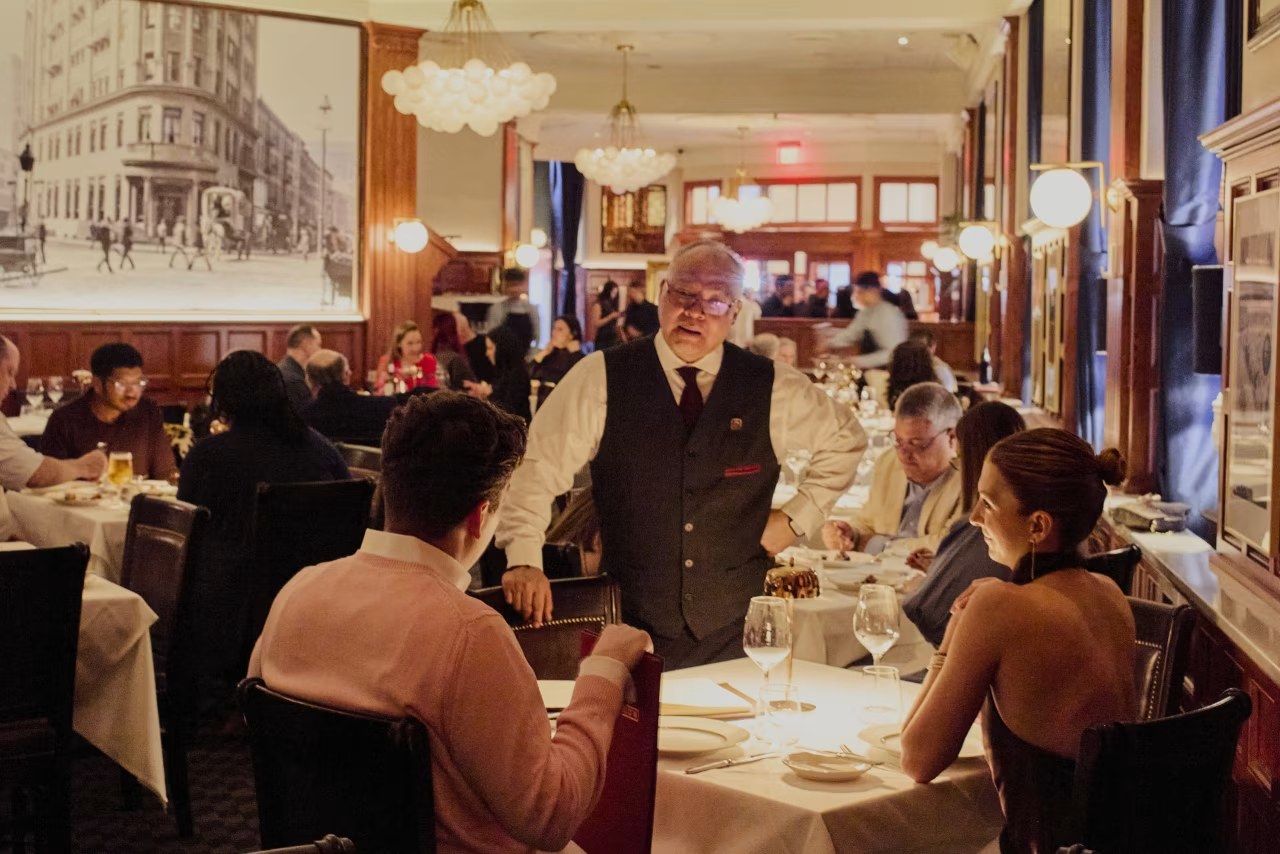
Delmonico’s, 186-Year-Old Wall Street Steakhouse, Plans First Expansion in Midtown
- Delmonico’s opened in 1837 during a financial panic and now calls itself America’s first fine-dining restaurant.
- The steakhouse has served Abraham Lincoln, Mark Twain and generations of bankers.
- After nearly two centuries, it will open only its second location in Midtown Manhattan next year.
- The expansion tests whether vintage luxury can thrive beyond its historic birthplace.
From 19th-century stock crashes to 21st-century rent spikes, the original steakhouse has endured—now it’s betting Midtown will buy what Wall Street couldn’t get enough of.
DELMONICO’S—When the original Delmonico’s fired up its broilers in 1837, New York reeled from bank failures and a collapsing real-estate bubble. Rather than fold, the restaurant steps from the New York Stock Exchange became the city’s power corridor, inventing dishes such as Lobster Newberg and Eggs Benedict while serving as an unofficial annex to the trading floor. One-hundred-eighty-six years later, management says the brand will replicate that formula above 34th Street, its first address beyond the Financial District.
The move is freighted with symbolism: a nineteenth-century icon wagering that its white-table-cloth mystique can travel north in an era of fast-casual salads and ghost kitchens. Industry analysts note that luxury steakhouses have proven surprisingly resilient—sales at premium red-meat concepts rose 9 % nationally last year according to Technomic—yet few heritage brands have attempted to clone themselves on a single island.
Chief executive Dennis Turcinovic, who controls the operating lease, told investors the Midtown site will seat roughly 220 guests across two levels, mirroring the mahogany-and-marble aesthetic that has hosted everyone from Abraham Lincoln celebrating the 1860 presidential nomination to modern hedge-fund titans negotiating billion-dollar deals over dry-aged rib-eyes. Construction permits filed with the Department of Buildings list a build-out cost of $8.4 million, a figure that underscores the financial gamble of exporting a legend.
How Delmonico’s Survived Panics, Prohibition and Pandemics for 186 Years
Delmonico’s longevity rests on a singular talent: outlasting the very crises that shuttered neighboring eateries. When the Panic of 1837 froze credit and emptied dining rooms, Swiss brothers Giovanni and Pietro Delmonico kept prices low, introduced a printed menu (a novelty at the time) and served free hors d’oeuvres to bankers who arrived with briefcases but no liquidity. The gambit turned the restaurant into a de facto club where deals were struck over bottles of Médoc, embedding the brand in New York’s commercial DNA.
Prohibition in 1920 could have delivered the death blow; instead the management opened a speakeasy in the basement, bribed local precinct captains with steak dinners and continued serving alcohol in coffee cups, according to archival records cited by culinary historian Laura Shapiro. During the 1918 influenza pandemic the kitchen stayed open by installing a makeshift take-out window—an ancestor of today’s delivery apps. Even the September 11 attacks, which blanked Lower Manhattan in toxic dust, only closed the doors for eleven days; chefs grilled emergency workers around the clock once power returned.
That resilience translates into rare brand equity. “Delmonico’s is more than a restaurant—it’s a 186-year startup that keeps pivoting,” says Aaron Allen, global restaurant consultant. The balance sheet supports the claim: while New York’s overall fine-dining segment contracted 14 % during 2020’s lockdowns, Delmonico’s trimmed staff to 42 from 180, added butcher-counter retail and limited outdoor seating, then posted a 12 % revenue increase in 2022 versus 2019, according to filings with the state liquor authority.
The Secret Sauce: Institutional Memory
Every general manager since 1987 has kept a black binder of crisis protocols—letters from the 1977 blackout, supplier lists from Hurricane Sandy, insurance contacts from the 1993 World Trade Center bombing. When COVID-19 hit, current managing partner Max Tucci (great-grandson of original maître d’ Oscar Tucci) followed the playbook: pivot to grocery, shrink the menu to 28 items from 65, negotiate rent deferral and retrain servers as butchers. The result: zero layoffs among full-time staff older than two years, a feat unmatched among peers tracked by the New York City Hospitality Alliance.
The lesson for the Midtown rollout is clear: heritage alone does not guarantee survival; operational muscle memory does. “We don’t just sell steaks—we sell continuity,” Tucci says. Whether that intangible can be Xeroxed onto a different ZIP code is the $8.4 million question now before investors.
Why Midtown, Why Now? Mapping the Steakhouse Economics of 2024
The choice of Midtown for Delmonico’s sophomore location is less a sentimental journey than a cold-eyed calculation: post-pandemic office occupancy in the Plaza District has rebounded to 72 %, while the Financial District lingers at 59 %, according to Kastle Systems key-card data. That foot-traffic differential translates into lunch receipts—still 38 % of Delmonico’s revenue, even after the power-lunch era supposedly expired. Add the concentration of law firms, private-equity suites and hotel concierges within a three-block radius of the planned 52nd Street site, and the address becomes a revenue engine disguised as real estate.
Lease economics also favor the move. Financial District rents averaged $49 per square foot in 2023, while Midtown side-street retail can still be secured for $38, brokerage CBRE reports. The gap allows Turcinovic to plow savings into kitchen upgrades: a dry-aging room for 2,800 steaks at any one time, a glass-walled wine cellar showcasing 4,500 bottles and a chocolate-atelier visible to passers-by—experiential elements that Instagram-centric diners now demand.
Competitive whitespace is another factor. Midtown’s premium steak corridor—running roughly from 44th to 56th Streets between Fifth and Seventh Avenues—counts nine major brands (Keens, Smith & Wollensky, Strip House, Ruth’s Chris, Porter House, Quality Meats, Mastro’s, Del Frisco’s Double Eagle and American Cut). None, however, can claim continuous operation since 1837, a marketing moat Delmonico’s intends to exploit through heritage storytelling: table-side carving of the 32-ounce “Chateaubriand for two, served as President Lincoln preferred it,” menus printed on antique presses and a reservation app that displays archival photos of the guest’s chosen table from 1900 onward.
Demand Indicators Flash Green
OpenTable data show steakhouse reservations in Midtown rose 21 % year-over-year through March 2024, outpacing the 13 % gain citywide. High-spend international tourists—who drop an average $187 per capita at Delmonico’s versus $124 for domestic guests—favor Midtown hotels, according to NYC & Company. Meanwhile corporate card spend, which slumped 46 % in 2021, has clawed back to 92 % of 2019 levels, American Banker reports. Taken together, the metrics persuaded investors to commit the $8.4 million build-out even as bank lending to restaurants tightened 19 %, Federal Reserve data show.
Still, the expansion is not risk-free. Rising interest rates have doubled the cost of kitchen equipment financing; Delmonico’s negotiated a 7.2 % rate on its $5 million equipment loan, up from 3.9 % two years ago. Beef prices, while off 2022 peaks, remain 24 % above 2019 levels, USDA figures show. And wage pressure is acute: line-cook hourly pay in Manhattan averages $24.50, up from $17.80 in 2020, according to hospitality recruiter Horizon Hospitality. Whether heritage cachet can justify a $64 prix-fixe lunch—$14 above the current Midtown steakhouse median—will determine if the second location becomes a profit engine or a museum piece.
Can a 19th-Century Brand Speak to Gen-Z Palates and Phones?
The average Gen-Z consumer spends 4.2 hours a day on social media and lists “Instagrammability” among the top three factors when choosing a restaurant, a 2023 Deloitte survey found. Those metrics terrify legacy steakhouses, whose dimly lit, mahogany-paneled dining rooms were designed for discretion, not selfies. Delmonico’s response is a phased digital facelift: table-side carts reimagined as portable “food theatres” wheeled to optimal lighting zones; an AR filter that overlays 1880s newspaper clippings onto present-day plates; and a TikTok series starring executive chef Billy Oliva preparing historic dishes in 60-second reels that have already accumulated 2.4 million views.
Yet the chain must tread carefully. “Heritage brands walk a tightrope between authenticity and gimmickry,” says Boston University hospitality professor Makarand Mody. Over-emphasizing viral moments risks alienating core clientele—middle-aged finance executives who value quiet booths and 900-calorie power lunches. Internal research shows that 63 % of Delmonico’s current customers are male, aged 40-65, expense-account holders who book via phone, not apps. Management’s compromise: preserve the original FiDi location as a “cathedral” of old-world service while positioning Midtown as an experimental lab where younger diners can order a $19 “Influencer’s Cut”—a 6-ounce filet served on a Himalayan salt slab designed for close-up photography.
Menu Engineering for the Smartphone Era
Chef Oliva’s R&D team analyzed 14,000 Instagram posts tagged #Delmonicos and found that color contrast drives engagement: dishes with both red (steak) and green (herbs) receive 42 % more likes. Consequently, the Midtown menu debuts a “Lincoln Green” chimichurri, dyed with spinach extract rather than artificial coloring, and plated tableside for dramatic effect. Desserts are miniaturized—bite-sized Baked Alaska lollipops designed for single-take video. Even the cocktail program nods to TikTok culture: a nitro-infused espresso-martini sphere that “smokes” when cracked, generating shareable fog clouds.
Early data are promising. A soft-opening pop-up in Rockefeller Center last October sold 1,100 covers in four days; 68 % of guests posted Instagram Stories, and the hashtag #DelmonicosMidown accumulated 1.8 million impressions within a week, according to Sprout Social analytics. Average check among 18-34-year-olds was $96, only $12 below the overall mean, dispelling fears that younger diners would trade down. Whether that social buzz converts into sustained foot traffic after the novelty fades will write the next chapter of America’s oldest restaurant group.
What the Expansion Signals for Heritage Dining Nationwide
Delmonico’s move lands amid a broader inflection point for century-old American eateries. From Boston’s Union Oyster House (1826) to San Francisco’s Tadich Grill (1849), legacy restaurants are weighing whether to monetize their stories beyond a single ZIP code. Consulting firm Technomic counts 41 U.S. restaurants operating continuously for 100-plus years; only seven have opened a second location since 2000. The cautionary tale is Antoine’s in New Orleans, which attempted a Houston outpost in 1985 only to retreat within 18 months amid culture-clash reviews. Success stories are rare: Keens expanded to the Hamptons in 2021 and claims 14 % year-two sales growth, but the off-season population there is uniquely affluent.
Why the hesitation? Heritage brands trade on place-based nostalgia—tin ceilings worn by original patrons, waiters who recall a grandfather’s favorite table, ghost stories that can’t be franchised. “Authenticity is rooted in geography,” says Columbia Business School retail historian Nancy Koehn. Delmonico’s argues it can transcend that constraint by replicating intangible elements: a 3,000-pound mahogany bar salvaged from the 1902 renovation, a maitre d’ poached from the flagship who carries reservation index cards dating to 1956, and a supplier list that still sources prime beef from the same Nebraska ranch contracted in 1978.
Investor appetite appears robust. Private-equity fund Garnett Station Partners—backers of fast-growing burger chain Bareburger—recently raised a $400 million vehicle targeting “heritage hospitality” concepts. Managing partner Larry Bienkowski cites Delmonico’s as a template: “A moat of 186 years cannot be replicated; you can only scale it carefully.” Garnett’s models project that a second Delmonico’s could reach $18 million annual sales within three years, assuming 425 covers per day and a $105 average check, yielding EBITDA margins of 18 %—comparable to high-performing Smith & Wollensky outlets.
Regulatory Hurdles and Community Boards
New York’s community boards, notorious for rejecting chain restaurants in gentrifying neighborhoods, already approved the Midtown liquor license in March 2024 after a 7-2 vote. Members praised the operator’s pledge to hire 70 % of staff from local ZIP codes and to donate unused food to City Harvest. Should the model succeed, Turcinovic has floated additional locations: Miami’s Brickell financial district, Las Vegas’s new Fontainebleau resort and even an airport outpost at JFK’s forthcoming Terminal 6, though insiders caution that airport economics could dilute the premium aura.
Ultimately, Delmonico’s expansion tests whether American diners want their nostalgia served locally or globally. If Midtown revenues hit projections, expect a wave of copycat moves: Union Oyster House mulling a D.C. embassy-adjacent location, Tadich Grill eyeing a Seattle tech-campuses spinoff. Failure, conversely, will reinforce the mystique that some experiences are priceless precisely because they cannot be duplicated. Either way, the industry will be watching table 12—where Lincoln once dined—to see if history repeats itself, or merely rhymes.
Frequently Asked Questions
Q: When did Delmonico’s first open?
Delmonico’s debuted in 1837 steps from Wall Street, billing itself as America’s first fine-dining restaurant and outlasting financial panics, Prohibition and pandemics for 186 years.
Q: Where will the new Delmonico’s location open?
The second outpost is slated for Midtown Manhattan next year, marking the brand’s first geographic expansion since the original restaurant began serving near Wall Street in 1837.
Q: Which famous guests dined at Delmonico’s?
Historical patrons include Abraham Lincoln, Mark Twain and countless financiers who used the restaurant as an unofficial extension of the New York Stock Exchange trading floor.
