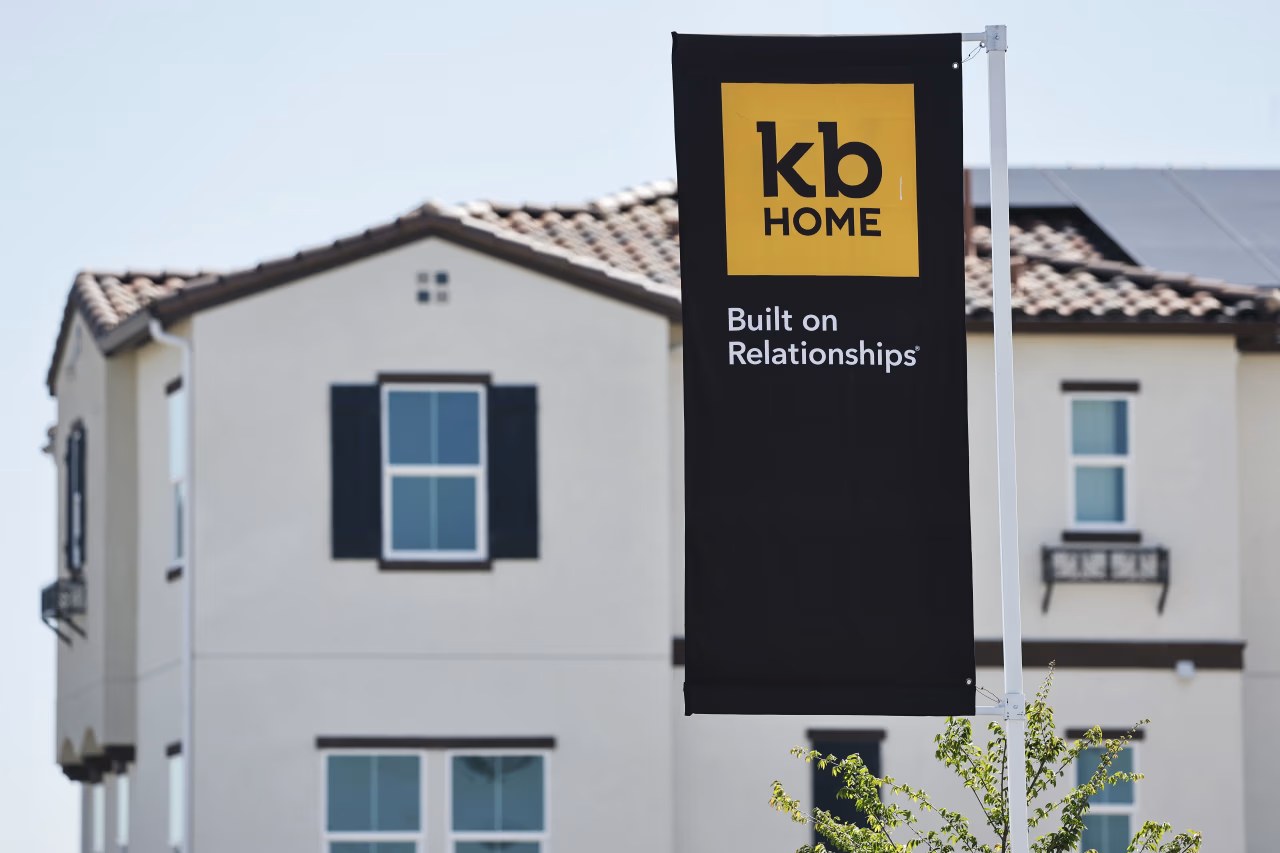
KB Home Misses $1.09B Forecast, Slashes 23% Revenue as Geopolitical Jitters Hit Buyers
- Revenue dropped 23% to $1.08 billion, below analyst expectations of $1.09 billion.
- Management reduced full‐year guidance, citing Middle East instability and cautious consumers.
- CEO Robert McGibrenny warned geopolitical tensions could keep would-be buyers on the sidelines.
- The quarter marks the third straight report where the Los‐Angeles‐based builder’s top line disappointed.
Home builders brace for a longer recovery as global unrest compounds mortgage-rate fatigue.
KB HOME—KB Home on Monday became the latest major U.S. homebuilder to acknowledge that a fragile housing recovery is being derailed by events thousands of miles away—this time by renewed conflict in the Middle East. The company reported quarterly revenue of $1.08 billion, down 23% from the year‐earlier period and narrowly below Wall Street’s $1.09 billion estimate, prompting executives to lower guidance for the remainder of the fiscal year.
“The conflict in the Middle East has created more uncertainty for an already cautious consumer,” Chief Executive Robert McGibney told analysts during the firm’s post-earnings call. The remark underlines a central challenge for residential builders in 2024: even modest improvements in mortgage rates have not been enough to offset buyers’ risk aversion triggered by headline shocks.
Shares fell 0.5% in after-hours trading, extending a 7% decline so far this year and leaving KB Home stock near its lowest level since late 2020. Investors worry the builder’s order pace and pricing power will remain under pressure if geopolitical fears keep foot traffic in model homes subdued.
Crunching the Numbers: 23% Sales Slide Sinks Expectations
KB Home’s top‐line contraction to $1.08 billion from $1.40 billion a year earlier underlines how quickly demand cooled once mortgage rates hovered above 6.5% for much of the spring selling season. The shortfall against the $1.09 billion consensus may appear marginal, but it marks the third consecutive quarter where the builder failed to meet even reduced analyst targets.
Homebuilding gross margin, excluding items, fell 190 basis points to 20.4%, pressured by incentives the company used to convert traffic. Net new orders declined 8% to 2,710 homes, while the community count increased just 2%, revealing absorption rates at their weakest since 2012. Average selling price inched up 1% to roughly $473,000, but executives said they sacrificed spec‐home premium pricing to close deals.
What Analysts Are Saying
“The combination of higher mortgage rates and geopolitical instability is the perfect excuse for buyers to press pause,” noted John Lovallo, equity analyst at UBS. “KB Home was already pivoting to smaller footprints and value engineering to preserve affordability, but incentives are rising faster than cost savings.”
The builder’s backlog value slid to $2.3 billion from $2.7 billion a year‐ago, a red flag for future‐period conversion. Management now expects full‐year revenue to land between $4.4 billion and $4.6 billion, down from a prior range topping out at $5.1 billion. Investors worry the lower volume could compress overhead absorption, risking a negative operating‐leverage spiral.
On the balance-sheet front, KB Home finished the quarter with roughly $650 million in unrestricted cash and $1.5 billion in home‐building debt. The company generated negative free cash flow of $115 million, reflecting elevated land development outlays and a strategic decision to hold more spec inventory amid slower sales.
Forward Look
Management guided to 10,500–11,000 deliveries in fiscal 2024, implying flat to modest growth, but analysts at JPMorgan caution that assumes no further macro shocks. “Builders are trading at trough multiples, yet visibility is limited,” says Michael Rehaut, JPMorgan’s homebuilding lead. “Any escalation in the Middle East could depress buyer psychology further.”
Middle East Anxiety: The New Wildcard for Homebuyer Psychology
While mortgage rates above 6% have dominated headlines, the sudden spike in Middle East hostilities has emerged as a fresh psychological constraint. Robert McGibney told investors the conflict “amplifies uncertainty” for consumers already grappling with record home‐price appreciation and a volatile rate environment.
Economists from Fannie Mae’s Economic & Strategic Research Group note that external shocks historically influence housing demand to a modest but measurable degree. Their 2023 working paper found that conflict‐driven energy‐price spikes can add roughly 0.‐4 percentage points to headline CPI, nudging consumers toward defensive saving rather than big‐ticket purchases like homes.
Consumer Sentiment Data
The University of Michigan’s Index of Consumer Sentiment fell 9% in a recent preliminary reading, with respondents citing both domestic inflation and global turmoil. Lynn Franco, senior director of economic indicators at the Conference Board, explains that geopolitical risks “often act as a tipping point for postponable decisions, especially for first‐time homebuyers who rely on household‐formation optimism.”
Kevin Gillen, economist at the University of Pennsylvania, points out that KB Home’s buyer profile skews toward entry‐level and first‐move‐up households—segments most sensitive to confidence shocks. “These shoppers can’t ‘time’ rates down, so they freeze when they perceive uncertainty in any form,” Gillen said.
KB Home’s traffic conversion rate dipped to 6.7% from 7.7% a year earlier, according to internal data cited during the call. Management expects the global backdrop to linger unless a ceasefire or diplomatic breakthrough emerges.
Forward Look
Until headline volatility subsides, builders like KB may have to lean on incentives averaging $22,000 a unit—up from $15,000 last spring—to compel hesitant buyers to sign contracts.
Can KB Home’s Cost Fixes Offset Lower Volume?
KC Home’s pivot to smaller, standardized floorplans is designed to shave roughly $12,000 per unit in direct construction costs, according to CFO Jeff Kaminski. The company is also renegotiating national supply contracts for lumber, concrete and drywall after commodity prices rebounded 6% year-to-date.
But those savings barely offset incentive increases. The average price after incentives fell 1% quarter-over-quarter, squeezing gross margin. Management aims to preserve margins by trimming community‐level SG&A, yet fixed corporate overhead makes that difficult when deliveries shrink.
Land Strategy
KB historically favored controlled‐lot options rather than outright land purchases, giving it flexibility to slow development. The company trimmed land spend 18% to $300 million this quarter, freeing up cash but limiting future revenue visibility. “They’re caught between conserving liquidity and securing lots for a rebound,” says Truman Patterson, analyst at Wells Fargo Securities.
If volume guidance is cut again, investors fear the builder could face negative operating leverage that wipes out cost savings. “Deliveries under 10,000 units would challenge overhead absorption—especially on land development depreciation that runs roughly $22 million per quarter,” warns Jay McCanles at Zelman & Associates.
Forward Look
Management insists they will underwrite additional lots only when monthly absorption rates exceed 2.5 homes per community—still 15% below current levels—signaling a cautious stance well into 2025.
Housing Market Catch-22: Rising Rates Meet Geopolitical Fear
The broader homebuilding sector is facing a classic catch‐22: mortgage rates remain 200 basis points above pre‐pandemic averages, while global unrest keeps sentiment fragile. The average 30‐year fixed mortgage hovered near 6.8%, up from 6.3% earlier this spring, according to Freddie Mac’s weekly survey.
Builders have responded by offering rate‐buydowns and closing‐cost assistance. KB extended temporary rate‐buydowns to 5.875% on select inventory, costing roughly $9,000 per loan. Yet traffic remains choppy, reinforcing the view that rate incentives alone won’t unlock demand until consumers feel confident about future income and geopolitical stability.
Industry Data
National Association of Home Builders’ monthly confidence gauge fell to 42 in May from 48 in April, marking the first sub‐50 reading since January. “Builders are reporting that traffic is down 5% year-over-year, even with incentives,” says Robert Dietz, NAHB’s chief economist. “The uncertainty premium is adding to the already high cost of homeownership.”
KB accounts for roughly 3% of U.S. single‐family construction but serves as a bellwether because it targets first‐time buyers. Its cancellation rate ticked up to 19% from 15% a year earlier, underscoring buyer hesitancy.
If rates stay above 6.5% and geopolitical tensions persist, industry forecasts from the Mortgage Bankers Association suggest new‐home sales could contract another 4% in 2024, forcing additional builders to guide lower.
Forward Look
Analysts at Evercore‐IS see potential for a modest rebound this fall if the Fed signals rate cuts and a ceasefire in the Middle East calms energy markets. Absent that, builders like KB may need to slash spec starts to preserve margins and cash.
Investor Reckoning: Is the Worst Priced In for KB Home?
KC Home shares trade at 7.2× forward earnings, a 20% discount to its five‐year average and below peers like Lennar at 8.9×. Book value sits at 0.9×, signaling the market prices little growth or asset appreciation. Bulls argue the discount is overdone if rates eventually fall to the mid‐5% range.
Bears, however, caution the stock merits a lower multiple as long as volume is shrinking and liabilities tied to land developments remain elevated. “KB’s balance sheet is more leveraged than peers, and that matters in a down cycle,” says Ken Zener of Seaport Global.
Cash Flow Concerns
Free cash flow has moved negative for two straight quarters as land development spend outpaced sales. Management targets positive cash by fiscal Q4 through slower land purchases and spec starts, but some investors are skeptical. “They have to hit 10,500 deliveries and hold margins above 19% to generate cash,” says Carl Reichhardt at BTIG. “That’s a tight rope.”
KB maintains $650 million in unrestricted cash and a $1.1 billion revolving credit line that extends to 2028. Covenants permit leverage up to 55% net‐debt‐to‐cap, with the ratio currently at 48%, leaving limited wiggle room if conditions worsen.
Management has indicated it will remain on offense in share‐buybacks only if operating cash turns sustainably positive. Until then, investors should expect dividends to be defended but not raised.
Forward Look
Analysts’ consensus target of $45 implies 18% upside, but that hinges on deliveries rising 8% in FY25 and gross margin rebounding to 21%. Any deeper guidance cut would likely push the stock to fresh lows and could prompt credit‐rating agencies to flag negative outlooks.
Frequently Asked Questions
Q: Why did KB Home cut its guidance?
Management cited two headw: a 23% revenue drop and heightened buyer caution stemming from Middle-East instability that is adding to affordability worries.
Q: How did the quarter’s sales compare to forecasts?
Revenue of $1.08 billion narrowly missed the $1.09 billion consensus, extending a three-quarter streak of top-line shortfalls for the Los-Angeles-based builder.
Q: Is the Mid-East conflict directly hurting demand?
📰 Related Articles
- Vonovia Posts €3.72 Billion Profit After Year‑Long Losses, Rental Growth Fuels Turnaround
- Service‑Centric Retail Surpasses Traditional Stores as U.S. Consumers Prioritize Wellness
- Lennar Quarterly Revenue Slumps 13% Amid Cooling Home Prices
- Mortgage Rates Climb Back Above 6%, Erasing Brief Respite for Homebuyers
