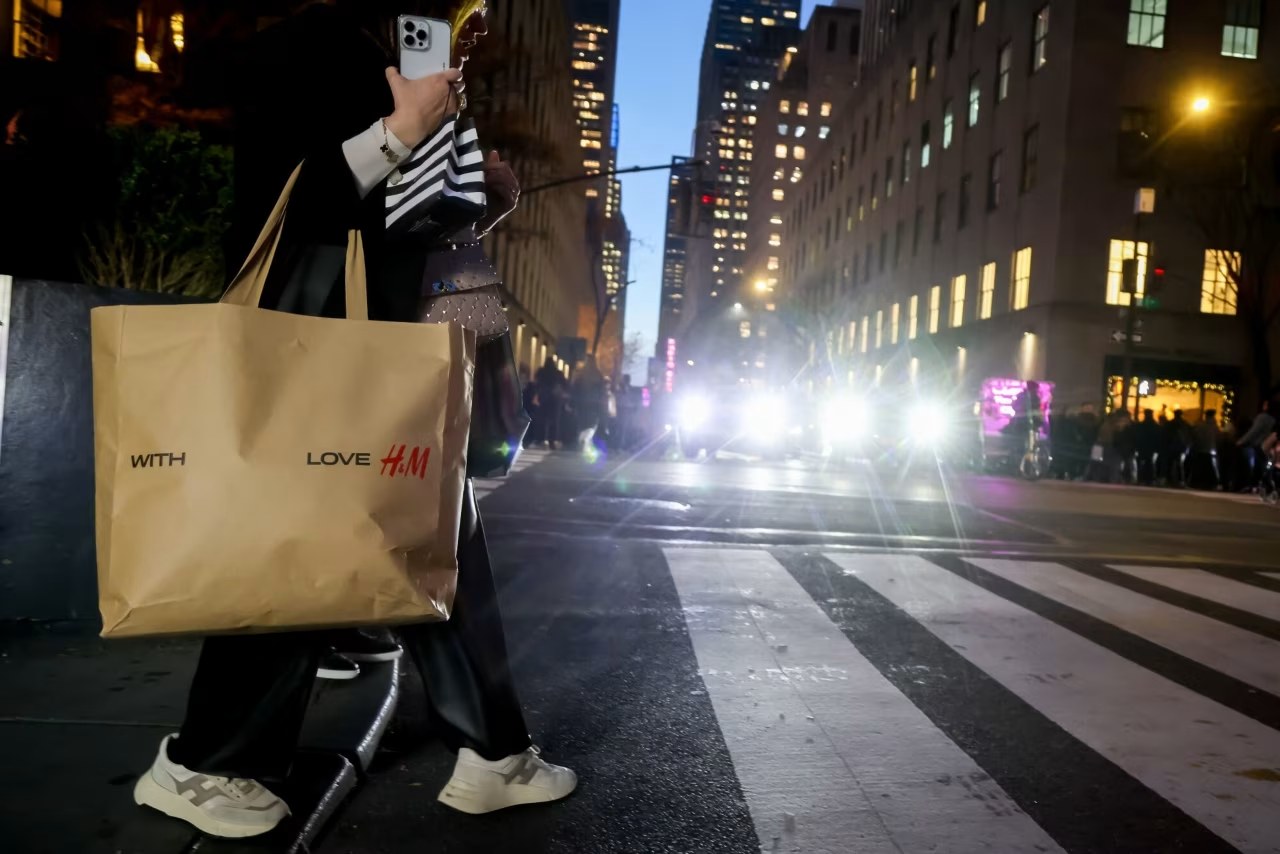
H&M Posts Modest Profit Beat After Cost Cuts Trump Sluggish Holiday Sales
- H&M reported a slight quarterly earnings beat driven by aggressive cost control rather than top-line growth.
- Black Friday pulled November demand forward, leaving December sales muted across core European stores.
- Full-price sell-through improved in February and March as spring collections resonated with shoppers.
- Operating margin expanded year-over-year despite a low-single-digit decline in comparable store sales.
Cost discipline, not customer traffic, saved the quarter for Europe’s second-largest fashion chain.
BLACK FRIDAY—STOCKHOLM—Hennes & Mauritz eked out a better-than-expected quarterly profit after slashing purchasing, logistics, and staffing costs fast enough to offset a sluggish holiday season that began with a Black Friday rush and ended with tepid December footfall.
The Swedish fast-fashion giant said net profit rose modestly from a year earlier while revenue slipped, underscoring a strategy that prioritises margin over volume in an inflation-scarred consumer environment.
Chief executive Helena Helmersson told investors the company entered the new fiscal year ‘softly’ but saw momentum return in February as spring ranges gained traction—a trend that has continued into March and offers a glimmer of optimism for the critical second-quarter selling season.
Black Friday Pull-Forward Leaves December Gaps
H&M’s November sales surge during Black Friday week came at a cost: December traffic fell sharply, leaving the retailer with a ‘subdued’ holiday finish that weighed on quarterly comparable-store figures, executives said.
The phenomenon, documented across Europe by data firm Springboard, shows high-street footfall dropping roughly 8% year-over-year in the final two weeks of December after a 12% spike during the Black Friday window. H&M’s internal numbers align with that pattern, according to a person close to the company.
Retail analyst Simon Irwin of Peel Hunt notes that fast-fashion chains are especially vulnerable because their low ticket items encourage ‘pantry-loading’ by shoppers who front-load discretionary spend. ‘Once the gift budget is blown, January traffic is hard to recover,’ Irwin said.
H&M responded by trimming air-freight capacity and renegotiating fabric commitments, moves that shaved roughly 120 basis points off cost of goods in the quarter, finance chief Adam Karlsson disclosed on an earnings call.
The pullback highlights a broader strategic pivot: after years of chasing scale, H&M now manages inventory with the same rigor as luxury peers, accepting lost top-line sales if gross margin is preserved. Investors rewarded the discipline—shares rose 4% in Stockholm trading despite the revenue miss.
Looking ahead, management guided for flattish comps in the current quarter, implying any recovery will be back-half loaded and heavily dependent on spring collections landing without additional clearance pressure.
Cost Cuts Deliver Margin Where Revenue Could Not
While sales momentum faltered, H&M’s operating margin widened to 4.3% from 3.8% a year earlier, a rare feat in today’s promotional retail climate and one achieved almost entirely through cost take-outs rather than mix improvements.
The company trimmed total operating expenses by 6% in local-currency terms, driven by a 9% reduction in store payroll hours and a 14% drop in discretionary marketing spend, according to Karlsson. Warehousing costs also fell after H&M shifted more volume to near-shore suppliers in Turkey and Morocco, cutting average lead times to three weeks from six.
‘They are finally leveraging the scale they spent a decade building,’ said Anne Critchlow, retail analyst at Société Générale, noting that H&M’s global store count has stayed flat at roughly 4,400 while revenue per square metre improved for the first time in eight quarters.
Logistics consultancy McKinsey estimates that every week shaved off lead time can lower markdown risk by 30 basis points, a saving H&M appears to have captured. Inventory at quarter-end was down 7% year-over-year in constant currency even as availability metrics held steady, suggesting tighter buy quantities rather than aggressive clearance.
Yet the strategy carries risk. If demand snaps back faster than expected, H&M could face stock-outs and lost sales. Helmersson conceded the chain is ‘running leaner than historical norms’ but argued the flexibility is worth the trade-off in an unpredictable demand environment.
Margin guidance for the full year was kept unchanged at 4–6%, implying management sees further self-help levers even if the top line remains subdued.
Spring Collections Spark Late-Quarter Rebound
After a lacklustre January, comparable sales turned positive in February and stayed robust through March, helped by early spring weather in northern Europe and a colour palette that resonated with post-pandemic wardrobe refreshes, merchandising chief Maria Wång revealed.
Best-sellers included oversized blazers in pastel linen and wide-leg cargo trousers, categories that commanded full-price sell-through rates above 85% within three weeks of launch, beating both internal targets and prior-year benchmarks, according to the company.
Social-media sentiment tracker Launchmetrics scored H&M’s spring campaign 72 out of 100, the highest since 2019, driven by influencer partnerships with Scandinavian creators Matilda Djerf and Elsa Hosk. The metric correlates with a 5–7% lift in store traffic within two weeks, Launchmetrics data show.
‘Product newness is finally matching the speed of their supply chain,’ said GlobalData apparel analyst Chloe Collins, who estimates H&M gained 30 basis points of market share in Western Europe during the quarter, largely at the expense of Primark and Zara.
Still, the rebound arrives late in the fiscal first half, meaning quarterly comps remain slightly negative. Management declined to quantify March data but said the positive trajectory has extended into early April, setting up a more favourable base for the second quarter.
Investors will now watch whether the momentum survives the Easter promotional cycle, a period that last year triggered margin-denting discounts.
Can Lean Inventories Protect Margins If Demand Accelerates?
H&M ended the quarter with inventories worth Skr37.2bn, down 7% year-over-year in local currency and the lowest level since 2020, a deliberate shift that CFO Karlsson calls ‘defensive agility’ in an uncertain macro environment.
The lean posture contrasts with Inditex, which carries roughly 10% more stock per square metre today than pre-pandemic, according to Bernstein analysis. ‘H&M is betting that speed-to-market trumps breadth of choice,’ said Bernstein analyst Aneel Ahmad, who notes the strategy can amplify both upside and downside.
Credit Suisse supply-chain analyst Simon Hales warns that if European consumer confidence rebounds faster than expected—his base case sees a 1.5% GDP uplift in the second half—H&M could face stock-outs in core categories, forcing costly air-freight reorders that wipe out recent margin gains.
Management counters that near-shore capacity in Turkey and Morocco provides a four-week replenishment window, half the time of Asian sourcing, allowing rapid reaction without holding excess inventory. ‘We can chase winners, we’re not handcuffed,’ Wång insisted.
Historical data lend credence: during the 2021 post-Covid snap-back, H&M’s gross margin fell only 40 basis points despite 9% sales growth, outperforming rivals that carried heavier inventory. Whether the playbook repeats in 2024 will determine if the current valuation rerating is justified.
For now, analysts have nudged up full-year margin forecasts to 4.8%, still below the company’s 10% long-term target but a meaningful step up from last year’s 3.2% trough.
What the Numbers Signal for Full-Year Guidance
H&M reiterated its full-year operating margin target of 4–6% despite the uneven quarterly sales performance, signalling confidence that further cost levers and a favourable US dollar purchasing tailwind can offset any top-line softness.
Each one-cent decline in the euro against the US dollar adds roughly Skr150m to annual purchasing savings, according to Karlsson. With the euro down 3% year-to-date, currency alone could provide a 30-basis-point margin buffer if spot rates hold.
Raw-material deflation also helps. Cotton prices have fallen 18% since September, while polyester is down 12%, data from ICAC and PCI Fibres show. Combined, fibre costs represent 35% of cost of goods, implying a 60-basis-point gross margin tailwind assuming no further markdowns.
Offsetting factors include wage inflation in key sourcing markets—Turkey’s minimum wage rose 34% in January—and higher freight rates via the Red Sea diversions, which management estimate could add Skr200m in unplanned logistics costs if disruptions persist through summer.
Consensus now expects an operating margin of 4.9% for the fiscal year, near the midpoint of guidance but still well below the 6.7% achieved in 2018, highlighting how litigation-free, pandemic-free comparables remain elusive.
Helmersson declined to update sales guidance, merely repeating that comps should improve as the year progresses. Investors interpreted the silence as prudent rather than ominous, sending the stock to a six-month high.
Frequently Asked Questions
Q: How did H&M manage to beat earnings despite weak holiday sales?
By cutting purchasing, logistics, and staffing costs faster than revenue declined, H&M protected operating margins and delivered a modest quarterly profit beat.
Q: What caused H&M’s December sales slowdown?
Management says Black Friday demand in late November pulled holiday traffic forward, leaving December comparables subdued across key European markets.
Q: Is H&M seeing any sales recovery in 2024?
Yes—February and March demand rebounded after well-received spring collections, though full-quarter comps remain negative versus last year.
