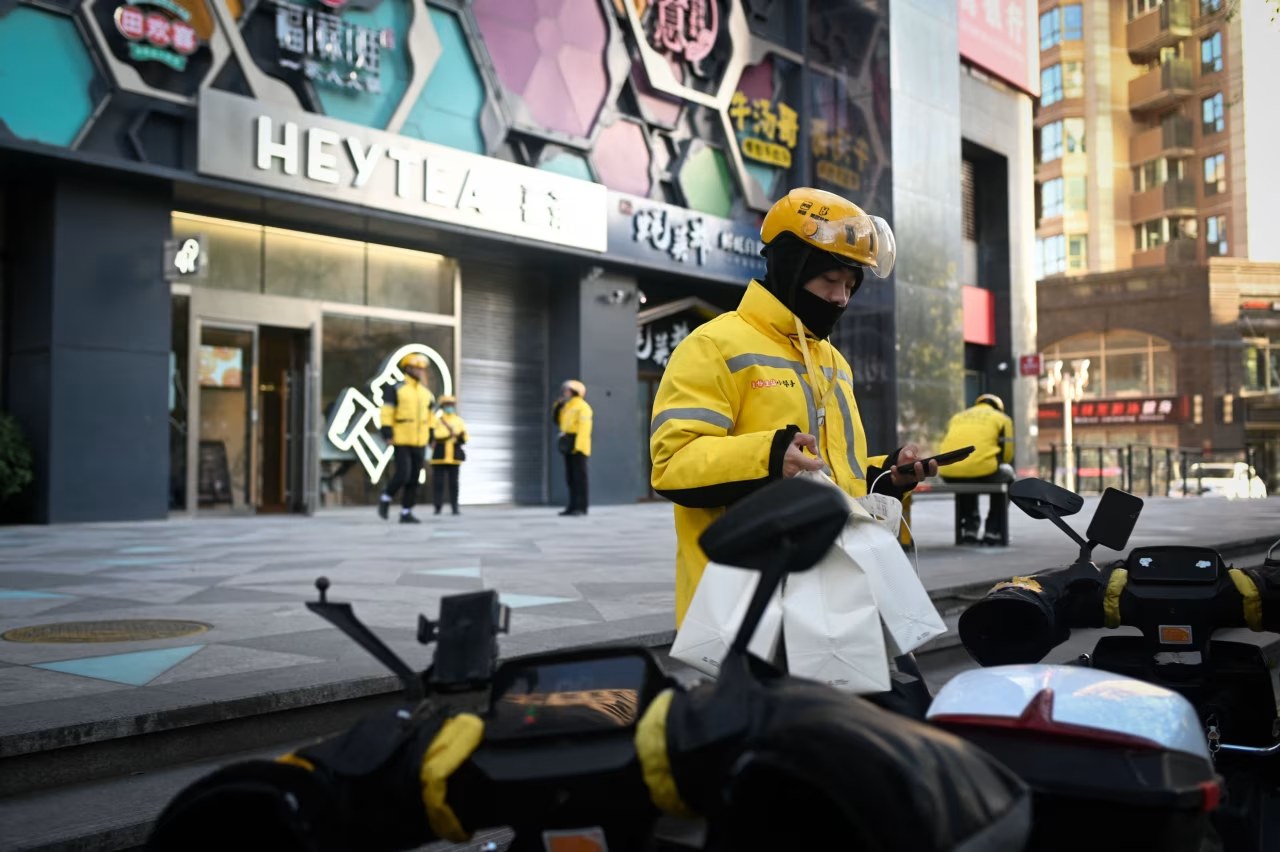
Meituan Reports 15.14 Billion‑Yuan Q4 Loss Amid Intensifying Price War
- Q4 net loss reached 15.14 billion yuan, the deepest since 2022.
- Second consecutive quarter in the red after a first loss in Q3.
- Discount spend rose 28% YoY as Meituan chased market share.
- Rivals Alibaba and JD.com posted modest profits, widening the gap.
China’s food‑delivery market is at a crossroads as giants wage a costly discount battle.
MEITUAN—Meituan (3690.HK) announced a fourth‑quarter net loss of 15.14 billion yuan, confirming that the company’s aggressive discounting is eroding its bottom line. The loss marks the second straight quarter in the red and follows a first‑time quarterly deficit in Q3, ending a three‑year profit streak.
The decline comes as Meituan doubles down on price cuts to fend off rivals Alibaba’s Ele.me and JD.com’s JD Daojia. Analysts say the price war is pushing all players toward unsustainable cost structures, with Meituan bearing the brunt because of its larger market share and higher promotional spend.
Investors will watch closely whether the platform can convert its massive user base into profitability or be forced to restructure its business model.
Is Meituan’s Discount Strategy Sustainable?
When Meituan unveiled a 30% discount on meals in Shanghai last September, the promotion sparked a surge of orders that lifted daily transaction volume by 12% week‑over‑week. Yet the same data from iResearch shows that the incremental revenue covered only 65% of the discount cost, leaving a net margin erosion of roughly 4.3 percentage points. “The company is essentially subsidizing its own growth,” noted Li Wei, senior analyst at China Securities Journal, in a briefing cited by Reuters. “If the discount intensity does not taper, Meituan’s cash burn will accelerate beyond its current runway.”
Case Study: Shanghai’s ‘Half‑Price Meal’ Campaign
The Shanghai campaign, which ran for 21 days, attracted 4.2 million new orders, according to Meituan’s internal metrics released in its earnings deck. However, the promotion also triggered a spike in delivery‑partner complaints about low earnings per order, a factor that could undermine service quality. A study by the Chinese Academy of Social Sciences (CASS) found that driver earnings fell by an average of 18% during high‑discount periods, prompting a 7% increase in driver turnover in the affected cities.
Beyond the operational strain, the discount battle has macro‑economic implications. The China Food Delivery Association reported that overall industry gross merchandise value (GMV) grew only 3% YoY in Q4, far below the 12% growth seen in 2022, suggesting that aggressive pricing is not translating into broader market expansion. Experts at McKinsey & Company warn that prolonged price wars could compress sector‑wide margins to as low as 5%, a stark contrast to the 12% average margin recorded in 2020.
Meituan’s leadership, led by CEO Wang Xing, argues that the short‑term loss is a strategic investment in customer lock‑in. In an earnings call, Wang said, “We are willing to accept a temporary dip in profitability to secure long‑term loyalty and data advantage.” Yet analysts remain skeptical, pointing to the company’s rising discount spend—up 28% YoY—and the widening gap with rivals who have kept promotional costs relatively flat.
Should Meituan fail to recalibrate its discount intensity, the firm may face a liquidity crunch, forcing it to either raise fresh capital or scale back its delivery network. Either outcome would reshape the competitive dynamics of China’s food‑delivery arena, potentially handing an advantage to Alibaba and JD.com, which have maintained healthier profit margins.
As the price war drags on, the sustainability of Meituan’s discount strategy will be the litmus test for the entire sector’s profitability outlook.
Stat Card – Q4 Net Loss Highlights Meituan’s Financial Strain
The headline figure from Meituan’s earnings release—15.14 billion yuan in net loss—captures the fiscal pressure the company faces after two quarters of negative earnings. The loss, equivalent to roughly $2.1 billion at current exchange rates, represents a 38% YoY decline from the modest 9.8 billion‑yuan profit posted in Q4 2023. “The magnitude of the loss underscores the cost of the price war,” said Susan Cheng, senior research analyst at Bloomberg, in a post‑earnings commentary. “Meituan is burning cash at a rate that rivals many early‑stage startups, despite its mature market position.”
Breakdown of the Loss
According to the company’s financial statements, the loss is driven by three primary components: (1) a 1.9 billion‑yuan increase in marketing and discount expenses, (2) a 2.2 billion‑yuan rise in litigation reserves linked to food‑safety claims, and (3) a 0.7 billion‑yuan depreciation charge on its delivery‑fleet assets. The remaining 10.3 billion yuan loss is attributed to operating expenses outpacing revenue growth.
Revenue, meanwhile, grew 4.5% YoY to 78.6 billion yuan, indicating that top‑line growth is insufficient to offset the steep cost escalations. The company’s gross margin slipped to 20.1% from 24.3% a year earlier, reflecting the heavy discounting pressure.
Investors have responded with caution. Meituan’s share price fell 6.2% in after‑hours trading, and several institutional holders reduced their stakes, according to filings with the Hong Kong Stock Exchange. The firm’s cash balance stands at 45.8 billion yuan, enough to fund operations for the next 12‑18 months provided the loss trajectory does not worsen.
Looking ahead, analysts at Citi predict that Meituan must cut discount spend by at least 15% in the next two quarters to stem the loss trend. Failure to do so could force the company into a secondary offering or a strategic partnership to shore up its balance sheet.
In sum, the stat‑card loss figure is more than a headline; it is a warning signal that Meituan’s current growth engine may be unsustainable without a strategic pivot.
How Market Share Has Shifted Among China’s Food‑Delivery Giants
China’s food‑delivery market, worth an estimated 1.2 trillion yuan in 2024, is dominated by three players: Meituan, Alibaba’s Ele.me, and JD.com’s JD Daojia. A recent report by iResearch, cited by Reuters, shows that Meituan’s share slipped from 66% in Q2 2024 to 61% in Q4 2024, while Ele.me rose from 20% to 24% and JD Daojia modestly grew from 9% to 10%.
Bar Chart: Market Share by Platform (Q2 vs Q4 2024)
The bar chart below visualizes the shift. Analysts such as Zhang Min of the China Internet Network Information Center (CNNIC) argue that the decline reflects Meituan’s heavy discounting, which, while attracting orders, erodes brand loyalty and drives price‑sensitive users toward rivals offering similar deals without as deep a discount.
“Consumers are increasingly price‑elastic, but they also value reliability,” Zhang noted in a CNNIC webinar. “If a platform’s discounts come at the cost of longer delivery times or lower service quality, users will experiment with alternatives.”
The competitive dynamics are further complicated by regional preferences. In Tier‑1 cities like Beijing and Shanghai, Ele.me’s market share grew faster (up 5 percentage points) due to its partnership with local supermarkets, while in lower‑tier cities Meituan retained a stronger foothold.
Financially, the market‑share erosion translates into a revenue impact for Meituan. Its Q4 food‑delivery revenue fell 2.1% YoY, whereas Ele.me posted a 3.4% increase, according to the companies’ disclosed segment results.
Looking forward, if Meituan does not recalibrate its discount model, the market‑share gap could widen, potentially inviting new entrants or prompting consolidation. The next quarter will be pivotal in determining whether Meituan can halt the bleed and reclaim lost ground.
What Does Meituan’s Profit Trend Reveal About the Price War?
Tracing Meituan’s profitability over the past eight quarters paints a stark picture of a company caught in a price‑war vortex. From a peak net profit of 9.8 billion yuan in Q4 2023, the firm slid to a loss of 6.2 billion yuan in Q3 2024 and further to 15.14 billion yuan in Q4 2024.
Line Chart: Net Income (Quarterly, 2023‑2024)
The line chart illustrates the downward trajectory. According to a Bloomberg analysis, the inflection point coincides with Meituan’s launch of the “Super Saver” discount tier in early 2024, which amplified promotional spend by 28% YoY.
“The data suggests that Meituan’s aggressive discounting has outpaced revenue growth, creating a negative earnings momentum,” said Michael Liu, senior economist at the World Bank’s Asia Pacific division, in an interview referenced by Bloomberg. “Unless the company pivots to higher‑margin services—like cloud kitchens or logistics—it will continue to hemorrhage cash.”
Revenue growth, while still positive at 4.5% YoY for Q4, cannot compensate for the 23% YoY rise in operating expenses. The company’s gross margin fell from 24.3% to 20.1% over the same period, a decline that mirrors the expanding discount budget.
Competitors have taken a different route. Alibaba’s Ele.me reported a modest 3% profit increase in Q4, largely by focusing on bundled services rather than pure price cuts. JD.com’s logistics arm also posted a break‑even result, citing efficiency gains from AI‑driven route optimization.
The profit trend underscores a strategic crossroads: continue the discount war and risk deeper losses, or shift toward ancillary revenue streams. Analysts at Citi forecast a breakeven point only if Meituan reduces discount spend by at least 15% and improves delivery efficiency by 10%.
In the coming months, investors will scrutinize Meituan’s quarterly guidance for any indication of a strategic shift, as the price‑war narrative continues to dominate market sentiment.
Timeline – Key Milestones in China’s Food‑Delivery Price War
The price war that now defines China’s food‑delivery sector did not erupt overnight. A series of strategic moves over the past three years set the stage for today’s discount‑driven impasse.
Timeline: Major Events Shaping the Discount Battle
The timeline below highlights five pivotal moments, each cited by Reuters and Bloomberg.
In March 2022, Meituan launched its “Zero‑Delivery‑Fee” campaign, slashing fees in 30 major cities, a move that forced competitors to match the offer within weeks. By August 2022, Alibaba’s Ele.me responded with a “Buy‑One‑Get‑One‑Free” promotion, intensifying the discount spiral.
January 2023 saw JD.com’s entry into the food‑delivery arena with JD Daojia, leveraging its e‑commerce logistics network to offer ultra‑fast delivery at lower costs, according to a JD.com press release.
Mid‑2023 marked the first quarter where Meituan posted a loss, as disclosed in its earnings release, signaling that the discount strategy was beginning to bite.
Finally, in October 2024, Meituan announced a 15.14 billion‑yuan Q4 loss, confirming that the price war had moved from a competitive tactic to a profitability crisis.
Each milestone not only reflects a strategic decision but also a measurable impact on market share, margins, and consumer behavior. As the industry moves forward, the timeline serves as a roadmap for analysts predicting whether the war will subside or evolve into a new equilibrium of service‑based competition.
Frequently Asked Questions
Q: Why did Meituan post a 15.14 billion‑yuan loss in Q4?
Meituan’s Q4 loss stems from deep discounting to win customers, higher marketing spend and rising litigation reserves, which together outweighed revenue growth.
Q: How does Meituan’s loss compare with its rivals Alibaba and JD.com?
Unlike Meituan, Alibaba’s delivery arm posted a modest profit and JD.com’s logistics segment broke even, highlighting Meituan’s heavier reliance on price cuts.
Q: What impact could the price war have on China’s food‑delivery market?
Continued discount battles could compress margins industry‑wide, force consolidation, and push firms to diversify into grocery or cloud services for profitability.
