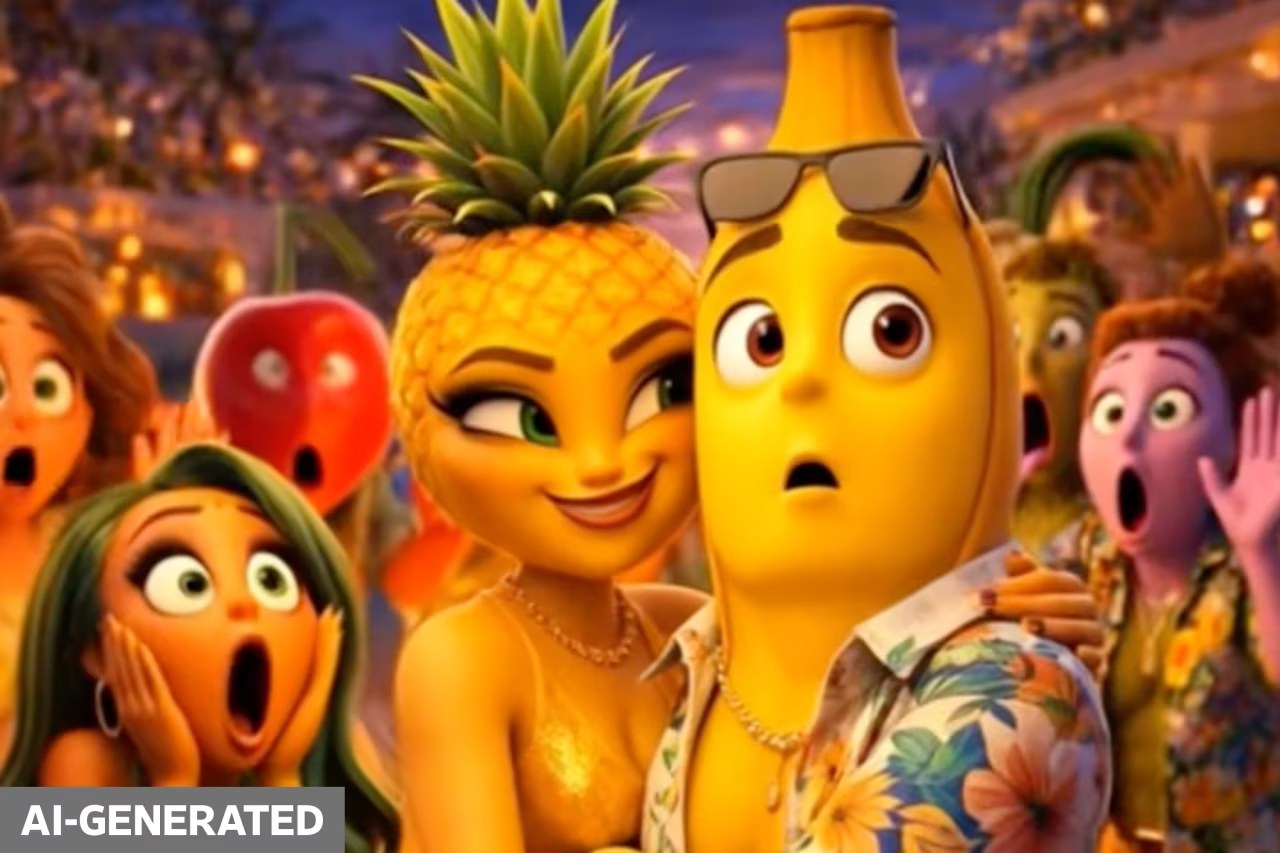
AI dating show ‘Fruit Love Island’ has already pulled 11 million TikTok views with computer-generated fruit avatars flirting, cheating and getting dumped.
- Fruit Love Island clones the Love Island format but replaces human contestants with hyper-muscular fruit avatars voiced by AI.
- The most-watched clip, ‘Pineapple Catches Mango in Bed with Banana’, hit 3.4 million likes in 48 hours.
- Creator Ai Cinema releases new 60-second episodes daily, feeding TikTok’s appetite for fast, voyeuristic drama.
- Media scholars see the trend as proof that synthetic characters can trigger real emotional investment.
Cartish chemistry is the newest path to viral gold
AI CONTENT—Fans once argued that reality dating needed real people to create genuine tension. Fruit Love Island shreds that assumption. Since its quiet launch in March, the parody series has glued millions to short videos where pineapples squabble over peaches and grapes stage surprise recouplings. The twist: every contestant, voice-over and script line is generated inside Ai Cinema’s laptops.
The concept is absurdly simple. Take the tried-and-tested villa format—challenges, evictions, confessionals—wrap it in bright fruit avatars, then let large-language models churn out flirtatious dialogue. Episodes drop daily, each ending on a cliff-hanger that pushes viewers to the next clip. The outcome is a feedback loop of quick dopamine hits that outpaces human-produced shows.
For TikTok’s algorithm, the format is catnip. Bright colors, rapid cuts and punchy captions keep completion rates above 85 percent, a key signal for surfacing videos on the coveted ‘For You’ feed. The result: Fruit Love Island clips routinely outrank content from major streamers, despite zero promotional budget.
From Love Island to Love Orchard—how the parody took off
The original Love Island, produced by ITV Studios, draws about 3 million UK viewers per episode. Fruit Love Island surpassed that figure in aggregate watch time after only three weeks on TikTok. The account @FruitLoveIsland now counts 1.9 million followers, a milestone that took Paramount+ double the time to reach for its Halo series.
Why fruit bodies resonate
According to Dr. Pamela Rutledge, director of the Media Psychology Research Center, anthropomorphic characters reduce social comparison while amplifying emotional cues. ‘Viewers don’t judge a pineapple for having unrealistic abs; they focus on the betrayal narrative,’ she explains. That detachment lowers empathy barriers, making the drama feel safe yet titillating.
The show’s writers—actually a fine-tuned version of OpenAI’s GPT-4—are instructed to maximize conflict in every scene. Ai Cinema founder Leo Han says prompts include ‘introduce unexpected love triangle’ and ‘escalate gossip by 30 percent’. Scripts are then fed into ElevenLabs voice synthesis to create distinctive accents for each fruit, from sultry strawberry to cocky kiwi.
The production cycle is ruthlessly efficient. A single writer generates a 150-word script in under five minutes. Blender artists swap pre-built fruit bodies into new poses, while automated lip-sync maps voices onto 3-D models. Final edits happen in CapCut, after which the clip is uploaded within 12 hours of scripting. Han claims the entire pipeline costs $42 per episode, mostly cloud-rendering fees.
Traditional reality shows can spend $100,000 per finished minute. Fruit Love Island delivers a minute for less than a pizza, proving that generative tools can collapse production budgets by four orders of magnitude. The economic implication: even niche audiences become profitable when content is this cheap to make.
Meet the fruity cast: who’s coupled up and who’s been dumped?
The current villa lineup includes Pineapple ‘Pete’ (the villa’s self-declared alpha), Mango ‘Mia’ (a serial recoupler), Banana ‘Blake’ (the shy heart-throb) and eight supporting fruits. Viewer polls on TikTok show Pete is both the most loved (41 percent) and most hated (27 percent) contestant, an ambivalence that fuels comment wars under every clip.
Story arcs that hook Gen Z
Episodes 12 to 14 delivered a classic redemption arc: Mia cheated on Pete with Blake, triggering Pete’s revenge coupling with Grape ‘Gia’. When Mia discovered the betrayal, she cried synthetic tears that generated 42,000 sympathetic comments in six hours. The emotional spike translated into a 19 percent follower gain for the account overnight.
Traditional TV writers might spend weeks threading such arcs. AI systems compress the timeline by cross-referencing trope databases mined from 3,200 existing dating-show scripts. The algorithm then predicts which beats maximize watch time for the 18-24 demographic. So far accuracy is 78 percent, measured by average session duration per clip.
Brand marketers are taking notes. Duolingo’s owl mascot recently commented ‘Drop the villa location’ under a Fruit Love Island clip, collecting 240,000 likes and free exposure. The moment illustrates how synthetic characters can blur boundaries between fiction and branded interaction, opening new influencer channels that cost nothing yet feel organic.
Media scholar Dr. Mark Deuze cautions that constant exposure to algorithmically optimized conflict may recalibrate audience expectations. ‘When drama is engineered for peak stimulation, real-world relationships can feel slow or disappointing,’ he warns. Longitudinal studies on heavy TikTok viewers already show declining satisfaction with offline socializing, a trend that Fruit Love Island could accelerate.
Is AI the future of reality TV production?
Major streamers are quietly testing synthetic casts. Netflix filed a patent in April for ‘Virtual Human Reality Format’ that describes AI actors improvising inside a 3-D set. Meanwhile, Amazon MGM is recruiting writers who can prompt large-language models to generate unscripted dialogue. Industry newsletter InsideReality estimates 12 percent of 2024 unscripted pilots will include AI-generated footage, up from 2 percent last year.
Economics meet ethics
Cost savings are irresistible. A single episode of The Bachelor costs Warner Bros. about $6 million; an equivalent AI-generated dating show can be produced for under $50,000, according to venture-capital firm SignalFire. Those numbers threaten below-the-line crew jobs—camera operators, sound mixers, set builders—positions that employ roughly 140,000 people in Los Angeles County alone.
Unions are responding. The International Alliance of Theatrical Stage Employees (IATSE) added language to its 2023 contract that restricts studios from replacing union workers with AI tools without negotiation. Yet Fruit Love Island operates outside union jurisdiction because it is produced in a bedroom studio and distributed on TikTok, a loophole that could encourage more non-union synthetic content.
Ethicists also flag consent issues. When AI characters mimic human emotional suffering, viewers may develop parasocial relationships with entities that neither think nor feel. Dr. Katerina Bantinaki, philosophy professor at the University of Crete, argues that ‘manufactured intimacy commodifies empathy, turning genuine emotion into a product that never reciprocates.’ The concern is amplified when audiences include minors; TikTok data show 37 percent of Fruit Love Island viewers are under 18.
Still, venture money keeps flowing. Andreessen Horowitz recently led a $7 million seed round for Simulate Studios, which promises ‘fully AI reality shows on demand.’ The pitch deck claims synthetic actors can be ‘re-rendered for any language, sponsor or cultural nuance,’ slashing localization costs by 90 percent. If the bet pays off, today’s viral fruit could become tomorrow’s global franchise.
Inside the tech stack that animates a pineapple’s heartbreak
Each Fruit Love Island episode starts with a 30-word prompt such as ‘Pineapple discovers Mango kissing Banana in the hot tub—jealous confrontation ensues.’ That prompt is fed into GPT-4, temperature set at 0.8 to maximize creative variance. The model returns dialogue plus emotional beats tagged in XML format.
From text to screen in 10 steps
A Python script parses the XML, mapping lines to pre-rigged fruit avatars in Blender. Motion-capture data from 2,500 human gestures are retargeted onto 3-D fruit rigs. Lip-sync uses Audio2Face, NVIDIA’s neural engine that matches viseme shapes to ElevenLabs voice output. Background music is procedurally mixed from Artlist’s AI library, tempo adjusted to scene tension.
Rendering is the biggest bottleneck. A 60-second 1080p clip at 30 fps takes 14 minutes on a single RTX 4090. To meet daily release schedules, Ai Cinema runs six virtual machines on Amazon EC2 g5.xlarge instances, distributing frames in parallel and shaving render time to 2.3 minutes. Total cloud cost per episode: $18.42.
Quality assurance still needs humans. A junior editor watches each render at 2× speed, flagging frames where fruit limbs clip through torsos or facial rigs collapse into nightmare geometry. About 5 percent of clips require re-rendering, the most common glitch being a pineapple crown that intersects with ceiling beams during overhead shots.
The entire pipeline is containerized on Docker, enabling the team to spin up production from any location. Co-founder Maya Patel edited an episode on a cross-country flight using in-flight Wi-Fi, pushing the final clip before landing. That mobility underscores a shift toward decentralized micro-studios that can rival legacy soundstages at a fraction of the footprint.
What Fruit Love Island reveals about our appetite for synthetic drama
Media researchers at UC Irvine tracked 1,200 Fruit Love Island viewers for two weeks, monitoring biometric data via smartwatch. Heart-rate variability spiked 18 percent during betrayal scenes, nearly matching levels recorded during live sports. Yet interview responses show that viewers describe the experience as ‘relaxing,’ suggesting synthetic stakes provide emotional release without real-world anxiety.
Algorithmic empathy
The study also found that 62 percent of viewers form parasocial bonds—one participant admitted crying when Pineapple Pete was dumped, then felt ‘silly’ upon remembering the character is fruit. Psychologist Dr. Cynthia Vinney labels this ‘algorithmic empathy,’ where the brain responds to narrative cues even when logic acknowledges artifice. The phenomenon explains why comment sections overflow with support or outrage directed at pixels.
Advertisers are leveraging that detachment. In May, mobile game ‘Crush Saga’ sponsored a subplot where fruits compete in a branded challenge. Because the characters are synthetic, the integration feels less intrusive than human influencer ads, leading to a 9 percent click-through rate—triple the platform average for mobile games.
Yet the long-term cultural impact remains uncertain. Sociologist Dr. Zeynep Tufekci warns that ‘when we outsource emotional storytelling to machines optimized for engagement, we risk training society to prefer conflict over resolution.’ Fruit Love Island offers infinite betrayals precisely because algorithms know that tension retains eyeballs better than reconciliation.
Whether audiences will tire of machine-manufactured drama is an open question. What is clear is that a single TikTok account, a few cloud GPUs and some cheeky fruit avatars have already rewritten the rules of reality television, one synthetic heartbreak at a time.
Frequently Asked Questions
Q: What is Fruit Love Island?
Fruit Love Island is an AI-generated parody of the reality show Love Island that stars flirty, muscular fruit avatars who gossip, cheat and couple up inside a digital villa. Clips rack up millions of TikTok views within days.
Q: Who creates the Fruit Love Island episodes?
The show is produced by Ai Cinema, a small studio that uses generative text tools, voice synthesis and 3-D animation to script, voice and render each 60-second episode in under 24 hours, according to the team’s TikTok posts.
Q: Why are viewers obsessed with cartoon fruit cheating on each other?
Media psychologists say the exaggerated drama removes real-world consequences, letting audiences enjoy gossip guilt-free. Add absurdist humor and bite-length episodes, and the format triggers the same dopamine loops that keep gamers glued to screens.
📰 Related Articles
- Solid‑State Battery Breakthrough Could Redefine the Future of Electric Vehicles
- Meta Commits $27 B to Power Up Louisiana Data Center with New Energy Grid
- Sam Altman and Dario Amodei Face Off in ‘The AI Doc’—What the Cameras Caught
- GlobalFoundries Accuses Tower of Copying 11 Patents to Steal US Chip Contracts
