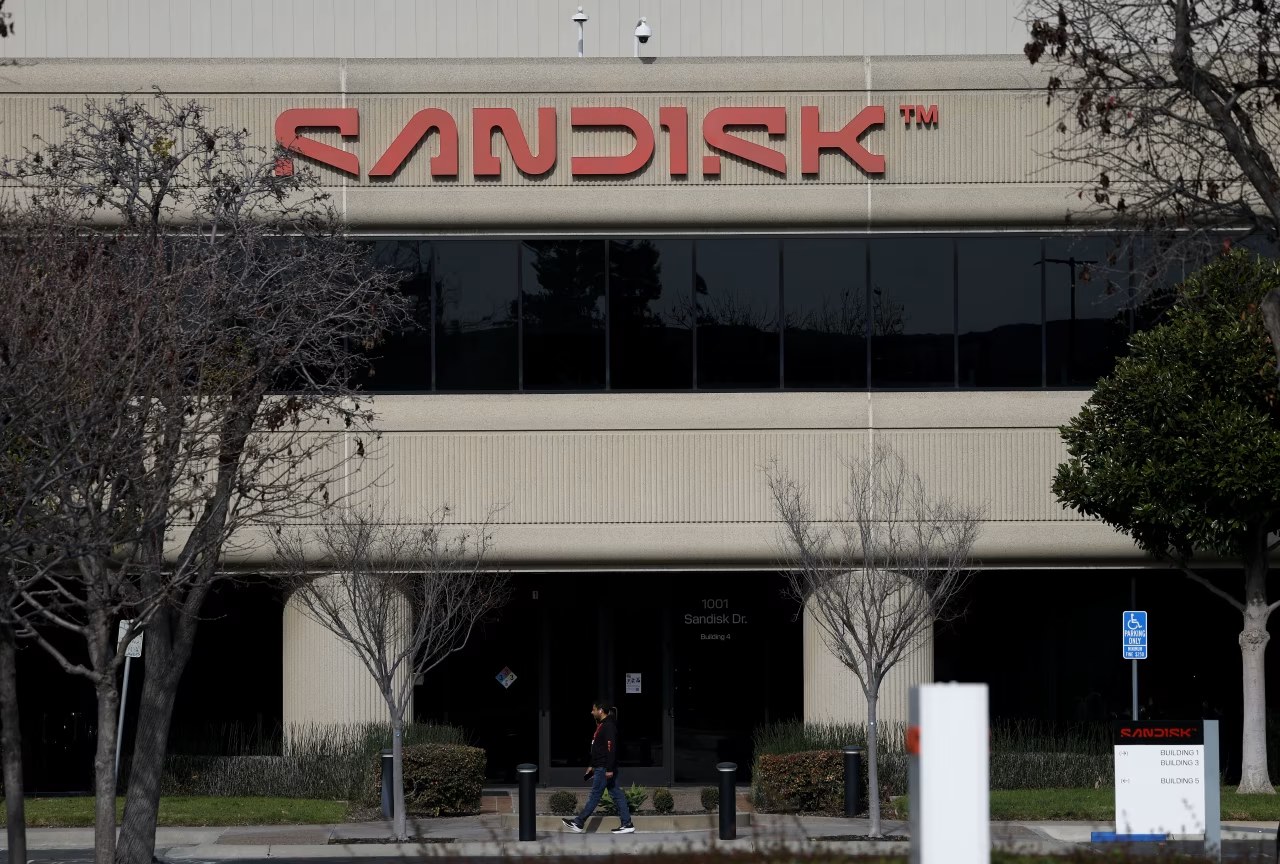
Sandisk to Spend $1 Billion for 3.9% of Taiwan’s Nanya in Flash Supply Pact
- Sandisk will acquire ~139 million Nanya shares at a 15% discount to the 30-day average price.
- The $1 billion equity stake secures a multi-year flash memory supply arrangement.
- Taiwan’s Nanya gains a locked-in customer while Sandisk shields itself from volatile spot prices.
- Deal comes as global chipmakers race to secure wafer supply amid surging AI and mobile demand.
The cash-and-supply agreement reshapes the flash memory pecking order
SANDISK—Flash memory giant Sandisk is ploughing $1 billion into Taiwan’s Nanya Technology, buying 3.9% of the DRAM and flash maker at a 15% discount to its recent trading range. The transaction, announced Wednesday, pairs equity with a long-term supply contract that gives Sandisk priority access to critical wafer capacity.
Under the terms, Sandisk will purchase roughly 139 million new common shares, instantly making it one of Nanya’s largest outside investors. The agreement also binds both companies to a six-year supply framework that fixes volume and pricing parameters—an unusual step in an industry accustomed to quarterly spot negotiations.
People briefed on the talks said the structure was modelled on similar equity-for-supply deals in the display-panel sector, where Apple and Samsung have swapped cash for guaranteed output. For Sandisk, the move caps a year-long search for captive fab capacity after its attempt to buy Japan’s Kioxia was derailed by regulatory concerns.
Why Sandisk Is Buying Its Way Into Nanya’s Cap Table
Semiconductor supply chains have morphed into high-stakes poker games where cash buys certainty. Sandisk’s $1 billion ticket into Nanya’s shareholder register mirrors a playbook first perfected by Apple in 2011 when it prepaid $3.9 billion to Toshiba for NAND flash. «Equity-linked supply contracts reduce counter-party risk and smooth cost volatility,» says Handel Jones, CEO of consultancy IBS. «Sandisk is effectively hedging 20–25% of its forward wafer needs in one stroke.»
The 15% pricing discount to Nanya’s 30-day volume-weighted average price gives Sandisk an immediate $150 million paper gain, cushioning dilution for its own investors. On a fully diluted basis, the new shares equate to 3.9% of Nanya’s enlarged capital, lifting Sandisk into the top-five shareholder cohort alongside Taiwan’s government pension fund and Singapore’s GIC.
Crucially, the deal is structured as a private placement, meaning Nanya can book the proceeds as equity rather than debt. That preserves its debt-to-equity ratio at 0.18—one of the leanest balance sheets among global memory makers—while injecting fresh capital for node-shrinkage to 10-nanometer DRAM and 162-layer 3D NAND pilot lines.
Sandisk’s strategic pivot from M&A to vertical integration
Until last year Sandisk explored a full acquisition of Kioxia, but Tokyo’s trade ministry signalled antitrust objections. The Nanya alliance achieves a similar end—guaranteed wafer supply—without the regulatory glare. «They are buying an option on future capacity rather than owning the fab,» says Mark Newman, Bernstein’s Asia semiconductor analyst. «Capital intensity drops from $8 billion for a greenfield site to $1 billion for a minority stake.»
Forward-looking, Sandisk has the right of first refusal on any additional shares Nanya may issue over the next 36 months, ensuring its stake cannot be diluted without its consent. That clause, buried on page 47 of the term sheet, could prove decisive if memory prices rebound and Nanya seeks fresh growth capital.
How the Six-Year Supply Agreement Reshapes Pricing Power
Memory spot markets are notorious for 40% quarterly swings. By locking in a cost-plus formula with Nanya, Sandisk removes a key variable from its gross-margin model. Nanya, in turn, gains a predictable revenue stream worth an estimated $500 million per annum—roughly 12% of its current top line—helping it smooth the boom-bust DRAM cycle.
The contract stipulates take-or-pay clauses: Sandisk must purchase a minimum number of wafer starts each quarter or pay a 15% cancellation fee. That mirrors LNG industry practice and signals both sides’ confidence in sustained demand for flash in mobile, automotive and AI servers.
Industry veterans note that six-year horizons are rare; most supply deals reset annually. «Longer visibility allows Nanya to amortize new EUV lithography machines over confirmed orders,» says Simon Chen, an analyst at BNP Paribas. «It also deters rival memory houses from poaching capacity with short-term price spikes.»
Price collar mechanisms and volume flex points
According to people who reviewed the contract, a collar keeps pricing within a 10% band around a blended cost benchmark of DRAMeXchange indices. If spot prices collapse below the floor, Nanya can invoice a make-whole payment; if they spike above the cap, Sandisk receives a rebate. The structure caps upside but shields downside, mirroring hedges used by airlines on jet fuel.
Volume flex points each December let Sandisk shift ±15% of quarterly takes, accommodating seasonality in consumer electronics. That flexibility was crucial for Sandisk CFO Rajan Naik, who told analysts the company «retains optionality without paying spot volatility.»
The agreement covers both planar NAND and next-generation 3D QLC, putting Sandisk on the priority list for Nanya’s 1-α node ramping in 2025. With only five major memory fabs globally, queue-jumping rights can be worth hundreds of basis points in gross margin.
Nanya’s Capacity Crunch and the Global Memory Arms Race
Taiwan’s government has declared memory a national-security priority, funneling subsidies and cheap land to Nanya and smaller peer PSMC. Yet Nanya’s two fabs in Taishan and Linkou are running at 97% utilisation, leaving scant room for incremental demand. The $1 billion cash injection therefore arrives at a pivotal moment: Nanya can accelerate a third fab—dubbed Fab C—without tapping equity markets again.
Construction crews broke ground on Fab C in late 2022, but equipment orders were delayed by export controls on EUV tools. With Sandisk’s prepaid cash, Nanya can front-load lithography purchases from ASML and Tokyo Electron, compressing the build-out schedule by roughly nine months. That could translate into first silicon in late 2025 rather than mid-2026.
«Capacity additions are a zero-sum game,» says Mehdi Hosseini, senior semiconductor analyst at SIG. «Every wafer Nanya sells to Sandisk is a wafer Micron or Samsung can’t bid for.» Market-research firm TrendForce estimates the extra 60k wafer starts per month will swell global NAND supply by 3%, enough to moderate spot prices that have rebounded 27% since January.
Geopolitical tailwinds for Taiwan memory
Washington’s CHIPS Act and similar subsidies in Japan have lured TSMC and Micron to build onshore plants. Paradoxically, that diverts construction talent and equipment toward the U.S., lengthening delivery times for Asian projects. Nanya’s ability to expand in its home base—where permitting is streamlined—becomes a competitive edge.
Meanwhile, Taipei’s Ministry of Economic Affairs has quietly signalled it will match 20% of capex for strategic memory projects, adding another $600 million to the pot. Taken together, Sandisk’s billion and state co-investment cover 70% of Fab C’s $2.3 billion budget, de-risking Nanya’s balance sheet.
Could This Deal Trigger More Equity-for-Supply Alliances?
Industry historians liken Sandisk-Nanya to the 1988 Hitachi-Texas Instruments cross-holding that stabilised early DRAM supply. With fabs now costing $20 billion for leading-edge nodes, swapping equity for wafers may become the norm. «We expect at least three similar transactions within 18 months,» says Vivek Arya, Bank of America chip analyst. Potential candidates include Western Digital courting Japan’s Kioxia and Micron eyeing a minority stake in Singapore’s Amkor for advanced packaging.
Regulators in Brussels and Washington have so far viewed such deals as commercial supply agreements rather than concentrations, meaning antitrust approvals are streamlined. Yet as stakes exceed 5%, disclosure thresholds and foreign-investment reviews could intensify scrutiny, especially where dual-use technology is involved.
For now, Sandisk’s $1 billion gambit secures it a front-row seat in Taiwan’s memory expansion while sparing it the political heat of a full acquisition. If spot prices stay volatile, expect more cash-rich buyers to swap balance-sheet firepower for the certainty of locked-in silicon.
Frequently Asked Questions
Q: Why is Sandisk investing $1 billion in Nanya Technology?
Sandisk is paying $1 billion for a 3.9% stake in Nanya to guarantee a multi-year supply of flash memory at a fixed 15% discount to market price, shielding itself from price swings.
Q: How many Nanya shares will Sandisk receive?
The deal delivers roughly 139 million Nanya shares, worth $1 billion and priced at a 15% discount to the stock’s 30-day average.
Q: What does the 15% discount mean for Sandisk?
By buying below recent trading levels, Sandisk books an immediate paper gain and secures cheaper wafers, trimming its cost of goods sold for flash products.
📰 Related Articles
- Cybersecurity Stocks Tumble After Anthropic AI Threat Report, Analysts Predict Long‑Term Surge
- AI-Generated Fruit Dating Show ‘Fruit Love Island’ Draws Millions of TikTok Viewers
- Solid‑State Battery Breakthrough Could Redefine the Future of Electric Vehicles
- Meta Commits $27 B to Power Up Louisiana Data Center with New Energy Grid
