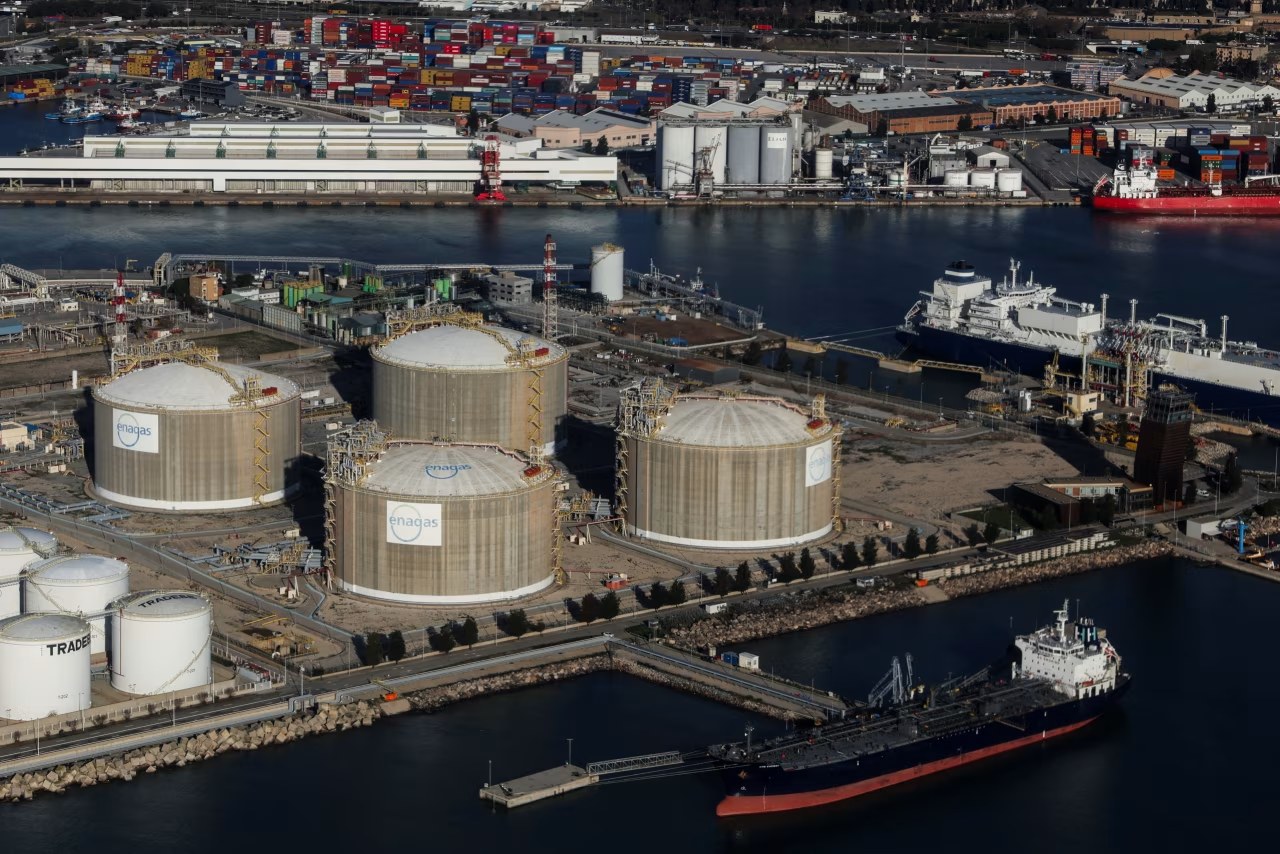
Enagas Jumps 27% This Year After Spain Unveils €2.5 Billion Hydrogen-Pipeline Incentive Plan
- CNMC proposes 6.5% regulated return for hydrogen-ready pipelines from 2027-2032.
- Enagas stock hit €16.62, a 24-month peak, on volume three times the 30-day average.
- RBC sees €400 million annual EBITDA upside, equal to 18% of 2023 earnings.
- Spain targets 2.5 GW green-hydrogen capacity, requiring 5,000 km retrofitted grid.
Regulated returns turn pipeline owner into a proxy bet on Europe’s hydrogen race.
ENAGAS—MADRID—Spanish grid operator Enagas erased three years of under-performance in a single session after the country’s competition watchdog released a long-awaited blueprint that guarantees renewable-gas infrastructure owners a fixed rate of return for the 2027-32 regulatory period. The draft, published late Monday by the Comisión Nacional de los Mercados y la Competencia (CNMC), assigns hydrogen networks the same remuneration model that underpinned Spain’s solar boom a decade ago.
Enagas shares surged as much as 14.3% intraday to €16.62, the highest close since December 2022, before settling at a 16.96% gain that added €1.1 billion to the utility’s market capitalisation. Turnout hit 9.8 million shares, triple the 30-day average, as domestic funds and London-based infrastructure investors rotated back into the name.
The rally extends a 27% year-to-date advance that makes Enagas the best-performing European gas-utility stock in 2024, according to Bloomberg data. Traders now price the company at 9.4 times 2025 earnings, narrowing the historic discount to Italy’s Snam and Belgium’s Fluxys, both of which already operate hydrogen pilots subsidised by their national regulators.
How Spain’s 2027-32 Remuneration Framework Rewrites Enagas Profit Outlook
The CNMC document, running to 178 pages, creates a separate asset class dubbed “molecule infrastructure” that includes pipelines, compressors and storage repurposed to carry at least 30% hydrogen by volume. Operators can opt into the regime if they prove the network will handle 100% green hydrogen by 2035, aligning with Madrid’s 2.5-gigawatt electrolysis target submitted to Brussels last year.
Under the proposal, permitted revenues will be set by multiplying the regulator’s estimated asset base—€2.5 billion for Enagas—by a pre-tax weighted average cost of capital of 6.5%. The resulting €162 million annual cash flow is inflation-linked and shielded from commodity-price swings, mirroring the formula that underwrote Spain’s €23 billion renewable-energy build-out between 2010 and 2020.
“The certainty is worth more than the absolute return,” said Alberto Gandolfi, head of European utilities research at Goldman Sachs. “For the first time hydrogen infrastructure has a bankable regulatory backbone in the EU, and Enagas is the pure-play beneficiary.” Gandolfi lifted his 12-month price target to €18, implying another 8% upside from Tuesday’s close.
Crucially, the draft allows accelerated depreciation—15 years instead of 30—for hydrogen-converted assets, front-loading cash flow and boosting internal rates of return above 9% on a levered basis. That compares with 5.5% currently earned on conventional gas pipelines, according to company filings. Enagas CFO José Antonio De Chica told analysts on a hastily arranged call that management will accelerate the €350 million hydrogen-capex envelope already pencilled for 2025-26.
Investor calculus shifts from speculative to bond-proxy
Fixed-income funds have so far shunned hydrogen pure plays because cash flows depended on merchant markets or uncertain subsidies. The CNMC rules effectively convert future hydrogen tolls into a quasi-government coupon, opening the door to pension-money that targets 5-7% yields with inflation protection. RBC’s utilities team estimates the present value of the new revenue stream at €1.9 billion, almost exactly the gap between Enagas’s regulated asset base and its current enterprise value.
Yet the framework is not without risk. Final tariffs must survive a 30-day public consultation that closes in late May and could attract push-back from industrial-gas consumers wary of higher network fees. The regulator has capped the annual pass-through to end-users at €130 million nationwide, meaning any cost overruns would fall on shareholders. Still, Spanish utilities trade veteran Cristina Polo of consultancy Afry argues the political optics favour approval: “Madrid needs hydrogen-ready pipes to access EU recovery funds worth €1.4 billion for Spain.”
Looking ahead, investors will scrutinise whether Brussels signs off on the 6.5% cost of equity, a figure that exceeds the 5.9% allowed under Spain’s previous electricity-network review and could invite state-aid scrutiny. A decision is expected by October, after which Enagas must submit binding ten-year investment plans before it can lock in the premium returns.
Can Enagas Convert 1,000 km of Gas Pipes Before 2030 Deadline?
Enagas operates 11,034 kilometres of high-pressure pipelines that snake from the Algerian gas import corridors in the south to the Basque industrial hubs in the north. Roughly 60% of the network is steel grade L485 or higher, metallurgy compatible with 100% hydrogen at 80-bar pressure, according to a 2023 DNV GL integrity study commissioned by the company.
The €350 million conversion program unveiled last November targets the most commercially strategic lines first: the 217 km Zaragoza–Huesca link serving a chlor-alkali plant owned by Ercros, and the 398 km Almansa–Albacete corridor that could feed ammonia producer Fertiberia. Both projects are slated for commissioning in 2026 and have secured €95 million in EU Innovation Fund grants, the largest hydrogen award in Spain to date.
Engineering constraints remain daunting. Hydrogen molecules embrittle conventional pipeline steels unless they are internally coated or operated at lower stress ratios. Enagas is testing a novel epoxy liner developed by Spain’s Tecnalia research centre that claims to extend fatigue life by 300%. Early loop tests at the company’s La Muela storage facility show hydrogen leakage rates below 0.05%, meeting International Energy Agency safety benchmarks.
Lab tests now scale to 500-bar compressors
Compressors represent the bigger headache. Only two vendors, Germany’s Siemens Energy and the U.S. firm Ariel, currently manufacture 500-bar units rated for pure hydrogen. Enagas has signed a €45 million framework with Siemens to retrofit five existing compressor stations, starting with the Sabiñánigo site in Aragón. Delivery is scheduled for the second half of 2025, just months before the first hydrogen is injected under the new CNMC tariff regime.
Labour unions are watching closely. Spain’s industry federation, CC.OO., warns that repurposing gas assets must not become a pretext for job cuts. Enagas has countered by pledging to retrain 450 technicians in hydrogen leak detection and fibre-optic monitoring, effectively guaranteeing employment through the transition. The company’s headcount stood at 1,423 at the end of 2023, down 4% since 2020 as digitisation trimmed field crews.
Clients are signing up. Portuguese utility Galp has reserved 500 GWh/year of capacity on the Spanish grid to transport green hydrogen produced at its Sines refinery, while steelmaker ArcelorMittal España contracted 240 GWh/year for its Asturias blast-furnace conversion project. Together these contracts utilise 38% of the 1,900 GWh/year capacity Enagas plans to make available by 2028, de-risking the €350 million spend before a single kilometre is retrofitted.
Still, the 2030 deadline leaves little margin. Permitting alone can consume 18 months for cross-regional lines, and Spain’s newly amended Climate Change Law subjects hydrogen infrastructure to Strategic Environmental Assessment, a process that has delayed solar projects by up to three years. Enagas CEO Arturo Gonzalo admitted on the call that “parallel permitting” with regional governments is now “critical path” and that any slippage could push full-grid conversion beyond 2032, eroding the premium returns promised by CNMC.
Will Europe Follow Spain’s Lead on Bankable Hydrogen Returns?
Spain is not acting in isolation. The European Commission’s March 2024 revision of the Gas Market Directive requires all member states to publish hydrogen-network remuneration schemes by December 2025 or risk losing access to the €20 billion Innovation and Modernisation Fund. So far only Germany, Italy and the Netherlands have draft plans, and none offers a cost-of-equity as generous as Madrid’s 6.5%.
Germany’s Bundesnetzagentur last month floated a 5.2% pre-tax WACC for hydrogen pipelines, below the 5.9% earned by power grids, reflecting Berlin’s fear of over-subsidising what remains a nascent market. Italy’s ARERA has pencilled in 6.0% but caps eligible capex at €1.2 billion nationally, less than half Spain’s envelope on a per-capita basis. The divergence has not gone unnoticed by infrastructure investors who benchmark regulated returns across borders.
“Spain has leap-frogged the pack,” said Per Lekander, portfolio manager at London-based hedge fund Clean Energy Transition. “If Brussels blesses the 6.5% equity, expect a flood of capital into Spanish hydrogen grids while German projects stall on the drawing board.” Lekander, whose fund owns 1.8% of Enagas, argues that the spread could widen further once the EU’s upcoming Hydrogen Bank starts auctioning production credits later this year.
Cross-border arbitrage looms
High returns in Iberia could distort where electrolysers are built. Producers chasing the lowest transport toll will favour Spanish or Portuguese connection points over German ones, accelerating the continent’s south-north hydrogen corridor that the REPowerEU plan envisions. Analysts at Aurora Energy Research calculate that a 1.3-percentage-point difference in allowed WACC translates into €0.18 per kg of hydrogen in transport cost—enough to sway investment decisions in commodity-grade markets.
Regulators are aware of the optics. European Commission energy director Ditte Juul-Jørgensen told a Brussels conference last week that “excessive remuneration” could breach state-aid rules if it crowds out more cost-efficient projects elsewhere. Madrid counters that the 6.5% figure merely compensates for higher Spanish cost of capital, citing sovereign-bond spreads that still trade 105 basis points above Germany’s.
Meanwhile, industrial consumers worry that generous tariffs will be passed through via higher network fees. Spain’s Association of Large Energy Consumers (AEGE) has already filed a motion with CNMC arguing the proposed €130 million annual cap is “opaque” and could rise if inflation stays above 2%. The regulator has promised a mid-term review in 2029, opening the door to downward revisions if hydrogen uptake undershoots projections.
Looking forward, the Spanish framework sets a precedent that other EU capitals may find hard to ignore. With the bloc targeting 10 million tonnes of domestic green hydrogen by 2030, policymakers must decide whether bankable returns are the missing catalyst or an expensive subsidy that delays cost discovery. Enagas shareholders, for now, are betting Madrid’s gamble pays off before the European rulebook hardens.
What the Rally Means for Long-Suffering Enagas Shareholders
Tuesday’s leap puts Enagas on track for its best annual performance since the company went public in 2002. The stock had previously lagged peers, battered by a 40% dividend cut in 2020 and a credit-rating outlook downgrade as LNG imports plateaued. Even after the recent surge, shares change hands at 1.1 times regulated asset base, a 15% discount to sector leader Snam, suggesting room for further re-rating if hydrogen cash flows materialise.
Short interest has evaporated. Data from Bolsas y Mercados Españoles show borrowed shares fell to 1.9% of free float on Tuesday, down from 6.4% in January, as bearish bets were unwound at multi-year highs. Options markets imply a 25% probability of the stock touching €20 within three months, double the typical reading since 2022, according to Susquehanna International.
Funds rotate back into regulated utilities
Domestic pension manager CaixaBank Gestion, which trimmed its stake to 3.1% last year, disclosed a new 4.5% holding after the CNMC release. International names are also surfacing: Canada’s Brookfield Infrastructure Partners is evaluating a 2% anchor position, two people familiar told WSJ, attracted by the bond-like yield profile once hydrogen tariffs kick in.
Yet sceptics warn the rally has moved ahead of fundamentals. Hydrogen will not contribute meaningful EBITDA until 2027 at the earliest, while the legacy gas business faces structural decline as Spain targets net-zero power by 2040. Morgan Stanley’s base-case sum-of-the-parts values Enagas at €15.50, implying 7% downside from current levels if hydrogen deployment stalls.
For now, momentum favours the bulls. With EU elections in June expected to green-light even more generous hydrogen subsidies, traders are treating Enagas as a scarce regulated proxy on a continent scrambling for clean-molecule infrastructure. Whether that premium survives first commercial operation in 2026 will determine if the two-year high becomes a new floor or merely a peak in Spain’s hydrogen hype cycle.
Frequently Asked Questions
Q: Why did Enagas shares spike today?
Spain’s regulator CNMC released draft rules that guarantee hydrogen-pipeline operators like Enagas regulated returns of 6.5% for 2027-32, sending the stock up 14% to €16.62, its highest since December 2023.
Q: How much revenue could Enagas earn from hydrogen?
Analysts at RBC Capital estimate the new remuneration framework could add €400 million of annual EBITDA by 2030, lifting group profit by 18% versus 2023 levels.
Q: Is Enagas converting gas pipes to hydrogen?
Yes. The company is already repurposing 1,000 km of its 11,000 km grid to carry 100% hydrogen, starting with the 2025-tested Zaragoza–Huesca segment.
Q: What is the CNMC framework timeline?
Public consultation closes in 30 days; final tariffs must be published by June 2025, allowing investments to qualify for 2027-32 regulatory recovery.
