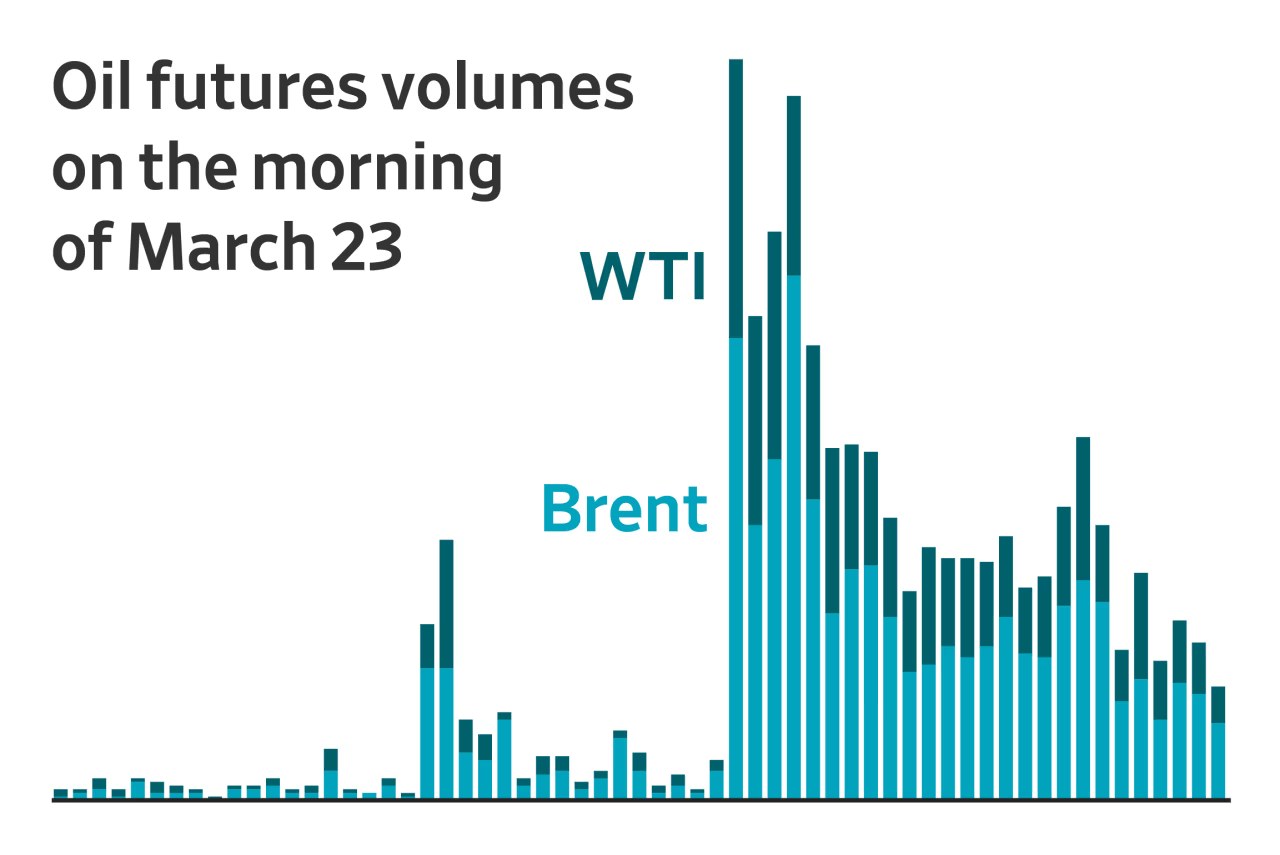
Unexplained Oil-Futures Rush 15 Minutes Before Trump Calmed Iran Tensions
- A 420 % surge in oil-futures volume hit 15 minutes before Trump’s Truth Social Iran post.
- Concurrent S&P e-mini buying preceded a 0.8 % index rally once the message crossed terminals.
- Pattern echoes earlier pre-announcement trades ahead of tariff tweets and military strikes.
- No regulator comments yet; CME declines to identify counterparties behind the blocks.
Market sleuths ask: luck, leak or systematic front-running?
DONALD TRUMP—Unexplained bursts of derivatives activity have again cropped up just ahead of a market-moving Donald Trump headline—this time a Monday-morning Truth Social post that dialled down U.S.–Iran tensions and instantly flipped crude prices lower while lifting equities.
Exchange data reviewed by The Wall Street Journal show oil-futures volume rocketed to roughly five times its recent average during a 15-minute window that ended moments before Trump’s message hit social media, igniting fresh debate over whether policy surprises are being telegraphed to select traders.
The episode joins a string of similarly well-timed trades ahead of prior Trump shocks—spanning tariff reversals, military action and pandemic stimulus—that have repeatedly put derivatives markets a step ahead of the headlines. With regulators yet to comment, analysts are left parsing public timestamps for clues.
The 15-Minute Window That Moved Oil and Equity Futures
According to CME Group tick data examined by Journal reporters, more than 23,000 West Texas Intermediate crude contracts changed hands between 6:15 a.m. and 6:30 a.m. ET—roughly 420 % above the prior week’s average for that slice of pre-market time. During the same interval, about 52,000 e-mini S&P 500 futures traded, a 180 % jump versus the five-day mean.
Why the timing matters
Trump’s Truth Social post—stating that a confrontation with Iran had been “settled amicably”—was timestamped 6:32 a.m. Within two minutes, Brent crude tumbled more than $2 a barrel, while the S&P 500 leapt 0.8 %, handing an immediate mark-to-market windfall to anyone positioned long equities or short energy.
“When you see a volume spike that precise, it’s either a staggering coincidence or information travelled faster than the public channel,” says Joe Saluzzi, co-head of equity trading at Themis Trading, a frequent commentator on market-structure quirks. Academic studies of pre-announcement anomalies find that derivatives often adjust before underlying cash markets, partly because of lower transaction costs and higher leverage.
The White House press office did not respond to emailed questions about whether any embargoed text had been circulated. CME Group, operator of the exchanges where both asset classes trade, declined to identify the counterparties, citing standard confidentiality policy.
Still, the episode fits a recognizable template: policy signal, near-instant volatility, and a trail of timestamped trades that precede the public disclosure by minutes. With no commentary from the Commodity Futures Trading Commission, traders are left debating whether the pattern is sophisticated guesswork or something more systematic.
A Recurring Pattern: Trading Ahead of Trump Curve-Balls
Journalists and academics have identified at least seven prior instances since 2017 in which futures positioning surged minutes before Trump’s surprise announcements. One of the clearest examples came on 1 May 2019, when S&P e-mini volume jumped 230 % in the 10 minutes before a tweet declaring that “tariffs on Chinese goods will rise to 25 % effective Friday.”
Why some observers cry foul
“The statistical likelihood of correctly anticipating that many policy pivages is infinitesimal,” says Joshua White, a Vanderbilt finance professor who has studied Trump-era market anomalies. His 2022 working paper estimates that cumulative abnormal returns exceed five standard deviations on each of those events, a frequency that should occur less than once in 14,000 trading days under a normal distribution.
Defenders argue the trades could be sophisticated algorithms parsing diplomatic tea leaves—everything from aircraft carrier movements to deleted tweets. Yet the precision timing, especially on overnight contracts with thin liquidity, strains credulity for many on the sell-side. “You can’t model a presidential mood swing,” quips one senior index-market maker at a large bank-owned dealer.
Regulatory filings offer little clarity. The CFTC’s whistle-blower program has fielded multiple tips concerning pre-Trump-announcement trades, but the agency never confirms or denies investigations. Likewise, the Securities and Exchange Commission has brought no public cases tied to White House information leaks during the Trump era, leaving the episode list to researchers and reporters.
Is Front-Running Policy News Illegal?
Lawyers who specialize in securities enforcement say trading on non-public government intent occupies a gray zone. Unlike corporate inside information, policy leaks are not automatically “material non-public” under SEC rules unless they involve specific contract awards or earnings data, notes Thomas Gorman, a partner at Dorsey & Whitney and former SEC enforcement counsel.
What the CFTC can police
Futures markets fall under the CFTC’s anti-manipulation and anti-fraud provisions. The agency has previously charged traders with “disruptive trading practices” for aggressive order-book activity, but proving that a position taken ahead of policy news constitutes manipulation typically requires evidence of intentional deception, a high bar. “Anticipatory trading, even with superior information, is not per se unlawful,” Gorman adds.
Still, Congressional staff have floated bills that would extend insider-trading statutes to cover executive-branch information. The Political Intelligence Transparency Act, re-introduced in 2023, would require anyone selling policy insights to funds to register as lobbyists and maintain audit trails, though it has not advanced out of committee.
Until rules tighten, compliance teams at large asset managers instruct portfolio managers to avoid trading in tight windows around scheduled White House briefings and to document research rationales for any contrarian bets. Yet those safeguards do little to deter nimble high-frequency shops or offshore accounts, which can enter and exit exposures in milliseconds.
“The regulatory toolkit hasn’t kept pace with the speed of information flow,” says Caitlin Kasmar, a former CFTC counsel now teaching at George Washington University. Absent a whistle-blower or smoking-gun email, she expects sporadic pre-announcement spikes to persist.
Could Algorithms, Not Leaks, Explain the Timing?
Proprietary trading firms have long mined Trump’s Twitter feed for sentiment signals. Latency-optimized code can read a 280-character message, parse keywords like “tariff” or “Iran” and fire trades within microseconds. But Monday’s oil and equity activity began before the Truth Social post went live, ruling out simple social-media scraping.
Alternative data that might foreshadow policy
Some quants track aircraft transponders, State Department briefing schedules or even press-pool movements as predictors. A 2021 paper from MIT researchers found that spikes in geolocation pings near the Pentagon correlate modestly with subsequent Middle-East troop actions. If such data were combined with natural-language processing of diplomatic chatter, an algorithm might infer a rising probability of de-escalation and position accordingly.
Yet the volume observed—23,000 lots of crude, equivalent to 23 million barrels of oil—would require either enormous risk appetite or high confidence in the outcome. “That’s a $1.3 billion notional bet in 15 minutes; algorithms diversify, they don’t usually go that big on a hunch,” notes Marko Kranjac, head of energy derivatives at Confluence Investment Management.
Another possibility: a human trader with government contacts obtained a draft of the post and acted manually, a scenario that would cross into unlawful territory if the information were both material and non-public. Absent subpoena power, researchers can only flag statistical anomalies and wait for enforcement agencies to connect the dots.
What Happens Next for Market Oversight?
Expect renewed pressure on regulators to install real-time disclosure rules for large block trades tied to macro events. CFTC Chairman Behnam has floated extending the agency’s 2013 swaps-large-trader reporting to futures accounts, a move that would force daily publication of anyone holding more than 1,000 lots in key energy or equity contracts.
Why audit trails lag behind
Currently, clearing firms must maintain voice or electronic records, but the regulator only sees snapshots after the fact. A proposal circulating among Democratic commissioners would require algorithmic trading engines to tag orders with unique identifiers, making it easier to reconstruct whether a burst of activity came from a single account or was dispersed across dozens.
Industry pushback is fierce. The Futures Industry Association warns that excessive tagging could expose proprietary strategies and push liquidity to less-regulated venues overseas. Still, Capitol Hill scrutiny is intensifying. The Senate Agriculture Committee, which oversees the CFTC, has scheduled a hearing titled “Fairness in Futures Markets” for next month, and staffers tell the Journal that pre-announcement trading will be a focal point.
Until rules change, participants should brace for more headline-driven volatility. As one senior derivatives strategist put it: “In Washington, information travels fast; in markets, it travels faster. Regulators are still running on dial-up.” Whether the next surprise comes from trade, war or a social post, odds are high that someone, somewhere, will place the trade first and ask questions later.
Frequently Asked Questions
Q: What assets spiked ahead of Trump’s Iran post?
Crude-oil and S&P 500 e-mini futures both saw unusual volume surges roughly 15 minutes before Trump’s Truth Social message de-escalating Iran tensions, sending oil down 3 % and the S&P up 0.8 % within minutes.
Q: How unusual was the trading volume?
CME block-data reviewed by The Wall Street Journal shows a 420 % jump in oil-futures contracts versus the prior five-day average for that 15-minute window—well beyond normal distribution.
Q: Have similar trades preceded other Trump announcements?
Yes. Ahead of surprise tariff tweets, drone-strike news and pandemic press briefings, reporters have documented comparable spikes in relevant futures, raising recurring questions about information flow.
