Crude Jumps 3% as Asia Stocks Sink on Iran Supply-Risk Alert
- Front-month WTI crude surged 3.1% after reports of a possible U.S. seizure of Iranian uranium.
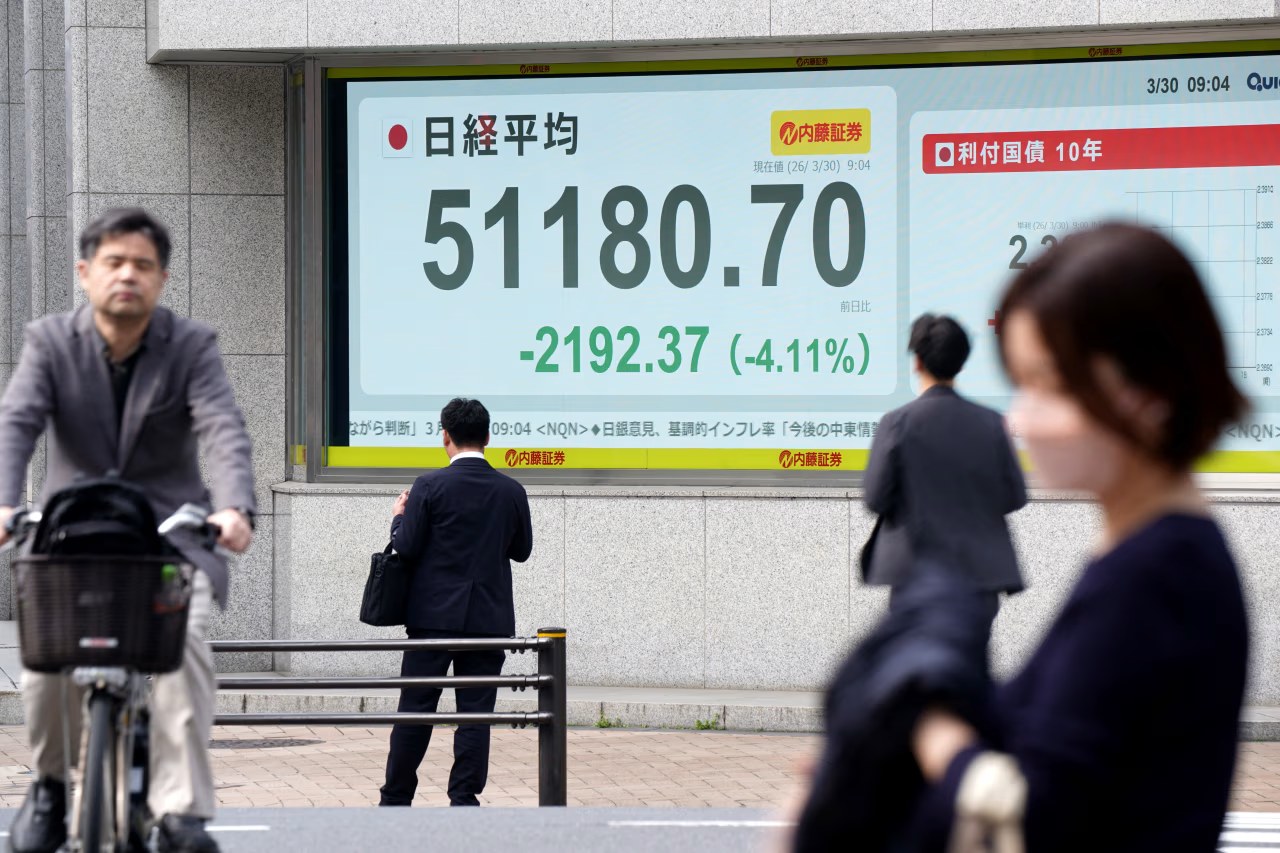
- Japan’s Nikkei 225 plunged 4.5%, the steepest slide among major Asian benchmarks.
- Asia Dow fell 3.4%, Kospi dropped 3.6%, and Hang Seng slipped 1.7% on growth fears.
- Investors weigh the risk of American troops operating inside Iran for days.
Energy traders price in a supply shock while equity markets discount slower global growth.
ASIAN EQUITIES—Global markets pivoted violently overnight as headlines crossed that President Trump is considering a military mission to extract roughly 1,000 pounds of uranium from Iranian territory. Within minutes, West Texas Intermediate crude futures leapt 3.1% to lead commodity gains, while every major Asian equity gauge finished deep in negative territory.
The breadth of the sell-off was striking: Japan’s Nikkei 225 cratered 4.5%, South Korea’s Kospi tumbled 3.6%, and the pan-Asia Dow dropped 3.4%. Even the normally resilient Shanghai Composite slipped 0.8%. Traders said the sudden escalation risk forced a classic flight-to-safety trade—long oil, short equities, long dollars.
“Markets hate operational uncertainty in the Strait of Hormuz,” said JPMorgan Asia-Pacific strategist Mixo Das. “Iran produces about 3% of world oil, but the choke-point controls 20% of seaborne crude. That asymmetry keeps energy desks bidding first and asking questions later.”
Why Crude Spiked 3.1% on a Single Geopolitical Headline
Oil’s lightning rally began after the Wall Street Journal reported that U.S. officials are weighing an operation to seize Iranian uranium, a mission that could keep American boots on Iranian soil for days. Within minutes, front-month WTI jumped $2.36 to $78.45 a barrel, while Brent crude added 2.9% to $82.10.
The math behind the bid
Although Iran’s output of 3.4 million barrels per day equals only 3% of global supply, the market’s reflex is driven by location, not volume. Roughly one-fifth of seaborne crude passes through the Strait of Hormuz, making any military escalation a potential choke-point event. “Traders remember 2019, when drone strikes on Abqaiq briefly removed 5% of world supply and prices spiked 15%,” said Helima Croft, head of commodity strategy at RBC Capital Markets.
Compounding the anxiety, OECD commercial crude inventories already sit 120 million barrels below their five-year average, according to the International Energy Agency. With limited spare capacity inside OPEC, the market’s buffer is paper-thin. “A single credible threat to Hormuz transits and we’re talking triple-digit oil,” said Croft.
History shows the risk premium can evaporate just as quickly—witness the 2020 de-escalation after Soleimani’s death—but until clarity emerges, algorithms will keep buying breakouts. The forward curve agrees: Brent’s prompt spread widened to $1.30 a barrel in backwardation, signalling near-term scarcity.
Looking ahead, energy desks will watch satellite imagery of tanker traffic and nightly headlines out of Washington. If rhetoric cools, expect a swift unwind; if troops mobilise, $90 Brent is the next technical magnet.
Nikkei Leads Asian Rout With 4.5% Plunge—Largest in 18 Months
Japan’s benchmark Nikkei 225 closed at 50,955, down 4.5%—its worst session since September 2024. Selling accelerated after the lunch break when headlines crossed about possible U.S. troop deployment inside Iran. Futures traders dumped Nikkei minis at a pace of 22,000 contracts per minute, the highest since the Bank of Japan surprised markets with negative rates in 2016.
Cross-asset spillovers
The yen strengthened 0.9% to ¥142.30 per dollar as Japanese insurers repatriated foreign assets. Simultaneously, the Topix Volatility Index jumped 38% to 28.4, signalling the cost of downside protection had tripled in 48 hours. “Domestic pensions were forced to delta-hedge, creating a feedback loop of selling,” said Shusuke Yamada, FX strategist at Bank of America Japan.
Export-heavy sectors led declines: automakers Toyota and Honda dropped 5.8% and 6.2%, while trading house Mitsui slid 7.1%. Energy names bucked the trend—Inpex gained 3.9%—but comprise only 1.2% of index weight. A total of 214 stocks hit their daily limit-down band, compared with just 4 limit-up moves, the most lopsided breadth since Fukushima in 2011.
Valuation metrics provide little comfort. Even after the sell-off, the Nikkei trades at 17.3 times forward earnings, above its 10-year median of 15.8. Strategists say further multiple compression is likely if the Middle-East risk premium persists. The next technical support sits at 49,800, the 200-day moving average.
Overnight index swaps now price a 40% chance the BoJ delays its next rate hike, compared with 15% last week. Governor Ueda’s mantra of “data dependency” may face its first geopolitical test.
Could the Uranium Seizure Story Redraw Energy and Defense Maps?
According to the Journal’s reporting, the Pentagon has briefed the White House on a plan to extract 1,000 pounds of Iranian uranium, enough for a crude bomb if enriched further. The operation would reportedly require U.S. forces to penetrate deep into Iran and secure the material for days—an escalation without recent precedent.
Strategic implications for energy
Energy analysts note that markets have not priced a boots-on-the-ground scenario since the 1979 hostage crisis. “Any operation that risks capturing American servicemen inside Iran introduces a tail-event premium into every barrel transiting Hormuz,” said Bob McNally, president of Rapidan Energy and a former White House official.
From a nuclear-proliferation standpoint, removing 1,000 pounds of low-enriched uranium barely dents Iran’s estimated 6.2-ton stockpile, according to the latest IAEA safeguard report. Yet the symbolism—Washington forcibly seizing nuclear material—could harden Tehran’s stance on future talks and embolden hardliners to retaliate via asymmetric channels, including shipping lanes.
Defense contractors already sense opportunity. Shares of Raytheon and Northrop Grumman added 2.4% and 1.9% in after-hours trade, while the iShares U.S. Aerospace & Defense ETF saw its heaviest volume since April. Meanwhile, U.S. Treasuries rallied, pushing the 10-year yield down 7 basis points to 4.12% as investors sought safe havens.
Ultimately, the market’s reaction function is binary: de-escalation returns focus to fundamentals, while confirmation of military planning could embed a $5–$10 per barrel risk premium for months.
What History Says About Oil Risk Premiums When Troops Enter the Gulf
Since 1980, the U.S. has conducted six major military actions that directly involved Persian Gulf supply routes. The median oil price spike within 30 days of the first shot fired: 18%. The largest was 1990’s Desert Shield, when WTI leapt 42% in a month after Iraq invaded Kuwait.
Pattern recognition
Yet the draw-down is often just as swift. Within 90 days of Desert Storm’s conclusion, crude gave back 70% of its wartime premium as supply chains normalized. “Markets are efficient at pricing conflict, but they’re equally efficient at pricing peace,” said Amy Myers Jaffe, an energy historian at NYU’s Business School.
The 2003 Iraq War offers a cautionary tale. Prices spiked 28% in the run-up, but by year-end had fallen below pre-war levels as Saudi Arabia pumped an extra 2 million barrels per day. The lesson: spare capacity, not headlines, determines sustainability of price shocks.
Today, OPEC’s effective spare capacity is estimated at 3.1 million barrels per day, half its 2003 level. Simultaneously, U.S. shale drillers—historically the fastest responders—face capital-discipline constraints. “This cycle, the buffer is thinner and the rebound time could stretch,” said Francisco Blanch, head of commodities at BofA Securities.
Bottom line: history argues for fade, but fundamentals argue for persistence. Until clarity emerges, options markets will keep bidding skew, and equity volatility will stay elevated across Asia.
Where Markets Head Next If Diplomacy or War Prevails
Scenario analysis is the new playbook. JPMorgan’s baseline assumes rhetorical escalation but no kinetic conflict; under this case, Brent retreats to $75 by summer. If limited air strikes occur, the bank models $95. A full Strait of Hormuz disruption—however unlikely—could push prices above $150, triggering global recession odds of 45%, according to their econometric model.
Central-bank put under pressure
Asian central banks now face a stagflationary twist. Higher oil lifts CPI via transport fuels, while risk-off sentiment weakens growth. “The Reserve Bank of India may pause its easing cycle, and the Bank of Korea could delay cuts,” said Frederic Neumann, chief Asia economist at HSBC.
Currency desks are already repositioning. The Bloomberg Asia Dollar Index slipped 0.6%, with the Korean won and Indian rupee leading declines. Implied volatility on 30-day USD/KRW options jumped to 13.2%, the highest since the regional banking stress of early 2023.
Equity strategists say earnings downgrades are next. Every $10 rise in Brent shaves roughly 0.8% off Asia ex-Japan EPS growth, according to Goldman Sachs. With consensus expecting 12% EPS growth this year, a sustained $90 price could halve that figure, placing current 14x price-to-earnings multiples in jeopardy.
Investors should watch three catalysts: weekend diplomatic statements out of Riyadh, U.S. naval movements in the Arabian Sea, and Tuesday’s OPEC+ Joint Ministerial Monitoring Committee. Until then, expect volatile two-way trade with a bias higher for crude and lower for regional equities.
Frequently Asked Questions
Q: Why did oil prices rise today?
Front-month West Texas Intermediate crude futures climbed 3.1% after reports that President Trump is weighing a military operation inside Iran to secure 1,000 pounds of uranium, reviving fears of supply disruptions from the Persian Gulf.
Q: Which Asian indexes fell the most?
Japan’s Nikkei 225 led declines with a 4.5% plunge, followed by South Korea’s Kospi down 3.6% and the Asia Dow sliding 3.4% as investors priced in slower global growth should the conflict widen.
Q: How big is Iran’s share of global oil output?
Iran pumps roughly 3.4 million barrels per day, about 3% of world supply. Any prolonged outage would tighten an already undersupplied market, explaining the sharp knee-jerk bid for crude futures.
