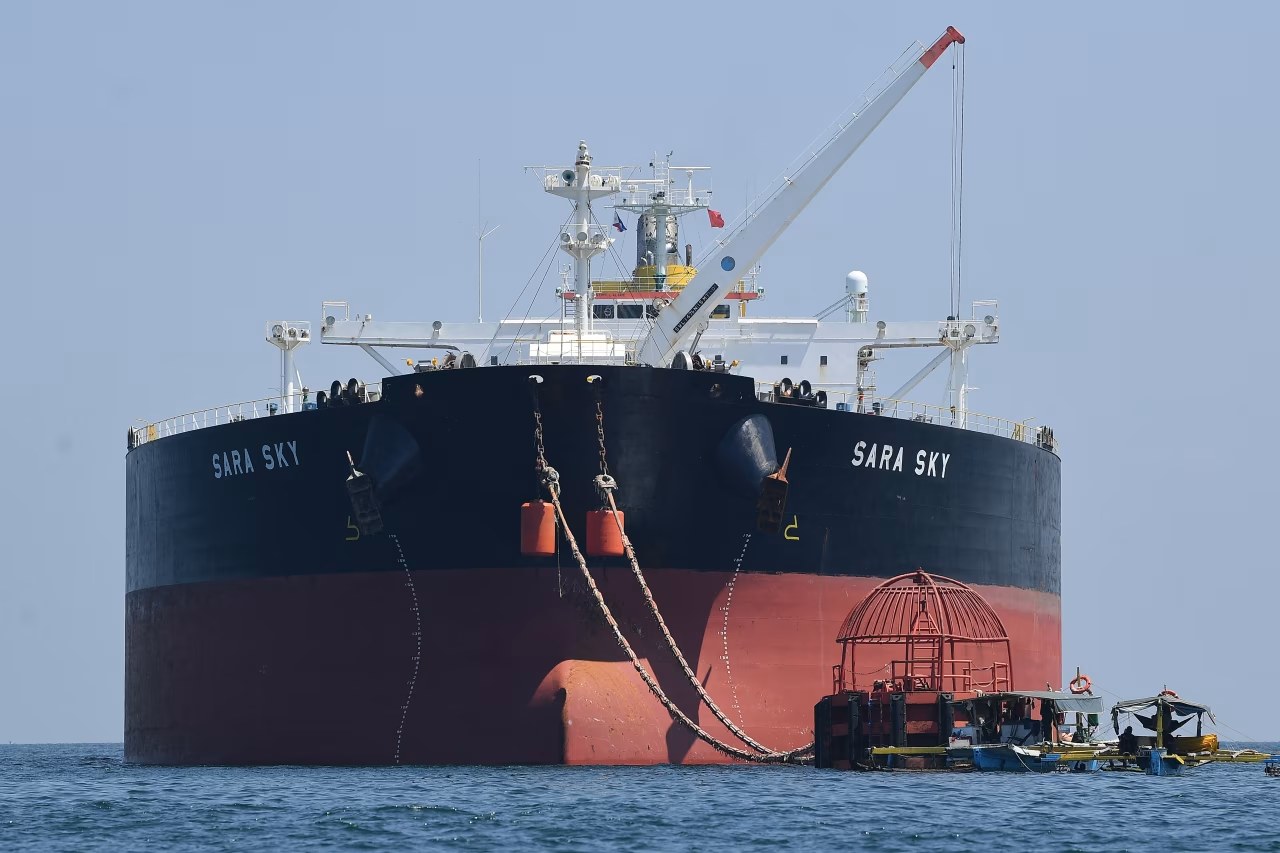
WTI Tops $102 and Brent Hits $115.53 as Mideast Violence Raises Odds of Hormuz Shutdown
- WTI crude leaps 2.8% to $102.43/bbl while Brent gains 2.6% to $115.53/bbl after Houthi rebels threaten Red Sea shipping.
- Yemen’s Houthis claim second attack on Israel within 24 hours, widening the Middle East conflict.
- Analysts warn oil prices could stay volatile if the Strait of Hormuz closes or Saudi Arabia’s 6 mbpd Red Sea detour is hit.
- Phillip Nova’s Priyanka Sachdeva says every scarce barrel is already hitting businesses, air travel, and fuel at the pump.
Energy traders now price in a rising risk premium as two key chokepoints face simultaneous threats.
BRENT CRUDE—Oil markets opened the week with a jolt as front-month Brent futures touched $115.53 a barrel—up 2.6% in early trade—after Yemen’s Houthi militants vowed to target ships in the Red Sea. The move compounds anxiety that the wider Middle East conflict could soon choke off more than one critical oil artery.
Phillip Nova senior market analyst Priyanka Sachdeva told clients the near-term trajectory of crude “depends heavily on how long the Strait of Hormuz will close,” adding that investors are already pricing in “long-term damage to critical oil infrastructure.” West Texas Intermediate simultaneously rose 2.8% to $102.43, its highest level since last year’s geopolitical flare-up.
Saudi Arabia has so far cushioned the market by rerouting up to 6 million barrels per day (mbpd) through its east-west Petroline to Red Sea ports, but that workaround is now under threat. “The pain of the U.S.-Iran conflict is being felt with every scarce barrel,” Sachdeva wrote. With two chokepoints at risk, volatility rather than stability has become the baseline scenario.
Hormuz and Red Sea: Dual Chokepoints on a Hair Trigger
The Strait of Hormuz is the world’s most important energy chokepoint. Roughly 21 mbpd of crude, condensate, and refined products—about 21% of global consumption—flow through the 21-mile-wide channel that separates Iran from Oman. Any hint of a military escalation that could close the strait sends hedge funds scrambling for bullish positions.
Why the Red Sea workaround matters
Saudi Arabia’s 746-mile Petroline can move 5.4 mbpd from the Arabian Gulf to Yanbu on the Red Sea. Riyadh boosted throughput to near 6 mbpd after the latest attacks, according to ANZ Research, effectively replacing Hormuz volumes for Asian and European buyers. Yet the detour adds 10–14 days of transit time and now faces its own threat: Houthi anti-ship missiles.
ANZ analysts caution that Houthi rebels have already demonstrated the ability to strike vessels 1,200 km from Yemen’s coast. A single successful hit on a laden Saudi very-large crude carrier (VLCC) inside the Red Sea would force insurers to impose wartime premiums, deterring many tanker owners. “The market is treating this as a low-probability, high-impact event,” says Richard Bronze, head of geopolitics at Energy Aspects. “But the skew is clearly to the upside on price if insurance exclusions kick in.”
Historical precedent underscores the danger. During the 1980s Tanker War, reflagged Kuwaiti vessels needed U.S. naval escorts to keep 3 mbpd flowing. Today’s volumes are twice as large, while U.S. carrier groups are simultaneously deployed to the Eastern Mediterranean, stretching naval coverage thin.
The forward curve reflects that unease. Brent’s front-month premium to the sixth-month contract—a metric known as backwardation—widened to $4.70/bbl, its steepest since the Ukraine invasion, signaling traders will pay a premium for prompt barrels. Exchange data show money-managers raised net-long Brent positions by 8% last week, the fastest pace in two months.
With two maritime flashpoints now intertwined, the margin for error is razor thin. Any miscalculation—an Iranian patrol boat confronting a Panamanian-flagged tanker, or a Houthi drone evading Saudi air defenses—could sever arteries that together carry nearly one-third of seaborne crude.
How High Can Prices Go if Both Routes Are Hit?
Energy policy academics at Oxford’s Institute for Energy Studies modeled three scenarios: (1) a 30-day partial Hormuz shutdown, (2) simultaneous Red Sea sabotage, and (3) a full six-month closure of both passages. The median outcomes point to Brent spiking to $130, $160, and $200 per barrel respectively, with global GDP growth shaved by 0.4, 0.9, and 1.8 percentage points.
The feedback loop to fuel demand
Gasoline prices in the European Union already average €1.91 per liter, up 14% since January. Deutsche Bank transport analysts estimate every $10 rise in Brent adds €0.07 to the pump price within three weeks. If Brent reaches $160, European gasoline would breach €2.20/l, a level that triggered demand destruction in 2008. U.S. retail gasoline would climb above $5.50 per gallon, a politically sensitive threshold ahead of presidential elections.
Airlines are even more exposed. jet-fuel swaps in Rotterdam leapt 18% overnight to $120/bbl, and carriers such as Lufthansa and Delta hedge only 40–50% of near-term consumption. Bernstein Research calculates that a sustained $120 jet price would erase 2025 earnings for half of Europe’s legacy carriers, raising the prospect of capacity cuts and higher ticket prices that spill into inflation.
Central banks would face an unpalatable trade-off: raise rates to defend currencies and anchor expectations, or tolerate inflation to protect growth. The Bank of England’s own stress test shows a $150 oil shock adding 2.3 percentage points to U.K. CPI within a year, far above the 1% buffer the Monetary Policy Committee targets.
Priyanka Sachdeva summarizes the dilemma: “The longer the uncertainty, the more permanent the economic scarring.” With each passing week of elevated tension, the probability of a demand-killing price spike rises exponentially.
Who Wins and Who Loses from a 2025 Oil Shock?
History shows that oil-price windfalls rarely benefit the economies most people assume. Norway, for instance, channels hydrocarbon rents into its $1.6 trillion sovereign-wealth fund, but a $40 price spike only raises 2025 GDP by 0.8%, Norges Bank estimates. The real winners are low-cost producers with spare capacity—Saudi Arabia, UAE, and increasingly the United States.
U.S. shale’s break-even evolution
Rystad Energy data put the average Permian Basin break-even at $48/bbl in 2024, down from $63 in 2019. If WTI averages $110 this year, the top 20 shale drillers generate a cumulative free-cash-flow yield of 18%, enough to fund record buybacks. Occidental Petroleum told investors last week that every $1 increase in WTI adds $350 million to annual cash flow, implying a $15bn windfall at current prices.
Losers are import-heavy Asian economies. India, which imports 87% of its crude, sees the current-account deficit widen by $14 billion for every $10 increase in Brent, according to the Reserve Bank of India. Korea and Japan face similar headwinds, and both central banks have already signaled a pause in rate-cut cycles.
China is more insulated: strategic petroleum reserves stand at 869 million barrels, equal to 90 days of net imports. Beijing has begun drawing 400 kbpd from caverns in Hainan and Zhejiang, cushioning refiners. Yet Sinopec executives privately warn that if Brent sustains $130, Beijing will reinstate export quotas on refined products to keep domestic diesel below ¥8 per liter, squeezing regional margins.
Bottom line: a prolonged price spike redistributes income from energy consumers to producers, but the scale of today’s shock would amplify global inequality just as governments confront record debt burdens.
Can Strategic Reserves Calm the Market This Time?
The International Energy Agency requires members to hold 90 days of net-import cover. Collectively, OECD governments control 1.5 billion barrels in government-controlled stocks and another 2.9 billion in industry inventories. A coordinated release of 60 million barrels over 60 days—the size deployed after Libya’s 2011 outage—would offset a 1 mbpd shortfall for two months, but current disruptions could erase 10–15 mbpd.
Logistics of an emergency release
U.S. barrels from the Strategic Petroleum Reserve (SPR) must traverse the Jones Act fleet, limited to 52 tankers. Shipping 30 mbpd from Louisiana to Asia requires 38 very-large crude carriers and takes 45 days, according to Poten & Partners. During the 2022 Ukraine release, Asian refiners complained of delivery delays that kept Brent backwardation elevated.
Europe faces storage constraints. The Netherlands’ 1.4 million cubic meter capacity at Vlissingen is 92% full, and Germany’s caverns at Etzel are earmarked for natural-gas back-filling. Even if the IEA authorizes a 1 mbpd coordinated sale, physical bottlenecks could blunt the price signal.
China’s willingness to participate is key. The National Food and Strategic Reserves Administration has not published inventory data since 2021, but satellite tank analysis from Orbital Insight suggests Beijing could release 200 mb over six months. Yet Chinese officials privately link any Western-coordinated sale to a rollback of U.S. technology tariffs—a geopolitical quid pro quo that complicates swift action.
In short, emergency reserves are a band-aid, not a tourniquet. Without a diplomatic off-ramp to de-escalate Middle East tensions, the market will keep pricing in scarcity rather than relief.
What Happens Next: Three Flashpoints to Watch
Energy Aspects maintains a 55% probability that Hormuz remains open through 2025 but flags three catalysts that could flip the odds: an Israeli strike on Iranian nuclear facilities, a successful Houthi missile hit on a Saudi export terminal, and the passage of a European Union sanctions package on Iranian oil. Each scenario is assessed at 15–20% likelihood, yet any one would send Brent toward $150.
Insurance exclusions as the hidden trigger
The London marine insurance market has already imposed an Additional War Risk Premium of $185,000 per VLCC transiting the Red Sea, up from $50,000 in December. If underwriters widen the Listed Areas to include the entire Arabian Gulf, charter rates could spike by $3 per barrel, effectively adding $20 billion annually to global transport costs, according to Howe Robinson’s tanker desk.
Second-order effects matter. A sustained $130 oil price would raise global headline inflation by 1.2 percentage points, forcing emerging-market central banks from Turkey to Brazil to hike real rates and risking a fresh capital-flight cycle. The Institute of International Finance estimates that every 10% rise in the Bloomberg commodity index triggers $8 billion in EM portfolio outflows within four weeks.
Finally, diplomacy remains the wildcard. Oman has quietly offered to host U.S.-Iran back-channel talks, and U.N. envoy Tor Wennesland is drafting a Yemen cease-fire proposal. Yet both initiatives hinge on de-escalation that has yet to materialize. Until headlines shift from rockets to negotiations, oil traders will keep buying call options struck at $150 and $200, ensuring volatility itself becomes the dominant narrative.
The next 30 days could thus determine whether the world faces a manageable risk premium or a 2008-style demand shock. For now, the default setting is fear priced into every futures curve.
Frequently Asked Questions
Q: Why did oil prices jump above $115?
Brent surged 2.6% to $115.53 after Yemen’s Houthi rebels claimed a second attack on Israel and threatened Red Sea shipping, compounding fears that the Strait of Hormuz could close.
Q: How much oil could be trapped if Hormuz shuts?
Roughly 21 million barrels per day—about one-fifth of global supply—pass through the Strait of Hormuz, making even a brief disruption a severe price shock.
Q: Is Saudi Arabia bypassing Hormuz?
Yes. Riyadh is using its 5.4 mbpd east-west Petroline to move up to 6 mbpd to the Red Sea, but Houthi missile threats now endanger that detour.
📰 Related Articles
- Kansas Roaster’s $18 Coffee Signals Stubborn Price Spike Across U.S. Cafés
- Crude Jumps 5.5% in One Day as Hormuz Fears Override Trump Pause on Iran Strikes
- Iran Conflict Triggers Fertilizer Shock, Threatening Global Food Supply
- Gold Price Plunges 14% as War and Inflation Fail to Boost Safe‑Haven Appeal
