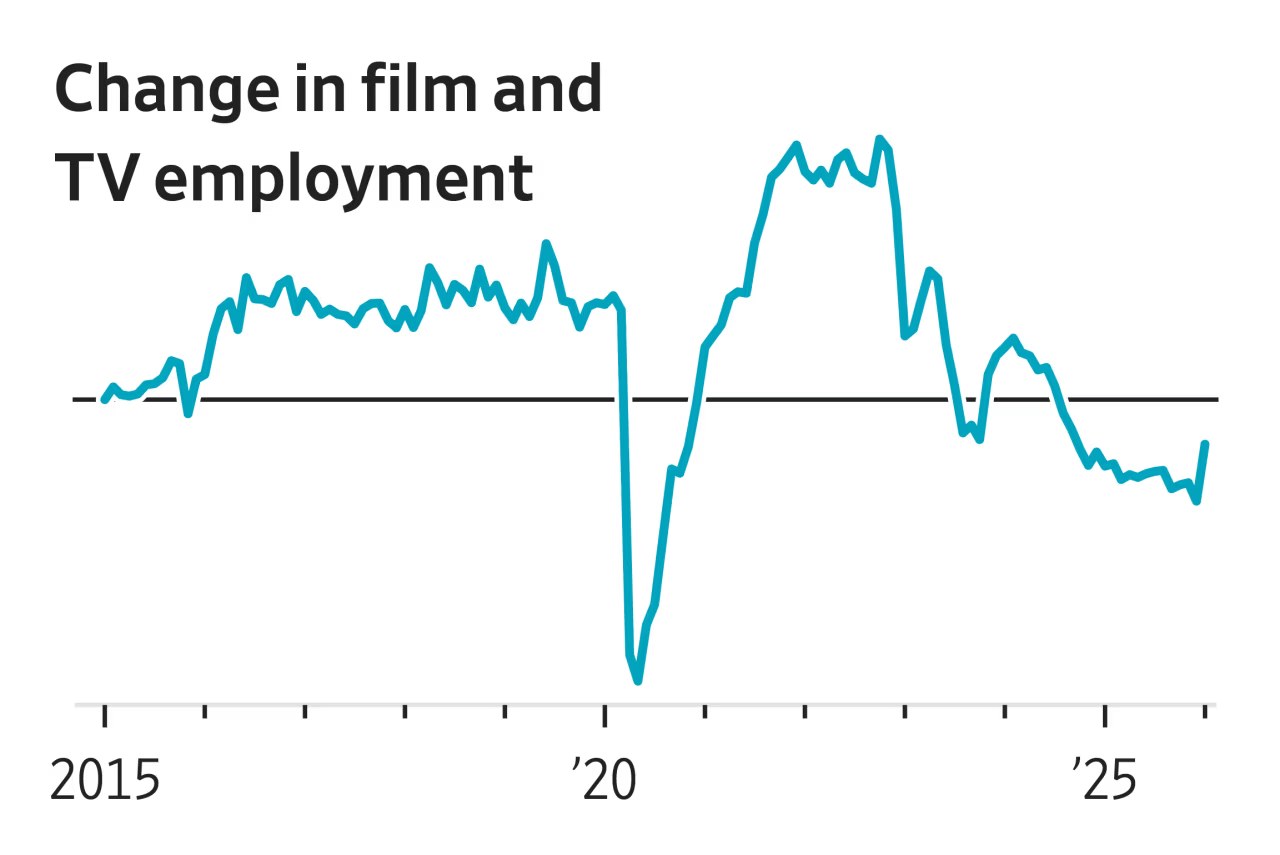
California’s Film and TV Sector Has Lost 42,000 Jobs Since 2022
- State data show a 20% drop in entertainment employment in just two years—the steepest on record.
- Rep. Sydney Kamlager-Dove told a Burbank hearing that even her acupuncturist begged for help restoring studio work.
- Noah Wyle, executive producer of “The Pitt,” testified the industry is facing a “near cratering” of production.
- Below-the-line crafts report unemployment above 30% as streaming budgets contract and theatrical releases stall.
A once-reliable jobs engine for Southern California is sputtering, and policymakers are scrambling for fixes
HOLLYWOOD JOBS CRISIS—BURBANK, Calif.—Inside a soundstage that once housed Marvel blockbusters, carpenters now sweep dust from idle sets. The production floor at Walt Disney Studios—usually buzzing with crews—has fallen quiet enough for Rep. Sydney Kamlager-Dove to overhear her acupuncturist plead, “Can you do anything to help bring back entertainment jobs?”
The exchange, relayed at a congressional field hearing blocks from Warner Bros.’ iconic water tower, distilled a crisis spreading far beyond studio lots. California has shed 42,000 film, television and sound-recording jobs since 2022, a 20% plunge that state labor officials call the fastest two-year decline since records began in 1990.
Actors and showrunners feel the pinch, but the pain is sharpest among riggers, drivers, costumers and set builders—crafts that rely on days of principal photography for paychecks. Noah Wyle, star and executive producer of the hospital drama “The Pitt,” told lawmakers the contraction amounts to “a near cratering of our once thriving industry,” leaving tens of thousands scrambling for side gigs.
From Boom to Bust: How Streaming’s Gold Rush Reversed Overnight
Netflix’s 2018 pledge to release 700 original series triggered a hiring arms race. Studios converted warehouses into stages, colleges added film programs, and real-estate developers marketed “content creator” condos. Then the math changed. Subscriber growth plateaued in North America, interest rates climbed, and investors demanded streaming profits, not just scale.
The $30 billion content splurge evaporates
MoffettNathanson research shows combined content spending by Disney, Warner Bros. Discovery, Comcast’s NBCUniversal and Paramount peaked at $30.3 billion in 2022 before contracting to an estimated $26.7 billion last year. Wall Street’s new mantra—fewer shows, higher margins—translates directly into pink slips on Sunset Boulevard.
“We used to green-light eight episodes just to test an idea,” a senior Disney+ development executive told the Journal on condition of anonymity. “Now we ask: Can this concept survive a 40% marketing cut and still top the Nielsen chart?” If the answer is no, the project dies in the pitch room, taking prep jobs with it.
California’s Employment Development Department reports motion-picture payroll employment averaged 209,000 in early 2022; by January 2024 it had fallen below 167,000. The 42,000-job gap exceeds the combined workforce of Facebook’s Menlo Park campus and Apple’s Cupertino headquarters—yet draws a fraction of tech-layoff headlines.
The contraction is amplified by runaway production. Louisiana, Georgia and New Mexico still offer tax credits, but even Atlanta’s Pinewood Studios has seen utilization slip to 65% from 95% in 2021, according to Georgia’s Department of Economic Development. When every jurisdiction slows, crew members cannot chase work across state lines.
What makes this slump different, UCLA entertainment economist Alex Bloch notes, is simultaneous retrenchment in both film and series output. “In 2008 the studios pivoted to TV to offset DVD losses,” Bloch says. “Today there is no escape hatch—every pipeline is frozen.”
Below-the-Line Workers Face 30% Unemployment—‘We’re the First Cut’
Production may look glamorous on Instagram, but the reality is piecemeal employment. International Alliance of Theatrical Stage Employees (IATSE) Business Agent Chris Duarte says the average member needs 240 call days a year to qualify for union health insurance. In 2021 that threshold was reachable; in 2024 many struggle to log 120.
Union halls turn into food-bank lines
Local 44, which represents prop masters and set decorators, reports 32% unemployment—triple the 2021 rate. Costume Designers Guild, Local 892, saw average working days per member fall 45% last year, forcing some stylists to accept commercial shoots at half the scripted-series rate just to stay current on pension hours.
“I’ve got 22 years in the business and I’m driving DoorSelect between gigs,” says key grip John Valdez, 51, who last worked on a Paramount+ series that was shelved after two episodes. Valdez estimates he has lost $78,000 in expected wages since mid-2022 and burned through savings to keep his North Hollywood mortgage afloat.
The pain is felt statewide. When a single hour-long drama wraps in Santa Clarita, roughly 270 direct jobs disappear—editors in Burbank, Foley artists in West L.A., visual-effects houses in Playa Vista. The Milken Institute calculates every $1 million in lost production spending erases another $1.3 million in ancillary services, from dry cleaners to camera-rental houses.
“Studios cut above-the-line last because stars have leverage,” notes Pepperdine entertainment finance professor Cyrus Ahanchian. “Below-the-line is the first lever pulled, and the numbers show it.”
Why Tax Credits Aren’t Enough to Restart the Pipeline
California boosted its annual film-tax-credit pool to $330 million in 2021, yet applications fell 38% last cycle. Producers say the sweetener cannot offset ballooning insurance premiums, COVID-testing costs and Wall Street’s content austerity. “We can’t monetize a credit if the show never gets ordered,” one finance lawyer quipped at the Burbank hearing.
Streamers slash new-series orders by half
Netflix ordered 60 new scripted series in 2021; the 2024 tally is on pace for 28, according to research firm PlumData. Disney+ has slashed development spending 30%, while Warner Bros. Discovery CEO David Zaslav told investors the company will “carry lower content expense forever.”
Even when projects qualify for subsidies, California’s 20% credit is dwarfed by Georgia’s 30% or New Mexico’s 35%. The Golden State’s advantage—stages within driving distance of writers’ rooms—matters less when writers are also idle. “We’re in a race to the bottom of budgets,” says state Sen. Anthony Portantino, who chairs the Senate Appropriations Committee.
Some lawmakers want to lift the annual cap to $600 million and allow credits to cover visual-effects work. Studios counter that demand, not incentives, is the missing piece. “Give us viewers willing to pay $15 a month for prestige dramas and we’ll staff up tomorrow,” a senior Amazon MGM executive testified.
Yet consumer surveys by Deloitte show 48% of U.S. households now describe streaming services as “too expensive,” up from 37% in 2022. When subscribers balk, content budgets shrink, and soundstages sit dark—no matter the geography.
Can Hollywood Rebuild—or Has the Business Model Shifted for Good?
History offers hope—and warnings. After the 2007-08 writers’ strike, employment rebounded within 18 months as digital platforms created new revenue. Today’s rebound is elusive because the same companies controlling distribution also throttle production. When Netflix slows, there is no rival streamer to pick up slack; every platform faces identical investor pressure.
AI threatens to shrink crews further
Studios are experimenting with generative AI to replace extras, translate dialogue and even storyboard scenes. While the technology remains imperfect, IATSE estimates it could eliminate 20% of entry-level jobs within five years, compounding today’s unemployment.
Still, some see seeds of renewal. Apple recently committed $1 billion annually to theatrical releases, betting prestige films will entice consumers back to cinemas. Amazon is financing a slate of 12 mid-budget movies shot entirely in California to maximize tax credits. If even one becomes a breakout hit,模仿效应 could restart the content flywheel.
“The industry has always been cyclical,” says former Disney executive and USC adjunct professor David A. G. Arnold. “But this cycle is driven by Wall Street, not writers’ strikes or recession. When capital markets pivot back to growth, production will return—though probably with smaller crews and more automation.”
For workers like John Valdez, the question is how to survive until that inflection point. His union health insurance expires in November unless he can log 300 more hours. “I’m polishing my real-estate license,” he sighs, eyeing a row of darkened soundstages. “Hollywood may come back, but I’ve got bills today.”
Frequently Asked Questions
Q: How many entertainment jobs have disappeared in California?
State employment data show 42,000 fewer film, TV and sound-recording jobs in California compared with the 2022 peak—roughly a 20% decline that dwarfs any two-year slide since the state began tracking the category in 1990.
Q: Why are studios green-lighting fewer projects?
Executives say Wall Street is no longer rewarding subscriber growth at all costs, so streamers are cutting content spend by double-digit percentages while theatrical releases face higher marketing risks, leaving producers unable to secure financing.
Q: Which crafts are being hit hardest?
Below-the-line unions report unemployment rates above 30%: set painters, carpenters, drivers and costume departments have seen their working days slashed by half since 2022, according to contracts that tie work hours to days of principal photography.
