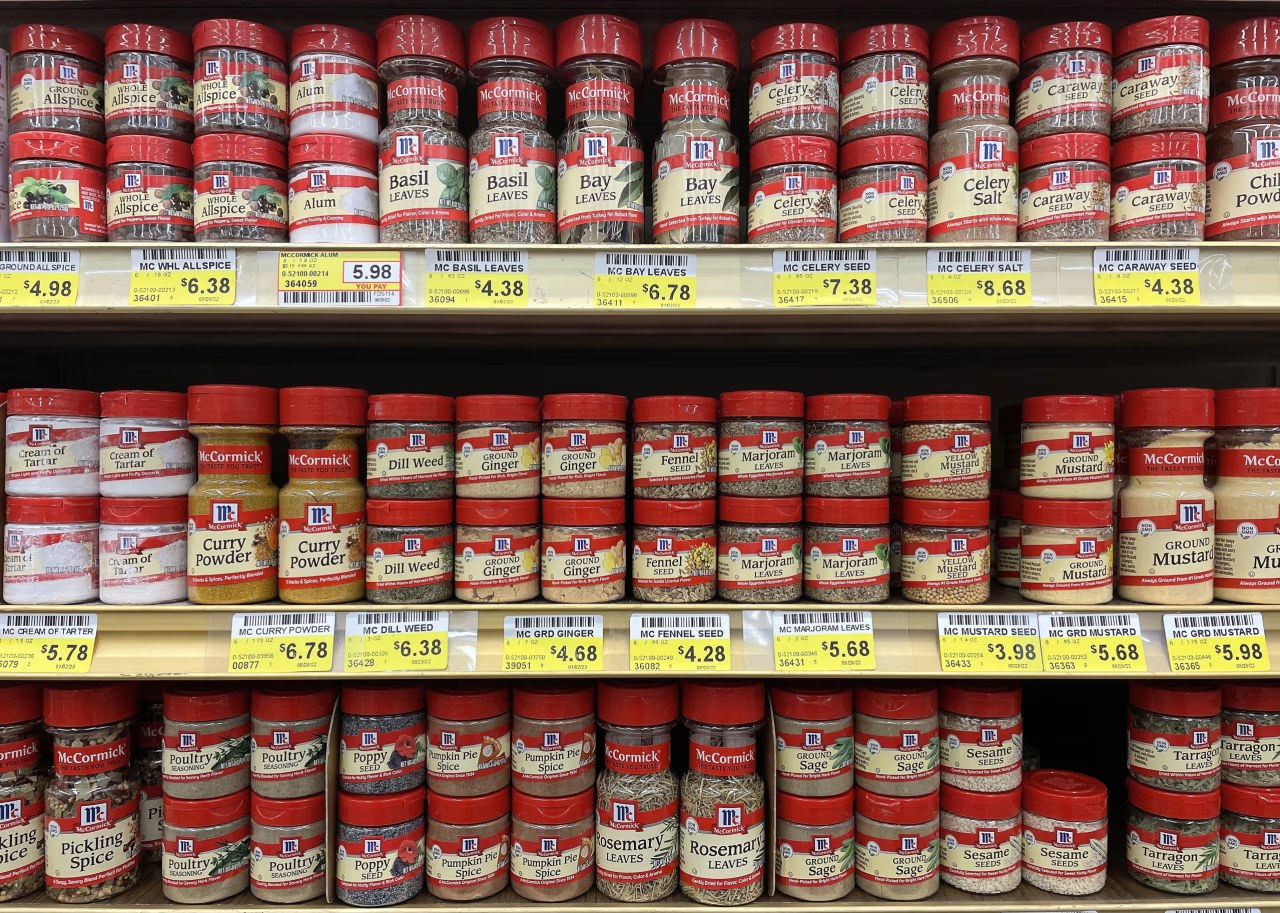
Unilever and McCormick in $60 Billion Merger Talks That Would Reshape Global Seasonings Market
- Deal structure is cash-and-stock and could be revealed when McCormick reports earnings Tuesday.
- Combined entity would be worth roughly $60 billion including debt, people familiar say.
- Unilever shares rose 1.09 % and McCormick 1.22 % as news of advanced talks leaked.
- Negotiations could still slip, sources caution, but boards on both sides have signed off in principle.
A trans-Atlantic alliance would create the world’s largest spice and condiments group
UNILEVER—Unilever is in advanced negotiations to fold its entire food division into spice-maker McCormick in a transaction that bankers value at about $60 billion including debt, according to people with direct knowledge of the discussions. The deal, which could be announced as early as Tuesday when McCormick is scheduled to release quarterly results, would instantly create a new consumer-staples behemoth spanning everything from Knorr stock cubes to Old Bay seasoning.
Under the proposed cash-and-stock structure, London-listed Unilever would spin off its €13-billion food arm—home to Hellmann’s mayonnaise, Maille mustard and a fast-growing meal-kit operation—into a new U.S.-domiciled entity that would be majority-owned by McCormick shareholders, the people said. Precise exchange ratios were still being finalised on Sunday night, but advisers expect McCormick to assume roughly €8 billion of Unilever’s debt while also raising about $12 billion in equity to finance the cash component.
Both boards have signed off on the strategic rationale, the people added, though they cautioned that last-minute snags over tax treatment or pension liabilities could still delay an announcement. If completed, the combination would rank among the largest food-industry mergers since Kraft bought Heinz for $55 billion in 2015, and would give the combined group unparalleled clout in grocery aisles across North America and Europe.
How a $60 Billion Valuation Stacks Up Against Food-Industry Giants
Bankers arrive at the eye-catching $60-billion enterprise value by applying McCormick’s current 17-times trailing-twelve-month EBITDA multiple to the combined profitability of both portfolios. McCormick generated $3.1 billion in EBITDA last year on $6.3 billion in revenue, while Unilever’s food division posted €3.5 billion on €13 billion sales, according to company filings compiled by S&P Capital IQ. Add the two, assume $10 billion in debt, and the arithmetic lands near $60 billion.
That would catapult the merged company past General Mills’ $38-billion market cap and nestle it just behind Mondelez’s $90-billion valuation, creating a solidly tier-one consumer-staples name. “Scale matters when you’re negotiating shelf space with Walmart or Carrefour,” notes Ken Shea, vice-president of consumer staples at Bloomberg Intelligence. “A $60-billion valuation gives them leverage to demand prime placement for 400-plus SKUs simultaneously.”
Global reach that no single spice maker has today
Unilever Foods ships to 190 countries, owns 27 regional factories and commands 18 % share of the global bouillon market, Euromonitor data show. McCormick, while strong in North America with 37 % U.S. spice share, remains under-represented in Africa and parts of Asia. Combining Unilever’s distribution muscle with McCormick’s flavour R&D could yield what analysts at Bernstein call “a geographic arbitrage play on emerging-market taste buds.”
Yet investors have punished food mega-mergers before: Kraft-Heinz wrote down $15 billion in 2019, and Conagra’s 2018 Pinnacle buy left net debt at 5.3-times EBITDA. The key difference here, argues Citi analyst Wendy Nicholson, is that there is “minimal product overlap”—Unilever brings savoury meals, McCormick brings seasonings—so antitrust risk is low and cost-synergy potential high. Management teams have already circled $450 million in annual savings by consolidating procurement of cumin, pepper and packaging resin.
Still, the merged entity would carry pro-forma leverage of 4.1-times EBITDA, slightly above the 3.5-times comfort zone that ratings agencies prefer for consumer staples. Moody’s has placed both companies under review for a potential downgrade if the deal closes without a credible plan to cut debt below 3-times within 24 months. That prospect has credit-default-swap spreads on McCormick widening by 28 basis points since news of the talks leaked.
Looking ahead, bankers say the valuation could climb toward $65 billion if McCormick’s post-synergy EBITDA jumps above $4 billion, a scenario that assumes 3 % organic growth and 2 % margin expansion—ambitious but not impossible given complementary routes to market. The next chapter explores why Tuesday’s earnings call is the chosen launchpad for what could become the food sector’s biggest headline of the decade.
Why McCormick’s Earnings Call Is the Perfect Stage for a Megadeal
McCormick has scheduled its first-quarter fiscal 2024 earnings release for Tuesday before market open, and people close to the talks say the timing is deliberate. Under U.S. Regulation FD, any material non-public information must be disseminated broadly at once; embedding the merger inside an already-mandated disclosure avoids a second market-moving announcement. “It’s a playbook straight out of 2015 when Kraft and Heinz confirmed their tie-up during an earnings call,” notes Jeff Gall, partner at law firm Ropes & Gray.
CEO Brendan Foley can also update investors on combined 2024 guidance, framing cost-synergy targets and dividend policy without creating a vacuum that algorithmic traders could exploit. Analysts polled by FactSet expect McCormick to post adjusted EPS of $0.65 on revenue of $1.78 billion; any deviation coupled with merger news would dominate headlines, effectively crowding out scrutiny of short-term commodity inflation.
Regulatory choreography behind the scenes
Both companies filed Hart-Scott-Rod notification forms with U.S. antitrust authorities last week, a 30-day review process that can be shortened if the Federal Trade Commission concludes there are no competitive overlaps. Because McCormick’s U.S. spice share is 37 % and Unilever’s is under 1 %, and because Unilever’s bouillon share is 18 % while McCormick’s is below 3 %, lawyers are confident of early termination, according to an attorney directly advising the deal.
Across the Atlantic, Brussels regulators will focus on whether the merged group could corner European spice procurement. Internal documents seen by the European Commission show a combined 22 % share of EU cumin and paprika imports—still below the 25 % threshold that normally triggers a Phase-2 probe. The U.K. Competition and Markets Authority, however, has signalled it may scrutinise private-label supply contracts because Unilever and McCormick together provide 43 % of Britain’s retailer-brand seasonings.
Announcing on Tuesday also gives management a 48-hour window to road-show the deal before Friday’s U.S. jobs report could shift Treasury yields and credit markets. Bankers at Goldman Sachs and JPMorgan, who are advising McCormick, have already lined up $15 billion in bridge financing from a syndicate of eight banks, people familiar say, ensuring the cash leg of the consideration is bullet-proof.
The tight choreography underscores a broader reality: consumer-staples boards have learned that megadeals live or die on first-day narrative control. If Tuesday’s call goes smoothly, the merged company can enter the market with a currency investors understand. If not, the next opportunity may not surface until after the U.S. presidential election cycle, when financing costs could be higher.
What Happens Next If the Deal Slips Past Tuesday?
People close to the negotiations stress that while Tuesday is the target, pension-fund trustees on both sides of the Atlantic must still sign off on benefit transfers, a process that can slip by days, not hours. Unilever’s U.K. pension has a £6.2-billion deficit that trustees want ring-fenced, while McCormick’s unionised Baltimore plant workers are demanding job guarantees through 2030. “We’ve seen deals derail over smaller retiree-health issues,” says Anu Aiyengar, co-head of North America M&A at JPMorgan Chase.
Market volatility is another wild card. Over the past week the VIX has jumped from 14 to 19, and McCormick’s beta of 0.67 means its stock could swing 3 % on any given session. A sharp fall could force the companies to re-price the equity exchange ratio, reopening weeks of haggling. Investment-grade credit spreads have already widened 15 basis points this month; every 10 bps adds roughly $25 million to annual interest expense on the $10-billion debt package.
Financing flex built into the bridge
Bankers have structured a 364-day bridge loan with two six-month extension options, giving the merged entity breathing room if bond markets seize up. The loan carries a 150-basis-point ticking fee that escalates to 225 bps after 90 days, creating incentive to refinance quickly via senior unsecured notes. Moody’s preliminarily rates the newco Baa2, one notch below McCormick’s current A3, reflecting the higher 4.1-times leverage but also the stability of cash flows in condiments and spices.
If the announcement slips beyond Tuesday, advisers have pencilled in McCormick’s late-May investor day as a back-stop. That would still allow management to cement 2024 guidance before the summer lull, but it risks leaks: 17 brokerage analysts have already updated models in the past 48 hours, according to Visible Alpha, signalling that Wall Street expects news imminently.
From a regulatory standpoint, a short delay is immaterial; both EU and U.S. merger-control clocks start only once formal notifications are submitted, and draft paperwork is already circulating. The bigger risk is competitor counter-bids. Industry insiders say PepsiCo evaluated Unilever Foods two years ago but balked at price; with cost synergies now better mapped, a rival offer—while unlikely—cannot be ruled out if the timeline drags into late March.
Ultimately, the merger agreement includes a material-adverse-change clause that allows either side to walk if equity markets fall more than 10 % before closing. That threshold was negotiated after Kraft-Heinz saw its own share price slide 15 % during the month-long gap between announcement and shareholder vote in 2015. For Unilever and McCormick, the message is clear: speed matters, but not at the expense of signing an unstable deal.
Frequently Asked Questions
Q: What businesses would the Unilever-McCormick deal combine?
The transaction would fold Unilever’s €13-billion food portfolio—Knorr bouillon, Hellmann’s mayonnaise, and mail-order meal kits—into Hunt Valley-based McCormick, best known for Schwartz spices and Old Bay seasoning, creating a $60-billion global food giant.
Q: How is the $60-billion figure calculated?
Bankers value the combined enterprise at roughly $60 billion including assumed debt, using McCormick’s current 17-times EBITDA multiple and adding Unilever Foods’ estimated €3.5 billion EBITDA, according to people familiar with the modelling.
Q: Why announce the deal on McCormick’s earnings day?
Releasing the merger alongside McCormick’s quarterly results lets management frame 2024 guidance around combined synergies, avoids a separate market-moving disclosure, and satisfies U.S. rules that material news be made public promptly.
