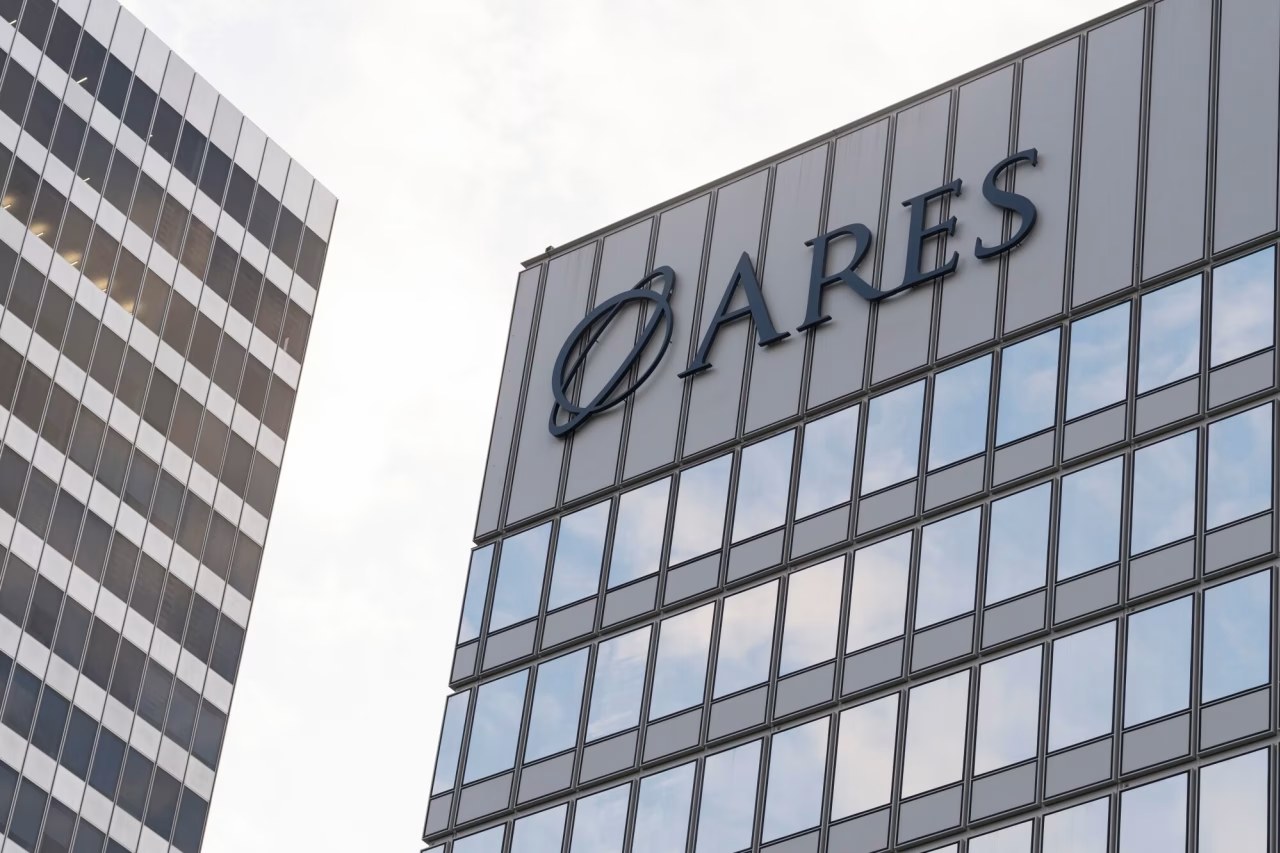
Ares and Antares Close $1.7B Private-Credit Continuation Fund—Their Second in a Year
- Ares Management’s credit-secondaries unit and Antares Capital have recapitalized a $1.7 billion private-credit portfolio through a continuation vehicle.
- The deal is the second time the two firms have used the structure inside 12 months, underscoring rapid adoption of credit secondaries.
- Antares oversees approximately $90 billion in capital across private credit, liquid credit and liquidity strategies as of Sept. 30.
- Continuation vehicles allow existing investors to cash out while giving new investors access to seasoned, cash-flowing loan books.
The move signals how private-credit giants are turning to secondaries to keep mature assets on fee-bearing platforms without forcing distressed exits.
ARES MANAGEMENT—Private-credit heavyweights Ares Management and Antares Capital have completed a more than $1.7 billion continuation fund designed to recapitalize a basket of existing private-credit assets, according to people familiar with the terms. The vehicle, led by Ares’s dedicated credit-secondaries team, represents the second time in a year that the two Los Angeles-based firms have teamed up on a continuation structure, underscoring the speed at which the once-niche product is becoming mainstream.
Continuation funds—traditionally the preserve of private-equity secondaries—allow general partners to extend the life of high-performing portfolios beyond a fund’s original term. Investors who want liquidity can sell their interests to new capital, while buy-and-hold LPs can roll into the new vehicle. Applying the template to private credit is gathering steam because direct-lending portfolios often throw off double-digit cash yields and have shorter durations than buy-out assets, making them attractive to both yield-seeking pension plans and insurers.
For Antares, the recapitalization keeps roughly $1.7 billion of seasoned loans inside its fee-bearing ecosystem without forcing a disposal into a volatile syndicated-loan market. For Ares, the transaction adds another jumbo credit-secondaries mandate to a tally that already exceeds $10 billion since the unit’s 2018 inception. Industry lawyers say the repeat nature of the Antares relationship shows managers are now treating continuation vehicles as a programmatic—rather than opportunistic—balance-sheet tool.
How the $1.7B Vehicle Was Structured
While neither Ares nor Antares disclosed the exact vintage of the underlying loans, market participants say the portfolio is dominated by first-lien senior-secured credits originated between 2019 and 2021, a period when Antares aggressively expanded its unitranche lending to upper-middle-market private-equity sponsors. The average enterprise value of the borrowers is believed to be around $200 million, with blended yields hovering in the high-8 percent range, according to secondary-market brokers who reviewed marketing materials.
The deal size—$1.7 billion—makes it one of the top-three largest credit-continuation vehicles ever raised, eclipsed only by two $2 billion-plus portfolios arranged by Apollo and Blackstone’s credit arms last year. Ares committed roughly $300 million from its own balance sheet and raised the remainder from a mix of North-American pension plans, Canadian insurers and Asian sovereign-wealth funds seeking U.S.-dollar yield, said a person close to the fundraising. Pricing was struck at 96 percent of par, implying only a modest liquidity discount relative to the 92–94 percent of par typically seen in one-off syndicated-loan strips.
Secondaries specialists see a structural shift
“What is striking is the cadence—two $1 billion-plus continuation funds inside a year shows Antares is treating this as a core liquidity lever, not a one-off,” said Andrew Lee, head of private-credit secondaries at Campbell Lutyens, who was not involved in the transaction. His firm’s data show that credit-continuation volume has tripled since 2021, reaching $18 billion globally last year, with Ares and its closest rivals capturing roughly 40 percent of the market.
From a legal standpoint, the vehicle was structured as a Delaware limited partnership with a five-year reinvestment period, mirroring terms more common in private-equity secondaries. Investors receive quarterly cash coupons pegged to SOFR plus a 650 basis-point spread, with an additional 75 basis-point step-up if SOFR drops below 2 percent. The structure also includes a European-style NAV floor set at 90 percent of par, protecting buyers against mark-to-market volatility should leveraged-loan prices sag below current levels.
Crucially, Antares retains a 10 percent residual stake in the portfolio, aligning its interests with incoming capital while keeping the assets on its administered book. That residual stake allows Antares to continue earning management fees—typically 100–125 basis points annually—on the entire $1.7 billion, according to industry consultants who reviewed comparable transactions. The economics underscore why managers view continuation vehicles as a way to crystallize performance fees without sacrificing recurring revenue streams.
Why Repeat Deals Matter for Antares’s $90B Platform
Antares Capital sits inside a crowded landscape of direct lenders, but its scale sets it apart. With $90 billion in capital under management and administration as of 30 September, the firm is larger than traditional banks such as HSBC’s U.S. middle-market arm and rivals midsize lenders like Golub Capital and Ares’s own middle-market franchise. The platform’s size gives Antares the critical mass to recycle mature assets rather than sell them into a jittery syndicated market where bids can evaporate overnight.
Repeating continuation vehicles inside twelve months signals to limited partners that Antares has reached a level of portfolio maturity and investor demand that justifies a programmatic approach. “Once you exceed $50 billion in AUM, liquidity solutions become essential—you can’t just let every vintage roll off into repayment,” said Mayree Clark, former global head of credit at Morgan Stanley and now an adviser to several private-credit funds. She notes that firms above that threshold typically hold $8–10 billion of loans older than four years, precisely the cohort that fits continuation-fund economics.
Fee retention is a key driver
By keeping the $1.7 billion inside a continuation structure, Antares preserves an estimated $19 million of annual management fees—calculated at 110 basis points on the portfolio. Over a five-year reinvestment period, that equates to roughly $95 million in predictable cash flow even before performance fees kick in. Given that Antares’s overall credit platform generated about $400 million in management fees last year, the single continuation vehicle accounts for nearly a quarter of recurring revenue, illustrating why managers are willing to seed the structure with their own capital.
From a ratings perspective, Moody’s Investors Service recently flagged continuation funds as a credit-positive development for large direct lenders because they reduce refinancing risk and smooth cash-flow volatility. In a November note, analyst Cristian de Guzman wrote that “managers who can demonstrate repeatable liquidity options command tighter funding spreads and stickier LP relationships,” a dynamic that feeds directly into higher franchise valuations if the firm pursues a public listing or stake sale.
Still, the model is not without governance headaches. Because continuation vehicles require re-underwriting every loan, Antares had to obtain borrower consents for roughly 70 percent of the 115 issuers in the portfolio, a process that took four months and required tweaks to 14 credit agreements. Lawyers at Ropes & Gray, who advised the vehicle, said the biggest sticking points were loosening restrictions on affiliate transfers and ensuring that financial-covenant step-downs did not trigger technical defaults under new ownership structures.
Is Credit Secondaries Becoming an Oligopoly?
Campbell Lutyens data show that the top-three credit-secondaries managers—Ares, Blackstone and Goldman Sachs—arranged 62 percent of the $18 billion in continuation volume last year, up from 48 percent two years earlier. The concentration is even starker for jumbo deals above $1 billion, where the same trio captured 80 percent of mandates. The reason: only a handful of firms boast both a large primary credit franchise to source assets and a dedicated secondaries desk with a captive buyer base.
Ares formalized its credit-secondaries business in 2018 and has since raised more than $10 billion across 27 transactions, giving it the deepest track record in North America. Blackstone followed suit in 2020, leveraging its $240 billion credit platform, while Goldman Sachs typically co-invests through its asset-management arm rather than third-party fundraising. Boutique rivals such as Pantheon, Lexington Partners and StepStone have largely stayed on the sidelines, deterred by the need to price floating-rate loans daily and the complexity of obtaining lender-of-record consents.
Barriers to entry remain high
“Credit continuation is not a cottage industry you can enter with a spreadsheet and a few relationships,” said Kevin Griffin, co-head of secondaries at Goldman Sachs, speaking at a recent industry conference. He cited three hurdles: real-time loan-level data feeds, covenant monitoring software and a trading desk capable of hedging interest-rate risk while marketing the vehicle. Goldman estimates the minimum viable technology stack costs $25 million upfront, a threshold that excludes all but the largest franchises.
Yet oligopolistic dynamics carry pricing risks. With only a few credible bidders, continuation funds can extract steeper discounts from sellers, squeezing returns for rolling investors. Ares addressed the optics by offering existing LPs a choice: cash out at 96 percent of par, or roll into the new vehicle at a 2 percent discount to the bid price, effectively valuing the portfolio at 98 percent of par for loyal capital. More than 60 percent of eligible investors chose the roll option, according to placement-agent records, suggesting pricing fairness is becoming a marketing point in its own right.
Looking ahead, Moody’s expects credit-secondaries volume to compound at 25 percent annually through 2027, propelled by aging direct-lending vintages and insurers’ thirst for floating-rate paper. If that forecast holds, the addressable market could reach $50 billion within three years, encouraging new entrants. But for now, Ares’s back-to-back $1 billion-plus deals with Antares illustrate how incumbents are entrenching share before competition arrives.
What the $1.7B Deal Means for the Wider Loan Market
Traditional syndicated-loan desks have watched private-credit continuation activity with a mix of envy and dread. On one hand, every dollar kept inside a continuation structure is one less dollar of supply for CLOs and hedge-fund buyers, helping to prop up secondary-loan prices that have fallen 5 percent since the Federal Reserve began raising rates. On the other, banks fear that managers like Antares will bypass syndication entirely, eroding fee pools that still account for roughly 15 percent of large U.S. banks’ investment-banking revenue.
Evidence of the squeeze is already visible. Refinitiv data show that middle-market syndicated-loan issuance dropped 18 percent year-over-year through the third quarter, while direct-lending funds raised a record $240 billion in fresh commitments. JP Morgan analysts estimate that continuation vehicles absorbed $6 billion of paper that would otherwise have come to the syndicated market, tightening spreads on B-rated credits by roughly 35 basis points relative to BB paper.
Insurance buyers are the big winners
Life insurers, constrained by capital rules that favor floating-rate instruments, have emerged as the natural buyers of credit-continuation paper. Because coupons reset off SOFR, the instruments match liability durations better than fixed-rate high-yield bonds. Ares marketed the Antares vehicle to a consortium that included MassMutual, Sun Life and a Canadian pension plan, all of whom were willing to accept lower headline yields in exchange for quarterly cash and diminished mark-to-market volatility.
The shift also has implications for pricing benchmarks. Historically, private-credit loans have been quoted as a spread over LIBOR or SOFR with little reference to public indices. Continuation funds change that dynamic by publishing monthly NAVs and quarterly valuation letters, effectively creating a shadow pricing grid that syndicated desks must now monitor. “We have to track continuation-fund levels the same way we track CLO liabilities,” said a trader at a bulge-bracket bank who declined to be named because he is not authorized to speak publicly.
Finally, the deal tightens terms for borrowers. Antares offered several portfolio companies margin reductions of 25–50 basis points in exchange for amended covenant packages that facilitate future transfers. While those savings seem modest, they set a precedent that other direct lenders may have to match, compressing industry-wide spreads at a time when base rates appear to have peaked. Analysts at Fitch Ratings warn that if continuation volumes double in 2025, average middle-market loan spreads could fall below 500 basis points for the first time since 2007.
The Road Ahead: More Deals, More Scrutiny
Regulators have so far treated credit-continuation vehicles as a subset of traditional secondary transactions, meaning they escape the same level of scrutiny applied to new CLO formations or fintech lending platforms. That era of light-touch oversight may be ending. The Securities and Exchange Commission’s Division of Examinations has added “mature private-credit liquidity mechanisms” to its 2025 inspection priorities list, a move attorneys at Dechert interpret as a signal that continuation funds will face enhanced disclosure requirements around valuation methodologies and investor communications.
Ares and Antares pre-empted some of that risk by hiring an independent valuation agent to sign off on the 96-percent-of-par price and by providing LPs with full cash-flow waterfalls under multiple default scenarios. Still, industry lobbyists expect the SEC to propose rules requiring managers to publish quarterly metrics similar to those mandated for business-development companies, including weighted-average coupon, debt-service-coverage ratios and portfolio-wide leverage. Compliance costs could rise by $3–5 million annually for managers with more than $5 billion in continuation assets, according to estimates by PwC.
LPs want transparency—and speed
Large pension plans are pushing for faster liquidity cycles. The California State Teachers’ Retirement System, which committed $150 million to the Antares vehicle, has asked managers to condense the traditional four-month marketing window to eight weeks, arguing that rapid execution reduces asset-price volatility. Ares achieved that timeline by front-loading due-diligence materials and pre-clearing borrower consents, a template other arrangers are racing to replicate. If the compressed timetable becomes standard, smaller managers without dedicated secondaries staff could find themselves shut out of the market.
Meanwhile, credit-rating agencies are wrestling with how to treat continuation-fund debt. S&P Global Ratings currently excludes such obligations from leverage calculations if the portfolio is fully cash-collateralized, but Moody’s applies a 50 percent weighting, creating divergent capital ratios that can swing borrowing capacity by hundreds of millions for large borrowers. Harmonization is likely in 2025, and the outcome will influence how much continuation paper insurers can hold without hitting risk-capital limits.
Despite the looming regulatory shadow, Ares executives sound bullish. “We have a visible pipeline of repeat sellers that could add another $5–7 billion next year,” said David Kaplan, co-head of credit secondaries, speaking on an investor call. If that forecast materializes, the firm could cement an unassailable lead in what is fast becoming the most lucrative corner of private credit. For Antares, the math is equally compelling: every billion dollars kept inside continuation structures adds roughly $11 million in annual fees, revenue that will help justify the infrastructure investments needed to stay ahead of a rapidly institutionalizing market.
Frequently Asked Questions
Q: What is a private-credit continuation vehicle?
It is a fund structure that gives existing investors liquidity by allowing new money to buy into an existing portfolio of loans or credit assets, extending the life of the investments rather than forcing a fire sale.
Q: Why are Ares and Antares repeating the structure within 12 months?
The partners see repeatable demand from yield-hungry buyers and want to crystallize gains for early LPs while keeping fee-earning assets under management inside Antares’s $90B platform.
Q: How large is Antares Capital?
Antares managed and administered roughly $90 billion across private credit, liquid credit and liquidity strategies as of 30 September, making it one of the ten biggest direct-lending franchises globally.
