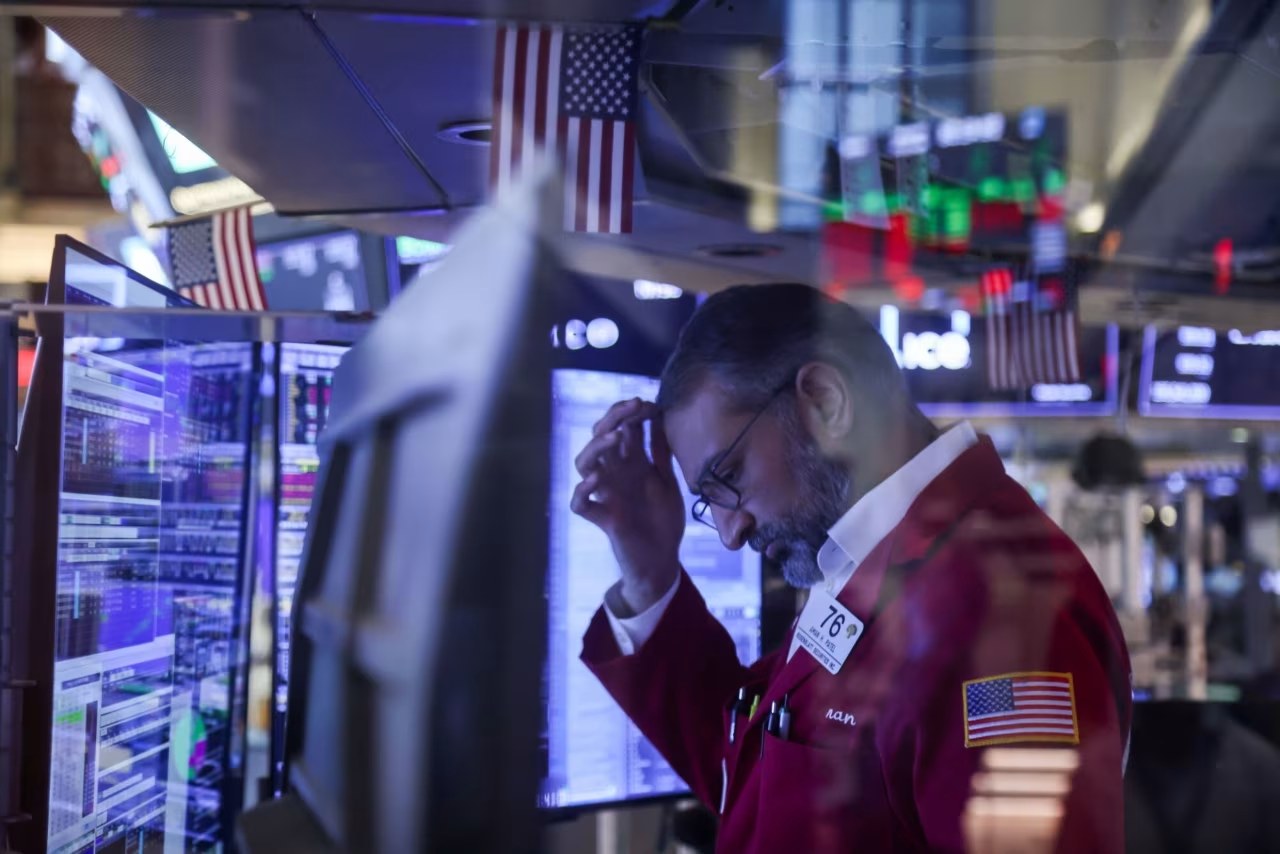
Nasdaq and Dow Both in Correction as Wall Street Logs Worst Quarter Since 2020
- The Nasdaq Composite tumbled 10 % below its recent peak on 26 March, entering technical correction territory.
- One day later the Dow Jones Industrial Average followed suit, down 10 % from its cycle high.
- U.S. equities are on pace for their steepest quarterly decline since the COVID-19 shock of Q1 2020.
- Oil’s historic spike—Brent crude briefly topped $130 a barrel—has investors pricing in rising odds of global recession.
An energy shock triggered by war has reversed Wall Street’s early-year momentum in fewer than 30 trading sessions.
NASDAQ CORRECTION—When traders rang in 2024, strategist price targets and fund-flow data pointed to a banner year: equities had just posted back-to-back double-digit annual gains, volatility was muted and the Federal Reserve’s rate-hike campaign appeared to be cresting. Instead, a geopolitical rupture has vaporized those assumptions with brutal speed. By the closing bell on 31 March the S&P 500 had shed roughly 9 %, the Nasdaq Composite sat more than 10 % below its February high and the Dow Jones Industrial Average had surrendered 2,600 points—its worst three-month start since the pandemic.
The catalyst is no mystery. Russia’s full-scale invasion upended commodity markets, sending Brent crude on its fastest rise since Iraq’s 1990 invasion of Kuwait and handing investors a textbook supply-side shock just as central banks were already tightening financial conditions. Energy shares are the only S&P 500 sector in positive territory year-to-date; every other group—including 2023’s high-flying technology giants—has fallen decisively.
Portfolio managers now confront a stark question: is the sell-off a healthy reset after two years of outsized gains, or the first act of a deeper bear market amplified by stagflation? What is clear is that Wall Street’s risk models, calibrated on a decade of low rates and quiescent inflation, are being stress-tested in real time.
From Bullish to Bearish in 30 Sessions
The speed of the reversal has caught even veteran traders off guard. On 1 February the S&P 500 traded at 4,510, within 3 % of its all-time closing high, and the Cboe VIX fear gauge hovered just above 17. Four weeks later the index had fallen below 4,100 while the VIX spiked above 30, a level not seen since the Omicron sell-off of late 2021.
Technical damage is now widespread. According to Bloomberg data, more than 60 % of S&P 500 components are in their own 10 % corrections and one-third have fallen at least 20 %—the traditional definition of a bear market. Small-cap investors have fared even worse: the Russell 2000 is down 12 % for the quarter, erasing $850 billion in market value.
Oil shock rewires sector leadership
The energy complex alone is posting gains. Brent crude futures surged from $78 on 1 February to an intraday peak of $133 on 7 March, the highest since 2008. With natural gas and coal benchmarks also soaring, the S&P 500 energy sector has rallied 38 % since year-end, led by Exxon Mobil and Occidental Petroleum. Every other sector—including once-resilient consumer staples and healthcare—has declined, underscoring how the inflationary impulse is rippling through input-cost models.
“The market is repricing the probability that higher energy prices tip the global economy into recession,” said Torsten Sløk, chief economist at Apollo Global Management, in a note to clients. Sløh estimates that every $10 increase in annual average oil prices shaves 0.1 percentage point off U.S. GDP growth. With Brent now $40 above December levels, the implied drag is roughly 0.4 percentage point—enough, when layered atop Fed tightening, to push 2024 growth close to stall speed.
Corporate guidance is already buckling. During the first two weeks of March, 72 companies in the S&P 500 issued updates; 54 cited “significant uncertainty” tied to commodity prices, and nine withdrew full-year forecasts entirely, according to FactSet. Earnings-revision breadth—defined as the ratio of upward to downward analyst adjustments—has fallen to 0.6, the lowest since the 2020 lockdowns.
What comes next hinges on whether oil stabilizes below $100 and whether consumer spending, which contributed 1.8 percentage points to last year’s 3.1 % GDP growth, holds firm. Early signals are mixed: the Conference Board’s consumer-confidence index slipped for a second straight month, while weekly mortgage demand fell to its lowest level since 2019, suggesting higher energy costs are already eroding disposable income.
Still, markets are forward-looking. If crude retreats and cease-fire talks progress, history shows equities can rebound quickly: after the 1990 Gulf War spike, the S&P 500 regained prior highs within four months. The risk is that commodity markets stay elevated, forcing the Fed to choose between fighting inflation and supporting growth—a dilemma that typically punishes valuations.
Tech’s Correction Spreads Beyond Profitless Growth
On 26 March the Nasdaq Composite closed at 12,690, down exactly 10 % from its 14,100 intraday peak set on 16 February. The pullback marks the index’s first correction since December 2022 and, critically, has broadened beyond speculative software names into megacaps that previously powered indices higher.
Apple, Microsoft, Alphabet and Amazon have all fallen at least 9 % from records, while Tesla and Meta have slid more than 20 %. Even Nvidia, the poster child for AI-driven demand, has retreated 18 % from its March high, evaporating $450 billion in market capitalization.
Rising real yields squeeze valuations
The 10-year U.S. Treasury yield has jumped from 3.4 % on 1 February to 4.2 % by quarter-end, driven by both higher breakeven inflation and real rates. Goldman Sachs strategists note that every 25-basis-point increase in real yields typically reduces the fair-value price-to-earnings multiple of the Nasdaq by roughly 1.2 times. With real yields up 50 basis points since mid-February, the valuation haircut is consistent with the observed 12 % forward-PE compression.
“Growth stocks are long-duration assets,” said Peter Berezin, chief global strategist at BCA Research. “When the discount rate rises faster than earnings expectations, multiples contract quickly.” Berezin’s team now recommends an underweight to U.S. technology and prefers energy and financials, sectors whose cash flows are positively correlated with higher commodity prices and steepening yield curves.
Fund-flow data from EPFR Global underscores the pivot. Technology equity funds recorded $12.3 billion of outflows during the three weeks ended 23 March, the heaviest redemptions since September 2022. Meanwhile energy funds absorbed $4.7 billion, their largest weekly uptake on record, and short-term Treasury ETFs pulled in $18 billion as cash-like instruments became attractive with yields above 5 %.
Options markets tell a similar story. The skew—measured by the difference between implied volatility on out-of-the-money puts versus calls—has widened to levels last seen during the 2020 pandemic crash, suggesting institutional hedging demand is concentrated on further downside rather than upside breakout trades.
Yet bargains may be emerging. Of the 15 Nasdaq-100 constituents trading below a 15-times forward earnings multiple, eight still generate free-cash-flow margins above 20 %, according to JPMorgan screens. If oil stabilizes and the Fed signals a pause after one more rate hike, history suggests beaten-down quality tech could recoup losses swiftly, as happened after the 2018 Q4 correction when the index rebounded 24 % in the following quarter.
Until visibility improves, however, the path of least resistance remains lower. Corporate insiders appear to agree: the ratio of insider selling to buying in the technology sector spiked to 8.3-to-1 in March, the highest in 18 months of Bloomberg data.
Are Energy Stocks the Only Game in Town?
While the broader market has unraveled, energy has emerged as the lone beacon. The S&P 500 Energy sector surged 38 % through 31 March, its best quarterly performance since 1990, driven by a perfect storm of supply disruptions and years of under-investment that left inventories at 14-year lows.
Integrated oil majors have been the biggest beneficiaries. Exxon Mobil’s market cap has swelled by $95 billion since January, eclipsing the combined gains of Apple and Microsoft over the same stretch for the first time in modern history. Chevron, ConocoPhillips and Occidental have all outperformed by at least 30 percentage points.
Free cash flow gushes higher
At $110 Brent, the U.S. shale industry is generating free cash flow yields of 18 %, according to Rystad Energy, versus 6 % for the S&P 500. That excess is translating into aggressive shareholder returns: 17 of the 23 companies in the sector have guided to combined buybacks and dividends exceeding 75 % of 2024 free cash flow, up from 45 % in 2022.
“Energy is no longer a value trap—it’s a cash-flow machine,” said Jean-Pierre Symon, portfolio manager at Aegon Asset Management. Symon points to break-even prices for many Permian producers falling below $45 a barrel, creating a massive margin of safety even if crude retreats toward $80.
Yet chasing the rally carries risks. Energy now represents 5.2 % of the S&P 500, the highest weighting since 2014 but still well below the 12 % peak of 2008. A rapid cease-fire or coordinated strategic-reserve release could send prices tumbling; during the 2008 second half, oil crashed from $147 to $32, and energy shares underperformed the index by 40 percentage points.
Valuation metrics are also less forgiving. The sector trades at 12.5-times forward earnings, a 25 % premium to its 10-year average, and EV/DACF multiples have expanded to 8.2-times from 5.1-times a year ago. If spot prices normalize to $70-$75, analysts at Bernstein estimate fair value for the group is 15 % below current levels.
Still, fundamentals appear supportive. U.S. crude inventories stand at 415 million barrels, down 12 % year-over-year, while OPEC+ spare capacity has fallen below 2 million barrels per day, the tightest buffer since 2004. With Russian exports potentially curtailed by sanctions and China’s economy re-opening, consensus expects Brent to average $95 in 2024, 10 % above futures curves.
For investors, the calculus hinges on time horizon. Tactical traders face asymmetric downside if diplomacy succeeds, but longer-term holders may benefit if capital discipline persists and U.S. production growth remains constrained by pipeline capacity and investor demands for returns over volume.
What History Says About the Next Move
Since 1970 there have been eight episodes where oil prices spiked more than 30 % over a single quarter while equities fell into correction. In five of those instances the S&P 500 was higher 12 months later, posting median gains of 14 %, according to Bespoke Investment Group. The key differentiator was whether the oil shock tipped the economy into recession.
In 1990, 2003 and 2014, growth remained positive and markets rebounded within six months; in 1974, 1980 and 2008, recessions ensued and stocks fell an additional 20 % on average. Today’s backdrop sits somewhere in the middle: U.S. leading indicators are soft but not collapsing, while consumer balance sheets remain sturdy with debt-service ratios near 40-year lows.
Fed policy may be the swing factor
Historical analysis by the San Francisco Fed shows that when the central bank paused rate hikes within three months of an oil shock, equities bottomed faster and valuations recovered sooner. Conversely, continued tightening amplified downside. Markets currently price a 70 % probability of one more 25-basis-point increase at the May meeting, followed by an extended pause—an outcome that, if realized, has historically supported a 10 % rebound in the subsequent two quarters.
Credit conditions will also dictate outcomes. Despite the equity selloff, investment-grade corporate bond spreads have widened only 28 basis points, far below the 120-basis-point blow-outs that accompanied 2008 or 2020. Bank lending standards, while tightening, remain looser than pre-pandemic levels, suggesting the financial system is not seized.
Sentiment extremes often mark turning points. The American Association of Individual Investors bull-bear spread fell to -32 %, the most negative reading since October 2022—right before the market’s 17 % Q4 rally. Similarly, the put-call ratio on the S&P 500 has spiked above 1.2, a level that in the past decade preceded median 6 % gains over the following three months.
Yet structural headwinds persist. The dollar’s 4 % year-to-date rise is tightening global liquidity, while Europe’s proximity to the conflict raises odds of a continental recession that could sap multinational earnings. If oil stays above $100 into summer, headline CPI could re-accelerate above 6 %, tying the Fed’s hands and reviving volatility.
For investors, the takeaway is nuanced: markets rarely bottom on good news, but they also don’t need perfect conditions—just an absence of worsening shocks. A diplomatic breakthrough, a coordinated SPR release and clearer Fed guidance could trigger a sharp relief rally, while escalation or a European recession would likely extend the bear trend into year-end.
Will Diversification Save Portfolios This Time?
Traditional 60/40 portfolios are on pace for their worst start since 2008. U.S. bonds have fallen 3 % year-to-date as rising yields overwhelm safe-haven demand, while the S&P 500 is down 9 %. The result: a balanced portfolio has lost roughly 6 %, underscoring the challenge of finding true diversification when inflation shocks hit both risk assets simultaneously.
Commodities have done their job. The Bloomberg Commodity Index has rallied 18 %, gold is up 9 % and front-month oil futures have doubled. Yet few retail portfolios hold meaningful commodity exposure; the average 401(k) allocation to commodities is below 1 %, according to Vanguard data.
Private markets offer limited liquidity
Institutional investors have turned to private credit and real assets. Blackstone’s latest fundraising haul of $40 billion for opportunistic credit funds signals demand for floating-rate instruments whose coupons adjust with base rates. Meanwhile, infrastructure debt yields have widened 150 basis points over Treasuries, the highest spread since 2009, attracting pension funds seeking inflation linkage.
Currency hedging has provided modest relief. The yen, traditionally a haven, has strengthened 4 % against the dollar since March 1, while the Swiss franc has gained 3 %. For U.S. investors holding unhedged European equities, however, euro weakness has erased an additional 2 % of total returns.
Factor investing is seeing rotation. Momentum, which outperformed in 2023, has cratered 11 % as high-beta tech names corrected, while value and high-dividend factors have declined only 3 %, thanks to heavy energy weightings. AQR Capital calculates that a long-short value-momentum spread has swung 900 basis points in favor of value—the largest quarterly reversal since 2009.
Advisors are revisiting commodity-linked equities as a liquid proxy. Energy pipelines, royalty trusts and gold miners carry equity beta but also cash-flow sensitivity to inflation. The Alerian MLP ETF has climbed 22 % year-to-date, while the VanEck Gold Miners ETF is up 14 %, both beating broader indices.
Ultimately, the episode highlights that inflationary shocks are the Achilles heel of conventional diversification. When both growth and inflation surprise to the upside, correlations between stocks and bonds turn positive, undermining the risk-parity model. Investors seeking resilience may need to embrace explicit inflation hedges—be it through commodities, floating-rate debt or real assets—rather than relying on historical correlations that break under stress.
Frequently Asked Questions
Q: Why is this the worst quarter for stocks in four years?
The S&P 500, Nasdaq and Dow have all dropped sharply since late February after Russia’s invasion sent Brent crude above $130 a barrel, reviving stagflation fears and triggering the fastest correction cycle since 2020.
Q: How far has the Nasdaq fallen?
On 26 March the tech-heavy Nasdaq Composite closed more than 10 % below its 52-week high, meeting the technical definition of a market correction and wiping out all year-to-date gains.
Q: Could energy prices push the economy into recession?
Goldman Sachs economists estimate every $10 rise in annual average oil prices shaves 0.1 pp from U.S. GDP growth; with Brent up roughly $40 since December, the implied drag is nearly 0.4 pp—enough, when coupled with rate hikes, to tip growth close to stall speed.
