Qatar Attack Removes One-Third of Global Helium Overnight, AI Chip Output at Risk
- Iran-linked strikes on Ras Laffan LNG complex halted Qatar’s helium output, source of 32 % of world supply.
- Spot helium prices jumped 170 % to $550 per thousand cubic feet, surpassing 2019 record.
- ASML, Samsung and TSMC warn EUV lithography tools idle if ultra-high-purity helium stays offline beyond 15 days.
- MRI clinics in Germany and Japan postpone non-urgent scans as liquid-helium deliveries fall 60 %.
- Helium is a by-product of Qatari LNG; plant restart hinges on regional cease-fire talks in Doha this week.
A single gas few consumers notice now underpins the global AI race and life-saving diagnostics.
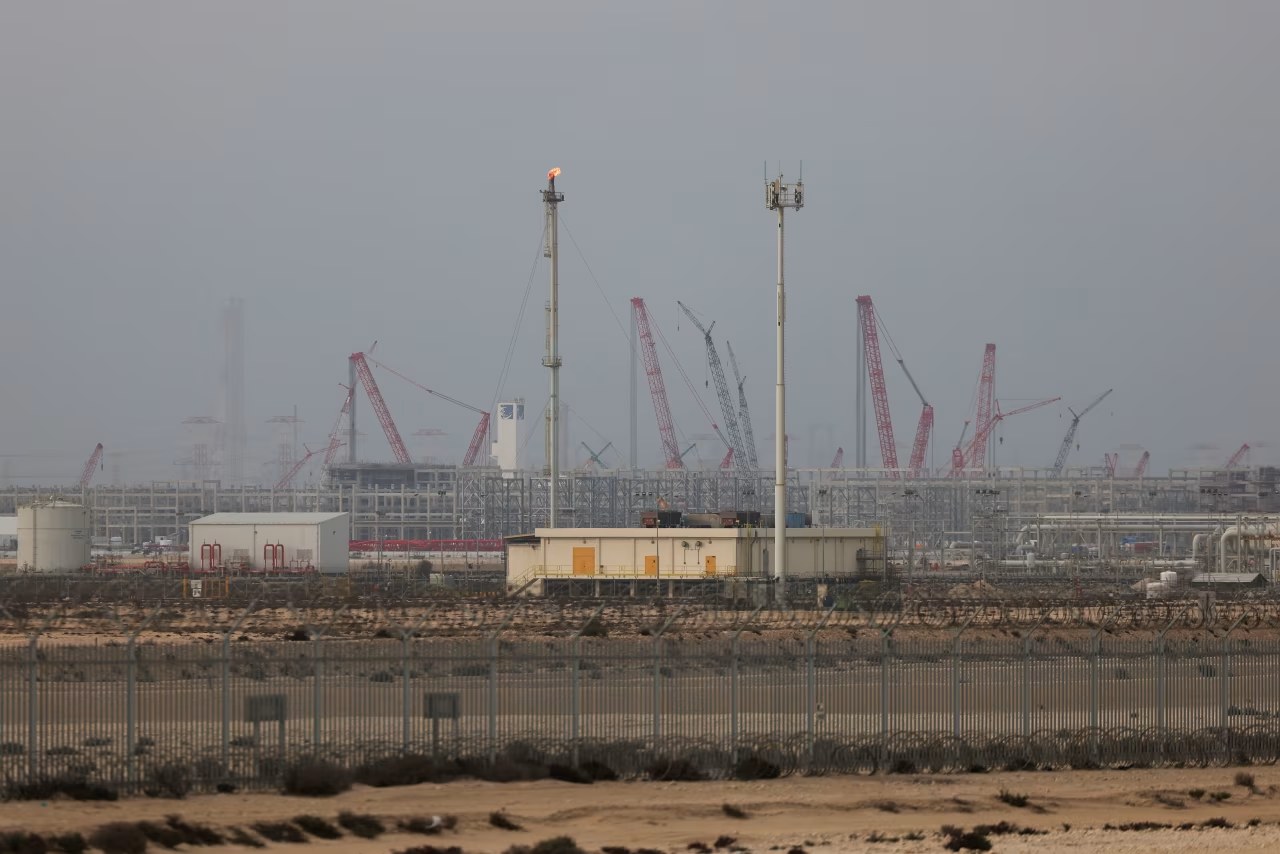
QATAR—When Iranian missiles struck storage tanks at Qatar’s Ras Laffan liquefied-natural-gas terminal late Friday, energy traders focused on lost LNG cargoes. Yet inside the same plant sits the world’s largest helium-refine train, a facility that separates the inert gas from methane and ships it in 40-foot iso-containers to semiconductor fabs from Arizona to Pyeongtaek. With those units now shut, roughly one in every three helium atoms used by AI-chip makers has vanished overnight.
The timing is brutal. Foundries in Taiwan and South Korea are ramping 3-nanometre production lines that rely on extreme-ultraviolet scanners operating at cryogenic temperatures. Each EUV unit circulates 12 liters of liquid helium per hour; a typical gigafab needs 40 000 liters a week. According to ASML’s engineering notes, even a 2 % purity drop can trigger thermal drift that misaligns the $200 million machine’s mirrors. Industry executives told The Wall Street Journal that current inventories cover “barely two weeks” of normal throughput.
Beyond chips, hospitals face their own cliff. MRI magnets must be bathed in liquid helium at –269 °C; without fresh top-ups, the magnets quench, causing $2 million scanners to shut down. Germany’s University Hospital Cologne has already postponed 80 scans since Monday, while Japan’s National Cancer Center is airlifting remaining stock from Australia at five-fold normal freight. The outage, traders say, is the most disruptive since 2006 when a diplomatic embargo briefly blocked Qatari shipments and prices quadrupled.
The Invisible Gas Powering the AI Boom
Helium’s role in artificial intelligence is rarely mentioned outside clean-room engineering manuals, yet no substitute exists for its extreme thermal conductivity and inertness. Inside ASML’s EUV scanners, a plasma of molten tin emits 13.5-nanometre light that etch features barely wider than a DNA strand. Mirrors focusing that light absorb enough energy to heat a coffee cup to 1 000 °C within milliseconds; only helium at 4 Kelvin can whisk the heat away without chemically reacting with the optics.
From Birthday Balloons to Billion-Dollar Fabs
Because helium is produced solely as a by-product of natural-gas extraction, its supply chain piggybacks on LNG politics. Qatar, home to the North Field—the planet’s largest single gas reservoir—operates three helium trains with combined capacity of 2.1 billion cubic feet per year, according to the U.S. Geological Survey. That equals 32 % of global supply, far ahead of the United States (28 %) and Algeria (12 %). When Ras Laffan shut, traders immediately booked replacement cargoes from the U.S. Bureau of Land Management’s Cliffside field in Texas, but U.S. output is already capped at 1.8 bcf/y after Congress mandated sell-down of the federal reserve by 2025.
Dr. Richard Clarke, a cryogenic engineer at MIT, explains the physics: “At single-digit Kelvin, hydrogen solidifies and nitrogen liquefies, leaving helium the only coolant that remains fluid. A fab could design closed-loop systems, yet contamination from trace air leaks forces continuous purge. Roughly 90 % of that helium vents to atmosphere—irrecoverable.” The result is a perpetual need for fresh supply, making fabs price-insensitive; a $5 000 helium invoice is negligible against a $20 billion fab budget.
Market data from commodity platform Kornbluth Helium Consulting show EUV-grade helium contracts averaged $210 per thousand cubic feet (mcf) in August. By Tuesday, Middle East spot cargoes traded at $550/mcf, eclipsing the 2019 record of $350 that followed the Amur explosion in Russia. The jump translates to an extra $4 million annual cost for a 100 000-wafer-per-month fab, but the bigger fear is physical unavailability. South Korea’s trade ministry convened an emergency meeting Tuesday after Samsung Electronics declared force majeure with two tool vendors, citing “unforeseeable helium shortfall.”
Forward curves now embed a $400-plus risk premium through 2025, a cost ultimately borne by consumers of AI accelerators, smartphones and electric vehicles. Analysts at Bernstein estimate every $100 increase adds 0.3 % to wafer cost, enough to erase profit margins on legacy nodes. Yet without helium, fabs simply cannot run; the question is who gets priority. Governments classify helium as a critical mineral, so export bans could follow, echoing 2020 when India blocked oxygen during the pandemic. The next chapter explores how semiconductor giants are scrambling to secure last-mile deliveries.
Why Chip Makers Cannot Simply Recycle Helium
Recycling sounds logical for a gas whose price now rivals silver, yet fabs face thermodynamic and economic hurdles. Once helium mixes with nitrogen or hydrogen in purge lines, separating it back to 99.998 % purity—the threshold for EUV optics—requires multi-stage cryogenic distillation plus pressure-swing adsorption. A single recovery skid costs $15 million and consumes 2 megawatts of power, enough to run 6 000 homes. Only four 300-millimetre fabs worldwide have installed such units, and even they recover at most 60 % of losses.
The Closed-Loop Myth
ASML’s latest NXE:3600D scanners include onboard helium recovery membranes, but engineers familiar with the tool say the loop vents 4–5 % per day through labyrinth seals that prevent vibration. “It’s like trying to keep air out of a bike tire that must spin at 3 000 rpm,” says Laura Kim, who managed lithography at GlobalFoundries until 2022. She adds that fabs budget for 1.5 times theoretical usage to avoid million-dollar-per-hour downtime, so surplus always exists. Stockpiling is impractical because helium escapes through most polymer barrier films at a rate of 1 % per week.
Alternative coolants have been explored. Hydrogen offers similar thermal conductivity but is combustible; neon, used in older lithography lasers, is 50 times costlier and still requires helium as a buffer. Japan’s National Institute of Advanced Industrial Science tested super-fluid neon slush, yet the viscosity clogged micro-channels. In short, no drop-in replacement exists at scale, cementing helium’s role as the semiconductor industry’s silent enabler.
Compounding scarcity, geopolitics restricts where new helium can be found. Russia’s Amur plant, designed to supply 1.8 bcf/y, has been offline since an October 2021 explosion and remains sanctioned. Algeria’s Skikda refinery can boost output by 15 %, but feed-gas is diverted to Europe to replace Russian molecules. The only near-term swing source is the Qatar expansion, but additional trains require Ras Laffan restart plus a new 2027 start-up. Analysts at ICIS therefore predict a structural deficit of 0.8 bcf/y—equal to 11 % of demand—through at least 2026.
Meanwhile, semiconductor unit growth is accelerating. Gartner forecasts EUV layers will rise from 14 per 5-nm chip to 26 per 2-nm node, doubling helium intensity. If fabs cannot secure supply, Moore’s Law itself stalls, delaying AI workloads and raising server-farm power consumption. The industry’s Plan B is rationing, but that merely shifts shortage to medical and scientific users already sounding alarms. The next section examines how hospitals are triaging patients as liquid helium evaporates.
MRI Clinics Forced to Quench Magnets as Supply Evaporates
The first casualties of the helium drought are not tech giants with billion-dollar stockpiles but neighborhood MRI clinics running on thin supply chains. A 1.5-tesla scanner contains 1 700 liters of liquid helium, and evaporation losses average 0.1 % per day. Refills arrive every 24–30 months under normal conditions. With Ras Laffan offline, distributors such as Air Liquide and Messer have allocated 60 % fewer tankers to healthcare, prioritizing semiconductor fabs under pre-existing contracts.
Quench Protocols Activated
When helium drops below 65 % fill level, magnets risk quenching—an emergency vent that collapses the magnetic field and can damage super-conducting coils. Re-energizing requires 2 000 liters of fresh helium and two weeks of downtime, a $200 000 procedure. University Hospital Cologne learned Monday its scheduled refill was cancelled; by Wednesday the magnet fell to 68 %, forcing administrators to postpone 80 scans including oncology staging. Hospital spokesperson Dr. Nina Ebert said: “We are triaging only life-threatening cases. Elective diagnostics are delayed indefinitely.”
Japan’s Ministry of Health estimates 1 200 MRI units—one fifth of the national fleet—will face shortages within 30 days. The Cabinet approved an emergency subsidy of ¥9 billion ($60 million) to charter liquid-helium imports from Australia, but freight capacity is limited to 12 cryogenic containers per week, enough for barely 100 scanners. Smaller clinics cannot compete on price; spot auction data show medical-grade helium climbed to $480/mcf versus $390 for chip makers, reversing the historic premium.
Alternative imaging modalities exist—CT for bone, ultrasound for soft tissue—but oncologists warn of missed early-stage cancers. A study in The Lancet found delayed MRI diagnostics raised mortality 7 % in Britain’s 2018 shortage. With Ras Laffan restart talks ongoing, hospitals are lobbying for helium to be classified as an essential medicine, banning exports when national stockpiles fall below 90 days. Absent such rules, med-tech firms like Philips and Siemens Healthineers face order cancellations; Philips has already trimmed MRI revenue guidance 4 % for Q4.
The crisis underscores helium’s irreplaceable role in modern medicine, paralleling its importance to AI. While diplomats negotiate a cease-fire, clinics worldwide are dusting off older 0.5-tesla scanners that use permanent magnets and require no helium—an ironic retreat to 1990s technology. Yet those machines cannot perform functional brain imaging or cardiac perfusion studies, so patient care regresses. The next chapter explores diplomatic efforts to reopen Qatar’s export valves and assesses the probability of a near-term restart.
Can Diplomacy Restore Qatar’s Helium Exports?
Restarting Ras Laffan’s helium trains is technically straightforward but politically fraught. Helium is extracted from LNG boil-off gas; once the larger liquefaction trains resume, the helium unit can ramp within 72 hours, Qatari engineers told Reuters. The obstacle is security: three missiles struck storage spheres, and insurers have declared force majeure until a cease-fire is brokered. QatarEnergy has flown in Halliburton crews to assess damage, but underwriters require indemnity guarantees against further attacks before lifting coverage.
Diplomatic Push in Doha
U.S. Secretary of State Antony Blinken arrived in Doha Tuesday for truce talks between Iran and Gulf states, with helium now on the agenda alongside prisoner swaps. A senior State Department official, speaking on condition of anonymity, said: “We are treating helium as a strategic material; its absence stalls both AI innovation and medical diagnostics.” Washington is pressing Tehran to halt drone strikes in exchange for partial sanctions relief on petrochemicals, a formula that could de-escalate risk premiums enough for insurers to sign back on.
Market watchers are skeptical. Helium analyst Phil Kornbluth, who has tracked the sector since 1986, notes: “Every major shortage—1960 Lunar program, 2006 Qatar blockade, 2012 U.S. reserve sell-off—lasted 12–18 months despite political fixes.” He points out that even if Ras Laffan restarts in November, global inventories are thin; the U.S. Federal Helium Reserve is down to 1.2 bcf, one third of 2010 levels. New capacity from Russia and Qatar-II trains will not arrive until 2027–28, so any diplomatic Band-Aid only postpones scarcity.
Traders have begun pricing a two-year risk premium into long-term contracts. German industrial-gas giant Linde signed a 10-year deal in September to buy 0.3 bcf/y from Qatar starting 2026 at a price indexed 30 % above the U.S. Bureau of Land Management auction, signaling enduring tightness. Meanwhile, China is building a strategic helium reserve in Ningxia, mirroring its oil stockpiles, and has instructed state fabs to cut usage 15 % via recycling retrofits. Beijing’s calculus is geopolitical: Taiwan imports 45 % of its helium from Qatar, so scarcity weakens the island’s semiconductor leverage.
The odds of a near-term restart hinge less on engineering than on whether Tehran perceives continued escalation as costly. With Brent crude at $93 a barrel, Iran’s oil revenues are robust, but European sanctions on petrochemicals bite; helium offers Tehran a bargaining chip. Analysts at Eurasia Group assign a 55 % probability of a limited cease-fire before year-end that allows partial Qatari helium exports. Even then, prices are unlikely to fall below $300/mcf, triple 2021 levels, cementing helium as the forgotten bottleneck of the AI revolution. The final chapter explores how tech firms are redesigning processes to survive a helium-scarce decade.
How Tech Giants Are Redesigning for a Helium-Scarce Future
Long-term scarcity is prompting the semiconductor industry to treat helium like water in arid regions—precious, metered and recycled. ASML’s roadmap includes a zero-vent option using cryocoolers that re-liquefy helium inside the scanner, cutting losses to under 1 %. The upgrade adds $30 million per unit and 0.5 m to footprint, but Intel and TSMC have both committed to retrofits starting 2025. Early tests at TSMC’s Fab 18 show 65 % reduction in helium draw, enough to withstand a 30 % supply shock.
Recycling Mandates and Design Shifts
Meanwhile, fabs are installing distributed recovery skids. Intel’s new Ohio plant, designed post-shortage, incorporates a central helium bank piped to tools with closed-loop purifiers. General Manager Ann Kelleher says the system will recapture 80 % of losses and pay for itself in three years at current prices. Similar logic drives memory giants: SK Hynix announced a $1.2 billion plan to retrofit its Korean fabs by 2027, including on-site 4-Kelvin refrigerators powered by renewable electricity.
Design-for-scarcity is also influencing chip architecture. EUV layers consume the most helium, so engineers are minimizing mask counts through design-technology co-optimization. A 3-nm smartphone processor that once needed 26 EUV layers can now be patterned in 20, saving 25 % helium per wafer. While such gains cannot offset a 30 % global shortfall, they buy time until new helium capacity emerges in Qatar and Russia later this decade.
Policy is catching up. The U.S. Senate is debating the Securing Helium for Advanced Research and Manufacturing Act, which would extend the Bureau of Land Management’s reserve sales beyond 2025 and fund university recycling R&D. The European Commission classifies helium as a strategic raw material, requiring member states to hold 90 days of net imports by 2028. China’s 14th Five-Year Plan earmarks $500 million for helium exploration in Sichuan shale gas, aiming for 20 % self-sufficiency by 2030.
These measures will not prevent the next shortage, but they redistribute risk from a single Qatari chokepoint to a diversified portfolio of sources, recyclers and substitutes. For AI startups dreaming of trillion-parameter models, the takeaway is stark: the scarce input is no longer just GPUs, but the invisible gas that keeps them cold. Whoever secures helium today secures the compute capacity of tomorrow.
Frequently Asked Questions
Q: How much helium does Qatar supply globally?
Ras Laffan LNG complex normally ships roughly 30–35 % of worldwide helium, making the current outage the single largest disruption since 2006 when a similar Gulf political crisis doubled spot prices overnight.
Q: Why is helium critical for AI-chip production?
Extreme-ultraviolet (EUV) lithography scanners from ASML must be cooled to 4 K to stabilize laser plasma; helium also purges impurities. No viable substitute exists at those temperatures, so fabs halt if supply drops below 99.98 % purity.
Q: Which industries face immediate shortages?
Semiconductor foundries, MRI hospitals, aerospace welding, and satellite propulsion are rationing. South Korean memory giants Samsung and SK Hynix have already declared force-majeure clauses with tool vendors.
📰 Related Articles
- Crude Spikes Past $115 as Mideast Violence Threatens 6 Million Barrel Red Sea Detour
- Kansas Roaster’s $18 Coffee Signals Stubborn Price Spike Across U.S. Cafés
- Crude Jumps 5.5% in One Day as Hormuz Fears Override Trump Pause on Iran Strikes
- Iran Conflict Triggers Fertilizer Shock, Threatening Global Food Supply
