Internal 2020 Briefing: Exxon’s $500 M Algae Program ‘Falling Well Short’ of Oil Yield Goal
- Exxon scientists told top planners algae strains struggled to produce oil outside the lab, documents show.
- One week later executives told investors algae could soon beat sugarcane and palm for biofuel volume.
- Staff feared data was misrepresented; none of the internal warnings had been previously reported.
- Program cost hit roughly half-billion dollars while failing key milestones, according to company files.
How a flagship green pledge collided with lab reality—and why investors never heard the caution
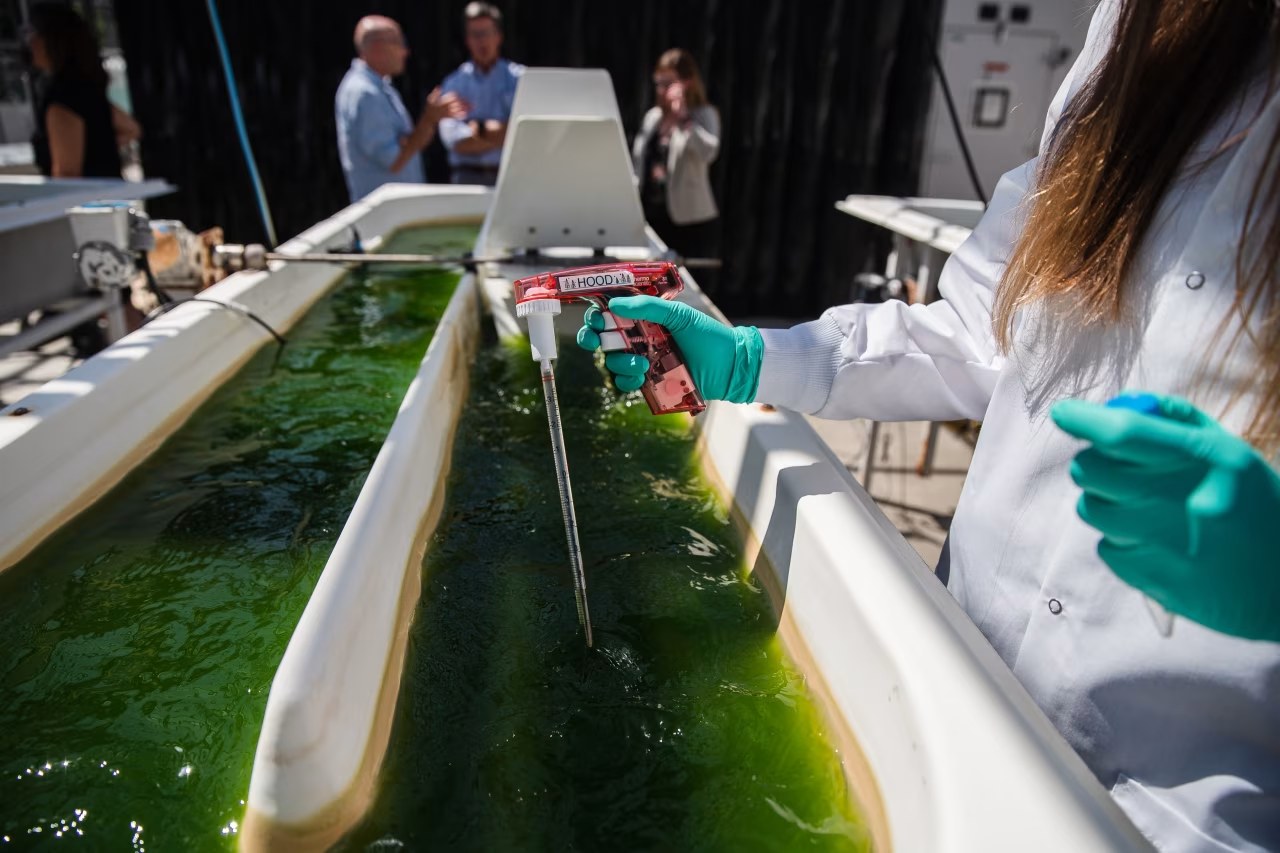
EXXON—In February 2020 a small group of Exxon Mobil researchers faced a stark task: explain to the oil major’s strategic-planning leadership why their marquee climate initiative, a nine-figure algae-to-fuels effort, was sputtering. Slides prepared by the scientists and reviewed by The Wall Street Journal delivered an unequivocal verdict—oil productivity from even the hardiest algae lines was “falling well short” once moved beyond petri dishes and into outdoor conditions.
The briefing landed amid a make-or-break moment for Exxon’s public climate narrative. Institutional investors had begun tying capital allocation to credible low-carbon road maps, and algae—touted since 2009 as a potential billion-barrel-scale breakthrough—sat at the center of the company’s green messaging. Yet inside the firm, researchers worried the gap between laboratory promise and field performance had become unsustainable.
Seven days after the internal warning, Exxon issued an investor note obtained by the Journal that claimed algae “could become a more prolific source of biofuel in the near term” than agricultural staples such as sugarcane and palm. The juxtaposition startled the scientists who felt their cautionary data had been omitted, according to people familiar with the matter. None of the internal documents spelling out the shortfall had been previously disclosed.
Inside the February 2020 Presentation That Rocked Exxon’s Climate Strategy
The February 2020 slide deck, prepared by Exxon’s own algae researchers and shown to the company’s head of strategic planning, carried a blunt header: “Technical Status & Outlook.” Below it, bullet points detailed a litany of setbacks, including “limited outdoor oil productivity” and “difficulty scaling beyond lab reactors,” according to the Journal’s review. Scientists noted that even the most genetically optimized strains, which had looked robust under controlled lighting and temperature, yielded less than 30 percent of the oil per kilogram of biomass that models had projected for commercial viability.
Sources familiar with the session said the mood in the room was tense. The program had already consumed roughly $500 million since its public launch in 2009, during which Exxon’s then-CEO Rex Tillerson predicted algae could eventually churn out 10,000 barrels a day of renewable oil. A decade later, the February briefing made clear the company was nowhere near that target. “We were asked for an honest assessment; we gave them one,” a scientist present told the Journal on condition of anonymity.
Adding to the pressure, Exxon’s board was preparing for its annual investor day in March, where climate progress would be scrutinized. Internally, some researchers pushed to qualify any forward-looking statements with explicit caveats about field-performance risk, but the final presentation deck delivered to investors the following week contained no such language, the documents show.
Key slide removed before investor day
One slide titled “Scale-Up Challenges” that appeared in internal rehearsals was absent from the public deck, according to a comparison reviewed by the Journal. Its deletion, scientists said, obscured the program’s largest vulnerability: outdoor ponds are biologically unstable, prone to invasive species, and require vast surface area to catch enough sunlight—factors that hammer oil yield.
Energy-transition communications experts say such omissions matter. “When a company highlights a single metric in public but suppresses contradictory internal data, it undermines capital-market transparency,” said Amy Myers Jaffe, managing director of the Climate Policy Lab at Tufts University, who was not involved in the Exxon review. “Investors need the full distribution of outcomes, not just the upside narrative.”
The episode illustrates the tightrope oil majors walk: promising breakthrough technologies to satisfy climate-focused shareholders while avoiding regulatory accusations of greenwashing. Exxon’s own 2020 sustainability report, published months after the internal briefing, reiterated that algae “could deliver large-scale, low-carbon biofuels,” with no mention of the lab-to-field gap.
By year-end 2020, Exxon quietly restructured the program, shifting resources toward carbon-capture and hydrogen projects that offered nearer-term revenue prospects. The algae team was downsized, and several senior scientists left, people familiar with the changes said. Yet the company has never publicly revised its rosy projections, leaving investors to parse technical progress from marketing rhetoric.
Why Algae Biofuels Seduced Big Oil—and Why Yields Crash Outside the Lab
Algae’s appeal is intuitive: the microscopic plants double their mass within hours, can be grown on non-arable land, and naturally produce lipids that can be converted into drop-in fuels compatible with existing engines. When Exxon partnered with California-based Synthetic Genomics in 2009, venture capital was flooding into clean tech, and U.S. policy aimed to cut petroleum dependence after oil hit $140 a barrel the previous year.
But the biology is brutal outdoors. Algae need consistent light, carbon dioxide concentrations above ambient air, and temperatures within a narrow band. Even a slight deviation slashes lipid output. A 2014 study by the U.S. National Renewable Energy Laboratory found outdoor ponds delivered only 15 percent of the theoretical oil yield predicted by lab photobioreactors. Exxon’s internal 2020 data echoed that gap, showing open-pond trials in Texas and California averaged 9 grams of oil per square meter per day—far below the 40 grams needed for $2-a-gallon fuel.
Contamination is another killer. Wild algae, amoebas, and viruses invade ponds within days, out-competing engineered strains. Exxon researchers tried enclosing ponds in greenhouses, but capex soared above $800 per barrel of annual capacity, triple the benchmark for corn ethanol, according to company cost models reviewed by the Journal.
Energy return on investment remains negative
A 2021 meta-analysis led by researchers at the University of Campinas in Brazil found that when energy for pumping CO₂, harvesting, and drying is tallied, algae diesel delivers only 0.7 units of energy for every unit consumed—below the break-even threshold of 1.2. “Without genetic leaps or ultra-cheap renewable power, algae fuels are effectively an energy sink,” said co-author Dr. Paulo Barbosa, who was not privy to Exxon’s data.
Despite these hurdles, Exxon’s public statements through 2020 continued to imply near-term scalability. A March 2020 LinkedIn video featuring the company’s biofuels marketing manager claimed algae could yield “2,000 gallons per acre per year—an order of magnitude above corn ethanol.” The post omitted that such yields had been achieved only in small, heavily controlled indoor raceways.
Market analysts say the mismatch highlights a structural problem in energy marketing. “Oil majors are accustomed to 30-year projects where early hype is tempered by decades of engineering,” said Christophe McGlade, head of energy supply unit at the International Energy Agency. “But in climate tech, investors demand rapid milestones, creating incentives to overpromise.”
Exxon’s experience also underscores the limits of venture-style R&D within a risk-averse culture. After the 2020 internal warnings, the company pivoted from open-pond trials to smaller, higher-cost closed photobioreactors, effectively conceding that bulk algae diesel was not imminent. Yet the external narrative barely shifted, leaving a credibility gap that still shadows the firm’s green claims.
How Exxon’s $500 Million Algae Bet Compares to Peer Spending
Exxon’s half-billion-dollar algae outlay is among the largest single-company commitments to advanced biofuels, dwarfing the $200 million that BP spent on its discontinued Choren gas-to-liquids plant and the roughly $300 million Chevron has invested across renewable diesel since 2011, according to company disclosures compiled by BloombergNEF. Yet the sum pales next to the $8.2 billion that the oil industry collectively spent on low-carbon ventures in 2022, a figure that includes offshore wind leases and EV charging networks.
What sets Exxon apart is concentration risk: more than 60 percent of its discretionary clean-tech budget between 2009 and 2020 flowed to algae, regulatory filings show. By contrast, Shell spread its $2 billion green R&D across hydrogen, biofuels, and carbon capture, while TotalEnergies capped algae exposure at €150 million, divesting most of its stake in algae producer SolarFuel in 2015 after field trials underperformed.
Shareholder advocates say the imbalance reflects Exxon’s preference for high-impact headlines. “Algae was a moonshot they could brand as uniquely Exxon—unlike solar or wind, where they were late,” said Andrew Logan, senior director of oil and gas at Ceres, a sustainability nonprofit that engaged with Exxon on climate risk. “The problem is moonshots rarely survive budget cycles when commodity prices crash.” Indeed, after Brent crude collapsed to $20 in April 2020, Exxon slashed 2021 capital spending by $10 billion, and algae funding fell by half, internal budget memos show.
Return on investment still elusive
Financial modeling by energy consultancy Wood Mackenzie estimates that even if Exxon had hit its 2015 target of 10,000 barrels a day, algae diesel would have cost $9 per gallon to produce—triple the rack price of conventional diesel that year. At that level, the internal rate of return would hover around 2 percent, below Exxon’s typical 10 percent hurdle for upstream projects.
Competitors took note. BP quietly wound down its 12-year algae program in 2020, reallocating funds to EV charging. Shell pivoted toward renewable naphtha and sustainable aviation fuel, citing faster scale-up. Only Chevron maintains a small algae joint venture with California’s NREL, budgeted at $35 million over five years—less than 7 percent of Exxon’s annual algae spend at its peak.
For investors, the comparison raises governance questions. “Capital allocation is the clearest window onto management’s view of risk,” said Jennifer Boswell, energy analyst at Edward Jones. “When a company funnels the majority of its clean-tech budget into a single, unproven pathway, it signals either breakthrough confidence or narrative capture—and in Exxon’s case, the market now knows which.”
What Disclosure Rules Did Exxon Trigger—and Did Investors Notice?
U.S. securities law does not require firms to publish every lab setback, but companies must avoid material misstatements. The Securities and Exchange Commission’s 2010 guidance on climate risk says information is material if a reasonable investor would consider it important to future earnings. A $500 million program that underpins public green claims could meet that bar, legal scholars say.
In 2021 the SEC’s Division of Enforcement sent Exxon a voluntary request for documents on algae communications, according to people familiar with the matter. No enforcement action followed, and Exxon noted in a 2022 10-K that “some R&D programs may not achieve expected outcomes,” a boilerplate caveat critics argue was too generic to capture the specific algae shortfall revealed in 2020.
Climate-engaged shareholders did press for clarity. At the 2021 annual meeting, 49 percent of independent investors backed a proposal asking Exxon to disclose capex-aligned emissions targets, an unusually high dissent level for the company. Yet the algae issue was not spotlighted; instead, the debate centered on Scope 3 emissions from product use.
Class-action threat fizzled
After the Journal’s 2023 article, two law firms advertised securities-class-action investigations, but no complaint has been filed. Analysts say the hurdle is proving intent to deceive. “You need evidence that executives knew the statements were false at the time made,” said James Cox, securities law professor at Duke University. Internal doubts voiced to strategic planners may not meet that standard unless tied directly to the investor-day script.
Still, reputational risk lingers. Morningstar’s sustainability rating for Exxon dropped from BB to B in 2022, citing “transparency concerns on biofuel claims.” Several European pension funds trimmed holdings, though Exxon remains a core position for many U.S. index funds.
The episode feeds a broader push for tougher climate-disclosure rules. The SEC’s 2024 proposal mandating greenhouse-gas inventories and transition-plan details could force firms to reconcile technical progress with marketing rhetoric—closing the gap Exxon’s algae saga exposed.
Could Algae Still Fuel Planes and Ships, or Is the Dream Dead?
Despite Exxon’s retreat, algae’s aviation niche persists. Start-ups such as Viridos (backed by $25 million from Breakthrough Energy Ventures) are engineering salt-water strains that yield 60 percent lipids by weight—double the best Exxon line—using CRISPR edits that knock down starch synthesis. Early outdoor ponds in New Mexico hit 25 grams of oil per square meter per day, still below the 40-gram benchmark but triple Exxon’s 2020 average.
The U.S. Defense Department remains a believer. The Air Force Research Laboratory in 2023 awarded Viridos a $15 million contract to produce 5 million gallons of algae jet fuel by 2027, targeting a cost of $3.50 per gallon—competitive with prevailing SAF prices that carry today’s subsidy. Military demand offers a premium market tolerant of higher costs, unlike road transport fuels.
Commercial airlines are more cautious. United Airlines pledged to buy 1 billion gallons of algae SAF over 20 years, but only if producers hit cost parity with conventional jet-A. Lufthansa’s 2022 sustainability report concluded algae SAF will remain “a single-digit percentage” of its 2030 fuel mix, citing land-use and water constraints.
Breakthrough may lie in synthetic biology
University of California scientists recently modified algae to secrete fatty acids into the growth medium, eliminating energy-intensive harvesting. Lab-scale reactors achieved continuous extraction with 80 percent lipid recovery, though outdoor trials are pending. “If we can get to 35 grams per meter per day, we’re in business,” said principal investigator Prof. Steve Mayfield, who advised Exxon in 2015 but now consults for Viridos.
Policy tailwinds are strengthening. The EU’s 2025 SAF mandate requires 2 percent of aviation fuel to be synthetic, rising to 63 percent by 2050. California’s Low Carbon Fuel Standard credits currently value algae oil at $120 per metric ton of CO₂ avoided—effectively a $1.30 per gallon subsidy when oil trades at $80.
Still, scaling remains daunting. Replacing 10 percent of global jet fuel would need 30,000 square kilometers of ponds—roughly the land area of Belgium—and 180 million metric tons of CO₂ supply, equal to total current merchant CO₂ market. “Algae aviation fuel is technically viable but geographically constrained,” said IEA’s McGlade. “Exxon’s mistake was promising it could power the whole highway fleet.”
For investors, the takeaway is specificity: algae may work for high-value, low-volume niches like defense or long-haul aviation, but the broad-brush biofuel revolution Exxon marketed is, for now, a mirage.
Frequently Asked Questions
Q: What did Exxon scientists conclude about algae biofuels in 2020?
They found even the most promising strains yielded little oil outside the lab, failing to meet project goals, according to internal briefings reviewed by the Journal.
Q: How much did Exxon spend on algae research?
The company invested roughly $500 million on the program, according to corporate documents cited in the investigation.
Q: Did Exxon disclose the lab-to-field shortfall to investors?
No. One week after scientists warned leadership, Exxon told investors algae could soon out-produce sugarcane and palm oil for fuel, alarming staff who felt data was misrepresented.
Q: Why is the timing of the 2020 warnings significant?
They arrived as major oil firms faced rising pressure to showcase low-carbon innovation, making headline-ready biofuel promises attractive to capital markets.
Q: What happened to the algae program after 2020?
The article does not specify post-2020 decisions; Exxon has since shifted climate messaging toward carbon capture and hydrogen.
📰 Related Articles
- Gasoline Prices Surge After Persian Gulf War Disrupts One-Fifth of Global Oil Supply
- Ørsted Shares Surge 7% as U.S. Wind Farm Outlook Brightens
- Middle East L.N.G. Disruptions Leave 28 Million Tons Off-Line and Asia Scrambling for Power
- Crude Spikes to $116 as Gaza War Widens to Iran and Shipping Lanes Close
