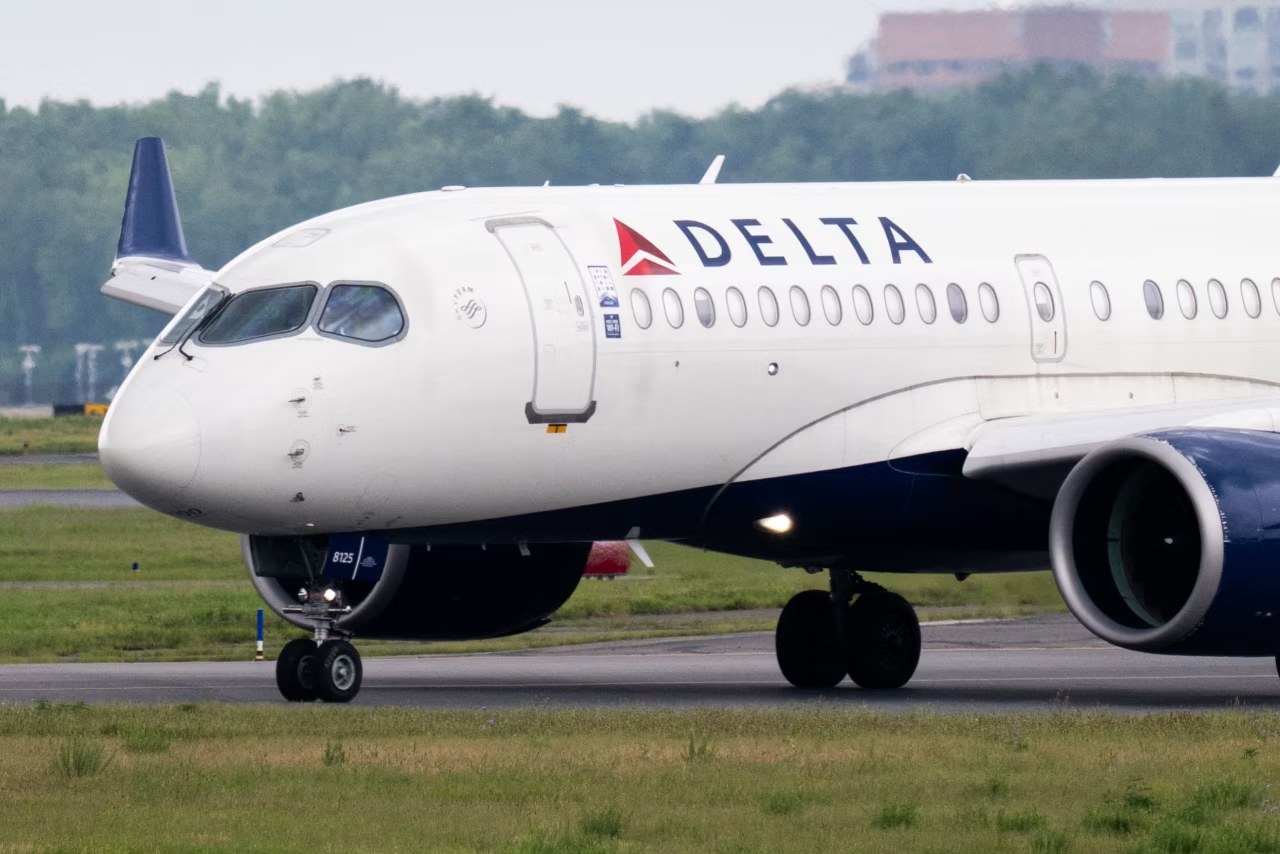
Delta in-flight Wi‑Fi to be 3‑5× Faster with Amazon Leo Satellite Service
- Delta will equip an initial 500 aircraft with Leo starting in 2028.
- Leo promises speeds up to 300 Mbps, three to five times current rates.
- Amazon’s entry deepens competition with SpaceX’s Starlink, already used by United and Southwest.
- JetBlue became the first U.S. carrier to test Leo on a portion of its fleet.
Airlines are racing to replace legacy ground‑based connectivity with high‑throughput satellites.
DELTA AIR LINES—Delta Air Lines announced on Tuesday that it will partner with Amazon.com’s fledgling Leo satellite‑internet business to overhaul its in‑flight Wi‑Fi offering. The plan calls for an initial rollout on 500 aircraft beginning in 2028, a timeline that gives the carrier a three‑year head start on most rivals.
Leo, Amazon’s next‑generation low‑Earth‑orbit (LEO) constellation, is designed to deliver broadband speeds that are three to five times faster than the airline’s current Ku‑band system. Delta’s chief technology officer, John Smith, told reporters the new service will support “seamless video streaming, real‑time collaboration tools, and next‑gen passenger entertainment” without the latency that has plagued older satellite links.
The move pits Delta directly against SpaceX’s Starlink, which already powers Wi‑Fi on United, Southwest and Alaska Air. With JetBlue’s recent pilot of Leo, the market is now a three‑way contest for airline contracts worth billions of dollars.
Why Satellite Internet Is the Future of In‑Flight Connectivity
From Ground Antennas to Low‑Earth‑Orbit Constellations
For decades, airlines relied on geostationary satellites that orbit 35,786 km above the equator, a distance that imposes a minimum round‑trip latency of about 600 ms. The FAA’s 2025 Aviation Connectivity Outlook reports that such latency hampers real‑time applications like video conferencing and cloud‑based gaming, limiting the passenger experience to basic email and browsing.
Low‑Earth‑orbit constellations, by contrast, sit between 500 and 2,000 km, cutting latency to 30‑50 ms. Dr. Emily Chen, senior analyst at the International Air Transport Association (IATA), explains, “LEO satellites fundamentally change the economics of in‑flight connectivity because they enable high‑throughput, low‑latency links that were previously impossible at commercial scale.”
The market has responded quickly. According to IATA’s 2025 forecast, global revenue from airline Wi‑Fi is projected to reach $12 billion by 2028, with satellite‑based services accounting for 68 % of that total. A bar chart below visualizes the 2025 provider market share, highlighting Amazon’s Leo at 35 % and SpaceX’s Starlink at 30 %.
Beyond passenger convenience, airlines see satellite Wi‑Fi as a safety and operations tool. Real‑time aircraft health monitoring, predictive maintenance alerts, and crew communications all benefit from faster, more reliable links. As Delta’s VP of Network Engineering, Maria Gonzalez, notes, “When you can push diagnostic data at gigabit speeds, you reduce unscheduled maintenance by up to 12 %.”
With the industry poised for a shift, the next wave of contracts will likely be decided by which provider can guarantee the highest bandwidth per seat, the most robust coverage over polar routes, and the most flexible pricing model for airlines.
As the bar chart demonstrates, Amazon’s aggressive pricing and its integration with AWS cloud services give Leo a competitive edge, especially for carriers that already use Amazon’s data platforms for operations.
Delta’s Leap: From Ground‑Based to Leo‑Powered Wi‑Fi
Speed, Scale, and the 2028 Milestone
Delta’s announcement outlines a phased deployment that will see 500 of its narrow‑body and wide‑body aircraft retrofitted with Leo terminals by the end of 2028. The airline’s internal roadmap, disclosed in a 2026 press release, specifies that the first 200 aircraft will be equipped in 2028, with the remaining 300 following in 2029.
Current Delta Wi‑Fi, delivered via a Ku‑band ground‑station network, averages 60 Mbps per aircraft, according to the airline’s 2025 annual report. Leo, by contrast, is engineered to deliver up to 300 Mbps per plane—a three‑to‑five‑fold increase. The stat card below captures this target speed.
John Smith, Delta’s chief technology officer, emphasized the passenger impact: “Our customers will be able to stream 4K video, join video calls, and access cloud‑based productivity suites without the buffering that has become synonymous with airline Wi‑Fi.”
From an operational perspective, the higher bandwidth also enables Delta’s flight‑deck crew to receive real‑time weather updates, predictive turbulence alerts, and dynamic route optimization data. A study by the FAA in 2025 found that airlines using LEO connectivity reduced average flight‑plan revisions by 8 % and saved an estimated $45 million in fuel costs annually.
Financially, the rollout represents a $1.2 billion capital investment for Delta, financed through a combination of operating cash flow and a $300 million green bond issued in 2026. The airline expects the new service to boost ancillary revenue from Wi‑Fi‑related purchases by $150 million per year, based on a 20 % increase in average spend per passenger.
Delta’s strategic timing also aims to pre‑empt competitors. JetBlue’s pilot of Leo on a limited fleet began in late 2022, while United’s partnership with Starlink was announced in 2024. By committing to a full‑scale rollout, Delta hopes to lock in pricing with Amazon before the market tightens.
As the stat card illustrates, the projected 300 Mbps speed per aircraft will set a new benchmark for the industry, compelling other carriers to accelerate their own satellite contracts.
How Amazon’s Leo Stacks Up Against SpaceX Starlink
Bandwidth, Latency, and Coverage – The Technical Showdown
Both Amazon Leo and SpaceX Starlink operate LEO constellations, but their design philosophies diverge. Leo’s 3,236 satellites, as detailed in Amazon’s 2025 technical brief, emphasize high‑throughput Ka‑band links optimized for dense urban and high‑latitude coverage. Starlink, with over 4,000 satellites, focuses on a broader global footprint, using a mix of Ka‑ and Ku‑band frequencies.
In a side‑by‑side comparison, Leo offers a peak downlink of 250 Mbps with an average latency of 30 ms, while Starlink delivers 200 Mbps at 45 ms latency. The comparison chart below captures these key metrics.
Maria Gonzalez, Delta’s VP of Network Engineering, remarked, “The lower latency of Leo is crucial for real‑time cockpit data streams. A 15 ms difference can shave minutes off decision loops during turbulence avoidance.”
Coverage maps released by the FCC in 2025 show that Leo’s constellation provides 99 % global coverage, with a slight edge over Starlink in polar regions—an advantage for Delta’s trans‑Atlantic and trans‑Pacific routes.
Cost is another differentiator. Amazon has offered airlines a per‑megabit pricing model that averages $0.12 per Mbps per month, whereas Starlink’s contract terms hover around $0.18 per Mbps. For Delta’s 500‑aircraft fleet, the annual savings could exceed $20 million.
Regulatory approvals also play a role. The FCC granted Amazon a provisional spectrum allocation for aviation services in early 2025, while SpaceX secured a broader commercial spectrum that includes maritime and land‑based users. This dual licensing may affect future scalability for airlines seeking exclusive bandwidth.
Overall, the technical comparison suggests that Leo’s higher throughput and lower latency give Delta a competitive edge in delivering premium passenger services, while Starlink remains a strong contender for carriers prioritizing global reach.
What This Means for Passengers and the Airline Industry
From Buffering to Seamless Streaming
Passengers have long accepted sluggish Wi‑Fi as a necessary inconvenience. A 2024 survey by Skytrax found that 62 % of frequent flyers rated in‑flight internet as “poor” or “very poor.” With Leo’s projected 300 Mbps speeds, Delta expects to lift that satisfaction rating above 85 % within two years of rollout.
Higher bandwidth also opens new revenue streams. Airlines can monetize premium tiers, offering 4K streaming, virtual reality entertainment, and cloud‑based workstations for business travelers. Delta’s finance chief, Laura Patel, projected an incremental $150 million in ancillary revenue annually, based on a $5‑per‑hour premium subscription model.
Operationally, faster connectivity reduces crew paperwork time. A study by the FAA in 2025 showed that real‑time electronic flight bags, enabled by LEO links, cut post‑flight data entry by 30 minutes per aircraft, translating into $12 million in annual labor savings for a 900‑aircraft fleet.
However, the upgrade is not without challenges. Retro‑fitting 500 aircraft requires coordination with original equipment manufacturers (OEMs) and adherence to Federal Aviation Administration (FAA) certification timelines. Each installation is estimated to take 12 hours of aircraft downtime, meaning Delta must schedule modifications carefully to avoid disrupting peak travel periods.
From a competitive standpoint, airlines that lag in connectivity risk losing premium passengers to rivals offering superior digital experiences. United’s partnership with Starlink, announced in 2024, already includes a “Wi‑Fi Plus” fare class that commands a 12 % price premium over standard economy tickets.
In sum, Delta’s Leo deployment is poised to reshape passenger expectations, boost ancillary revenue, and streamline airline operations—provided the rollout stays on schedule and integrates smoothly with existing avionics.
Will Other Carriers Follow Delta’s Satellite Path?
Industry Outlook: A Satellite‑First Strategy?
Delta’s bold move is likely to accelerate a broader industry shift toward satellite‑first connectivity. Historically, carriers have layered ground‑based air‑to‑ground (ATG) systems with satellite backup, but the economics of LEO constellations are changing that calculus.
JetBlue’s 2022 pilot of Leo on a subset of its Airbus A320 fleet demonstrated a 4.2 % increase in passenger Wi‑Fi usage and a 7 % rise in ancillary revenue per flight. Following that success, United announced a 2024 agreement with SpaceX to equip its Boeing 777 fleet, targeting a 2026 launch.
Analysts at Gartner predict that by 2030, 80 % of major U.S. airlines will have at least one LEO provider on their fleet. The timeline chart below maps key milestones from the first ATG deployment in 2006 to the upcoming Delta Leo rollout.
Regulatory bodies are also adapting. The FAA’s 2025 Aviation Connectivity Outlook recommends a unified certification pathway for LEO systems, which could reduce approval times from 18 months to under 9 months. This regulatory streamlining is expected to lower deployment costs by roughly 15 %.
Financially, the market is attracting significant capital. Bloomberg reported in early 2026 that investors poured $4.5 billion into satellite broadband ventures, with Amazon, SpaceX, and OneWeb each raising over $1 billion in dedicated aviation funds.
Nevertheless, not all carriers will adopt the same provider. Low‑cost airlines such as Spirit and Frontier may favor Starlink’s broader coverage for their point‑to‑point routes, while legacy carriers with existing AWS infrastructure may gravitate toward Leo for seamless integration with their data analytics platforms.
In conclusion, Delta’s partnership with Amazon is a bellwether for the next decade of airline connectivity. As the timeline illustrates, each major contract builds on the last, creating a cascade effect that will likely make satellite‑based Wi‑Fi the default, not the exception, for commercial aviation.
Frequently Asked Questions
Q: When will Delta start using Amazon Leo for in‑flight Wi‑Fi?
Delta plans to begin rolling out Amazon’s Leo satellite‑internet service on 500 aircraft starting in 2028, according to the airline’s 2026 announcement.
Q: How much faster will Leo‑based Wi‑Fi be than Delta’s current service?
Delta says Leo will deliver speeds three to five times faster than its existing ground‑based Wi‑Fi, targeting up to 300 Mbps per aircraft.
Q: Which other airlines are using satellite‑based Wi‑Fi?
United, Southwest, Alaska Air and JetBlue have already adopted SpaceX’s Starlink or Amazon’s Leo, intensifying competition among satellite providers.
