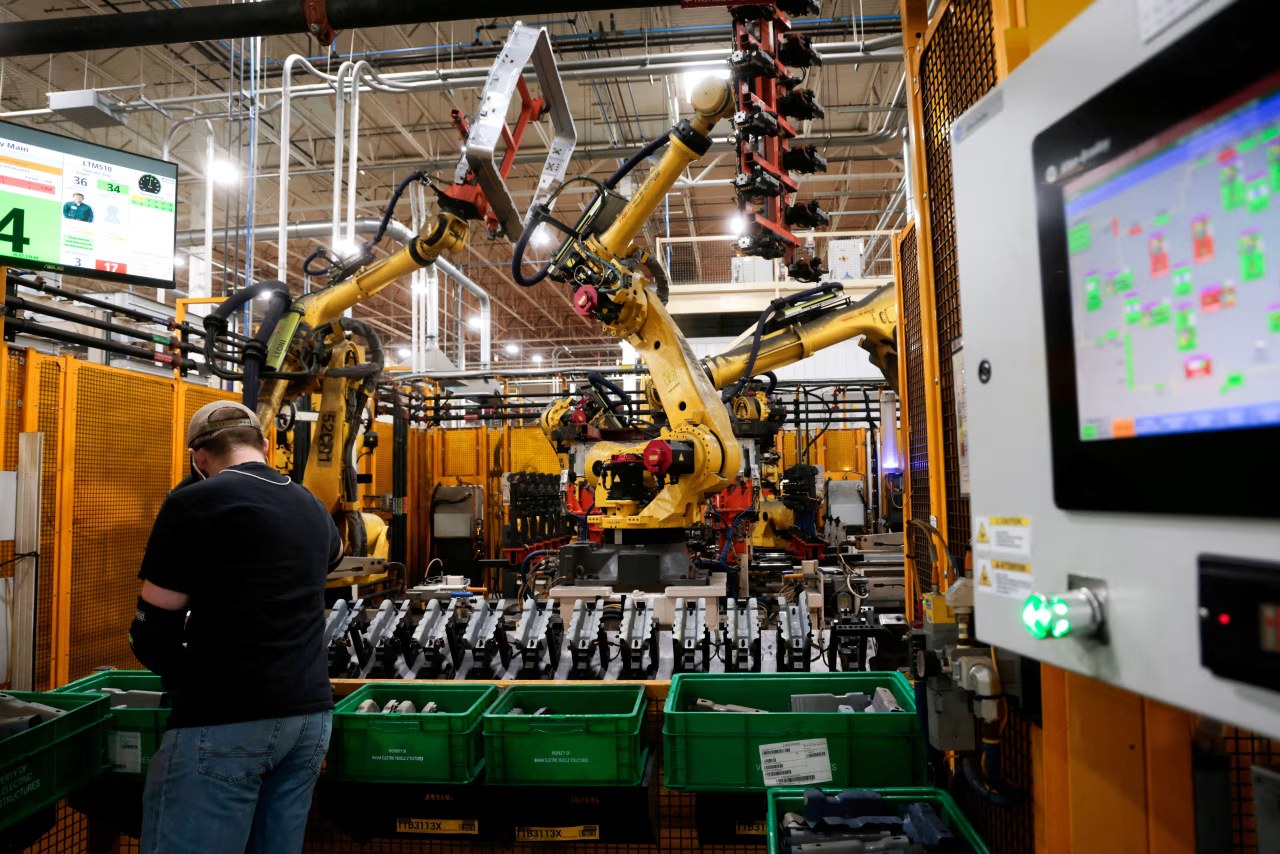
Michigan’s EV Dream Faces a Stark Reality with Over 1 Million Square Feet of Underutilized Factory Space
- Magna International’s million-square-foot EV battery enclosure plant in St. Clair, Michigan, built for General Motors, is largely empty and unprofitable five years after its construction.
- General Motors recently idled its Detroit factory producing large electric trucks, citing weak demand for the very vehicles Magna was contracted to supply components for.
- Despite a surge in gas prices, GM’s CFO Paul Jacobson indicates it would require four to six months of sustained high prices for consumers to significantly reconsider more fuel-efficient options.
- The rapid pivot from internal combustion engine production to electric vehicles presents significant, long-term supply chain and manufacturing retooling challenges for the auto industry.
From Ambitious Vision to Unsettling Vacancy: The Shifting Tides of Automotive Manufacturing
ELECTRIC VEHICLES—The vision was clear and compelling: a future where electric vehicles dominated American roadways, supported by a burgeoning domestic manufacturing base. In St. Clair, Michigan, this future began to take shape with the construction of a sprawling, million-square-foot factory by Magna International, one of North America’s largest auto-parts suppliers. This state-of-the-art facility was purpose-built to produce battery enclosures for General Motors’ new electric pickup trucks, a cornerstone project that promised years of robust activity and a powerful symbol of the nation’s commitment to an electrified automotive landscape. The initial excitement was palpable, reflecting a broader industry-wide zeal for the electric revolution.
However, five years after its inception, the reality on the ground paints a far more somber picture. The once-bustling promise of the Magna plant has largely evaporated, leaving behind a facility that is now mostly empty and struggling with significant financial losses. This stark reversal is not an isolated incident but rather a poignant symptom of a wider, often turbulent, transition within the American automotive sector—a messy breakup with the unbridled enthusiasm for electric vehicles that characterized the preceding years. The idled machinery and silent production lines underscore a profound misalignment between ambitious investment and evolving consumer demand.
Even the recent escalation of gas prices, spurred by geopolitical tensions in regions like Iran, has failed to ignite the anticipated resurgence in consumer interest for electric vehicles. While enthusiasts might hope for a renewed look at EVs, major players like Magna and its key client, General Motors, are demonstrably moving in the opposite direction, actively scaling back their substantial investments in electric vehicle production. This strategic recalibration highlights the immense challenges of rapidly transforming an entire industrial ecosystem, particularly when consumer behavior and economic indicators remain volatile. As the industry grapples with these shifts, the path forward for the electric vehicle industry slowdown becomes increasingly uncertain, demanding a closer examination of the factors at play.
The Dawn of a New Era: Initial EV Optimism and Greenfield Investments
The early 2020s heralded a period of unprecedented optimism and investment in the electric vehicle sector, driven by ambitious climate goals, government incentives, and a fervent belief in the inevitability of an electrified future. Auto manufacturers, buoyed by robust projections, poured billions into retooling existing plants and establishing entirely new greenfield facilities across North America. Magna International’s decision to construct a massive million-square-foot factory in a Michigan cornfield was emblematic of this era, representing a bold commitment to becoming a linchpin in the burgeoning EV supply chain. This investment was directly tied to a substantial, multi-year contract to supply crucial battery enclosures for General Motors’ next-generation electric pickup trucks, a deal that promised stability and growth for decades to come. According to an analysis by S&P Global Mobility, the period between 2020 and 2023 saw an estimated cumulative investment of over $100 billion by automakers and suppliers in North American EV production capabilities. This financial commitment was aimed at accelerating the transition away from fossil fuels, fostering domestic manufacturing jobs, and positioning the U.S. at the forefront of the global electric vehicle race. Magna’s St. Clair plant, strategically located in Michigan’s traditional automotive heartland, was designed not just for scale but also for efficiency, leveraging advanced automation to produce complex battery enclosures essential for GM’s Ultium platform. The prospect of such a large-scale, dedicated EV component facility generated considerable excitement, promising to anchor a significant number of high-tech manufacturing jobs in the region. Local communities celebrated these developments as a revitalization of the Rust Belt, transforming it into an ‘EV Belt’ of innovation and opportunity. However, the very speed and scale of this expansion laid the groundwork for potential vulnerabilities. The long lead times inherent in constructing and commissioning such vast industrial complexes meant that by the time these facilities were operational, market dynamics could—and did—shift. Experts like Sam Fiorani, Vice President at AutoForecast Solutions, frequently cautioned that while the long-term trajectory for EVs was positive, the short-term adoption rate would be subject to economic headwinds and infrastructure development. The initial projections, while aggressive, often did not fully account for the multifaceted challenges of consumer adoption, ranging from charging anxiety to vehicle affordability. The foundational assumption was that demand would perpetually outstrip supply, a scenario that has proven more nuanced than anticipated. The ambitious vision of the initial investment boom now contrasts sharply with the emerging realities, setting the stage for a period of significant recalibration within the electric vehicle industry slowdown, the implications of which will ripple through the entire automotive ecosystem.The Unsettling Silence: When Optimism Meets Economic Reality
The ambitious vision for a vibrant EV manufacturing hub in St. Clair, Michigan, has been replaced by an unsettling silence. Five years after its groundbreaking, Magna International’s expansive million-square-foot plant, once heralded as a beacon of the new automotive era, now stands largely empty and, critically, is losing money. This dramatic shift from anticipated prosperity to economic struggle underscores the volatility inherent in pioneering new industrial frontiers. The facility, designed to churn out crucial battery enclosures for General Motors’ electric trucks, is a vivid illustration of the challenges facing the electric vehicle industry slowdown, where even robust contracts cannot guarantee sustained utilization amidst a changing market. The immediate trigger for Magna’s predicament is the weakening demand for the very electric trucks it was commissioned to support. General Motors, a titan of American manufacturing, recently made the difficult decision to idle its Detroit factory, where these large electric trucks were being assembled. This move by GM is a direct response to a market that has not embraced these vehicles with the speed and volume initially projected. For suppliers like Magna, whose business models are often deeply intertwined with the production schedules of major automakers, such a shutdown has immediate and severe consequences, translating directly into vast amounts of unused capacity and mounting operational losses. The downstream effects are considerable, impacting everything from raw material orders to local employment. This phenomenon of underutilized and struggling EV-dedicated plants is not unique to St. Clair. Across the country, dozens of similar facilities, once bustling with construction and hiring, now stand desolate or are operating at a fraction of their planned capacity. This nascent ‘EV Rust Belt,’ as some are calling it, mirrors the struggles of traditional manufacturing regions during past economic transformations. Dr. Sarah Miller, an economist specializing in industrial transitions at the Brookings Institution, notes that “the rapid scaling of production ahead of confirmed demand creates a significant risk profile, particularly for capital-intensive industries. The shift to EVs, while necessary, was always going to be a bumpy road, and we’re seeing those bumps now manifest in underutilized assets.” The financial drain of maintaining a million-square-foot facility with minimal output can be substantial, impacting Magna’s bottom line and potentially leading to further strategic adjustments. The company, like many in the sector, faces the difficult balancing act of preserving long-term capabilities while navigating immediate financial pressures. The idled GM factory and the quiet Magna plant serve as potent reminders that the journey to an all-electric automotive future is far from linear, and the economic realities of the present demand careful attention as the electric vehicle industry slowdown continues to reshape investment strategies.Beyond the Pump: Why High Gas Prices Aren’t Rescuing EV Demand
The recent surge in gas prices, fueled by global geopolitical events like the war in Iran, would, on the surface, seem like a natural catalyst for renewed interest in fuel-efficient vehicles, especially electric ones. Conventional wisdom suggests that when the cost of filling up a tank skyrockets, consumers pivot towards alternatives that promise lower running costs. However, the current reality for the electric vehicle industry slowdown indicates a more complex interplay of factors, where pump prices alone are insufficient to overcome existing barriers to EV adoption. Automakers and suppliers are observing that the connection between gas prices and EV purchases is not as direct or immediate as once presumed. General Motors’ Chief Financial Officer, Paul Jacobson, recently articulated this nuanced perspective, stating that it would take a sustained period of four to six months of consistently higher gas prices for most American car buyers to genuinely reconsider more fuel-efficient vehicles. His candid assessment, “We certainly don’t see it today,” highlights the inertia within consumer purchasing habits and the depth of other deterrents to EV adoption. This timeframe suggests that short-term price spikes, while impactful on household budgets, rarely translate into instant, fundamental shifts in major vehicle purchases, which are typically long-term investments involving significant financial outlay and planning.Consumer Hesitation: More Than Just Fuel Costs
Multiple factors beyond the immediate cost of gasoline contribute to consumer hesitation regarding EVs. High interest rates, for instance, significantly increase the total cost of ownership for new vehicles, making the premium price point of many EVs less appealing. Concerns about the availability and reliability of charging infrastructure, often termed ‘range anxiety’ or ‘charging anxiety,’ remain a significant psychological barrier. Furthermore, the perceived depreciation of early EV models and the lack of diverse, affordable options in certain vehicle segments continue to weigh on buyers’ minds. A recent survey by J.D. Power indicated that while interest in EVs is growing, only about 26% of consumers are ‘very likely’ to consider an EV for their next purchase, down from earlier peaks, citing concerns over charging, cost, and range. Ultimately, the decision to purchase an EV is a complex one, influenced by a blend of economic realities, practical considerations, and personal preferences. While persistent high gas prices might nudge some consumers towards the electric option, they are proving insufficient on their own to overcome the broader set of challenges currently facing the electric vehicle industry slowdown. This suggests that the industry’s path to widespread adoption requires more than just favorable fuel economics; it demands a holistic approach to infrastructure, affordability, and product diversity to truly reshape buyer behavior and revitalize manufacturing investments.The High Stakes of Pivoting: Retooling and Supply Chain Vulnerabilities
The transition from manufacturing internal combustion engine (ICE) vehicles to electric vehicles represents one of the most significant industrial pivots in modern history, fraught with immense challenges and high stakes. It requires not just new product designs but a wholesale re-engineering of entire production processes and the establishment of complex, globally interconnected supply chains. For companies like Magna International, whose new factory in Michigan stands underutilized, this pivot can take years to implement fully and even longer to become profitable, especially when market conditions shift unexpectedly. The difficulty lies in the sheer scale of retooling, retraining, and reimagining an industrial apparatus built over a century. Manufacturing an EV is fundamentally different from building a gasoline-powered car. It involves different materials, components, and assembly techniques, with batteries being the most prominent new element. Creating a robust and resilient supply chain for EV components, from raw materials like lithium and cobalt to advanced electronics and, in Magna’s case, battery enclosures, is a monumental task. The initial rush to build capacity, often based on aggressive sales forecasts, has now exposed vulnerabilities in this nascent supply chain. When demand falters, as it has for GM’s electric trucks, the domino effect is swift and painful, leading to production slowdowns, order cancellations, and, ultimately, underutilized assets.The Cost of Industrial Transformation
Industry analysts at institutions like the Center for Automotive Research (CAR) consistently highlight the immense capital expenditure required for this transformation. Retooling a single assembly plant for EV production can cost hundreds of millions to over a billion dollars. This includes installing new machinery for battery pack assembly, enhancing robotics for lighter materials, and establishing advanced testing facilities. The consequence of these long-term, fixed investments being met with short-term demand fluctuations is a significant drag on profitability, exemplified by Magna’s plant losing money. The idling of GM’s Detroit factory, which produced the large electric trucks Magna supplied, is a stark reminder of how quickly these investments can turn from assets into liabilities when market conditions shift against initial projections for the electric vehicle industry slowdown. The strategic implications for the automotive sector are profound. Companies must weigh the imperative of electrifying their fleets against the immediate economic realities of slower adoption rates and the substantial costs of maintaining excess capacity. The ability to pivot factories and supply chains from one vehicle type to another is not a swift process; it requires foresight, flexibility, and often, significant financial resilience. As the market continues to evolve, automakers and their suppliers will face ongoing pressure to optimize their manufacturing footprints and supply chains to navigate the persistent challenges within the electric vehicle industry slowdown.Navigating the New Normal: Strategic Decisions for a Maturing EV Market
The current landscape of the electric vehicle industry slowdown represents a critical inflection point, moving from an era of unchecked expansion to one of cautious optimization. Automakers and their extensive supply networks are now tasked with navigating a ‘new normal’ where the path to full electrification is recognized as more protracted and complex than initially envisioned. This reality demands a reevaluation of strategic decisions, balancing aggressive future targets with present-day market realities, as companies like GM and Magna demonstrate the consequences of this recalibration. The future trajectory of EV investments hinges significantly on sustained consumer confidence, which in turn is tied to advances in charging infrastructure, competitive pricing, and a broader array of vehicle options. Industry leaders, including Mary Barra, CEO of General Motors, have reiterated their long-term commitment to an all-electric future, yet the immediate necessity to adjust production schedules and investment flows is undeniable. This includes making tough choices, such as idling factories or deferring planned expansions, to align supply more closely with current demand. These decisions, while painful in the short term, are deemed essential for long-term financial health and sustainable growth within the electric vehicle industry slowdown.Long-Term Vision vs. Short-Term Pressures
Analyses from institutions like the U.S. Department of Energy’s Alternative Fuels Data Center suggest that while global EV sales continue to grow year-over-year, the *rate* of growth has normalized from its earlier exponential trajectory. This maturation requires a more deliberate approach to capital allocation. For a company like Magna, having a million-square-foot facility largely empty is a significant operational burden, prompting discussions about diversifying its capabilities or reallocating resources. The challenge lies in maintaining technological leadership and supply chain readiness without incurring crippling costs from underutilized assets. This delicate balance is central to corporate strategy as the industry adapts to a more tempered growth outlook. Looking ahead, the resilience of the automotive sector will be tested by its ability to adapt to these evolving market conditions. Future investment strategies will likely be characterized by greater flexibility, modular manufacturing approaches, and a stronger emphasis on consumer-centric development. While the war in Iran may temporarily elevate gas prices, the long-term structural issues impacting EV adoption—cost, infrastructure, and consumer preference—will continue to shape the industry’s pace. The lessons learned from the current electric vehicle industry slowdown, particularly in Michigan’s manufacturing heartland, will undoubtedly inform how the global automotive industry moves forward in its ambitious, yet increasingly complex, journey towards an electrified future.Economic Ripple Effects: The Broader Impact on Workforce and Regional Economies
The electric vehicle industry slowdown has far-reaching economic ripple effects that extend well beyond the balance sheets of major automakers and their primary suppliers. The idled factories and underutilized plants, such as Magna International’s facility in St. Clair, Michigan, have a direct and profound impact on local workforces and regional economies. When production lines slow or cease, it translates into reduced shifts, temporary layoffs, and, in some cases, permanent job losses, challenging the promise of a revitalized manufacturing sector that was once a hallmark of the EV transition. The initial boom in EV manufacturing created significant anticipation for job creation, particularly in traditional automotive hubs. Communities in states like Michigan, Ohio, and Tennessee welcomed new factory announcements and investment commitments, envisioning stable, high-paying jobs for their residents. However, the current slowdown threatens to undermine these aspirations. For the workers in the Detroit factory idled by GM, or those at Magna’s underperforming plant, the uncertainty of their employment status casts a long shadow. This instability affects not only individual families but also the broader local economies, impacting small businesses, housing markets, and municipal tax revenues.Reskilling the Workforce for Future Transitions
Experts in labor economics, such as Dr. Robert Bruno from the University of Illinois’s School of Labor and Employment Relations, highlight that industrial transitions always involve a degree of workforce displacement. “The challenge with the EV transition,” Dr. Bruno notes, “is its rapid pace and the specific new skill sets required. When demand suddenly shifts, workers trained for one type of EV production might find their skills temporarily mismatched to available opportunities, even if the long-term outlook for electrification remains positive.” This underscores the need for proactive reskilling and workforce development programs to mitigate the impact of market volatility on the labor force. Furthermore, the long-term plans to roll back EV investments by major automakers indicate a strategic shift that could have lasting consequences for regional economic development. Governments that offered incentives for EV plant construction now face the potential for reduced returns on those investments if the anticipated job growth and economic activity do not materialize as initially projected. The situation in Michigan serves as a critical case study in the complexities of managing such an industrial transformation, where macroeconomic forces and consumer sentiment can swiftly alter even the most meticulously laid plans. As the electric vehicle industry slowdown continues to evolve, policymakers and industry leaders alike must confront these broader societal and economic implications, ensuring a more equitable and stable transition for the workforce and the communities that depend on it.Frequently Asked Questions
Q: What is driving the electric vehicle industry slowdown?
The electric vehicle industry slowdown is influenced by several factors, including fluctuating consumer demand, higher interest rates affecting vehicle financing, concerns over charging infrastructure availability, and the premium price point of many EV models compared to their gasoline counterparts. Automakers like GM are adjusting production in response to these market dynamics, impacting suppliers like Magna International.
Q: How long do rising gas prices need to persist to impact EV sales?
According to GM’s Chief Financial Officer Paul Jacobson, it would take a sustained period of four to six months of higher gas prices for American car buyers to significantly reconsider purchasing more fuel-efficient vehicles, including electric models. This suggests that short-term price spikes have less impact on long-term purchase decisions within the electric vehicle industry slowdown.
Q: What are the challenges for manufacturers in pivoting to EVs?
Pivoting manufacturing operations and supply chains from traditional internal combustion engines to electric vehicles is a complex and capital-intensive endeavor. It involves retooling factories, retraining workers, and developing entirely new supply chains for components like batteries. As seen with Magna International, this pivot can take years, making sudden shifts in market demand particularly disruptive and costly for the electric vehicle industry.
