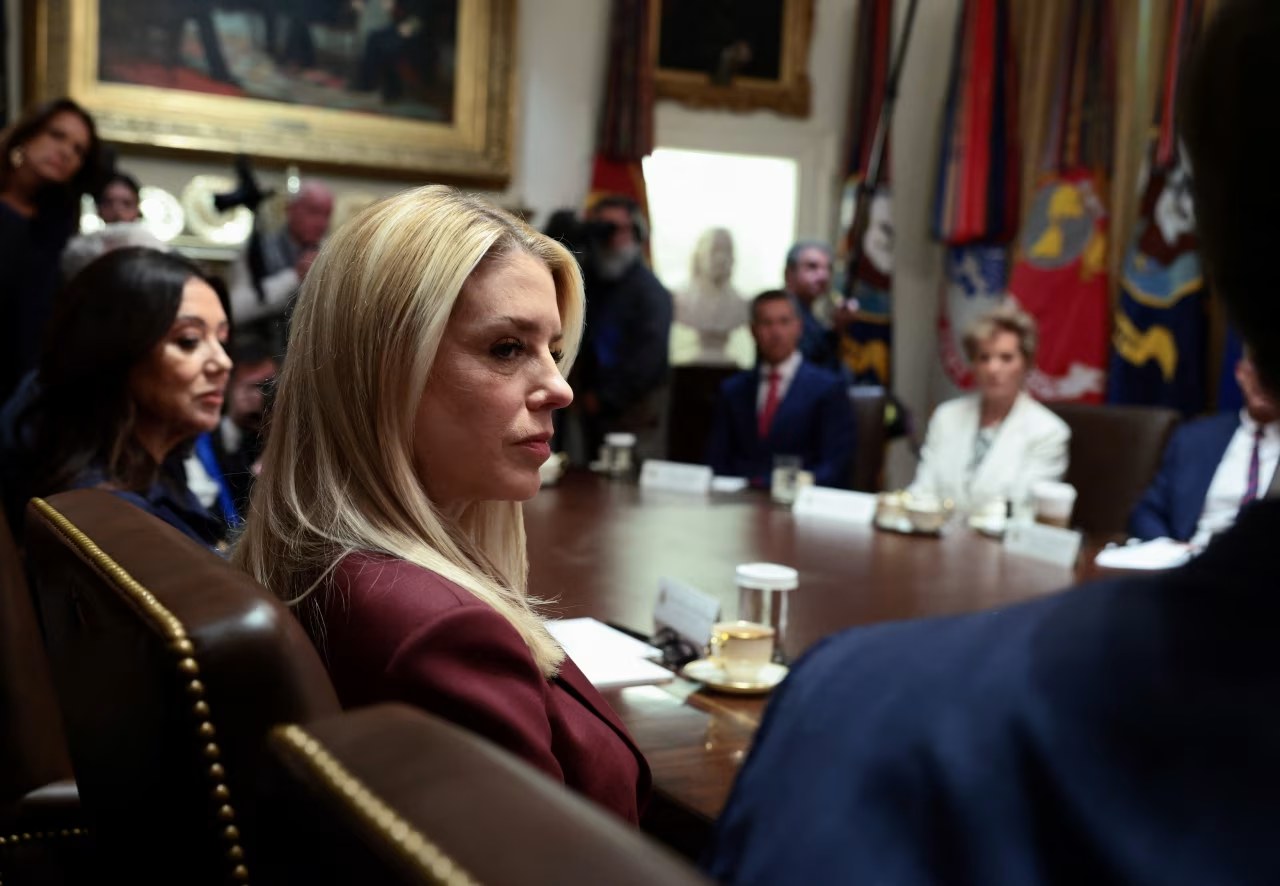
Attorney General Bondi’s yearlong tenure concludes amid scrutiny over prosecutions and the Epstein scandal.
- Attorney General Bondi was dismissed by President Trump after approximately one year in office.
- The firing was linked to perceived ‘failed efforts to prosecute Trump’s favored targets’ and ‘mismanagement of the Jeffrey Epstein scandal.’
- Bondi is expected to transition into a new role within the private sector following her departure.
- Deputy Attorney General Todd Blanche has assumed the role of acting Attorney General.
- EPA head Lee Zeldin is reportedly under consideration as the next permanent Attorney General.
A Pivotal Dismissal: Navigating Justice, Presidential Will, and Public Accountability
TRUMP ADMINISTRATION—In a decisive move that reverberated through Washington, President Trump announced the dismissal of Attorney General Bondi, concluding her yearlong tenure atop the Justice Department. This significant personnel change underscores the inherent tensions between presidential expectations and the often-independent operations of the nation’s top law enforcement agency. The abrupt Attorney General firing signals a clear intent to realign the Justice Department with White House priorities, particularly in areas of high political sensitivity and public scrutiny.
The reasons cited for Bondi’s departure — specifically, her alleged ‘failed efforts to prosecute Trump’s favored targets’ and concerns from the president and his advisers regarding her handling of the Jeffrey Epstein scandal — point to a complex interplay of political will, prosecutorial discretion, and the immense pressure placed on those who lead federal investigations. Such a high-profile exit inevitably invites a deeper examination of the forces shaping federal law enforcement in a highly charged political environment, prompting questions about the delicate balance between executive authority and judicial independence.
As the administration pivots to an interim leader, Deputy Attorney General Todd Blanche, and considers new nominees like EPA head Lee Zeldin, the implications of this leadership transition extend far beyond the individuals involved. It casts a spotlight on the foundational principles of justice administration and the enduring challenge of maintaining public trust in an era of intense political polarization. The path forward for the Justice Department, under new guidance, will undoubtedly be shaped by the precedents and pressures that culminated in this consequential Attorney General firing, setting the stage for subsequent chapters exploring these critical dimensions.
The Weight of Executive Expectation: An Attorney General’s Precarious Position
The sudden announcement of Attorney General Bondi’s dismissal by President Trump, after what was described as a yearlong tenure, highlights the inherent fragility of even the most senior cabinet positions when presidential expectations clash with departmental outcomes. In the American system of government, the Attorney General serves as the nation’s chief law enforcement officer, a role that demands both loyalty to the executive branch and unwavering adherence to the rule of law. This duality often places the Attorney General in a precarious position, caught between political imperatives and the imperative of justice. When the White House explicitly cites ‘failed efforts to prosecute Trump’s favored targets’ as a reason for an Attorney General firing, it immediately raises fundamental questions about the independence of the Justice Department, a cornerstone of democratic governance.Navigating the Demands of Power and Principle
Legal scholars and political analysts often emphasize that the Justice Department, while part of the executive branch, operates with a degree of independence from direct political interference in specific cases. This separation is crucial to prevent the weaponization of law enforcement for political ends. However, the President, as the ultimate head of the executive branch, retains the authority to appoint and remove cabinet members, including the Attorney General. This constitutional power provides a mechanism for presidential control, but its exercise in the context of prosecutorial decisions can spark considerable debate. For an Attorney General like Bondi, her yearlong tenure was defined by the challenge of navigating these complex dynamics, responding to both the demands of the President and the professional obligations of her office. When a president expresses a desire for the prosecution of ‘favored targets,’ it places immense pressure on the Attorney General to deliver results that align with the administration’s political agenda. The phrase itself can be interpreted in various ways, from a general alignment on policy enforcement to specific demands regarding individuals or groups. When these ‘efforts’ are deemed to have ‘failed,’ it can imply a host of issues: perhaps insufficient evidence, legal barriers, or a different interpretation of prosecutorial merit by the Justice Department’s career professionals. Political observers suggest that such a statement can signal a perception from the executive that the Justice Department was not sufficiently aggressive in pursuing cases deemed important by the White House, regardless of the legal complexities involved. The implications of such a presidential directive, whether explicit or implicit, are profound. An Attorney General must weigh the political cost of non-compliance against the ethical and legal obligations to uphold justice impartially. The Attorney General firing, in this context, serves as a stark reminder of the executive’s power to shape the direction of federal law enforcement and underscores the intense scrutiny faced by those in the Justice Department’s highest office. The successor to Bondi will undoubtedly inherit this challenging landscape, facing immediate pressure to align with the administration’s legal priorities while upholding the integrity of the institution.The Shadow of Scandal: Mismanagement of the Jeffrey Epstein Case
Beyond the general disappointment over unfulfilled prosecutorial goals, the President and his advisers specifically pointed to the ‘mismanagement of the Jeffrey Epstein scandal’ as a critical factor in Attorney General Bondi’s departure. This particular accusation places the Attorney General firing within a broader narrative of public trust and accountability, given the global outrage and intense media scrutiny surrounding Epstein’s crimes and the subsequent legal proceedings. The Jeffrey Epstein case, involving allegations of sex trafficking and abuse of minors, transcended typical legal disputes, becoming a potent symbol of perceived injustices and the vulnerability of powerful individuals to accountability.Public Trust and Prosecutorial Oversight
For any Attorney General, the handling of a high-profile case like that of Jeffrey Epstein carries immense weight. The public expects swift, thorough, and transparent justice, especially when the allegations involve such heinous acts and potentially implicate influential figures. When the term ‘mismanagement’ is applied by the White House, it suggests a perceived failure in leadership, strategic decision-making, or operational effectiveness within the Justice Department concerning this specific, highly sensitive investigation. This could relate to various aspects: the pace of the investigation, the handling of evidence, engagement with victims, or public communications surrounding the case. The perception of mismanagement can quickly erode public confidence in the Justice Department’s capacity to deliver impartial justice, particularly in cases involving the powerful and well-connected. The political implications of the Epstein scandal were immense, placing tremendous pressure on federal law enforcement to demonstrate competence and impartiality. Any perceived missteps, whether real or imagined, could be amplified in the public sphere and directly impact the standing of the Attorney General. The fact that the President and his advisers specifically invoked this scandal underscores its salience in the decision to initiate the Attorney General firing. It suggests that the handling of this particular case was viewed as a significant test of the Justice Department’s leadership, and Bondi’s performance, from the administration’s perspective, did not meet the required standard. This element of the dismissal signals the administration’s sensitivity to public opinion and high-stakes legal outcomes, indicating a desire for a more assertive or politically aligned approach to such matters. The successor will face immediate pressure to demonstrate effective leadership in complex, publicly charged cases.The Interim and the Future: Todd Blanche and Lee Zeldin’s Potential Path to Justice
With the immediate void left by Attorney General Bondi’s dismissal, the machinery of government swiftly moved to ensure continuity of leadership at the Justice Department. Deputy Attorney General Todd Blanche has stepped into the role on an acting basis, a common procedural step designed to maintain stability during leadership transitions. An acting Attorney General, while possessing the full powers of the office, typically serves with the understanding that their tenure is temporary, awaiting a permanent nominee. This interim period is often characterized by cautious management, as the acting head navigates ongoing departmental operations while the White House considers its long-term strategy for the Justice Department.A Shift in Departmental Leadership
Beyond the immediate acting appointment, President Trump’s consideration of EPA head Lee Zeldin as Bondi’s successor introduces a new dimension to the leadership transition. Zeldin, currently leading the Environmental Protection Agency, brings a different professional background to the table compared to a career prosecutor or judge typically considered for the Attorney General role. While a background in law is essential, leading the EPA involves significant policy, regulatory, and administrative experience, which, while valuable, diverges from the core prosecutorial and national security functions of the Justice Department. This potential nomination signals a willingness by the administration to look beyond traditional legal circles for its top law enforcement official, possibly reflecting a desire for a leader whose strengths align with broader administrative or political goals. The process of confirming a new Attorney General is a significant undertaking, requiring Senate approval. During this period, the acting Attorney General, Todd Blanche, will be tasked with overseeing the department’s vast responsibilities, from criminal investigations and national security matters to civil litigation and antitrust enforcement. His leadership will be critical in maintaining the department’s operational integrity and morale. Meanwhile, Lee Zeldin’s potential nomination would spark a thorough examination of his qualifications, past professional conduct, and legal philosophy by the Senate. This process is often highly politicized, serving as a forum for debate over the administration’s approach to justice and law enforcement. The choice of a permanent Attorney General following this Attorney General firing will undoubtedly set the tone for the Justice Department for the remainder of the presidential term, influencing policy, enforcement priorities, and the department’s perceived independence. The scrutiny of a nominee’s background, particularly from a non-traditional agency head, would be intense, setting the stage for a critical legislative battle.What are the Broader Implications of an Attorney General Firing for the Justice Department?
An Attorney General firing, particularly under the circumstances described, extends its impact far beyond the individuals directly involved, reverberating throughout the Justice Department and casting a long shadow over its future direction. The Justice Department, with its sprawling network of U.S. Attorneys, federal agents, and legal professionals, is designed to operate as an impartial arbiter of the law, insulated from daily political pressures. However, a presidential dismissal of its chief can send a powerful message about the administration’s expectations for legal outcomes and its willingness to assert executive authority over areas typically guarded for their independence.Maintaining Trust in Federal Law Enforcement
Such a high-level change can create uncertainty and impact morale within the department. Career prosecutors and agents, committed to upholding the law without fear or favor, might perceive an Attorney General firing as a sign of politicization, potentially affecting their willingness to pursue investigations that might displease the White House. This perception, whether accurate or not, is critical because public trust in the Justice Department’s integrity is paramount. If the public views the department as overly influenced by political considerations, the legitimacy of its actions, from indictments to policy enforcement, can be undermined. This erosion of trust can have lasting consequences for the rule of law and the public’s faith in the fairness of the justice system. The stated reasons for Bondi’s dismissal — ‘failed efforts to prosecute Trump’s favored targets’ and ‘mismanagement of the Jeffrey Epstein scandal’ — are particularly revealing. They suggest a desire for a Justice Department leadership that more closely aligns with the President’s personal and political objectives. This raises questions about the scope of an Attorney General’s independence, particularly concerning investigations that touch upon presidential interests or high-profile public controversies. Legal experts often debate the appropriate balance, acknowledging the President’s constitutional authority while advocating for the Justice Department’s operational autonomy to prevent abuse of power. The incoming leadership will therefore face the immediate challenge of reassuring both the department’s employees and the American public of its commitment to impartial justice, even as it navigates the political realities that precipitated the Attorney General firing. This ongoing tension between executive will and institutional independence will undoubtedly define the Justice Department’s trajectory in the coming months, influencing everything from prosecutorial priorities to the very perception of justice in America.Repercussions and Precedents: Shaping the Future of Executive Authority and Justice
The Attorney General firing, occurring after Bondi’s yearlong tenure, sets a significant precedent for the exercise of presidential power and the perceived autonomy of the Justice Department. In the annals of American political history, presidential dismissals of cabinet members are not uncommon, but when the head of federal law enforcement is removed under such explicit circumstances—citing disagreements over prosecutorial priorities and the handling of sensitive cases—it invariably sparks broader discussions about the boundaries of executive authority. This event serves as a vivid illustration of the delicate balance between a President’s constitutional right to staff their administration as they see fit and the institutional imperative for the Justice Department to remain insulated from political pressure.The Enduring Debate on Judicial Independence
From the perspective of constitutional law, the President has clear authority over the executive branch. However, the unique role of the Attorney General, as both a political appointee and the steward of legal impartiality, means that such dismissals are scrutinized with particular intensity. Legal scholars often highlight that the integrity of the Justice Department is foundational to the rule of law, requiring its leadership to make decisions based on evidence and legal principles, not political expediency. The specific mention of ‘failed efforts to prosecute Trump’s favored targets’ in Bondi’s dismissal reignites the long-standing debate about whether a President’s ‘targets’ should ever be a guiding factor for federal prosecutors. This directly challenges the notion of blind justice and could, if interpreted broadly, risk politicizing the entire prosecutorial apparatus. Furthermore, the concern over ‘mismanagement of the Jeffrey Epstein scandal’ underscores how high-profile cases, especially those with significant public and political implications, can become flashpoints for accountability. The way the Justice Department handles such cases is seen as a litmus test of its competence and impartiality. A perceived failure in this regard can quickly become a political liability for the Attorney General and, by extension, the administration. The Attorney General firing, therefore, is not merely a change in personnel; it is a profound commentary on the administration’s vision for the Justice Department and the extent to which it expects alignment on legal and political matters. As Deputy Attorney General Todd Blanche assumes his acting role and Lee Zeldin is considered, the challenges they face will be twofold: to uphold the department’s institutional integrity while navigating the overt expectations emanating from the White House. The enduring implications of this event will continue to shape the dialogue around presidential power, the independence of the Justice Department, and the future of justice administration in the United States, underscoring the constant tension at the heart of America’s legal and political landscape.Frequently Asked Questions
Q: Why was Attorney General Bondi fired?
Attorney General Bondi’s dismissal by President Trump was attributed to her perceived ‘failed efforts to prosecute Trump’s favored targets’ and a belief among the president and his advisers that she ‘mismanaged the Jeffrey Epstein scandal.’ This Attorney General firing came after a yearlong tenure at the Justice Department, marking a significant leadership change within the administration.
Q: Who replaced Attorney General Bondi after her dismissal?
Following the Attorney General firing, Deputy Attorney General Todd Blanche immediately took over on an acting basis, stepping into the role of interim Attorney General. President Trump is reportedly considering EPA head Lee Zeldin as a potential successor for the permanent position, indicating a possible shift in departmental leadership from an environmental background.
Q: What is the significance of the Jeffrey Epstein scandal in the Attorney General firing?
The Jeffrey Epstein scandal was cited by President Trump and his advisers as a key reason for Attorney General Bondi’s removal, highlighting concerns over her perceived ‘mismanagement’ of the high-profile case. The scandal, involving serious allegations, underscored the immense public and political pressure on the Justice Department, contributing to the context of the Attorney General firing.
