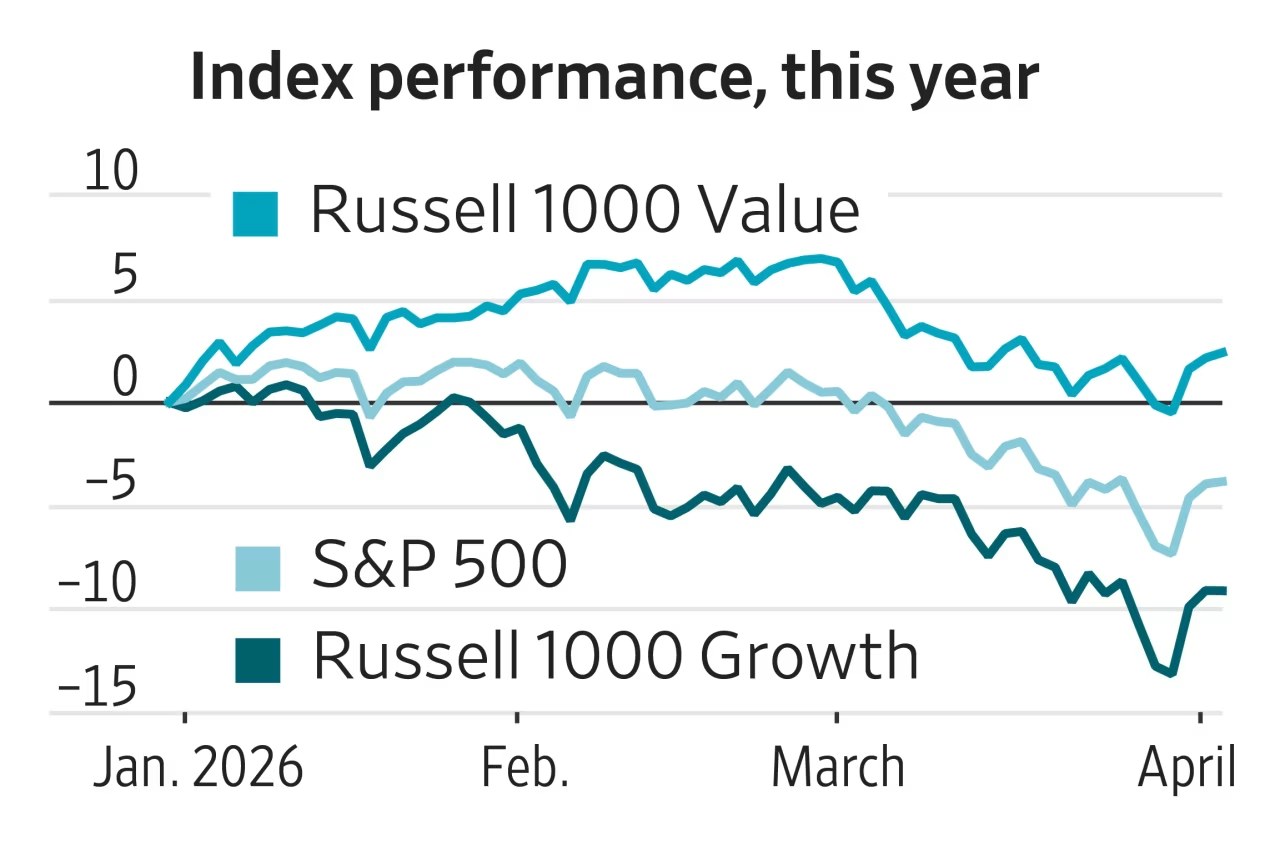
Value Stocks Outperformed Growth by the Largest Margin in Years, Now Face Unprecedented Headwinds
- Value stocks, long considered a reliable haven, have recently demonstrated their strongest outperformance against growth stocks in years.
- This significant market trend, highlighted on April 5, 2026, marks a quiet shift in investor preferences amidst broader turbulence.
- The surge in geopolitical tensions, particularly the war in the Middle East, is now threatening to undermine this established investment strategy.
- Rapid advancements in artificial intelligence are simultaneously introducing new layers of uncertainty, challenging traditional valuation models for value stocks.
The Shifting Sands of Market Security: Why Traditional Havens Are Under Siege
VALUE STOCKS—For investors navigating a landscape fraught with economic uncertainty and unpredictable global events, the concept of a market haven has always been a beacon of stability. Traditionally, value stocks—companies trading at lower multiples of their book value, often characterized by mature industries, consistent earnings, and reliable dividends—have served this critical role. Indeed, as of April 5, 2026, these steadfast equities had quietly achieved a remarkable feat, outpacing their growth-oriented counterparts by the widest margin seen in years, according to financial reporting. This substantial outperformance provided a much-needed sanctuary from the prevailing stock-market turbulence, offering a sense of security against the backdrop of an erratic global economy.
However, this hard-won stability is now confronting an array of formidable challenges that threaten to upend the very premise of value as a defensive play. A deepening war in the Middle East has injected a new, volatile element into the global financial system, potentially disrupting supply chains, influencing commodity prices, and dampening investor sentiment across the board. Simultaneously, the relentless march of technological innovation, particularly in the realm of artificial intelligence, is reshaping economic paradigms at an unprecedented pace. These twin forces—geopolitical strife and technological disruption—are converging to create an environment where even the most reliable investment strategies, including the appeal of value stocks, are being tested in unforeseen ways. The once clear path for these market stalwarts now appears increasingly obscured by complex global dynamics.
The current market juncture represents a critical inflection point, challenging investors to reassess their fundamental assumptions about risk and reward. The confluence of these macro factors means that the sanctuary once offered by value stocks is no longer guaranteed. Understanding the forces at play—from the mechanics of value investing to the broader implications of global instability and technological leaps—becomes paramount for navigating the turbulent months ahead. The question remains whether these traditional havens can adapt to a rapidly evolving world, or if the nature of investment security itself is undergoing a fundamental transformation, demanding new approaches to portfolio construction.
The Enduring Appeal and Recent Triumph of Value Stocks
Value investing, a strategy popularized by figures like Benjamin Graham and Warren Buffett, centers on identifying companies whose shares trade below their intrinsic worth. These are often mature businesses with established revenue streams, tangible assets, and a history of profitability, yet whose market valuation does not fully reflect their underlying fundamentals. The core tenet is that the market sometimes undervalues solid companies due to temporary challenges, sector rotations, or general market sentiment, providing an opportunity for discerning investors. Historically, value stocks have demonstrated periods of robust outperformance, especially during economic downturns or when market exuberance for growth-oriented sectors wanes, offering a defensive characteristic often sought after in turbulent times.
The Defensive Charm of Deep Value
This enduring appeal was particularly evident in the period leading up to April 5, 2026. Data indicated that value stocks had quietly posted a banner year, demonstrating an outperformance against growth stocks by the largest margin observed in years. This shift suggested a rotation away from speculative, high-growth narratives—often associated with rapid technological advancements—towards more tangible, reliable assets. As financial analysts widely note, such rotations are common when the broader stock market experiences turbulence or when interest rates rise, making future earnings of growth companies less attractive. The appeal of a steady dividend yield and a solid balance sheet becomes increasingly compelling when the economic outlook is uncertain, providing investors with a perceived cushion against market volatility.
However, the current global environment presents a unique challenge to this traditional dynamic. While value stocks have historically acted as a refuge, the nature of today’s threats—spanning geopolitical conflict and the sweeping impact of artificial intelligence—are multifaceted and less predictable than typical economic cycles. Investment professionals frequently advise that even the most robust strategies require constant re-evaluation in the face of unprecedented external pressures. The very factors that made value stocks a ‘safe haven’ are now being scrutinized, forcing a re-assessment of their defensive capabilities. The question for many investors is whether the characteristics that define value stocks—such as their often-cyclical nature and sensitivity to global supply chains—could transform from strengths into vulnerabilities amidst an escalating global crisis and a rapidly evolving technological landscape. The coming months will likely reveal the true resilience of this once-unquestioned market segment.
Geopolitical Crosscurrents: How Global Tensions Disrupt Market Sanctuaries
The sudden escalation of geopolitical tensions, particularly the renewed conflict in the Middle East, stands as one of the most immediate and potent threats to the stability of value stocks and the broader market. Geopolitical events have a profound and often unpredictable impact on global financial systems, influencing everything from oil prices and currency valuations to investor confidence and corporate earnings. Historically, periods of heightened global instability tend to trigger a flight to safety, but the nature of this current conflict is such that it threatens to destabilize even those assets traditionally considered low-risk, according to many market strategists.
The Ripple Effect of Regional Strife on Global Markets
The Middle East, a pivotal region for global energy supplies, shipping routes, and international trade, holds significant sway over the global economy. A prolonged or intensifying war in the area could lead to substantial disruptions, causing energy prices to spike, supply chains to fracture, and overall economic activity to decelerate. Such macro-economic headwinds disproportionately affect industries that often house value stocks, such as manufacturing, transportation, and consumer staples, as their profitability is highly sensitive to input costs and consumer demand. As Krystal Hur reported on April 5, 2026, this geopolitical conflict is poised to upend the market’s reliance on value stocks as a safe haven, forcing investors to grapple with newfound vulnerabilities in their portfolios.
Moreover, geopolitical conflict introduces a layer of systemic risk that is difficult to quantify or hedge against. Unlike typical business cycle fluctuations, a major international crisis can fundamentally alter the operating environment for companies, making long-term projections uncertain. Major financial institutions, like the International Monetary Fund (IMF), consistently highlight geopolitical risk as a top concern for global economic stability. Their analyses often suggest that uncertainty suppresses investment and increases market volatility, making it harder for any stock segment, including value, to maintain its perceived stability. The interconnectedness of global markets means that regional conflicts can quickly become global economic challenges, demanding a sophisticated approach to risk management that extends beyond conventional wisdom for investment strategies. The unfolding dynamics of global political landscapes will undoubtedly continue to shape the narrative for these foundational investment vehicles.
The AI Revolution and its Shadow: Reshaping Investment Paradigms
Beyond the immediate geopolitical concerns, the rapid and transformative advances in artificial intelligence (AI) present a different, yet equally profound, challenge to the traditional valuation of value stocks. While AI has largely been a boon for growth stocks, particularly in the technology sector, its disruptive potential extends far beyond Silicon Valley. AI’s capacity to automate, optimize, and innovate across industries means that even traditionally stable, mature companies—the bedrock of value investing—must adapt or risk obsolescence. This technological wave injects a new element of uncertainty into long-established business models, forcing investors to reconsider what truly constitutes ‘value’ in a future increasingly shaped by intelligent machines.
Disruptive Innovation vs. Fundamental Value
The core of value investing often relies on the predictability of a company’s earnings and its tangible assets. However, AI can fundamentally alter competitive landscapes overnight. A sudden breakthrough in automation, for example, could redefine the labor costs and operational efficiencies of an entire industry, eroding the competitive advantage of established players. Conversely, companies that fail to integrate AI effectively might see their market share and profitability diminish rapidly. This dynamic creates a conundrum for value stocks, as their traditional appeal of stability could be undermined by the swift pace of technological change. As various reports from institutions like McKinsey & Company highlight, AI is not merely an incremental improvement but a foundational shift that promises to reshape virtually every industry, demanding a proactive strategic response from businesses.
Furthermore, the speculative frenzy surrounding AI has exacerbated stock market turbulence. While certain AI-driven companies command astronomical valuations, the broader market grapples with how to properly assess the long-term winners and losers. This environment of rapid, tech-driven change makes it more challenging for investors to identify genuinely undervalued companies. According to general investment theory, a healthy market balances growth potential with fundamental value. When one side of this equation becomes overly dominant or highly volatile due to a disruptive technology like AI, it can obscure the true worth of traditional assets. The implications for portfolio diversification and investment strategies are significant, requiring a delicate balance between embracing innovation and adhering to sound financial principles. As AI continues its relentless evolution, its influence on the perceived security of value stocks will only grow, demanding an agile response from market participants.
Navigating the Turbulent Waters: Investment Strategies in an Unpredictable Era
The confluence of escalating geopolitical conflict and the profound impact of artificial intelligence is compelling investors to fundamentally reconsider their investment strategies. The traditional binary choice between value stocks and growth stocks, while still relevant, is now viewed through a lens of unprecedented global and technological uncertainty. As Krystal Hur highlighted on April 5, 2026, the historical haven status of value stocks is at risk, demanding a more nuanced approach to portfolio diversification and asset allocation. Prudent investing in this new era requires a blend of resilience, adaptability, and a deep understanding of evolving risk factors, moving beyond conventional playbooks.
Rethinking Resilience: Beyond Traditional Hedges
One critical aspect for investors is the reassessment of diversification. While spreading investments across different asset classes and geographic regions remains a core principle, the interconnected nature of global markets means that even diversified portfolios are susceptible to systemic shocks originating from geopolitical events or widespread technological disruption. Financial experts often suggest looking for companies with strong balance sheets, low debt, and robust free cash flow, irrespective of whether they are categorized as pure ‘value’ or ‘growth.’ These characteristics inherently build a degree of resilience against unexpected market turbulence, ensuring businesses can weather both economic downturns and periods of rapid technological shifts. The key is to seek quality and adaptability within companies, rather than relying solely on broad market categorizations.
Furthermore, integrating a forward-looking perspective on risk becomes paramount. This involves not only monitoring economic indicators and corporate earnings but also actively assessing the potential impact of geopolitical developments and AI adoption on specific industries and individual companies. According to various market commentators, a successful investment strategy in this environment must be dynamic, capable of pivoting as new information emerges about the Middle East war or the latest AI breakthrough. It’s no longer sufficient to merely buy and hold; instead, investors must engage in continuous analysis and adjust their positions to mitigate emerging threats and capitalize on nascent opportunities. The focus shifts from merely identifying undervalued assets to discerning which companies possess the foresight and flexibility to thrive amidst persistent economic uncertainty and rapid change. This proactive stance will be crucial for protecting capital and fostering growth in the volatile markets ahead.
What’s Next for Market Stability Amidst Competing Global Forces?
As the global financial landscape continues to grapple with the simultaneous pressures of escalating geopolitical tensions and transformative technological advancements, the path forward for market stability remains uncertain. The erosion of traditional havens, particularly the vulnerability now exposed in value stocks, signals a departure from conventional investment wisdom. The challenge for investors and policymakers alike is to understand whether these disruptive forces will lead to a prolonged era of heightened market volatility or if new equilibrium points will emerge, defining a fresh set of reliable investment principles. The dynamic interplay between global politics and technological innovation will dictate the contours of this evolving financial environment for years to come.
The Evolving Definition of a Market Haven
The immediate outlook is shaped by the ongoing developments in the Middle East, which continue to inject systemic risk and economic uncertainty into global markets. The economic repercussions, from disrupted trade routes to potential energy supply shocks, are far-reaching and can quickly undermine even the most resilient economies. Simultaneously, the relentless progress in artificial intelligence means that industries across the spectrum are facing existential questions about their future. While AI promises immense productivity gains, it also raises concerns about job displacement, ethical dilemmas, and the concentration of economic power, all of which can contribute to social and economic instability that reverberates through financial markets. This dual challenge requires a sophisticated understanding of macro-economic forces and micro-level corporate adaptation.
Ultimately, the long-term resilience of the stock market—and specifically the role of value stocks—will depend on how effectively global leaders and corporate entities manage these competing forces. According to leading economists, fostering international cooperation to de-escalate conflicts and establishing clear regulatory frameworks for emerging technologies like AI are critical steps. For individual investors, this means prioritizing adaptable and well-managed companies, engaging in continuous learning, and maintaining a truly diversified portfolio that can withstand unpredictable shocks. The year that commenced with value stocks quietly marching toward a banner performance, as reported on April 5, 2026, is now poised to redefine investment tenets, urging a proactive and flexible approach to navigating a complex and ever-changing global economy. The journey to rediscover market stability will be a test of foresight and strategic agility for all participants.
Frequently Asked Questions
Q: What defines value stocks in today’s market?
Value stocks are typically shares trading at low multiples of their book value, often from established companies with stable earnings and dividends. They are favored by investors seeking resilience and relative safety, particularly when market turbulence increases, as seen in their recent outperformance against growth stocks.
Q: How are geopolitical conflicts impacting value stocks?
Geopolitical conflicts, such as the war in the Middle East, introduce significant uncertainty and can disrupt global supply chains, energy markets, and consumer confidence. This heightened risk environment threatens the traditional appeal of value stocks by increasing overall market turbulence and potentially eroding their perceived stability.
Q: What role does Artificial Intelligence play in market turbulence affecting value stocks?
Rapid advances in artificial intelligence create both opportunities and disruption. While fueling growth stocks in the tech sector, AI also introduces uncertainty regarding its long-term economic impact and potential to transform traditional industries where value stocks reside, contributing to broader stock market turbulence.
Q: Why have value stocks outperformed growth stocks recently?
Value stocks have quietly marched toward a banner year, outperforming growth stocks by the biggest margin in years. This trend typically occurs during periods of economic uncertainty or rising interest rates, as investors rotate into more stable, often dividend-paying companies perceived as less sensitive to high-growth, speculative bets.
