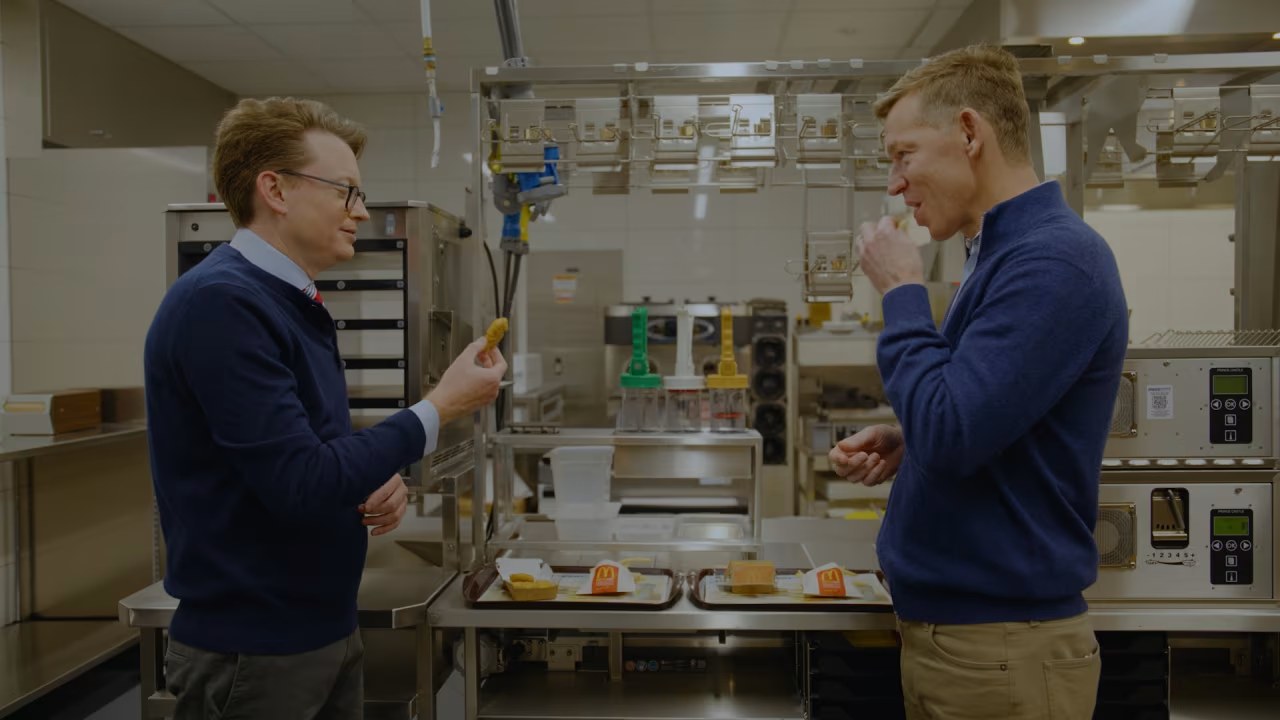
McDonald’s CEO Chris Kempczinski Breaks Silence on Viral ‘Big Arch Backlash’
- McDonald’s CEO Chris Kempczinski faced a ‘Big Arch Backlash’ following a viral burger taste test.
- Kempczinski gave his first interview since the incident to The Wall Street Journal.
- The interview topics included his approach to social media and willingness to appear on camera again.
- McDonald’s stock (MCD) showed a 0.75% increase at the time of the report.
Navigating Public Opinion in the Digital Age: A CEO’s Direct Engagement
MCDONALD’S—In an era where corporate leaders are increasingly under the microscope of public scrutiny, McDonald’s Chief Executive Chris Kempczinski recently found himself at the center of a social media storm. Following a burger taste test that unexpectedly went viral, Kempczinski faced what has been dubbed the ‘Big Arch Backlash.’ This incident, while specific in its origin, highlights the broader challenges modern CEOs encounter in managing brand perception and direct communication in the fast-paced digital landscape.
The aftermath of the viral event prompted Kempczinski to sit down for his inaugural interview on the subject with The Wall Street Journal. This exclusive conversation offered a rare glimpse into the strategies a global corporate leader employs when confronting public sentiment shaped by online discourse. The interview focused on critical aspects of contemporary leadership, including the CEO’s personal philosophy on social media engagement and his readiness to appear on camera once more, signaling a commitment to transparency and direct interaction with the public.
The Wall Street Journal’s exclusive provided context on Kempczinski’s direct engagement, detailing his willingness to confront public opinion head-on. As corporations increasingly navigate a landscape where every action can become content for widespread online discussion, the approach taken by prominent figures like Chris Kempczinski becomes a blueprint for effective, or at times challenging, corporate communication.
The Fallout from a Viral Moment
The digital age has fundamentally reshaped the interaction between global corporations and their consumer base, bringing unprecedented levels of transparency and immediate feedback. For McDonald’s, a brand deeply embedded in the public consciousness, even seemingly innocuous internal activities can rapidly transform into widespread public events. This was starkly demonstrated when McDonald’s Chief Executive Chris Kempczinski participated in a burger taste test that subsequently garnered significant online attention, culminating in what has been widely referred to as the ‘Big Arch Backlash.’
Understanding the Genesis of the Backlash
While the specifics of the taste test and the precise nature of the viral content remain to be fully detailed in public accounts, its impact was undeniable, triggering a notable wave of negative sentiment across various digital platforms. The incident underscores the inherent risks and rewards of executive visibility in an interconnected world, where moments intended for internal assessment or casual engagement can quickly escape corporate control and become subjects of intense public debate. The Wall Street Journal exclusively reported on the CEO’s response, marking it as his first public address since the controversy erupted.
The ‘Big Arch Backlash’ serves as a contemporary case study in how quickly public perception can shift for even the most established global brands. It highlights the power of social media to amplify events, transforming a single incident involving a senior executive into a significant challenge to brand reputation. The necessity for a swift and considered executive response in such circumstances is paramount, paving the way for a deeper examination of corporate social media strategies.
Navigating the Digital Storm: Kempczinski’s Social Media Approach
In the wake of the ‘Big Arch Backlash,’ the spotlight turned to how McDonald’s CEO Chris Kempczinski would address the digital storm. His first interview since the incident, conducted by The Wall Street Journal, specifically delved into his philosophy and practical approach to social media. This candid discussion provides crucial insights into how a leader of a global enterprise grapples with the pervasive influence of online platforms on brand image and public trust.
Corporate Communication in a Viral Ecosystem
The discussion with The Wall Street Journal illuminated Kempczinski’s considered perspective on engaging with social media, a domain where corporate messages can be instantly disseminated, scrutinized, and often, reinterpreted. The experience of the viral taste test evidently prompted a deeper reflection on the mechanisms of digital communication. For an executive like Kempczinski, whose decisions impact a vast global workforce and consumer base, understanding and strategically navigating social media is no longer optional but a fundamental aspect of modern leadership. While the interview did not detail specific policy changes, it underscored the critical importance of a thoughtful, responsive approach to online interactions, especially when faced with public criticism. The broader implications extend to how McDonald’s, as a corporation, will continue to evolve its digital footprint in light of such experiences.
The CEO’s Commitment to Transparency: Eating on Camera Again
A key element of Chris Kempczinski’s post-‘Big Arch Backlash’ interview with The Wall Street Journal involved his expressed willingness to eat on camera again. This particular aspect of his response is highly indicative of a strategic commitment to transparency and direct engagement with the public, even after a previous on-camera event led to significant scrutiny. For a CEO, such a public declaration signifies a broader corporate stance on openness and accountability.
Rebuilding Trust Through Direct Interaction
The decision to willingly return to a public, on-camera setting for something as personal as eating directly challenges the traditional corporate playbook of retreating from the spotlight after negative viral attention. This move by the McDonald’s CEO suggests a deliberate effort to confront, rather than avoid, the very medium that amplified the backlash. It frames him as a leader prepared to demonstrate authenticity and approachability, potentially rebuilding public trust through direct, unvarnished interaction. This readiness to engage again, as highlighted in the exclusive Wall Street Journal interview, extends beyond personal courage; it reflects a broader organizational understanding of the importance of genuine connection with consumers in an age demanding greater corporate transparency. The willingness to be visible, even when vulnerable, is a powerful tool in shaping public narratives.
McDonald’s Stock Performance Amidst Public Scrutiny
Amidst the public discourse surrounding the ‘Big Arch Backlash’ and Chris Kempczinski’s subsequent interview, the financial markets provided their own perspective on McDonald’s corporate health. The Wall Street Journal’s reporting on the CEO’s response also included a notable detail regarding the company’s stock performance. At the time of the report, McDonald’s stock (MCD) registered a 0.75% increase, as indicated by a green up-pointing triangle.
Market Resilience vs. Public Perception
This marginal increase in MCD’s stock price offers a snapshot of how the market perceived the company’s position at that specific moment, or perhaps how it reacted to broader economic factors. It is important to note that the source text does not explicitly link this stock increase directly to the viral backlash or the CEO’s response, nor does it provide a comparative analysis against prior periods or industry benchmarks. However, the inclusion of this data point highlights the constant interplay between corporate events, public sentiment, and investor confidence. While social media can rapidly shift public opinion, the stock market’s reaction, even if modest, provides a different lens through which to view corporate stability during times of intense scrutiny. The financial implications, while not fully detailed in the provided source, are a crucial dimension for any global company navigating public relations challenges.
What’s Next for McDonald’s Leadership in the Public Eye?
The aftermath of the ‘Big Arch Backlash’ and McDonald’s CEO Chris Kempczinski’s subsequent engagement with The Wall Street Journal set a precedent for how the company’s leadership might continue to operate in the public sphere. His discussions on social media strategy and willingness to appear on camera again signal a forward-looking approach to corporate communication, one that acknowledges the inescapable reality of continuous public scrutiny in the digital age.
Evolving Corporate Responsibility in a Connected World
Moving forward, the lessons learned from this viral incident are likely to influence McDonald’s broader corporate communication policies and executive engagement strategies. The emphasis on direct dialogue and perceived transparency, as articulated by Kempczinski in his interview, suggests an evolving understanding of corporate responsibility that extends beyond traditional press releases. It points towards a future where executive leaders are expected to be more accessible, more responsive, and more personally involved in shaping the narrative around their brands, especially when faced with online challenges. The ongoing commitment of Chris Kempczinski to navigate these complex digital waters will undoubtedly serve as a crucial benchmark for how McDonald’s maintains its global brand reputation in the years to come, illustrating the continuous adaptation required of major corporate leaders.
Frequently Asked Questions
Q: What was the ‘Big Arch Backlash’ involving McDonald’s CEO Chris Kempczinski?
The ‘Big Arch Backlash’ refers to significant public criticism and negative reactions that followed McDonald’s CEO Chris Kempczinski’s burger taste test, which subsequently went viral online. The exact details of the backlash and taste test are not elaborated in the source material, but it prompted a rare public response from the McDonald’s CEO.
Q: How is McDonald’s CEO Chris Kempczinski addressing social media challenges?
McDonald’s CEO Chris Kempczinski addressed his approach to social media during his first interview since the viral ‘Big Arch Backlash’ with The Wall Street Journal. While specific strategies were not detailed in the provided information, his willingness to discuss the matter indicates a proactive stance on corporate communication and brand reputation in the digital age.
Q: Why did McDonald’s stock show a 0.75% increase amidst the backlash?
The provided source text notes a ‘MCD 0.75 % increase’ for McDonald’s stock. The article does not explicitly connect this stock performance directly to the ‘Big Arch Backlash’ or Chris Kempczinski’s response. It is presented as a separate financial data point concurrent with the reporting on the CEO’s interview.
