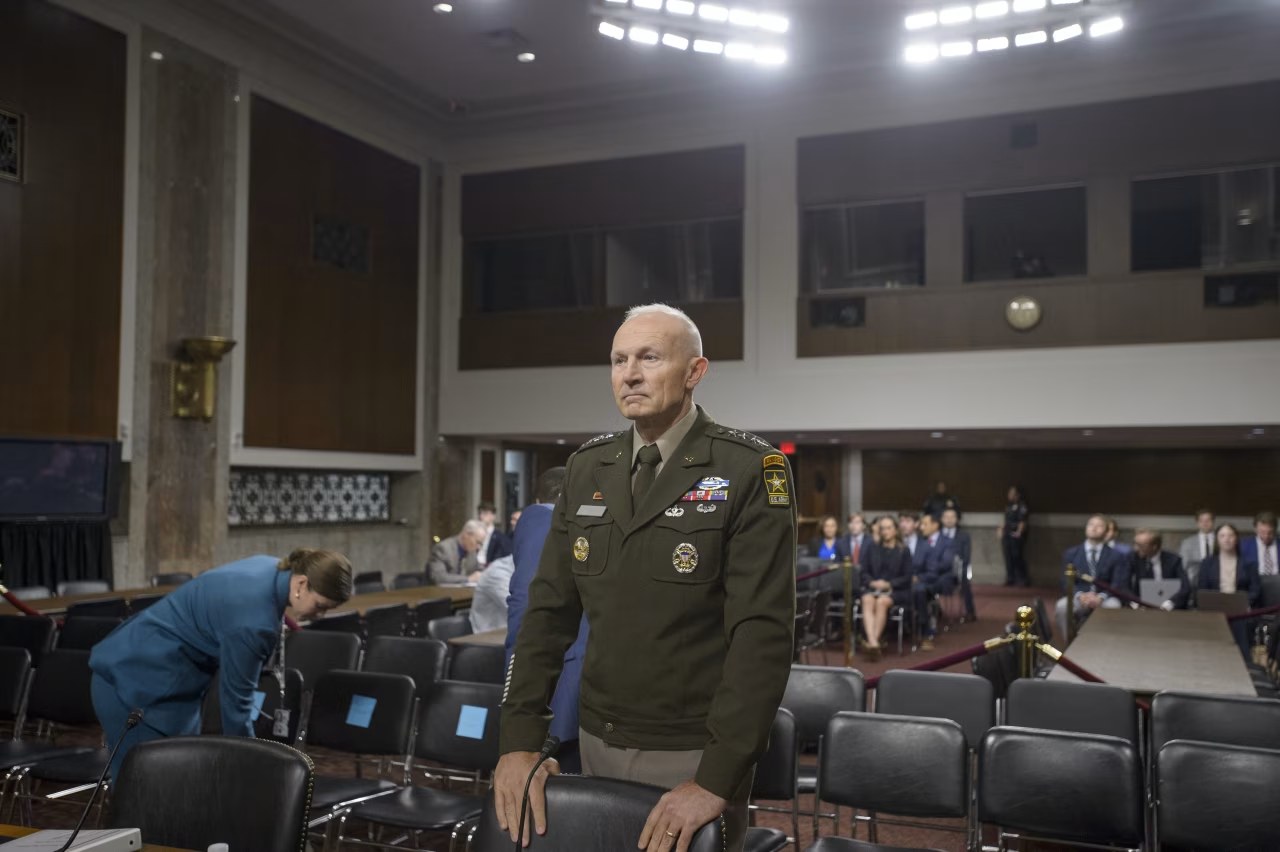
Defense Secretary Hegseth’s Shocking Move: Army’s Top General Removed in Under a Year
- Defense Secretary Pete Hegseth ousted Gen. Randy George, the Army’s top general, on Thursday, less than a year into his term.
- The Pentagon provided no reason for Gen. George’s unexpected removal, despite the Army Chief of Staff typically serving a four-year tenure.
- This dismissal marks the latest in a series of top military leader removals, indicating a broader ‘purge of its top ranks’ within the Pentagon.
- Gen. George, who assumed his post in September 2023, had given no public indication of preparing for retirement prior to the announcement.
A Sudden Departure: Unraveling the Implications of a High-Stakes Ousting
PENTAGON—In a move that reverberated through Washington’s national security circles on Thursday, Defense Secretary Pete Hegseth announced the ousting of Gen. Randy George, the Army’s top general. The decision, delivered with stark brevity by the Pentagon, provided no explicit reason for the removal of the esteemed Army chief of staff. This sudden dismissal of the Army’s top general sends a powerful signal regarding the administration’s approach to military leadership and raises immediate questions about stability within the nation’s defense apparatus, particularly as it follows a pattern of high-level departures.
General George’s tenure, which began in September 2023, was conspicuously short, contrasting sharply with the customary four-year term for the Army’s most senior uniformed officer. The abruptness of his departure is amplified by the fact that he had offered no public indication of any intention to retire. This singular event, while significant on its own, takes on heightened importance when viewed within the broader context explicitly noted by observers: it represents the latest in a series of top military leaders removed during what has been characterized as a substantial ‘purge of its top ranks under the Trump administration.’ This ongoing upheaval at the highest echelons of the Pentagon suggests a deliberate, if often unexplained, reshaping of military command, with potentially profound consequences for national security strategy and the morale of the armed forces.
The absence of a publicly articulated rationale for such a high-profile change in military command is particularly striking. In an environment where transparency is often expected, especially concerning the leadership of critical national institutions like the U.S. Army, the Pentagon’s silence leaves a void filled with speculation. This situation not only impacts the perception of stability within the military but also tests the fundamental principles of civil-military relations, challenging the traditional understanding of how and why senior officers are appointed and, crucially, removed from their posts. The implications extend far beyond a single individual’s career, touching upon the strategic direction and operational readiness of one of the world’s most powerful military forces, hinting at future adjustments within the defense landscape.
The Unprecedented Abruptness of a Top General’s Departure
The sudden removal of Gen. Randy George as the Army’s top general on Thursday represents a rare and significant event within the U.S. military establishment. Typically, the Army chief of staff, a position of immense strategic responsibility, serves a four-year term, providing a consistent vision and stable leadership for the vast and complex organization. Gen. George, having assumed his pivotal post in September 2023, was just months into what was expected to be a multi-year command, making his departure less than a year later profoundly unusual. This swift exit, confirmed by the Pentagon, immediately draws attention to the forces at play within the highest echelons of national defense and raises pointed questions about the operational environment for senior uniformed officers.
A Tenure Cut Short: Deviating from Established Norms
The established norm of a four-year term for the Army chief of staff is not merely a bureaucratic guideline; it is a foundational principle designed to ensure continuity, long-range planning, and the insulation of military leadership from short-term political fluctuations. This standard allows the Army’s top general to develop and implement strategic initiatives, oversee major force transformations, and build enduring relationships with international allies over a sufficient period. Gen. George’s abbreviated tenure, therefore, stands as a stark deviation from this institutional expectation. His predecessor, for instance, would have navigated the complexities of global security for a full term, bringing a sustained approach to the challenges facing the Army. The fact that the Pentagon offered no explanation further compounds the impact of this divergence, leaving observers to ponder the underlying circumstances that precipitated such a dramatic and early exit for the Army’s top general. This unexpected turn of events inevitably sparks discussions about the potential for policy shifts and leadership vacancies that could affect ongoing operations and long-term strategic goals.
The implications of such an abrupt leadership change are manifold. For the thousands of soldiers, officers, and civilian personnel who constitute the U.S. Army, the sudden departure of their most senior leader can introduce uncertainty and disrupt morale. Trust in the command structure relies heavily on perceived stability and a clear understanding of leadership transitions. When an Army chief of staff is removed without a public explanation, particularly when they had given no indication of an impending retirement, it can lead to internal speculation and external scrutiny regarding the reasons behind the decision. This can challenge the perception of an apolitical military leadership, a cornerstone of American democratic governance. The rapid turnover at such a critical post forces an immediate search for a successor, potentially accelerating timelines and introducing new leadership perspectives more quickly than anticipated, which carries its own set of challenges for the institution and its global responsibilities.
Tracing the ‘Purge’: A Pattern of Unexplained Departures
The ousting of Gen. Randy George is not an isolated incident but rather the “latest top military leader removed” in what the source text explicitly describes as “a purge of its top ranks under the Trump administration.” This recurring pattern signifies a broader, more systematic reshaping of military leadership, which has prompted considerable debate and concern within national security circles. A ‘purge’ implies a deliberate, often swift and opaque, removal of personnel from positions of authority, frequently for reasons that may extend beyond standard performance evaluations or disciplinary actions. The consistent nature of these high-level departures suggests an overarching strategy to bring military command into closer alignment with the administration’s specific objectives or ideological perspectives, challenging the traditional buffers between political leadership and uniformed service. This trend raises fundamental questions about civil-military relations and the perceived independence of the armed forces, particularly regarding the continuity of military doctrine and strategic guidance. It points to a dynamic where the highest levels of military leadership are subjected to an unusual degree of turnover, which can have profound implications for institutional knowledge and long-term stability.
Unpacking the Implications of Systemic Leadership Turnover
The cumulative effect of multiple, unexplained departures of senior military officers is a central concern for defense analysts and policymakers. When numerous leaders are removed in quick succession or without clear public justification, it can erode institutional confidence and foster an environment of uncertainty within the ranks. For instance, the strategic planning necessary for managing complex global challenges—from geopolitical rivalries to counter-terrorism operations—requires stable leadership that can commit to and oversee multi-year initiatives. Frequent changes at the top can fragment these efforts, necessitating constant re-evaluation and adaptation by incoming leaders, potentially leading to inefficiencies or strategic drift. The precedent set by such a ‘purge’ might also influence future military officers, affecting career progression, decision-making, and even the willingness of highly qualified individuals to seek senior command positions if they perceive an increased risk of arbitrary removal. This cycle of accelerated change affects not only individual careers but the collective experience and expertise that guide the nation’s defense apparatus, posing a significant challenge to the long-established professional military ethic. The continuity of experienced leadership is paramount for maintaining cohesion and effectiveness across a global military presence, emphasizing the serious nature of these reported actions within the Pentagon.
What Does ‘No Reason Provided’ Mean for Trust and Transparency?
The Pentagon’s decision to provide “no reason for his removal” following the ousting of the Army’s top general, Gen. Randy George, on Thursday is perhaps one of the most unsettling aspects of this development. In a democratic society, especially concerning institutions as critical as the military, transparency is often considered vital for maintaining public trust and accountability. When a senior military leader is removed without any stated cause, it can open the door to widespread speculation, raise questions about the integrity of the decision-making process, and potentially undermine confidence in both civilian and military leadership. This lack of explanation directly contradicts the principles of open governance and can be perceived as an intentional effort to obscure the true motivations behind such a consequential action, leading to a void that journalistic inquiry must attempt to fill, even when facts are scarce. It also creates a precedent where such significant shifts in command can occur without public justification, impacting the very fabric of civil-military understanding. The opaqueness surrounding this event challenges the established norms for how high-level military personnel changes are communicated to the public and to the forces they lead.
Eroding Confidence: The Silent Impact of Unexplained Dismissals
The absence of a publicly articulated rationale for Gen. George’s removal carries significant implications for civil-military relations and the morale within the armed forces. For a professional military, the understanding that merit and performance are the primary drivers of career progression and tenure is paramount. When a leader of Gen. George’s stature, who had given “no indication he had been preparing to retire,” is removed abruptly and silently, it can sow seeds of doubt. This doubt may pertain to whether political considerations or personal disagreements, rather than objective professional assessments, are increasingly influencing key leadership appointments and removals. Such uncertainty can create an environment where senior officers become hesitant to voice dissenting opinions or provide candid advice, fearing similar unceremonious exits. This erosion of trust can have long-term detrimental effects on the military’s ability to provide independent, expert counsel to civilian leadership, a cornerstone of its function in a democracy. Furthermore, it creates a potential chilling effect on future military leaders, impacting their willingness to engage in robust internal debate or challenge assumptions if they believe their careers could be jeopardized without cause. The long-term health of the military institution, its strategic effectiveness, and its ability to attract and retain top talent are all contingent on the perception of fair and transparent leadership decisions, making the ‘no reason provided’ stance particularly concerning and warranting further scrutiny as the situation unfolds.
How Do Such Leadership Shifts Impact Military Readiness and Morale?
The sudden removal of the Army’s top general, particularly when it occurs without a stated reason and within a broader context of a ‘purge,’ inevitably raises questions about its tangible impact on military readiness and morale. At the pinnacle of the Army’s command structure, the chief of staff is responsible for overseeing the training, equipping, and deployment of forces worldwide. An abrupt change in this position can disrupt ongoing initiatives, delay critical decision-making processes, and inject a degree of uncertainty into strategic planning. For instance, major modernization programs, personnel reforms, or responses to evolving global threats require sustained, consistent leadership. The replacement of a senior officer, especially one who had only served since September 2023, means that the incoming leader must quickly come to grips with a vast portfolio, potentially re-evaluating existing strategies and priorities at a moment’s notice. This period of transition, even if brief, can create operational pauses or shifts in focus that may have far-reaching consequences for the Army’s global posture and responsiveness.
Beyond the Top Brass: Ripple Effects on the Ranks
The effects of such high-level leadership changes extend beyond the immediate strategic implications; they also have a direct bearing on the morale and stability of the entire force. Soldiers and officers across all ranks look to their leadership for consistency, vision, and a clear sense of direction. When the Army’s top general is removed without explanation, it can lead to anxiety and questions about the stability of their own careers and the broader institutional values. The perception of political interference in military appointments, or the arbitrary nature of senior command changes, can undermine the apolitical ethos that is central to professional military service. Furthermore, it can distract from core missions, as focus shifts internally to understanding the dynamics of leadership rather than solely concentrating on external threats and operational objectives. The expectation of a four-year term for the Army chief of staff is rooted in the need for long-term vision and commitment, allowing a leader to cultivate an organizational culture and drive significant reforms. The premature departure of Gen. George means that this critical period of leadership, intended for deep strategic engagement, has been cut short, potentially leaving a leadership vacuum that the next incumbent will need to address rapidly amidst ongoing operational demands and a complex geopolitical landscape, creating a challenging environment for future leaders and affecting the readiness of the entire force.
Looking Ahead: The Future of Army Leadership Amidst Pentagon Shifts
The sudden removal of Gen. Randy George as the Army’s top general, just months after assuming his post in September 2023, not only concludes a brief chapter in his distinguished career but also inaugurates a period of profound uncertainty for the U.S. Army’s leadership. As the Pentagon confronts the task of appointing a new chief of staff, the process will undoubtedly be scrutinized through the lens of recent leadership changes and the overarching context of a ‘purge of its top ranks under the Trump administration.’ The next individual to fill this critical role will inherit an Army grappling with ongoing global commitments, technological modernization demands, and the internal implications of recent high-level departures. This individual will need to quickly establish authority, instill confidence, and articulate a clear vision that can steady the institution and reaffirm its core mission, all while navigating a political environment that has demonstrated a willingness to enact rapid and unexplained changes at the highest levels of military command. The appointment will be a key indicator of the administration’s future approach to military command and its relationship with the uniformed services.
Navigating a Politically Charged Landscape for the New Chief
The challenges awaiting the next Army chief of staff are multifaceted. Beyond the inherent demands of leading one of the world’s largest and most powerful ground forces, the incoming general will operate in a politically charged environment where civilian leadership has demonstrated a propensity for swift and opaque personnel decisions. This context could influence not only who is selected for the role but also how that individual approaches their duties, particularly regarding their relationship with the Defense Secretary and the wider administration. The need to balance military professionalism with political realities will be paramount. Furthermore, the selection process itself, given the previous unexplained removal, will be observed closely for signs of transparency or continuity. The new Army’s top general will be tasked with reassuring the ranks, maintaining institutional integrity, and upholding the apolitical traditions of the military, all while adapting to the strategic priorities set by civilian leadership. The legacy of Gen. George’s unexpected departure, and the broader pattern of a ‘purge,’ will undoubtedly cast a long shadow, making the task of the incoming chief exceptionally demanding. Their success will hinge on their ability to navigate these complex dynamics, rebuild any eroded trust, and steadfastly guide the Army through an era defined by rapid change and heightened scrutiny, setting the stage for the Army’s trajectory in the coming years.
Frequently Asked Questions
Q: Why was the Army’s top general removed?
Defense Secretary Pete Hegseth ousted Gen. Randy George, the Army’s top general, on Thursday. The Pentagon announced his departure but provided no specific reason for the removal. This unexpected dismissal has raised concerns about transparency and the stability of military leadership.
Q: How long did Gen. Randy George serve as Army Chief of Staff?
Gen. Randy George assumed his post as the Army Chief of Staff in September 2023. He was removed on Thursday, meaning his tenure lasted less than a year, significantly shorter than the customary four-year term for the Army’s top general. This brevity highlights the unusual nature of his departure.
Q: What is the context of recent military leadership changes in the Pentagon?
Gen. Randy George’s removal is characterized as the ‘latest top military leader removed’ in a Pentagon experiencing ‘a purge of its top ranks under the Trump administration.’ This broader pattern suggests a concerted effort to reshape the military’s leadership, raising questions about civil-military relations and institutional independence.
Q: Who removed Gen. Randy George from his position?
Defense Secretary Pete Hegseth was responsible for ousting Gen. Randy George, the Army’s top general. This action underscores the authority of the Defense Secretary in appointing and removing senior military personnel, although the lack of a public explanation for such a high-profile removal is notable.
📰 Related Articles
- US Military’s Low-Cost Drone Designed Using Iranian Tech Proves Effective in Conflict
- Judge Blocks Pentagon’s New Press Restrictions, Citing First Amendment Violations
- Inside the Pentagon’s Contentious Clash With Anthropic Over AI Procurement
- Eric Trump and Donald Trump Jr. are backing Powerus, a drone company vying to meet Pentagon demand and fill a hole left by the administration’s ban on new Chinese drones in the U.S.
