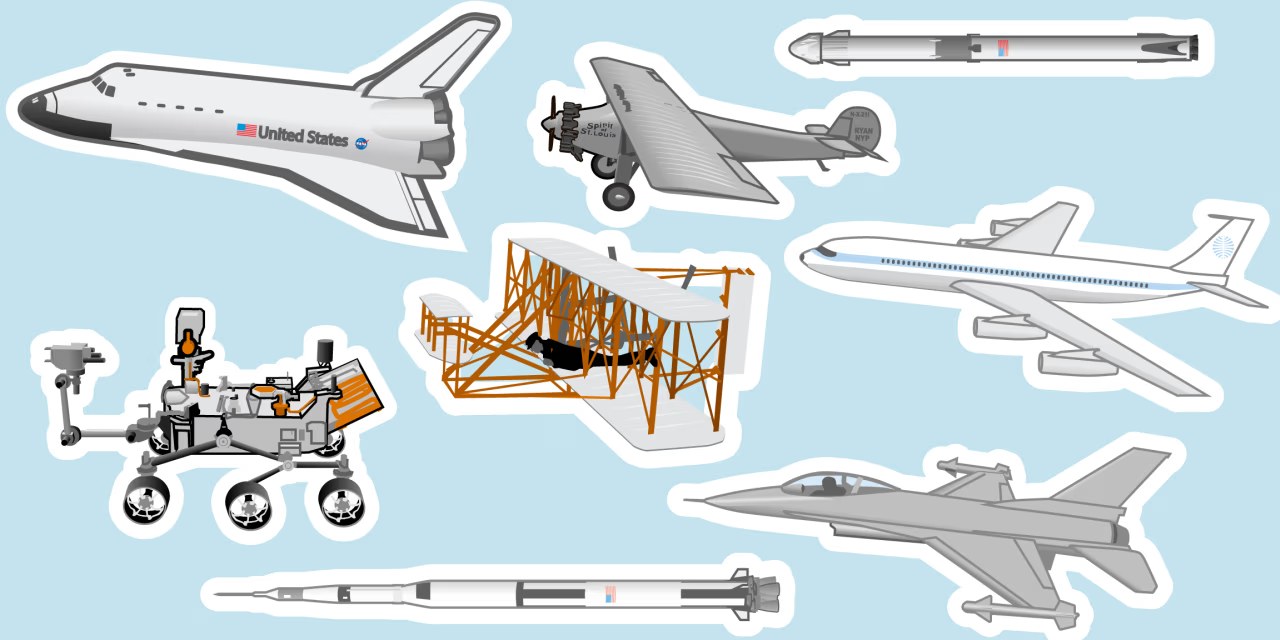
American Aviation: From Wright Brothers’ 1903 Flight to Mars Rovers
- The Wright brothers’ first flight in 1903 lasted only 12 seconds.
- American scientists now operate robotic vehicles on Mars.
- Innovation has been crucial for U.S. aviation, driving progress despite setbacks.
- The nation has often maintained a leading edge in aerospace technology.
The Unfolding Saga of American Flight Innovation
WRIGHT BROTHERS—The story of American aviation is one of relentless progress, a journey that began with a fleeting 12-second flight in 1903 and has since reached the distant surface of Mars. This trajectory underscores a persistent American drive for innovation, a defining characteristic that has propelled the nation to the forefront of both commercial air travel and ambitious space exploration endeavors.
From the sandy dunes of Kitty Hawk to the red dust of the Martian landscape, the evolution of flight technology has been nothing short of revolutionary. It’s a narrative marked by daring leaps of imagination, significant scientific breakthroughs, and an unwavering commitment to pushing the boundaries of what is possible in the skies and beyond.
Despite facing formidable challenges, including devastating accidents and complex engineering hurdles, the United States has consistently demonstrated an exceptional capacity to innovate and lead. This resilience has allowed American ingenuity to shape the future of aerospace, turning audacious dreams into tangible realities that continue to redefine human potential.
The Dawn of Powered Flight: A Humble Beginning
A Momentary Leap, A Lasting Legacy
On a windswept morning in 1903, near Kitty Hawk, North Carolina, Orville and Wilbur Wright achieved what many had only dreamed of: sustained, powered flight. Their Flyer I, a marvel of early engineering, lifted off the ground, its gasoline engine sputtering to life. For a mere 12 seconds, Orville piloted the craft, covering a distance of 120 feet – a modest beginning, yet one that would irrevocably alter the course of human history. This initial success, though brief, represented a monumental leap from the era of balloons and gliders, introducing the world to the potential of heavier-than-air flight.
The Wrights’ Approach to Innovation
The Wright brothers’ triumph was not a sudden stroke of luck but the culmination of years of meticulous research, experimentation, and a systematic approach to problem-solving. They understood the complexities of flight, particularly the challenges of control, lift, and propulsion. Unlike many contemporaries who focused solely on engine power, the Wrights dedicated significant effort to developing three-axis control – roll, pitch, and yaw – a fundamental principle that still governs aircraft maneuverability today. Their meticulous wind tunnel experiments, conducted in Dayton, Ohio, between 1901 and 1902, were crucial in developing more accurate aerodynamic data, which informed the design of their wing warping system and propellers. This dedication to fundamental aerodynamic research, a hallmark of true innovation, distinguished them and laid the groundwork for their historic achievement. The U.S. military, represented by observers from the U.S. Army’s Signal Corps, took note of these advancements, though initial interest was cautious.
A Century of Transformation
Looking back from the vantage point of the early 21st century, the significance of those 12 seconds in 1903 becomes profoundly clear. The world that witnessed the Wright brothers’ flight was vastly different from the one that would see American engineers sending robotic vehicles to explore the surface of Mars. This remarkable transformation, spanning just over a hundred years, is a testament to the power of sustained innovation within the United States. The initial spark ignited by the Wrights has since fueled continuous advancements across commercial aviation, military capabilities, and the ambitious frontiers of space exploration, solidifying America’s role as a leader in aerospace technology.
From Airplanes to Orbit: America’s Ascendancy
Pioneering the Skies and Beyond
The initial success of the Wright brothers in 1903 was merely the opening act in a grand narrative of American aviation. Over the subsequent decades, the United States consistently pushed the envelope, moving from experimental aircraft to robust commercial airliners and sophisticated military planes. The nation’s aerospace industry, bolstered by government investment and a spirit of relentless invention, became a global powerhouse. Innovations such as the development of jet engines, advancements in materials science, and sophisticated navigation systems rapidly transformed air travel from a novelty into a global necessity. The establishment of institutions like the National Advisory Committee for Aeronautics (NACA) in 1915, a precursor to NASA, played a critical role in fostering research and development, ensuring that American engineers and scientists remained at the cutting edge.
The Leap to Space Exploration
The mid-20th century saw American ambition soar beyond Earth’s atmosphere. The Space Race, a period of intense competition with the Soviet Union, spurred unprecedented investment and innovation in rocketry, spacecraft design, and life support systems. NASA, formed in 1958 from the NACA, became the vanguard of this new era. The Apollo program, culminating in the historic moon landing in 1969, showcased American technological prowess on a global stage. This era wasn’t just about reaching celestial bodies; it was about developing entirely new capabilities, including advanced robotics, communication technologies, and materials science, many of which found applications back on Earth. The legacy of these endeavors continues to shape modern flight, influencing everything from satellite technology to the intricate systems powering today’s long-haul aircraft. NASA’s ongoing missions, such as the Mars rovers, are direct descendants of this pioneering spirit, demonstrating a continuous commitment to exploration and discovery that started with that 12-second flight in 1903.
Resilience Amidst Adversity
The path of American aviation innovation has been far from smooth. Tragic accidents, such as the de Havilland Comet disasters in the 1950s (though British, they had global implications for aviation safety standards) and later, the Challenger and Columbia shuttle failures, served as stark reminders of the inherent risks. These catastrophic events, alongside numerous smaller setbacks and intense competitive pressures from international aerospace firms, could have easily derailed progress. However, a defining characteristic of the U.S. aviation sector has been its remarkable resilience. Rather than succumbing to failure, these incidents spurred rigorous investigations, led to significant safety improvements, and reinforced a culture of continuous learning and adaptation. This ability to confront challenges, learn from mistakes, and persistently innovate has been instrumental in maintaining America’s leadership position in the skies and beyond, ensuring that the nation’s journey from Kitty Hawk continues to break new ground.
Innovation’s Impact: Driving the Industry Forward
Economic and Technological Ripples
The relentless pursuit of innovation in American aviation has generated profound economic and technological benefits, extending far beyond the aerospace industry itself. The development of lighter, stronger materials, advanced computer systems for navigation and control, and sophisticated manufacturing techniques have had a ripple effect across numerous sectors, from automotive design to medical devices. Commercial aviation, in particular, has become a cornerstone of the global economy, facilitating trade, tourism, and cultural exchange. The U.S. commercial aviation sector, historically a leader, continues to be shaped by innovations in fuel efficiency, passenger comfort, and operational safety, driven by companies like Boeing and the ongoing technological race with international competitors. This constant evolution ensures that air travel remains accessible and increasingly sophisticated for millions worldwide.
The Role of Government and Private Enterprise
America’s leadership in aviation innovation is a product of a dynamic interplay between government initiatives and private sector enterprise. Early government support, through entities like the U.S. Army’s procurement of early aircraft and the foundational research conducted by NACA, laid crucial groundwork. Post-World War II, significant investment in military aviation and the subsequent establishment of NASA fueled rapid technological advancement. Today, this partnership continues, with government agencies funding cutting-edge research in areas like hypersonic flight and sustainable aviation fuels, while private companies, from established giants to agile startups, translate these advancements into market-ready products. For instance, the development of advanced composite materials, initially explored for aerospace applications, now features prominently in high-performance aircraft and is driving the creation of more fuel-efficient planes. This collaborative ecosystem is vital for sustained progress, ensuring that the innovations seen on Mars are supported by developments in terrestrial flight.
Setting the Global Standard
The enduring legacy of American aviation innovation is its consistent ability to set global standards. From the fundamental principles of aerodynamics established in the early 20th century to the complex robotic systems operating on other planets today, U.S. contributions have often defined the trajectory of aerospace development worldwide. Even with increasing global competition, the foundational research, engineering excellence, and the sheer scale of ambition originating from American institutions continue to shape the industry. The ambition to reach Mars with sophisticated rovers, capable of intricate scientific analysis, is a modern testament to this legacy. It demonstrates not only a mastery of complex engineering and autonomous systems but also a forward-looking vision that inspires continued investment and development across the entire spectrum of flight, ensuring that America remains at the forefront of exploring the final frontier.
How Have American Innovations Redefined Flight Capabilities?
From Propellers to Supersonic Speeds
The evolution of American aviation technology represents a dramatic expansion of human capability. Following the Wright brothers’ initial success in 1903, the focus shifted rapidly to increasing range, speed, and reliability. World War I spurred significant advancements in aircraft design and production. The interwar period saw the development of larger, more capable passenger planes, and the dawn of the jet age in the latter half of the 20th century, significantly boosted by U.S. military research, revolutionized air travel. Innovations like the swept wing, advanced jet engines, and pressurized cabins transformed long-distance flight. Companies like Douglas Aircraft and later Boeing played pivotal roles in developing iconic aircraft that defined eras of air travel and transport, making the world feel smaller and more interconnected.
The Digital Revolution in the Cockpit and Beyond
The integration of digital technology has profoundly reshaped aviation, a transformation deeply rooted in American innovation. The advent of fly-by-wire systems, where pilot controls are translated into electronic signals, enhanced aircraft maneuverability and safety, with early adopters being military programs that later influenced commercial designs. Advanced avionics, including GPS navigation, sophisticated autopilot systems, and integrated flight decks (glass cockpits), have dramatically improved operational efficiency and reduced pilot workload. These advancements are critical not only for commercial airliners navigating complex airspace but are also foundational for the autonomous operations seen in robotic space missions. NASA’s Jet Propulsion Laboratory (JPL), for example, has been a leader in developing the complex software and communication systems required for deep-space exploration, such as the autonomous navigation and data processing capabilities of the Mars rovers like Curiosity and Perseverance.
Pushing the Boundaries: Space and Future Frontiers
The ultimate expression of American innovation in flight has been venturing beyond Earth’s atmosphere. The creation of NASA and its subsequent achievements, from the Mercury and Gemini programs to the Apollo moon landings and the ongoing operation of the International Space Station (ISS), showcase an unparalleled commitment to space exploration. The development of powerful rockets, reusable spacecraft technologies like the Space Shuttle, and sophisticated orbital mechanics has opened up new possibilities for scientific research, resource utilization, and even space tourism. The current endeavors, such as the Mars Perseverance rover, represent the pinnacle of this innovation, employing artificial intelligence, advanced robotics, and sophisticated scientific instruments to seek signs of ancient microbial life. This relentless drive to explore, a direct lineage from the Wright brothers’ first tentative flight, continues to push the boundaries of what humanity can achieve in flight, both on Earth and in the cosmos.
Frequently Asked Questions
Q: When did the Wright brothers achieve their first successful flight?
The Wright brothers achieved their historic first successful flight on December 17, 1903, near Kitty Hawk, North Carolina. This momentous event lasted for 12 seconds and covered a distance of 120 feet, marking a pivotal moment in aviation history.
Q: How has American aviation innovation evolved since the Wright brothers’ flight?
Since the Wright brothers’ pioneering flight in 1903, American aviation innovation has dramatically evolved. It has progressed from short flights to supersonic jets, and further expanded into the realm of space exploration with robotic vehicles on Mars.
Q: What role has innovation played in U.S. aviation programs?
Innovation has been a central driving force behind U.S. commercial aviation and government programs. It has consistently enabled these sectors to achieve new milestones and maintain a leading position in aerospace advancements, despite facing numerous challenges.
Q: Has American aviation been free of setbacks?
No, American aviation has faced significant setbacks, including tragic accidents. However, the history of U.S. aerospace development demonstrates a remarkable ability to learn from these failures and persevere, often re-emerging at the forefront of technological progress.
