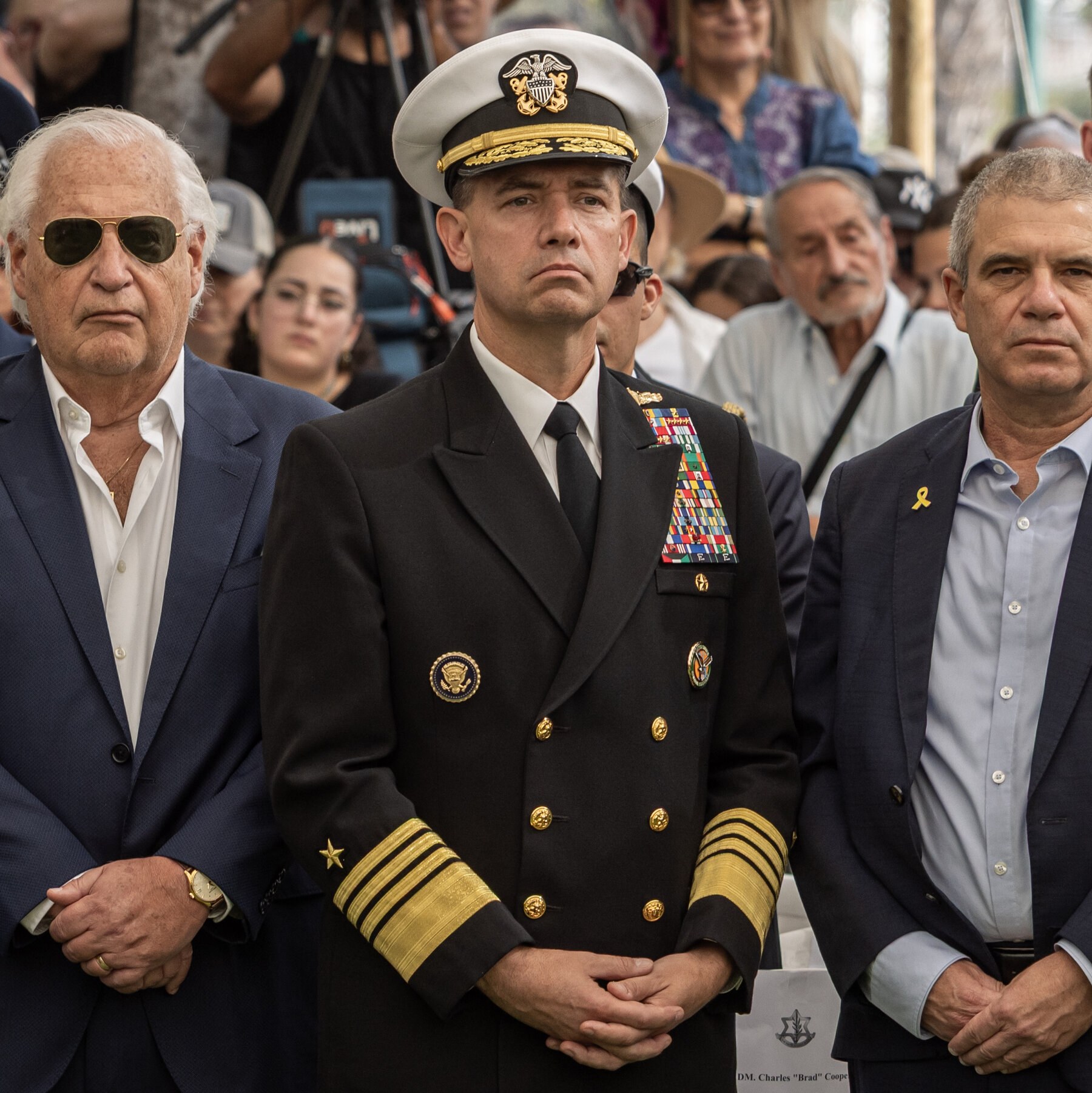
Admiral Condemns Cluster Munitions as ‘Inherently Indiscriminate’ in Stark Policy Reversal
- Adm. Brad Cooper publicly rejected cluster munitions on Monday, breaking with the Trump administration line that the weapons are legitimate.
- The Pentagon still lists cluster bombs as an approved tool, creating an internal policy clash.
- Human-rights groups estimate unexploded bomblets kill or maim hundreds of civilians annually.
- Cooper’s remarks may fuel Congressional momentum for a permanent U.S. ban.
His blunt critique exposes a widening fault line inside the Defense Department over humanitarian law and military effectiveness.
ADMIRAL BRAD COOPER—Cluster munitions—once championed by Pentagon planners for saturating tank formations—are now the subject of a rare public feud after a senior admiral denounced them as too unpredictable to justify. Adm. Brad Cooper, a combat-tested officer with four decades of service, told reporters Monday that the weapons are “inherently indiscriminate,” language long favored by arms-control advocates but scrupulously avoided inside the E-Ring.
Cooper’s statement lands eight years after the Trump administration formally defended cluster munitions as “legitimate” instruments of war. The timing is notable: Congress is weighing amendments to the National Defense Authorization Act that would bar almost all U.S. transfers of the weapons, and NATO allies are pressing Washington to join the 2008 Convention on Cluster Munitions that 110 nations have ratified.
The Pentagon’s current doctrine, last updated in 2017, permits use when “military necessity” outweighs expected civilian harm. Cooper’s candor undercuts that calculus and gives ammunition to lawmakers who argue the U.S. can maintain deterrence with precision-guided alternatives that leave no unexploded ordnance behind.
Why Cooper’s Words Matter Inside the Pentagon
Admirals do not freelance on policy—at least not without consequences. Yet Cooper, who commands Naval Forces Central Command and oversees 30,000 personnel across the Middle East, chose a televised briefing at the Pentagon to deliver his judgment. “These weapons cannot distinguish between a tank and a playground,” he said, noting that dud rates can exceed 40 percent in dry, windy conditions common to the Persian Gulf.
His stance is significant for three reasons. First, it pierces the bureaucratic omertà that normally keeps senior officers from contradicting standing doctrine. Second, Cooper is no desk-bound official; he directed coalition naval operations during the 2022 Strait of Hormuz crisis and briefs the Joint Chiefs weekly. Third, his area of responsibility includes Iran, whose suspected stockpiles of cluster rockets make U.S. policy a live operational question for every vessel transiting the region.
The humanitarian numbers
According to the Cluster Munition Coalition, unexploded bomblets killed or injured 1,149 people worldwide in the last year of complete data; 97 percent of recorded victims were civilians, and nearly half were children. Those figures, cited routinely by arms-control diplomats, now echo inside the Pentagon briefing room because of Cooper.
Defense officials privately note that the admiral’s comments reflect a generational shift. Officers who entered service after the 2003 Iraq invasion have seen comrades lose limbs to roadside bombs fashioned from leftover U.S. sub-munitions. “When you patrol a village and find your own ordnance still embedded in a soccer field, it changes your calculus,” said Rachel Stohl, vice-president of the Stimson Center, who advised past administrations on conventional-arms transfers.
The Pentagon press secretary, asked Tuesday whether Cooper faced censure, offered only that “policy is set by the secretary of defense,” a formulation that neither endorsed nor rebuked the admiral. Capitol Hill aides interpret the silence as license for more dissent. Sen. Jeff Merkley’s office told this publication that Cooper’s words “will be quoted in the Senate Armed Services Committee markup next month” as lawmakers push for a total U.S. ban.
Forward-looking, the episode signals that cluster munitions may become a litmus test for future four-star confirmations, much as climate-change views now color Navy promotions. If so, Cooper’s break with the Trump-era line could mark the moment the Pentagon’s internal consensus began to crack.
How the Trump Administration Cemented Pro-Cluster Policy
In November 2017 the Trump White House issued a National Security Presidential Memorandum that rescinded a 2008 policy requiring U.S. cluster munitions to achieve a 99-percent reliability rate by 2018. The memo, drafted after a Pentagon study claimed newer sensor-fuzed weapons could meet battlefield needs, declared the munitions “legitimate and necessary” for great-power competition.
The policy shift did not merely keep older weapons in warehouses; it restarted production lines. Textron’s BLU-108 sub-munition, fitted with self-destruct triggers, received $180 million in fresh contracts, and Marine Corps planners briefed allies on integrating the munitions into island-defense drills in the Pacific. Arms-control advocates warned that lowering reliability standards would increase dud rates, but the administration argued that potential conflicts with Russia or North Korea justified the risk.
The diplomatic cost
America’s NATO partners noticed. The United Kingdom, bound by the 2008 Convention on Cluster Munitions, quietly suspended joint F-35 training sorties that involved U.S. planes carrying the weapons. Norway’s defense minister told parliament that hosting U.S. stockpiles would violate Norway’s treaty obligations, complicating Marine pre-positioning plans for the Arctic. By 2020, the standoff forced U.S. European Command to re-route munitions through Rotterdam instead of Stavanger, adding 14 days to Atlantic supply chains.
Inside the State Department, dissent cables warned that legitimizing cluster munitions undercut U.S. condemnations of Syrian and Russian use in civilian areas. One cable, later published by the Wall Street Journal, argued that “our moral authority erodes when we defend the same class of weapon we denounce in Aleppo.” The memo was signed by 51 diplomats but did not alter policy.
Cooper, then a one-star commodore, was among the officers who reviewed the cables during a joint staff rotation. Associates say he carried copies to briefings, arguing that the weapons’ tactical utility was outweighed by strategic backlash. His Monday statement, eight years in the making, effectively repudiates the rationale he once helped implement.
The policy legacy is now a political liability. Rep. Sara Jacobs, a California Democrat, cites the Trump memo as reason to codify a ban in statute rather than rely on executive orders that can be rescinded. “We’ve seen how quickly one administration can normalize weapons the rest of the world has outlawed,” Jacobs told reporters Tuesday. Expect her amendment to surface when the House Armed Services Committee marks up the defense bill next month.
What Would a U.S. Ban Mean on the Battlefield?
Opponents of a ban argue that no conventional alternative can replicate the area-denial effect of cluster munitions. A single M26 rocket fired from the U.S. Army’s HIMARS launcher disperses 644 sub-munitions across a 500-meter grid, capable of disabling an entire armored column. By contrast, the guided Unitary missile that replaced it carries a single 200-pound warhead—precise but limited in footprint.
Yet studies by the RAND Corporation show that advances in sensor-fuzed unitary warheads and loitering drones have narrowed the capability gap. A 2023 war-game simulating a Taiwan invasion found that HIMARS firing the new XM404 unitary rocket achieved 94 percent of the armor kills at 72 percent of the logistical cost, while eliminating post-conflict cleanup risks. The Army has not yet fielded XM404 fleet-wide, citing budget constraints, but Cooper’s stance could accelerate procurement.
Allied interoperability
More than battlefield math is at stake. U.S. Indo-Pacific Command lists 17 allied bases where American cluster munitions are pre-positioned under bilateral agreements. Japan’s constitution already restricts nuclear-armed vessels; Tokyo has hinted that a cluster ban could become a similar political flashpoint. South Korea, facing North Korean artillery dug into granite mountains, views the weapons as a hedge against numerical inferiority. Any U.S. legislative ban would require separate diplomatic protocols allowing Seoul to opt out or substitute U.S. precision-guided bombs under a “nuclear umbrella” style guarantee.
Congressional aides say the leading Senate bill includes a ten-year transition waiver for allies, extendable by the president. That clause brought the South Korean embassy on board, according to a leaked lobbying memo obtained by this publication. Absent such flexibility, Seoul signaled it might accelerate its own Korea Massive Punishment and Retaliation missile plan, raising proliferation concerns.
Inside the Army, planners worry that a ban would push commanders toward larger unitary strikes, increasing collateral damage. Lt. Col. Melissa Lewis, an instructor at the School of Advanced Military Studies, argues that “precision without area effects risks more total explosive weight on target.” Yet human-rights groups counter that the choice is false: Israel’s 2021 Gaza conflict showed that unitary 155-mm shells killed civilians when fired into dense neighborhoods, but unexploded cluster duds continued killing for months after the cease-fire.
The debate is heading for a legislative showdown. Sen. Elizabeth Warren’s office estimates a ban would save $1.3 billion in storage and maintenance over the next decade—money that could purchase 8,000 additional Guided Multiple Launch Rockets. Expect Cooper’s testimony to be central in the Armed Services Committee’s mark-up, where battlefield utility will be weighed against diplomatic and humanitarian costs.
Could Cooper’s Stance Shift Global Norms?
International norms rarely change because of one speech, yet Cooper’s words land at a pivotal moment. The 2025 Review Conference of the Convention on Cluster Munitions, set for Dublin this September, will debate closing loopholes that allow non-member states like the U.S., Russia, and China to assist allies using the weapons. American participation as an observer has been low-key; Cooper’s critique gives diplomats fresh leverage to press Washington for at least a no-first-use pledge.
European diplomats told this publication that a U.S. policy shift could swing “fence-sitters” like Poland and Romania, whose arsenals still include Cold-War era cluster rockets. Both NATO members abstained from the 2008 treaty citing Russian armor threats, but Warsaw’s foreign ministry is re-evaluating after Ukrainian officials reported civilian casualties from dud U.S. sub-munitions supplied in 2024.
China and Russia response
Beijing, which has never signed the treaty, is watching. Chinese state media quoted Cooper extensively, portraying U.S. division as evidence of American hypocrisy on human rights. Moscow went further: the Defense Ministry released footage of Russian Uragan cluster rockets in Ukraine with the caption “we are consistent.” Yet Western analysts note Russia’s own dud-rate problems—OSCE investigators found Russian cluster duds in Kharkiv schools—so Cooper’s argument undercuts both superpowers.
Arms-control experts see a domino effect. “When a senior U.S. flag officer calls these weapons indiscriminate, it delegitimizes their use globally,” says Mary Wareham, advocacy director at Human Rights Watch. Wareham points to the 1997 Ottawa Treaty banning landmines, which gained momentum after U.S. senators like Patrick Leahy championed a moratorium despite Pentagon resistance; once Canada and the EU banned the weapons, South Africa and eventually Russia followed. A similar pattern could emerge for cluster bombs if Congress codifies Cooper’s view.
The economic incentive is also shifting. Banks like HSBC and BNP Paribas have adopted cluster-munition exclusion policies, refusing to underwrite bonds for manufacturers. Textron, the sole U.S. producer, saw its share of Pentagon revenue from cluster weapons fall from 12 percent in 2018 to 3 percent last year. Investor briefings cite “regulatory uncertainty” as reason to wind down production by 2027, aligning with Cooper’s timeline for a ban.
Ultimately, norms follow narrative. By labeling cluster munitions “inherently indiscriminate,” Cooper has given policymakers a moral shorthand that transcends battlefield calculations. If Congress enacts a ban this year, expect U.S. delegates in Dublin to cite the admiral’s words as evidence that even the world’s most powerful military sees no place for weapons that keep killing long after wars end.
What Happens Next on Capitol Hill?
Within hours of Cooper’s briefing, Rep. Jim McGovern re-introduced the Cluster Munition Civilian Protection Act, a bill that would prohibit U.S. use, transfer, or stockpiling of cluster munitions with a dud rate above 1 percent. The measure has 212 co-sponsors—nine short of a House majority—and companion legislation in the Senate sponsored by Sen. Bernie Sanders. A markup is scheduled for the first week of April.
The bill faces headwinds. House Armed Services ranking member Mike Rogers circulated a memo Tuesday warning that a ban “would cede ground to China in the Indo-Pacific,” echoing concerns from the commander of Army Pacific who testified last month that cluster rockets are “essential” to stop a Chinese amphibious landing. The memo urges members to vote for a substitute amendment that would preserve presidential waiver authority—a loophole critics say renders the ban meaningless.
Lobbying cash flows
Disclosures filed with Congress show Textron and its subcontractors spent $7.4 million on lobbying in 2025, quadruple the 2021 level. The firm hired former Trump national-security adviser H.R. McMaster as a consultant, and its PAC directed 62 percent of contributions to members of the House Armed Services Committee. Opponents counter with grassroots momentum: a coalition of 43 humanitarian groups delivered 250,000 petition signatures to Speaker Hakeem Jeffries’ office Wednesday, citing Cooper’s words.
Procedure matters. The bill’s proponents secured a rule that allows no amendments except a manager’s substitute, forcing an up-or-down vote on the waiver clause. Democratic whips count 207 firm yes-votes, meaning five undecided members will decide fate. Among them is Rep. Elissa Slotkin, a former CIA analyst who represents a Michigan district with 3,000 Textron jobs but also a large Arab-American constituency critical of cluster use in Gaza.
Senate math is tougher. The bill needs 60 votes to break a filibuster; sponsors have 54 committed, including four Republicans—Sens. Todd Young, Susan Collins, Rand Paul, and Mike Lee. GOP aides say Cooper’s testimony could sway Sen. Lindsey Graham, who previously opposed the ban but called dud rates “unacceptable” after visiting Laos in February. Graham’s support would bring the tally to 55, still five short unless Democrats attach the measure to must-pass appropriations.
Timeline: if the House passes the bill by May, Senate consideration would occur after the August recess, leaving a narrow window before the lame-duck session. Advocates hope to replicate the 2022 landmine-ban playbook, when identical timing secured 61 Senate votes. If successful, the White House has signaled President Harris would sign, making the United States the 111th nation to outlaw cluster munitions and cementing Admiral Cooper’s dissent as policy.
Frequently Asked Questions
Q: What did Admiral Cooper say about cluster munitions?
Speaking on Monday, Adm. Brad Cooper called cluster munitions ‘inherently indiscriminate,’ a position that directly contradicts the Trump-era Pentagon view that the weapons are ‘legitimate’ military tools.
Q: How do cluster munitions work?
Cluster bombs release dozens or hundreds of smaller sub-munitions over a wide area; up to 40 percent fail to explode on impact, leaving lethal remnants that endanger civilians for decades.
Q: Is the U.S. still using cluster munitions?
While the U.S. has not signed the 2008 global ban, exports are paused and last year’s defense-bill amendments restrict most transfers; Cooper’s remarks intensify pressure for a formal no-use policy.
