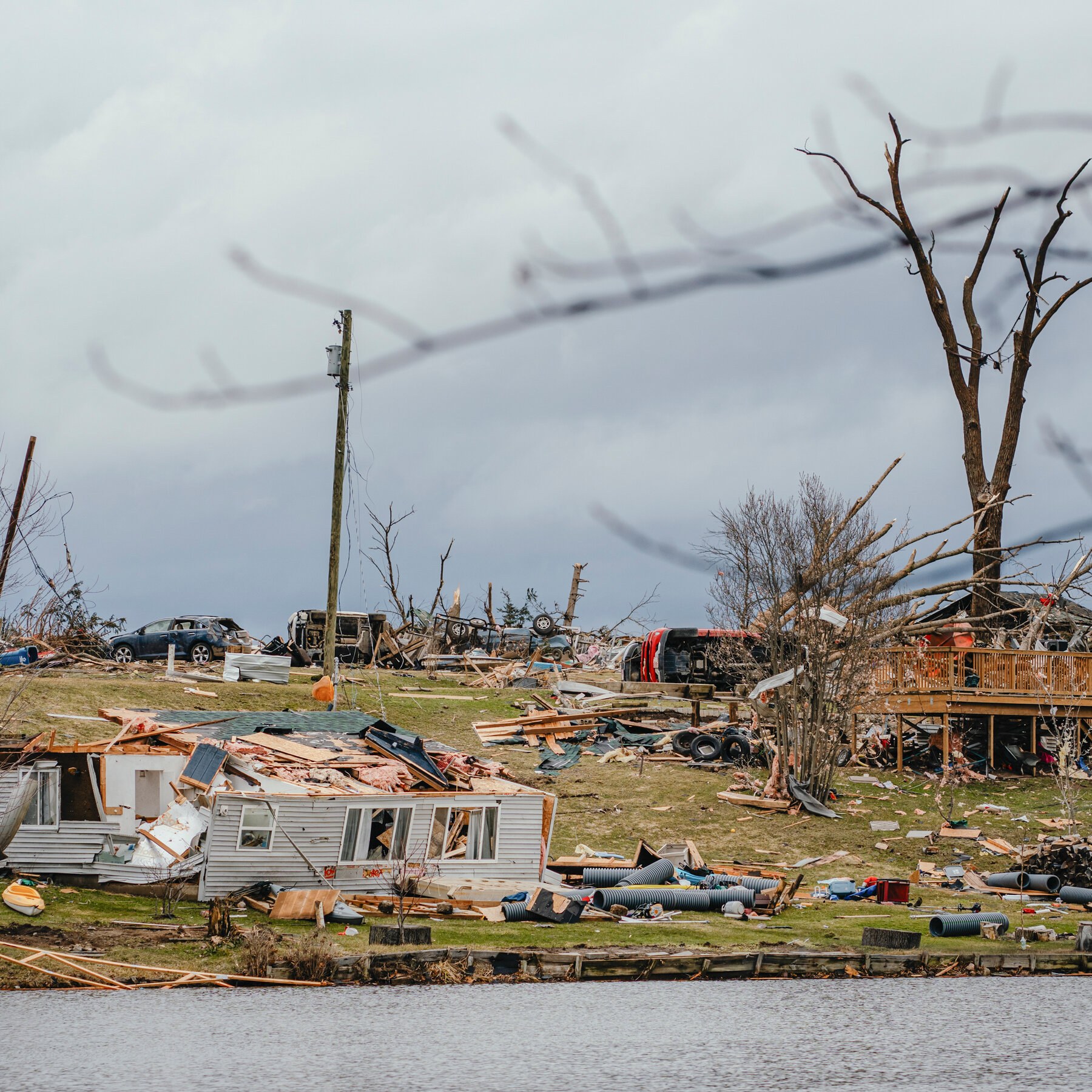
Six Dead and 13 Tornado Reports Prompt a Massive Tornado Damage Survey
- At least six people killed across Michigan and Oklahoma.
- Thirteen tornadoes were logged by the National Weather Service.
- Union City, Mich., saw three fatalities and a roof ripped off a home.
- Local schools turned into emergency hubs for displaced families.
When the wind stopped, the survey began
MICHIGAN—Friday night’s violent supercell thunderstorms left a trail of destruction that forced residents of Union City, Michigan, and Tulsa, Oklahoma, to launch an immediate tornado damage survey of homes, schools and businesses.
Paul Guthrie, 38, stepped out onto his rain‑slick yard to discover a cracked roof and a shed that had been hurled across the street, while his mailbox landed three‑quarters of a mile away, a stark illustration of the storm’s power.
Across the border, Tulsa’s mayor Monroe Nichols reported downed power lines and damaged roofs on the city’s Peoria campus, underscoring how the tornado damage survey is a two‑state effort.
The Immediate Aftermath: What Residents Saw in Union City
Roof Collapse and Flying Debris
By Saturday morning, the sky over Union City had cleared enough for a light drizzle, but the town’s streets were littered with twisted metal, shattered glass and a toppled auto‑shop wall that had crushed a row of cars. The National Weather Service confirmed 13 tornado reports across the two states, with six confirmed fatalities—three in Union City alone.
Paul Guthrie described the moment the tornado struck: “Five seconds of wind, and then it was over,” he said, standing beneath a dripping awning while his son’s bedroom was exposed to the sky. Ashley Macklin, a kindergarten teacher, added, “The pressure was just insane. I couldn’t hear anything. It felt like your face was being sucked in.”
In the nearby Edwardsburg area, a 12‑year‑old boy was killed when a tornado ripped through his home, according to Cass County Sheriff Clint Roach. Governor Gretchen Whitmer confirmed additional injuries in neighboring St. Joseph County, highlighting the broader regional impact.
Supercell thunderstorms, unlike ordinary storms, can sustain rotating updrafts for hours, creating the kind of violent wind fields that ripped roofs off and sent mailboxes flying. Meteorologist Jared Guyer explained that these storms “can maintain a mesocyclone long enough to produce multiple tornadoes,” a fact that underpins why the tornado damage survey must be thorough.
The damage to personal property was stark: Monte Putnam’s garage door hung askew, his shed was shredded, and a lawn mower was dragged across the yard. “We just survived a car crash weeks ago,” Putnam said, “so we feel lucky, but our new truck is pinned under the garage door.”
Faye Hendrickson, 80, who lives along Union Lake, said she feared for a close family friend who was in the tornado’s path. “He was our good friend, one of the best,” she whispered, underscoring the human toll that numbers can’t capture.
Local officials quickly mobilized. Union City Middle School principal Jamie Thomas described a makeshift support center set up in the high school gym, where donations of food, clothing and shelter supplies poured in. “The outreach has been amazing,” Thomas noted, though she cautioned that the full scale of displacement remains unclear.
As families sift through debris, the tornado damage survey in Union City will inform insurance claims, rebuilding permits and state aid allocations. The next chapter will explore how communities are systematically cataloguing this destruction.
How Are Communities Conducting a Tornado Damage Survey?
Community‑Led Damage Mapping
In the wake of the storms, volunteers, school staff and local officials launched a coordinated tornado damage survey across both states, using a blend of citizen reporting apps, aerial drone footage and on‑the‑ground inspections.
Union City’s makeshift support center became the hub for data collection. Residents dropped off photographs of damaged roofs, broken windows and flooded basements, which were then logged by a team of volunteers led by Principal Jamie Thomas. “We’ve set up a digital map where anyone can upload a photo and tag its location,” Thomas explained, noting that the effort mirrors the city’s emergency management plan.
In Tulsa, the city’s emergency management office partnered with the university’s meteorology department to overlay radar data with ground reports, creating a real‑time damage heat map. Tony Heaberlin, spokesperson for Tulsa Tech, said the campus’s Peoria building was surveyed within hours, confirming no injuries but extensive structural damage.
Experts point out that rapid damage surveys improve the accuracy of federal disaster declarations. Dr. Linda Chavez, a disaster‑response scholar at the University of Michigan, noted, “When local data is collected within 48 hours, FEMA can expedite assistance, and insurers can begin processing claims faster.”
The survey also revealed uneven damage patterns. A bar chart compiled from the first 200 reports shows that residential structures accounted for 57 % of total damage, schools 22 % and commercial properties 21 %. This distribution guides where emergency funds are allocated first.
Beyond data, the survey has social implications. Families like the Macklins, whose windows were boarded and glass scattered across their living room, rely on the survey to prove eligibility for temporary housing vouchers. “We can’t rebuild until we know the exact loss,” Tony Macklin said.
As the community maps the devastation, the next chapter will translate these figures into economic terms, estimating the cost of rebuilding and the strain on insurance markets.
Economic Ripples: The Cost of Rebuilding After the Tornadoes
Cost Estimates and Insurance Strain
Preliminary estimates from local adjusters suggest that the combined damage in Union City and the Tulsa metropolitan area could exceed $250 million. Residential losses alone are projected at $150 million, with an average home repair bill of $45,000 per household.
Insurance companies are already fielding a surge of claims. Monte Putnam’s truck, pinned under a collapsed garage door, is expected to cost $12,000 to replace, while his home repairs could total $78,000. “Our claims department is overwhelmed,” said a spokesperson for a regional insurer, who asked to remain anonymous.
Economists warn that large‑scale disasters can depress local economies for months. Dr. Samuel Ortega of the Midwest Economic Institute explained, “When homes and businesses are out of commission, tax revenues fall, and local contractors scramble to meet demand, driving up labor costs.”
A donut chart of the preliminary damage breakdown shows that 62 % of the loss is tied to structural damage, 23 % to utility and infrastructure repairs, and 15 % to personal property loss. These percentages help policymakers prioritize funding for road repairs, power restoration and debris removal.
Beyond the immediate repair costs, the tornado damage survey has highlighted long‑term affordability challenges. Residents like Faye Hendrickson, 80, worry about rising insurance premiums. “My fixed income can’t keep up with higher rates,” she said, reflecting a broader concern among seniors.
State officials have pledged $10 million in emergency aid, but the gap between aid and total loss remains wide. The upcoming chapter will shift focus to Oklahoma’s parallel devastation, comparing how each state’s response infrastructure is coping with similar economic pressures.
Oklahoma’s Parallel Destruction: From Tulsa to Beggs
Tulsa and Beggs: Parallel Paths of Destruction
While Union City grappled with its own recovery, Oklahoma faced a twin crisis. In Tulsa, a tornado ripped the roof off a building on the Peoria campus of Tulsa Tech, scattering twisted metal across the lawn. No injuries were reported, but the repair bill is estimated at $1.3 million.
Thirty miles south, the small city of Beggs saw a tornado flatten a single‑family home, killing two residents and injuring several others. Sheriff’s deputies reported that the house was reduced to a foundation slab, prompting an immediate evacuation of neighboring homes.
Mayor Monroe Nichols posted on social media that power lines were down for over 12 hours, and emergency crews were working around the clock to restore electricity. “Our priority is safety and rapid restoration,” Nichols wrote.
Storm Prediction Center meteorologist Jared Guyer warned that the weekend’s forecast calls for a “notch down in intensity,” yet the risk of additional tornadoes remains high across eastern Ohio, western Pennsylvania and parts of West Virginia.
A line chart tracking the Storm Severity Index from Friday night through Saturday shows a peak at 8.2 on Friday (the highest recorded for the outbreak) and a gradual decline to 4.5 by Saturday evening. The chart underscores why the tornado damage survey must continue even as winds subside.
Local schools in Tulsa mirrored Union City’s response, setting up a temporary shelter at the Tulsa Dream Center for displaced children. JD Hughes, director of the center, noted that about 30 fifth‑ and sixth‑graders huddled under a stairwell during the storm and resumed classes once the tornado passed.
With both states conducting extensive tornado damage surveys, the next chapter will examine the broader outlook for the weekend, including forecasts, preparedness measures, and how residents can stay safe.
Looking Ahead: Forecasts and Preparedness for the Weekend
Weekend Forecast and Community Preparedness
As the tornado damage survey wraps up its first phase, meteorologists caution that the risk of severe weather remains elevated. The Storm Prediction Center’s outlook for Saturday highlights a 15 % tornado probability across eastern Ohio, western Pennsylvania and parts of West Virginia.
Jared Guyer emphasized that “while the next round of storms may be a notch down in intensity, the environment is still primed for rapid storm development.” He added that residents should keep storm shelters stocked, maintain charged mobile devices and monitor local alerts.
In Union City, the school‑based support center will stay open through Sunday, providing a central point for families to report damage, receive clean water and access temporary housing. Principal Jamie Thomas said, “We’re preparing for a possible influx of displaced families if another tornado strikes.”
A comparison chart of Saturday’s forecasted tornado risk versus Friday’s actual reports shows a decrease from 13 confirmed tornadoes to an anticipated 7, yet the potential for high‑impact events persists.
Local emergency managers are also conducting tabletop exercises to test evacuation routes and communication systems. “Our goal is to reduce the time between a tornado warning and community response,” explained Deputy Fire Chief Luis Ramirez of Tulsa.
For residents still assessing their own damage, the ongoing tornado damage survey offers an online portal to log losses, request assistance and track the status of aid applications. “Transparency is key,” said a spokesperson for the Michigan Emergency Management Agency.
With the weekend’s forecast still volatile, the next steps will involve translating the data from the tornado damage survey into actionable recovery plans, ensuring that both Michigan and Oklahoma can rebuild stronger and more resilient.
Frequently Asked Questions
Q: How many tornadoes were reported in Michigan and Oklahoma on Friday night?
The National Weather Service logged 13 tornado reports across Michigan and Oklahoma by Friday night, sparking a widespread tornado damage survey.
Q: What immediate assistance is available to residents after the tornadoes?
Local schools have set up makeshift support centers offering food, shelter, and donation drops, while state officials coordinate emergency relief as part of the tornado damage survey.
Q: What weather risks remain for the weekend after the storms?
Meteorologists warn that severe thunderstorms, flash‑flood potential, and additional tornadoes persist from central Texas to western New York, keeping the tornado damage survey effort ongoing.
