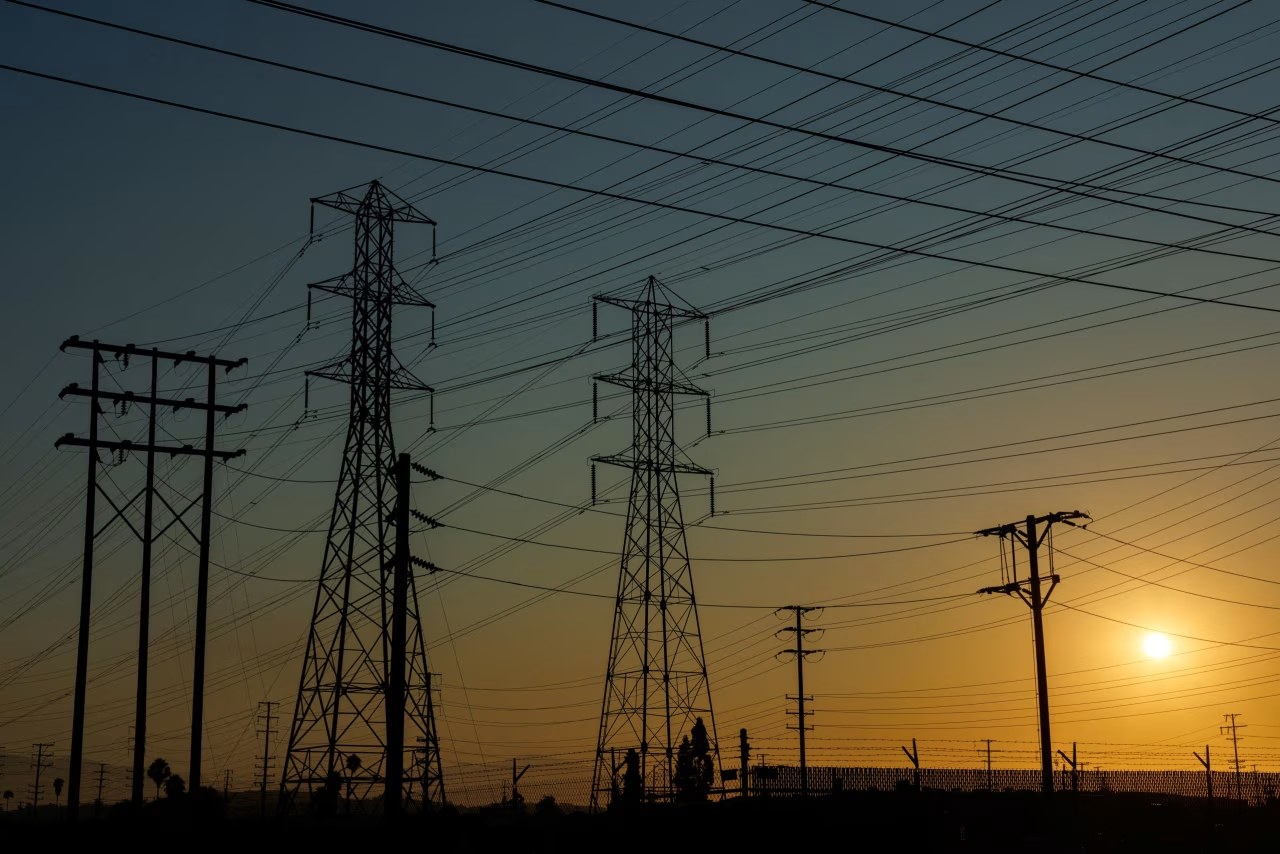
Utilities Plan $100 Billion in AI-Fueled Grid Upgrades—and Households May Foot Half the Bill
- U.S. utilities announced tens of billions in new capex this year, mostly for high-voltage lines to supply AI data centers.
- President Trump has pushed to shield consumers from data-center-driven costs, but regulators say complete protection is impossible under current federal cost-sharing rules.
- Industry groups estimate transmission investment could top $100 billion within a decade, the largest since WWII.
- Ratepayers in Virginia, Texas and Ohio already face proposed double-digit bill increases tied to new transmission projects.
The AI boom is colliding with a creaking grid, and the fight over who pays has only just begun.
AI DATA CENTERS—The nation’s utilities are quietly unveiling spending plans that rival the post-war rural electrification program. Driven by an unprecedented surge in electricity demand from artificial-intelligence data centers, companies from Dominion Energy to American Electric Power intend to string thousands of miles of new high-voltage transmission lines—projects that carry price tags measured in tens of billions of dollars. Yet no consensus exists on how to allocate those costs between deep-pocketed tech giants and residential customers already struggling with rising utility bills.
President Donald Trump’s administration has signaled it wants to minimize the consumer share, but interviews with regulators, utility executives and energy economists reveal a more complicated arithmetic: federal cost-allocation rules, regional-grid interdependencies and the sheer scale of the upgrade make it nearly impossible to quarantine expenses within Silicon Valley balance sheets. The result is a high-stakes policy stalemate that could shape household electric bills for decades—and determine whether the United States can keep pace with the AI revolution.
Why AI Data Centers Are Forcing the Biggest Grid Build-Out Since WWII
The catalyst is a spike in forecast electricity use that the Department of Energy calls “historic.” A single hyperscale data center can consume 200 megawatts—roughly the demand of 160,000 homes—and developers are proposing clusters of 10 to 50 such facilities across Virginia’s Loudoun County, Texas’s Permian Basin and Ohio’s corn belt. Grid operators now warn that peak demand in some regions could double within 15 years, reversing two decades of flat load growth.
Meeting that appetite requires more than incremental tweaks. Modern AI workloads run 24/7, stressing transmission lines that were sized for daytime air-conditioning peaks, not round-the-clock baseload. The solution, utilities argue, is a new network of 765-kilovolt lines capable of moving surplus power from remote wind and solar farms to data-center hubs. The last build-out of comparable magnitude occurred between 1949 and 1959, when federal rural-electrification loans helped erect 300,000 miles of line, according to the Edison Electric Institute.
Yet today’s political economy differs sharply. Back then, costs were socialized through federal low-interest loans repaid over 35 years. Now, most new transmission is financed through regional grid operators governed by complex Federal Energy Regulatory Commission (FERC) rules that require benefits—and costs—to be shared across all customers in a region, regardless of who triggered the upgrade. “There is no opt-out clause for households,” says Ari Peskoe, director of the Electricity Law Center at Harvard Law School. “Once a project is deemed ‘regionally beneficial,’ everyone chips in.”
Compounding the tension, utilities have moved fast. Dominion Energy announced a $9.8 billion capital-expansion plan in March, citing “data-center corridors.” American Electric Power boosted its five-year transmission budget 32 % to $25 billion. Oncor in Texas tacked on another $5 billion. Collectively, S&P Global Commodity Insights counts $97 billion in proposed transmission projects nationwide that cite data-center load growth as a primary driver—numbers last seen during the post-war boom.
The scale is unprecedented, but the financing mechanism remains rooted in 20th-century cost-sharing formulas.
Who Pays? Inside the Federal Rule That Prevents Targeted Billing
FERC Order 1000, finalized in 2011, requires regional grid planners to identify transmission needs and allocate costs based on “beneficiaries pay” principles. The hitch: regulators define a beneficiary broadly. If a new 765-kV line improves reliability for an entire zone—even if the zone contains only one 500-MW data center—every ratepayer in that zone helps foot the bill. Attempts to single out tech giants are legally fraught.
In 2022, Dominion floated a special “data-center tariff” that would have assigned 70 % of a $3.2 billion line to new commercial customers. FERC rejected the filing, ruling it violated the federal duty to charge just and reasonable rates. “The commission essentially said you can’t wall off costs to one class if the infrastructure provides system-wide benefits,” recalls Christi Tezak, managing director at ClearView Energy Partners.
State regulators feel handcuffed. “We’re told the upgrade is needed tomorrow, but we can’t force the party causing the need to pay,” Kentucky Public Service Commission chairman Kent Chandler told a National Association of Regulatory Utility Commissioners (NARUC) panel in February. Consumer advocates warn the default mechanism—splitting costs per kilowatt-hour sold—hits low-income households hardest because they spend a larger share of income on utilities.
Some states are experimenting. Colorado allows utilities to levy a “demand-related” rider that recovers 50 % of new transmission from customers whose peak load exceeds 5 MW. Texas’s ERCOT grid lets developers build dedicated 345-kV lines and recover costs through negotiated contracts, but those projects must still interconnect to the shared grid, triggering cost-sharing for backup upgrades.
Meanwhile, tech firms are privately negotiating. Amazon Web Services has agreed to front-fund $1.1 billion in Virginia substations in exchange for 15-year depreciation credits; Microsoft signed a similar $500 million deal with Xcel Energy in Minnesota. Yet even these side payments are blended into the regional revenue requirement, reducing household exposure only marginally.
Without a statutory overhaul of federal cost-allocation rules, households will shoulder an estimated 45-60 % of data-center-driven upgrades, according to Grid Strategies LLC.
What $100 Billion in New Lines Could Mean for Monthly Bills
The arithmetic is sobering. A typical 765-kV line runs about $3 million per mile in the Midwest and $7 million in the Northeast, where land and labor are pricier. FERC filings show utilities seek 11-13 % return on equity over 40 years. Amortized, every $1 billion in new transmission adds roughly $0.50 to the monthly bill of a typical residential customer in a region with 3 million meters.
Multiply by 100: if the nationwide build-out reaches the upper end of industry forecasts, households could see a permanent $45-60 monthly surcharge—on top of existing charges—for lines justified largely by AI demand. “That’s a regressive transfer to the most profitable sector in history,” says Jean Su, energy justice director at the Center for Biological Diversity.
Regulators are pushing back. In Virginia, the State Corporation Commission approved only 60 % of Dominion’s requested $9.8 billion plan, citing “excessive consumer exposure.” Ohio regulators slashed AEP’s rider increase from 14 % to 6 %. Texas lawmakers are debating a bill that would cap transmission-cost recovery from residential customers at 5 % of the prior year’s bill.
Yet delaying projects carries its own price. Grid congestion already costs the Midwest $2.3 billion a year in curtailment payments, according to MISO’s 2023 report. Blackouts during 2021’s Winter Storm Uri cost Texans an estimated $195 billion in economic losses. “Under-investment is not victimless,” notes Joshua Rhodes, research scientist at the University of Texas at Austin.
The political dilemma: pay billions now through higher bills, or risk bigger economic losses later.
Is There a Tech-Backed Financing Model That Could Protect Ratepayers?
Some analysts argue the closest precedent lies in the fiber-optic boom of the 1990s, when telecom carriers paid utilities to string broadband on existing poles. A similar “carrier-neutral” model could see consortia of cloud giants build and own transmission assets, then provide open-access capacity to utilities. FERC precedent exists: Order 888 mandates open-access transmission, but it applies only to existing wires, not greenfield lines.
Legislation percolating in Congress would create a federal “Grid Bank” modeled on the Export-Import Bank, offering below-market loans for projects that serve national-security needs—including data-center clusters. The draft bill caps residential cost share at 30 %, with Treasury absorbing the remainder. The idea has bipartisan sponsors but faces opposition from fiscal hawks who decry subsidies for Silicon Valley.
Another proposal—endorsed by former FERC chairman Neil Chatterjee—would expand the Energy Department’s Loan Programs Office to offer 50-year zero-interest loans for AI-related transmission, repaid through a kilowatt-hour surcharge on data-center servers. “We already socialize highway costs through fuel taxes; why not treat bits the same way?” Chatterjee told a Senate Energy panel in April.
Tech firms are lukewarm. While they prefer predictable cost recovery, they fear ownership brings stranded-asset risk if AI workloads migrate. “We’re in the compute business, not the wires business,” a senior Amazon executive said on background. Microsoft has floated a public-private partnership that would lease lines back to utilities after 20 years, effectively converting capex to opex.
Absent federal action, states are improvising. Illinois lawmakers approved a 2 % “digital services” excise tax whose proceeds are earmarked for transmission upgrades in data-center corridors. The tax is projected to raise $180 million annually—enough to offset 25 % of ComEd’s proposed $700 million line. Similar bills are pending in Oregon and Georgia.
Whether Silicon Valley or Main America pays may hinge on the next FERC quorum—and the 2025 budget reconciliation bill.
Frequently Asked Questions
Q: How much will the AI-driven grid expansion cost?
Industry estimates put the nationwide transmission build-out at well above $100 billion over the next decade, with single projects like new 765-kV lines averaging $3 million per mile.
Q: Why can’t tech giants pay the full tab for grid upgrades?
Even if Meta or Amazon finance adjacent substations, regional grids are interconnected; federal rules require costs to be shared across all users, limiting utilities’ ability to isolate charges.
Q: Which states face the steepest rate hikes?
Texas, Virginia and Ohio—where data-center clusters are surging—already see utilities request double-digit increases, with regulators warning residential bills could rise 15-30 % within five years.
