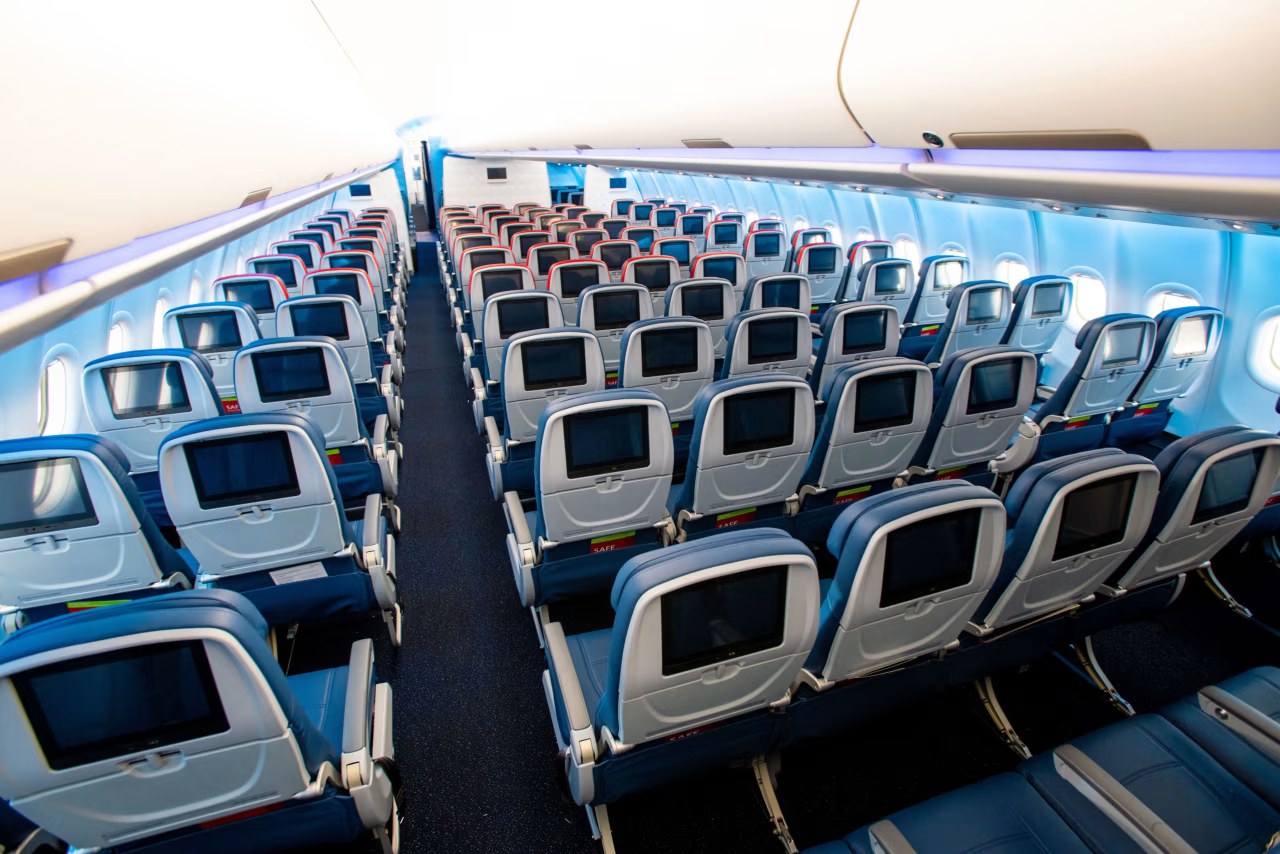
Airlines Strip Out 40 Economy Seats to Add 16 Premium Pods on New A330neo Jets
- Delta’s refurbished A330neo now devotes 45 % of the main deck to Delta One or Comfort+ sections, up from 34 % on the same model delivered three years ago.
- United’s forthcoming 787-10 retrofits will remove 41 economy chairs to install 24 Polaris suites, lifting premium square footage from 28 % to 39 % of the cabin.
- Airbus and Boeing order books show 62 % of newly delivered single-aisle jets for U.S. carriers configured with “high-premium” layouts, compared with 28 % in 2019.
- The shift allows carriers to chase business travelers who paid 3.4× more per seat than leisure flyers in 2023, according to Airlines for America data.
Passengers who buy the cheapest ticket now find fewer seats—and less legroom—than ever before.
DELTA AIR LINES—On Delta’s newest Airbus A330neo, economy class begins where row 35 used to be. The first 34 rows are now Delta One lie-flat suites or Comfort+ extra-legroom sections, a configuration that shrunk standard economy capacity by 40 seats compared with the same aircraft delivered in 2019. The change is deliberate: every square foot reassigned from economy to premium can add between $30 and $150 in incremental revenue per departure, airline executives told analysts last quarter.
The industry-wide cabin rebalancing accelerated after carriers burned through $36 billion in cash during 2020 and 2021. With corporate travel rebounding faster than budget leisure trips, airlines are redesigning cabins to capture the highest willingness to pay first. The result is a quiet but steady erosion of the back-of-the-bus footprint that once dominated most twin-aisle jets.
Airlines for America, the industry trade group, says the share of main-deck floor space devoted to standard economy on new wide-body deliveries to U.S. carriers has fallen below 50 % for the first time since deregulation in 1978. For passengers, the numbers translate into tighter booking curves: average load factors on domestic economy cabins hit 88 % this summer, while premium sections hovered at 71 %, Department of Transportation data show.
The Economics Behind Shrinking Economy Cabins
Airlines do not reveal exact per-seat profit figures, but public earnings calls provide enough data to model the math. Delta president Glen Hauenstein told investors in April that one square foot assigned to a Delta One suite generates about four times the revenue of the same space in standard economy. On a trans-Atlantic flight, that can mean $1,800 versus $450 for the area under a 20-inch-wide, 32-inch-pitch economy chair.
The leverage is even larger on United’s new Polaris retrofit. CFO Michael Leskinen said removing 41 economy seats to add 24 Polaris pods cuts 108 economy passengers but adds 72 high-fare travelers. Because Polaris round-trip fares between Newark and London averaged $3,200 this summer against $520 in basic economy, United gains roughly $130,000 in incremental revenue per round-trip, even after accounting for the 12 % reduction in total seats.
Boeing’s 2023 Cabin Configuration Survey shows carriers worldwide now allocate 42 % of wide-body floor space to premium sections, up from 29 % in 2015. The same survey found airlines expect premium share to reach 50 % by 2028, driven by lie-flat business demand and high-margin extra-legroom economy. The trend is accelerating because aircraft manufacturers deliver jets with pre-wired seat tracks that allow airlines to slide partitions forward or aft within 24 hours, making cabin rebalancing cheaper than in earlier generations.
Wall Street rewards the shift
Analysis by Raymond James shows airlines that increased premium density by at least five percentage points between 2019 and 2023 saw unit revenue outpace labor cost inflation by 6.4 percentage points, a margin that translated into 14 % higher share-price performance relative to the NYSE Arca Airline Index. Investors view premium seats as a hedge against volatile fuel and labor costs because those tickets are purchased closer to departure, reducing pricing risk.
Yet the strategy carries execution risk. Jamie Baker, airline analyst at J.P. Morgan, warns that over-allocating space to premium can leave carriers vulnerable during recessions when corporate travel budgets are first to be cut. “History shows premium cabins empty faster than economy in downturns,” Baker wrote in a July note, citing 2001 and 2009 load-factor drops.
For now, carriers are betting that hybrid work patterns have structurally elevated business travel. Delta chief executive Ed Bastian told attendees at a September investor day that 70 % of the airline’s Fortune 500 accounts have restored or exceeded 2019 travel spend, a metric that underpins the carrier’s plan to grow premium capacity 8 % next year while shrinking economy capacity 2 %.
Which Planes Are Changing First—and by How Much?
Delta’s A330-900 retrofit program illustrates the pace of change. The airline took delivery of 11 A330neos between 2019 and 2021 with 281 economy seats; the next 16 aircraft arriving from 2024 onward will carry only 241 economy seats, a 14 % reduction. The space is reassigned to 28 Delta One suites (up from 21) and 56 Comfort+ seats (up from 38), according to fleet-planning slides released in May.
United is going further on its 787-10 fleet. The carrier currently operates 21 of the jets with 318 economy seats; by 2026, retrofits will cut that to 277 while adding 24 Polaris pods and 54 Premium Plus recliners. The new layout increases premium square footage from 28 % to 39 % of the main deck, internal diagrams reviewed by The Wall Street Journal show.
American Airlines is reconfiguring 47 Boeing 777-200ERs under its “Project Kodiak.” The mod removes 42 main-cabin seats to install 30 new Flagship Business pods and 28 Premium Economy chairs. Engineers had to relocate two galley complexes and move two lavatories to the cargo hold ceiling—changes that add $6 million in certification cost per aircraft, people familiar with the program said.
Narrow-body jets follow the same playbook
On single-aisle aircraft, the shift is less dramatic but still measurable. Alaska Airlines’ new 737-10s arrive with 32 first-class recliners—eight more than the -900ER variant—and 30 extra-legroom “Premium” seats, trimming standard economy capacity by 12 seats to 138. JetBlue’s A321LRs flying trans-Atlantic carry 114 Core economy seats, 24 fewer than the domestic A321 configuration, because 24 lie-flat Mint suites occupy the forward cabin.
Airbus order data show that 62 % of A321neo deliveries to U.S. carriers in 2024 feature so-called Cabin Flex bulkheads that allow airlines to slide the partition between premium and economy sections. The same modularity on Boeing’s 737 MAX 10 has led United to order 130 jets with 20 % of the cabin earmarked for first-class or extra-legroom sections, up from 12 % on the 737-900.
Retrofits are not cheap. Delta budgets $8 million per wide-body and $1.2 million per narrow-body for interior overhauls, figures that include new seats, in-flight entertainment, and galleys. Yet payback periods have shortened: Delta’s finance team told analysts the A330neo reconfiguration will break even in 2.3 years, compared with 4.1 years for a similar mod in 2014, because premium fares have risen faster than retrofit costs.
What Does This Mean for Fares and Availability?
Basic-economy fares have not risen in lockstep with capacity cuts—yet. Department of Transportation data show average domestic economy fares in the second quarter of 2024 were $328, roughly flat with 2019 after adjusting for inflation. But travelers increasingly face sell-outs on peak days. Load factors in the economy cabin reached a record 88.3 % during June, July and August, compared with 85.7 % in summer 2019, according to Airlines Reporting Corp.
Harrell Associates aviation consultant Bob Harrell says the mismatch is deliberate. “airlines are rationing the cheapest inventory to push upgraders into Comfort+ or Main Cabin Extra,” Harrell said. His firm’s fare-tracking database shows Comfort+ fares averaged 31 % more than adjacent standard economy on the same Delta flights this summer, a premium that has widened from 19 % in 2019.
Internationally, the trend is sharper. Round-trip economy fares between New York and London averaged $612 this September, down 8 % from 2019, but premium-economy fares rose 14 % to $1,480, Cirium Diio data show. British Airways executives told investors in November that every percentage point of cabin space moved from economy to premium-economy lifts total trip revenue by 0.8 %, a formula that underpins the carrier’s plan to grow premium-economy capacity 25 % by 2026.
Corporate travel managers feel the squeeze
Steve Singh, managing director of travel at SAP Concur, says Fortune 1000 clients report a 22 % year-over-year increase in automatic ticket upgrades triggered when lowest economy buckets are closed. “The seat map disappears fast; travelers book what’s left,” Singh said. Concur’s anonymized receipt data show average ticket prices for U.S. domestic economy itineraries rose 6 % in the first nine months of 2024, even though published fares were flat, because travelers were nudged into higher classes.
Airlines counter that consumers still have choice. JetBlue vice-president Dave Clark notes his airline added 10 % more Core seats on its refreshed A320s while still growing Mint capacity. “The key is segmentation,” Clark said. Yet JetBlue’s own data reveal Core fares rose 11 % year-over-year in the third quarter, the fastest clip since 2015, as the carrier reduced off-peak inventory to match seasonal demand.
Forward bookings suggest the economy seat shortage will intensify. OAG schedules show U.S. carriers plan to increase domestic capacity only 2 % next summer, the slowest growth since 2013, while premium capacity will rise 9 %. If demand holds, basic-economy sell-outs could become routine, pushing walk-up fares higher and reducing the fare gap that once separated legacy carriers from ultra-low-cost rivals.
Is There a Regulatory or Safety Limit to How Small Economy Can Shrink?
The Federal Aviation Administration sets evacuation standards, not seat dimensions, but those rules indirectly cap density. Tests require that all passengers can evacuate within 90 seconds using half the exits; as seat pitch drops below 28 inches, certification becomes harder. Airbus and Boeing engineers say 27 inches is the practical floor for twin-aisle jets, while single-aisle aircraft certified under the “Over-Wing Slide” rule rarely go below 29 inches.
Consumer advocates petitioned the FAA in 2019 to impose a 32-inch minimum pitch, citing deep-vein-thrombosis risks. The agency denied the rule-making, arguing insufficient medical evidence, but Congress inserted a directive in the 2023 FAA reauthorization bill requiring the agency to study seat dimensions’ impact on safety and health. The report is due in 2025; regulators could propose new limits thereafter.
Meanwhile, airlines are innovating within existing rules. United’s new 737 MAX 10 uses thinner, carbon-fiber seatbacks that reclaim 2 inches of perceived legroom without reducing pitch. Alaska’s Recaro-designed seats shave 1.5 inches from the aft bulkhead by reshaping the magazine pocket. “We’re not going below 30 inches,” Alaska director of interior engineering Alex Smith said. “We’re just using space smarter.”
Civil rights complaints rise
FlyersRights.org, a passenger advocacy group, says complaints about seat comfort rose 42 % in 2024, with many alleging discriminatory impact on taller, older or disabled passengers. The Department of Transportation does not collect seat-pitch data, but a Government Accountability Office study released in October found no evidence that denser cabins increased evacuation times in FAA drills. Still, investigators recommended the agency collect real-world data from airlines after every in-flight evacuation, a step the FAA has not committed to take.
Internationally, regulators are moving faster. France’s civil aviation authority now requires airlines to disclose seat pitch and width at the point of sale, and the U.K. is considering similar rules. If the European Union adopts a 29-inch minimum pitch, global manufacturers may be forced to redesign seat tracks, potentially raising costs and slowing the premium-cabin expansion trend.
For now, airlines retain the upper hand. FAA administrator Michael Whitaker told a Senate hearing in September that his agency’s priority is “runway safety, not seat width,” signaling that market forces rather than regulation will dictate how small economy gets. With premium demand still climbing and labor costs rising, carriers have every incentive to keep shaving space until either demand softens or regulators say stop.
What’s Next: Will Economy Ever Rebound—or Is This the New Normal?
Airline fleet planners speak of a structural shift rather than a cycle. Boeing’s 2024 market outlook predicts premium traffic will grow 6 % annually through 2043, double the rate of economy travel, as hybrid work makes business trips less frequent but more valuable. If that forecast holds, the economic incentive to reallocate cabin space will persist even if regulators impose modest seat-pitch floors.
Technology may soften the blow. Airbus is testing “flex-cabin” modules that allow airlines to slide partitions overnight, converting a 60-premium/200-economy layout to 40/220 for leisure-heavy routes. Delta has filed patents for pop-up premium berths that fold from overhead bins, creating lie-flat capacity only on peak days. Such innovations could restore some economy seats during low-demand periods without sacrificing high-fare inventory when it matters.
Yet the long-term trajectory is clear: the back of the plane will occupy a smaller share of the fuselage. Avolon, the aircraft-leasing giant, forecasts that by 2030 the average new wide-body delivered to a U.S. carrier will devote 55 % of main-deck floor space to premium sections, up from 42 % today. That implies another 8–10 % reduction in economy capacity even as total aircraft deliveries rise 14 %.
Passenger adaptation
Travel managers report a quiet acceptance among corporate travelers who once resisted premium fares but now book them to secure availability. Expense-management firm AppZen found that the share of U.S. business trips booked in premium economy or higher rose to 38 % in 2024 from 24 % in 2019, even though corporate travel budgets remain 7 % below pre-pandemic levels. “Companies are reallocating, not spending more,” AppZen analyst Vipul Kasera said.
For leisure travelers, the adjustment is harsher. Google Flights data show the average cheapest round-trip between Los Angeles and New York departing within seven days was $618 this October, up 22 % from 2019, while the cheapest premium-economy option rose only 9 % to $1,050. The narrowing gap nudges some middle-class travelers to pay up, effectively converting price-sensitive flyers into reluctant premium passengers.
If current trends persist, the term “economy class” may evolve to mean a smaller, tighter cabin offered mainly as an anchor price rather than a practical choice. The turf war is over; premium has won the real estate, and economy is left with what remains—less space, fewer seats, and a higher psychological hurdle to fly.
Frequently Asked Questions
Q: Why are airlines shrinking economy cabins?
Carriers can earn up to four times more per square foot from lie-flat business or extra-legroom seats than from standard economy, so they redesign cabins to shift the mix toward premium.
Q: Which aircraft types are being retrofitted first?
Wide-body jets used on trans-Atlantic and trans-Pacific routes—Airbus A330s, A350s and Boeing 787s—are priorities because premium demand is strongest on long-haul flights.
Q: How much extra revenue does each premium seat generate?
Delta told investors that one Comfort+ seat produces roughly 30 % more unit revenue than a standard economy seat on the same flight; a Delta One suite can yield 300 % more.
📰 Related Articles
- Rising Diesel Costs Hit Long-Haul Drivers First, Threatening Supply Chains
- Prestige Consumer Healthcare Expands OTC Portfolio with $1.045 Billion Brand Purchase
- Genco Rejects $23.50 Offer Amid $25 NAV Dispute, Shaking Auto and Transport Market
- Jury Rules Elon Musk Partially Liable for Twitter Investor Losses After Deal Threat
