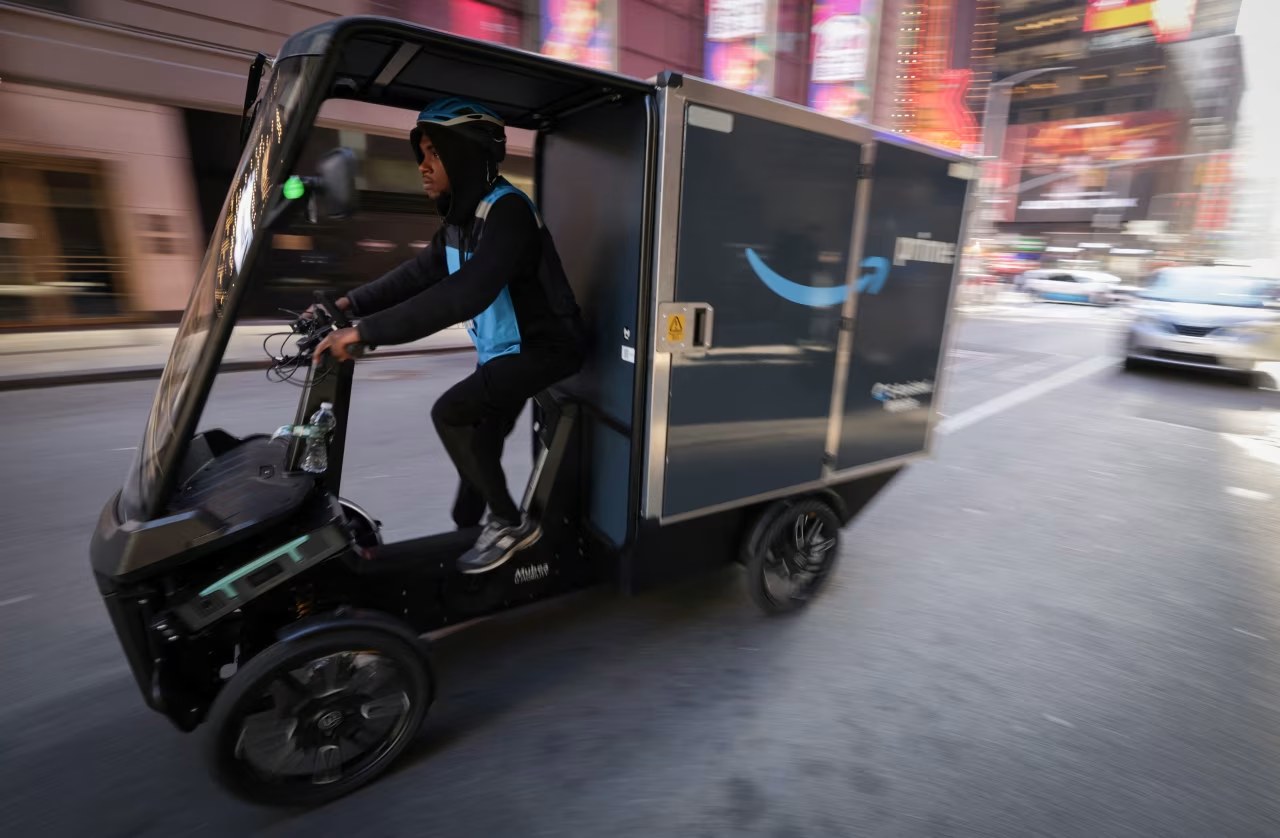
Amazon Rolls Out 1-Hour Delivery to Hundreds of Cities and 3-Hour Service to 2,000 More
- One-hour delivery now covers hundreds of U.S. cities, targeting household essentials and OTC medications.
- Three-hour option reaches over 2,000 towns, quadrupling Amazon’s prior ultrafast footprint.
- Move counters Walmart Express and emerging same-day players like Instacart and Target’s Shipt.
- Expansion leans on 150+ Prime same-day sites and a flex-driver network Amazon scaled during the pandemic.
Speed becomes the new battleground as the e-commerce giant tries to outrun Walmart’s grocery dominance
AMAZON—Amazon on Tuesday said shoppers in hundreds of American cities can now tap “Buy Now” and see diapers or ibuprofen on their doorstep within 60 minutes, a pace that narrows the gap between digital carts and neighborhood drugstores. The initiative—first hinted at in job postings earlier this year—marks the company’s largest single-day enlargement of ultrafast delivery since it pioneered two-day Prime shipping in 2005.
The retail behemoth also flipped on a three-hour promise across more than 2,000 ZIP codes, quadruple the prior coverage, giving it a footprint that stretches from Seattle suburbs to exurbs of Atlanta. Analysts say the timing is deliberate: Walmart this spring began touting a two-hour Express tier for 40,000 grocery SKUs, while start-ups like Gopuff and Gorillas have attracted billions in venture capital by promising 30-minute drop-offs of snacks and soap.
“Amazon is essentially telling investors and rivals that the logistics moat is still theirs to lose,” said Sucharita Kodali, retail strategist at Forrester. The stakes are enormous: McKinsey estimates the U.S. market for same-day and instant delivery will top $16 billion this year, up 40 percent versus pre-pandemic levels.
Inside Amazon’s 60-Minute Promise: How the Fulfillment Machine Works
Amazon’s one-hour pledge hinges on a network of 153 “same-day” micro-fulfillment centers that the company quietly built inside existing sortation buildings, according to logistics executives familiar with the rollout. Each site stocks roughly 20,000 high-velocity items—everything from Tide pods to Tylenol—within 100 miles of major population corridors. Algorithms forecast demand down to the neighborhood level, pre-positioning inventory so that when a customer hits purchase, a picker can assemble the order in under nine minutes.
The final stretch relies on Amazon Flex, a gig-driver fleet the firm expanded to 250,000 active couriers last quarter, up 28 percent year-over-year. Drivers receive batched offers that keep them inside a 15-mile radius, enabling round-trip fulfillment inside 60 minutes during peak daylight windows. “It’s basically a hyper-local relay race,” said Marc Wulfraat, president of logistics consultancy MWPVL International, who has tracked Amazon real-estate leases since 2015.
Company insiders say the service is profitable on a contribution-margin basis when baskets exceed $25, helped by a $9.99 delivery fee for non-Prime members and by dynamic pricing that surges during high-demand intervals. Amazon declined to disclose exact margins, but CFO Brian Olsavsky told analysts last quarter that ultrafast orders generate 1.7 times the revenue per unit of standard next-day packages because shoppers tend to add impulse items once delivery is guaranteed within an hour.
Inventory depth remains the choke point
Despite algorithmic forecasting, about 12 percent of one-hour orders are diverted to three-hour slots because an SKU is unavailable in the nearest node, according to a June audit by e-commerce analytics firm Profitero. That compares with a 4 percent stock-out rate for next-day Prime, illustrating the operational challenge of compressing fulfillment cycles without building redundant inventory. Amazon is experimenting with “virtual bundling,” where multiple items from different nodes are consolidated mid-transit, a tactic that could shave another eight minutes off average handling time if scaled.
The company must also navigate municipal restrictions; New York City’s Taxi & Limousine Commission, for example, requires commercial delivery drivers to carry additional permits, adding an average 90 seconds per stop. Still, early adoption data show order volumes growing 18 percent week-over-week in pilot ZIP codes, a clip that outpaces Amazon’s 2020 grocery surge, suggesting consumers value immediacy over slight fee premiums.
Looking ahead, analysts expect Amazon to license the technology to third-party retailers, mirroring its “Buy with Prime” playbook, potentially turning the logistics platform into a revenue line rather than merely a cost center.
Why Walmart and Target Are Racing to Keep Up
Walmart’s answer landed in March when it announced Walmart Express, a two-hour delivery window for 40,000 grocery and consumable items across 1,700 stores. The Bentonville giant leans on its 4,700 U.S. locations—within 10 miles of 90 percent of the population—to act as hybrid stores and fulfillment hubs. Workers pick orders directly off shelves, then hand them to Spark drivers, Walmart’s gig platform that competes with Flex. Walmart+ members pay no delivery fee on orders above $35, undercutting Amazon’s $9.99 charge for non-Prime shoppers.
Target, not to be outdone, expanded its Shipt same-day service to 1,500 cities and piloted a 45-minute “urgent” category in Minneapolis, Dallas and Tampa. Yet Amazon’s one-hour gambit raises the bar, said Scott Mushkin, retail analyst at R5 Capital. “Speed is becoming the new price. Once consumers experience 60 minutes, two hours feels sluggish.”
Data from Earnest Analytics show households earning above $100,000 are 1.8 times more likely to abandon a retailer after a single late grocery delivery, underscoring why Amazon is absorbing higher variable costs to guarantee shorter windows. The stakes are amplified because grocery baskets average 1.4 times the size of general-merchandise carts, according to Placer.ai foot-traffic insights.
Who leads where?
In a June survey of 3,200 shoppers by Pymnts.com, 42 percent named Amazon their “primary” same-day provider versus 31 percent for Walmart and 9 percent for Target. But Walmart leads on grocery share—23 percent of U.S. grocery dollars versus Amazon’s 2.3 percent, per Numerator. Translation: Amazon is using ultrafast delivery to punch above its weight in food, while Walmart is using grocery to defend its e-commerce turf.
Both retailers are racing to lock in suburban moms, the cohort with the highest repeat-purchase frequency. Amazon’s ability to bundle Prime Video, pharmacy savings and now 60-minute delivery creates what Forrester calls a “value fortress,” making membership cancellations less likely even if fees rise.
The next battleground is rural ZIP codes, where Walmart’s store density still trumps Amazon’s nodes. Analysts expect Amazon to license its micro-fulfillment tech to regional grocers, effectively turning independents into franchisees that extend the one-hour promise beyond major metros.
Can Amazon’s Bet Pay Off? Unit Economics and Investor Hurdles
Wall Street’s reaction has been cautiously optimistic. Amazon shares rose 1.96 percent the day of the announcement, trimming a 9 percent year-to-date loss. Investors are weighing higher variable costs—analysts at Morgan Stanley estimate each one-hour order costs Amazon $2.40 more to fulfill than a next-day Prime parcel—against the lifetime-value upside of stickier Prime renewals.
Internal projections viewed by Insider suggest the one-hour program can break even if average order values climb to $38, just above the current $25 minimum. The path hinges on attach-rate improvements: shoppers who use ultrafast delivery are 34 percent more likely to add a high-margin item like Amazon-branded batteries or Kindle accessories, according to Facteus card-transaction data.
Another lever is advertising. Brands selling household staples are paying Amazon $1.12 per click for sponsored listings inside the one-hour window, a 48 percent premium over standard search ads, because conversion rates spike when customers need products immediately. J.P. Morgan estimates sponsored products could offset 18 percent of incremental logistics costs by 2025 if adoption mirrors prior ad-vertical launches.
Investor concerns linger
Yet some fund managers warn the initiative could cannibalize Amazon’s own higher-margin next-day lanes. “You’re trading a $4 contribution margin for a $1.20 margin and hoping frequency makes up the difference,” said Simeon Gutman, retail analyst at Morgan Stanley. Labor shortages also pose risk: Flex driver utilization rates hover at 68 percent during peak, meaning Amazon must dangle surge pay—sometimes $28 an hour—to ensure coverage, compressing margins further.
Still, history suggests Amazon is willing to absorb short-term losses to lock in long-term share. Prime’s original two-day shipping lost money for seven consecutive quarters before scale flipped the program profitable. If ultrafast delivery follows a similar trajectory, investors may tolerate two years of compressed margins in exchange for higher renewal rates and advertising upside.
What’s Next: Drones, Robots and the 30-Minute Horizon
Amazon isn’t stopping at 60 minutes. In June the FAA granted the company a Part 135 air-carrier certificate expansion, allowing drone flights beyond visual line of sight in parts of Texas and California. Executives say the waiver could eventually trim delivery times to 30 minutes for packages under five pounds, which account for 75 percent of Amazon’s shipments. A pilot in College Station, Texas, is already delivering mosquito spray and phone chargers in 26 minutes on average, according to company blog posts.
Parallel efforts focus on robotics. Amazon’s new “Cardinal” robotic arm can sort 1,000 packages an hour, double the human rate, and is being deployed in same-day nodes to reduce pick time to six minutes. Meanwhile, the just-unveiled “Proteus” robot can navigate floors while carrying 1,200-pound carts, eliminating the need for fixed conveyor belts and freeing 30 percent more floor space for inventory.
Rural coverage gaps could close through a partnership model. Amazon has held early-stage talks with regional grocers like H-E-B and Meijer about installing micro-fulfillment pods inside their stores, according to two people familiar with the discussions. Under the concept, Amazon would supply software and select inventory, while local retailers provide labor and real estate, splitting delivery fees.
Regulatory headwinds
Yet tighter labor rules may complicate scaling. The Department of Labor’s proposed reclassification of gig workers could raise driver costs 15–20 percent if Flex contractors must be treated as employees. Environmental groups are also pressing for electric-vehicle mandates; Amazon has ordered 100,000 custom Rivian vans but only 14,000 are on the road so far. Each combustion van replaced by an EV adds $12,000 upfront cost, though Amazon expects total cost of ownership parity by 2027.
Internationally, Amazon is exporting learnings: one-hour delivery debuted in London and Paris last quarter, leveraging smaller geographic footprints. Early data show 28 percent of European Prime members try the service within 60 days, nearly double the U.S. adoption rate, suggesting cultural appetite for speed may be even stronger abroad.
If Amazon hits its internal target of 500 same-day nodes globally by 2026, analysts at Baird estimate ultrafast delivery could add $24 billion in annual gross merchandise volume—roughly the size of Macy’s total yearly sales—while reinforcing Prime’s moat against a resurgent Walmart and an army of nimble start-ups.
Frequently Asked Questions
Q: Which cities now get Amazon one-hour delivery?
Amazon has not released a master list, but confirms the one-hour option is live in hundreds of U.S. municipalities, including major metro areas where Prime same-day stations already operate.
Q: What products qualify for Amazon’s 60-minute delivery?
Customers can order household essentials, health and beauty items, and over-the-counter medications—products typically stocked in a local supercenter.
Q: How does Amazon’s speed compare with Walmart’s delivery?
Amazon’s new one-hour window beats Walmart Express’s two-hour promise in most ZIP codes, while its three-hour tier reaches 2,000 towns versus Walmart’s roughly 1,700.
