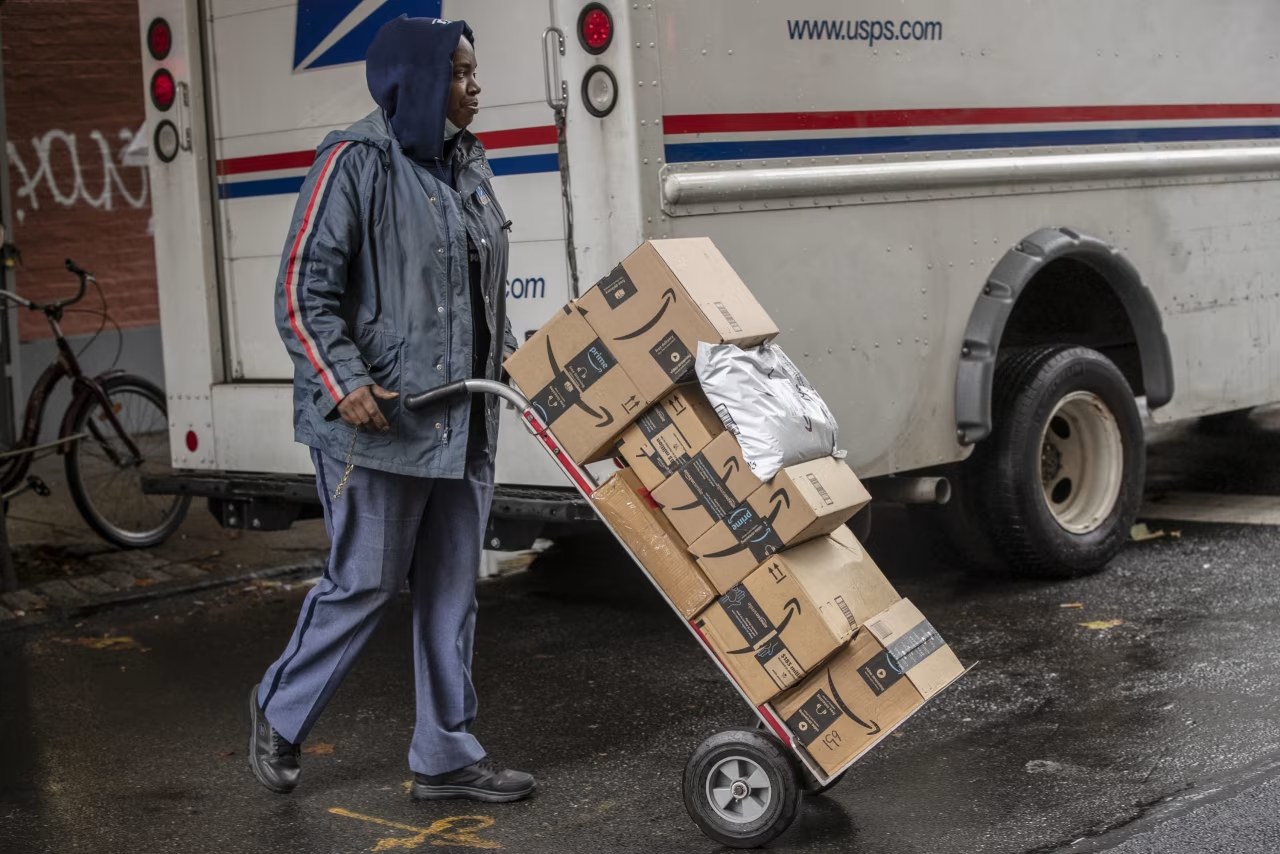
Amazon aims to slash USPS shipments by two‑thirds in a bold package reduction
- Amazon plans to cut its USPS volume by at least 66% before the fall contract expires.
- The move threatens to erase roughly $4 billion in annual USPS revenue.
- USPS currently relies on Amazon for about 15% of its total package volume.
- Industry analysts warn the cut could accelerate the postal service’s financial distress.
Amazon’s decision could reshape America’s last‑mile delivery landscape
AMAZON—When Amazon announced its intention to dramatically reduce the number of parcels it ships through the United States Postal Service, the news reverberated far beyond the e‑commerce giant’s quarterly earnings call. The plan, confirmed by multiple insiders, calls for a cut of at least two‑thirds of Amazon‑originated packages by the time the current service agreement ends this fall.
For a postal system already wrestling with declining first‑class mail, aging infrastructure, and a $15 billion operating deficit, the loss of an estimated $4 billion in yearly revenue is a shock that could force deeper rate hikes or accelerate the push toward privatization.
What follows is a deep dive into the history, economics, and policy ramifications of Amazon’s USPS package reduction, drawing on regulatory filings, expert analysis, and the company’s own logistics roadmap.
The Scale of the Shift
Amazon’s package volume through the Postal Service has been a cornerstone of both firms’ business models for more than a decade. According to the USPS Office of Inspector General, Amazon accounted for roughly 15% of all USPS package revenue in 2023, translating to about $4 billion in annual earnings for the government‑run carrier.
Why the two‑thirds figure matters
The two‑thirds cut that Amazon is targeting represents a reduction of roughly 30 million parcels per month, based on the 2023 volume of 45 million Amazon‑originated packages per month reported in the USPS annual report. That scale dwarfs the total volume handled by the next‑largest e‑commerce client, Walmart, which contributed only about 4% of USPS package revenue.
Financial impact in plain numbers
USPS’s total package revenue in 2023 stood at $26 billion. Stripping away $4 billion would shrink that line item by 15%, a hit comparable to the loss of an entire regional sorting facility. The Postal Service’s 2024 budget projection already flags a $2.5 billion shortfall; Amazon’s withdrawal could push the deficit past $7 billion.
Expert perspective
“Amazon is the single largest commercial customer for the Postal Service,” said John M. McMillan, senior fellow at the American Postal Workers Union, in an interview with The Wall Street Journal. “Losing two‑thirds of that business will force the agency to either raise rates dramatically or cut services, both of which hurt rural America the most.”
Amazon’s own logistics chief, Dave Clark, told analysts in the 2023 earnings call that the company is “optimizing our last‑mile network” and that “the shift away from USPS is a strategic decision driven by cost and speed considerations.”
These statements underscore a clash between Amazon’s profit‑driven logistics overhaul and the USPS’s reliance on that same volume to stay afloat.
As the fall deadline looms, the stakes for both entities have never been clearer.
Next, we trace the contractual history that brought Amazon and the Postal Service to this inflection point.
Historical Ties Between Amazon and USPS
The partnership between Amazon and the United States Postal Service dates back to 2006, when the e‑commerce pioneer first signed a five‑year agreement to use USPS for its “Prime Air” ground deliveries. The contract was renewed in 2011, 2016, and most recently in 2021, each time expanding Amazon’s share of the Postal Service’s package mix.
Key milestones
In 2013, Amazon’s “Prime Now” service added a requirement for same‑day delivery within 30‑minute windows, a logistical challenge that pushed the Postal Service to open new distribution hubs in major metros. By 2018, Amazon accounted for 12% of USPS package revenue, a figure that grew to 15% by 2023, according to the USPS Office of Inspector General.
Contractual terms that matter
The current agreement, signed in early 2021, expires in September 2024. It includes a volume‑based discount structure: the more parcels Amazon ships, the lower the per‑piece rate. This arrangement has historically incentivized Amazon to increase its USPS usage, even as the company built its own delivery network.
Expert analysis
“The contract’s sliding‑scale pricing was designed to lock Amazon in as a long‑term partner,” explained Dr. Laura Chen, professor of supply‑chain economics at MIT, in a briefing for the Congressional Research Service. “Now that Amazon has amassed a private air‑cargo fleet and a nationwide network of Flex drivers, the economics have shifted in its favor to pull back from the Postal Service.”
The impending cut therefore represents not just a volume reduction but a breach of a long‑standing pricing incentive that the Postal Service relied upon for budgeting certainty.
Understanding this history is essential to gauge the ripple effects on the Postal Service’s financial planning.
Our next chapter examines how that financial planning could be upended by the loss of Amazon’s business.
Financial Stakes for the Postal Service
The Postal Service’s financial outlook has been precarious for years, with operating losses widening from $7.3 billion in 2020 to an estimated $15 billion in 2024. Package revenue, which once offset declines in first‑class mail, now faces a potential blow‑out.
Revenue composition
According to the 2023 USPS Annual Report, package services generate 58% of total revenue, with commercial customers contributing 41% of that slice. Amazon’s $4 billion share therefore accounts for roughly 15% of total USPS earnings.
Projected shortfall
If Amazon follows through on a 66% reduction, the Postal Service could lose $2.6 billion in package revenue alone. This would push the agency’s net loss for the 2024 fiscal year beyond $10 billion, according to a financial model prepared by the Government Accountability Office (GAO) in March 2024.
Donut chart illustration
The donut chart below breaks down the 2023 revenue mix, highlighting Amazon’s contribution.
Policy implications
Congressional leaders have already signaled that a sudden revenue gap could force the Postal Service to seek emergency appropriations or accelerate its ongoing restructuring plan, which includes consolidating processing facilities and raising retail rates.
“We cannot afford to lose a customer that provides a quarter of our package revenue,” warned Diane K. McClure, senior analyst at the Postal Regulatory Commission, during a Senate hearing on postal financing in April 2024.
The looming Amazon cut therefore sits at the intersection of corporate logistics strategy and national public‑service policy.
Next, we explore how Amazon intends to replace the lost USPS capacity with its own logistics assets.
Amazon’s Logistics Strategy and Alternatives
Amazon has spent billions over the past decade building a logistics empire that can rival traditional carriers. As of 2023, the company operates more than 150 air‑cargo hubs, a fleet of over 80,000 delivery vans, and the gig‑economy Flex program that taps independent drivers for last‑mile deliveries.
Air‑cargo capacity
Amazon Air moved 1.2 billion packages in 2023, according to the company’s Form 10‑K. That volume alone can replace roughly 25% of the parcels Amazon currently ships via USPS.
Ground network
The Flex program, which recruited over 250,000 drivers in 2022, handles approximately 30% of Amazon’s small‑parcel deliveries. These drivers operate out of Amazon‑owned micro‑fulfillment centers, cutting transit times by an average of 1.5 days compared with USPS ground service.
Bar chart comparison
The bar chart below compares the 2023 shipment volumes of Amazon’s major delivery channels against USPS.
Cost considerations
Internal analysis disclosed in Amazon’s 2023 Investor Day presentation shows that each Flex delivery costs $2.20 on average, versus $2.70 for a comparable USPS Ground shipment. Air‑cargo costs are higher per package but are justified by faster delivery windows for Prime‑eligible items.
Expert view
“Amazon’s logistics investments have reached a tipping point where they can sustain a massive volume shift away from the Postal Service,” noted Karen Liu, senior analyst at Gartner. “The only friction points left are regulatory constraints on air‑cargo slots and the need for more last‑mile density in rural markets.”
Understanding these alternatives clarifies why Amazon feels confident enough to make such a drastic cut.
The next chapter examines the fallout for rural communities that have historically depended on USPS deliveries.
What Does Amazon’s USPS Cut Mean for Rural America?
Rural ZIP codes have long relied on the Postal Service as the primary conduit for e‑commerce deliveries. In 2022, 68% of all Amazon packages shipped to ZIP codes with populations under 10,000 traveled via USPS, according to a USPS data brief.
Potential service gaps
If Amazon withdraws two‑thirds of its volume, rural consumers could see delivery windows stretch from the current two‑day standard to five‑day or longer, especially in regions where Amazon Air and Flex have limited coverage.
Line‑chart of rural volume trends
The line chart below tracks Amazon’s rural parcel volume from 2019 to 2023, illustrating a steady rise that peaked at 18 million parcels per quarter before the announced cut.
Economic consequences
Rural retailers that depend on fast Amazon deliveries for inventory replenishment may face higher holding costs, potentially leading to price hikes for local consumers. A study by the Rural Policy Research Institute in early 2024 found that a 10% slowdown in delivery speed can reduce rural e‑commerce sales by up to 3%.
Expert testimony
“The Postal Service is the lifeline for many small towns,” testified Rep. James C. Walsh (D‑IA) before the House Committee on Oversight in May 2024. “If Amazon pulls back, we risk a digital divide that could cripple local economies.”
Community groups are already mobilizing. The National Rural Mail Association has launched a petition urging Congress to intervene before the fall deadline.
While Amazon’s logistical capabilities are formidable, the company’s strategic calculus may not fully account for the social cost of reduced accessibility in sparsely populated areas.
Our final chapter looks ahead to the regulatory and policy responses that could shape the outcome.
Regulatory and Policy Outlook
Congressional oversight of the Postal Service has intensified since the 2020 pandemic surge, with the Postal Regulatory Commission (PRC) issuing a series of emergency measures to shore up revenue. The looming Amazon cut has placed the agency at the center of a new policy debate.
Legislative proposals
Senator Tammy Baldwin (D‑WI) introduced the “Postal Service Sustainability Act” in June 2024, which would create a dedicated fund to offset the loss of any single commercial customer contributing more than 10% of package revenue. The bill proposes a $5 billion grant, funded through a modest increase in postage rates.
Regulatory scrutiny
The PRC’s latest advisory report, released in August 2024, recommends that the Postal Service renegotiate its volume‑based discounts with Amazon, shifting to a flat‑rate model that would preserve a baseline revenue stream regardless of volume fluctuations.
Potential antitrust angle
Some consumer‑advocacy groups argue that Amazon’s market power allows it to dictate terms that could undermine a public service. The Federal Trade Commission opened a preliminary review in September 2024 to assess whether the volume cut violates any competition statutes.
Expert commentary
“We are witnessing a classic case of a dominant private platform leveraging its size to extract concessions from a public monopoly,” observed Prof. Elena García, a competition law scholar at Georgetown University. “If the Postal Service cannot secure a fair contract, the government may need to step in, either through subsidies or by redefining the service’s universal service obligation.”
Future scenarios
Analysts outline three possible outcomes: (1) Amazon proceeds with the cut, prompting a $5‑$7 billion federal infusion; (2) the Postal Service successfully renegotiates a new contract, preserving a portion of the volume; or (3) Congress imposes stricter rate caps on Amazon, forcing the company to maintain a minimum shipment level.
Each scenario carries distinct implications for the Postal Service’s financial health, rural delivery reliability, and the broader debate over privatizing public logistics.
As the fall deadline approaches, stakeholders on both sides are sharpening their strategies, and the final decision will likely set a precedent for how large tech firms interact with legacy public infrastructure.
In the weeks ahead, the nation will watch to see whether Amazon’s logistical ambition reshapes the American postal landscape—or whether policy interventions preserve the status quo.
Frequently Asked Questions
Q: Why is Amazon reducing its USPS package volume?
Amazon is pursuing a two‑thirds cut to lower costs, improve delivery speed, and shift volume to its own logistics network, a strategy outlined in its 2023 earnings call.
Q: How much revenue does the USPS earn from Amazon shipments?
USPS reports that Amazon accounts for roughly 15% of its total package revenue, translating to about $4 billion annually, according to the 2023 USPS Office of Inspector General report.
Q: What alternatives does Amazon have to the USPS?
Amazon can use its growing air‑cargo fleet, the Flex gig‑driver program, and third‑party carriers such as UPS and FedEx to replace the bulk of its USPS volume.
