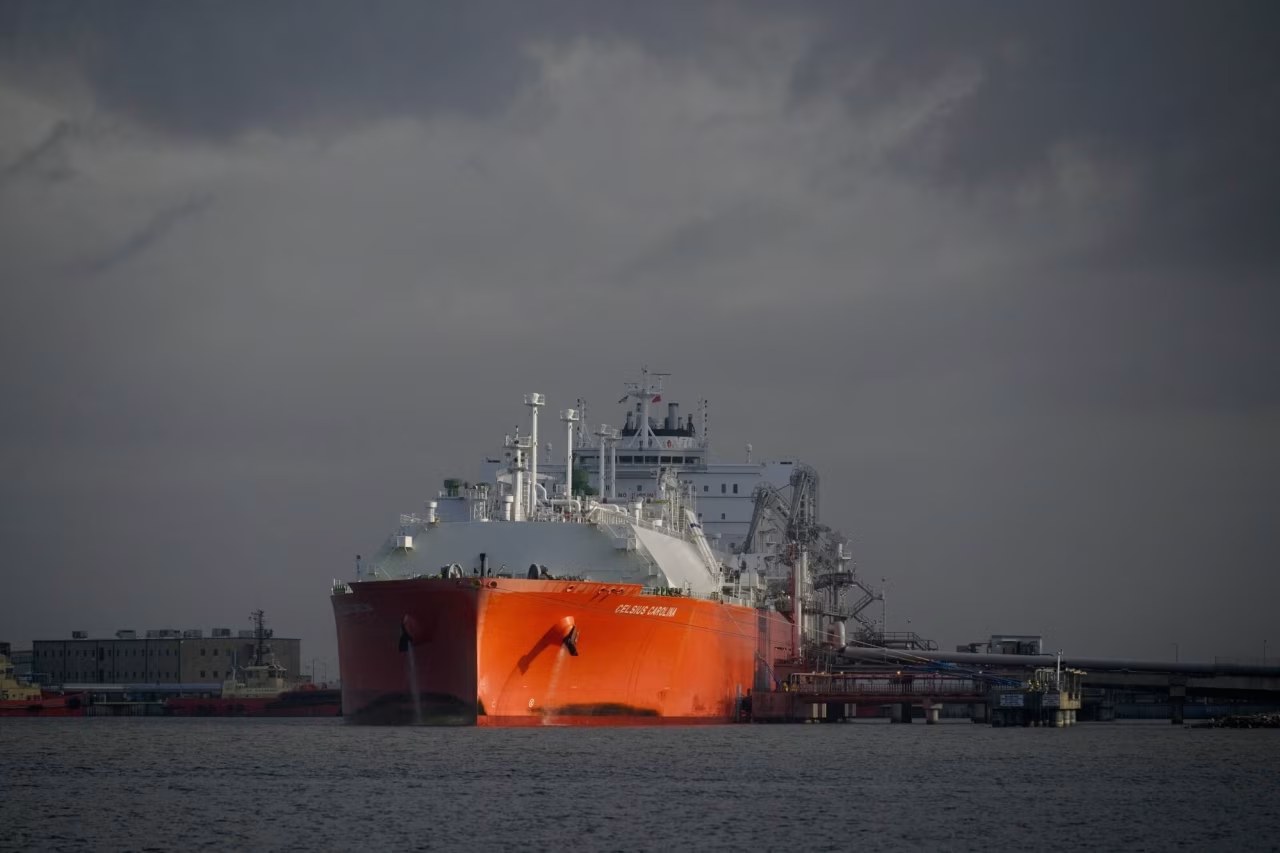
U.S. natural-gas prices rose only 11% after the world’s largest LNG plant was hit—proof America’s gas bounty is cushioning markets
- U.S. natural-gas futures climbed a modest 11% after Iran’s attack on the planet’s biggest LNG export hub.
- Global LNG spot prices spiked far higher, but American consumers face only muted power-bill risk.
- Cheniere Energy, the Louisiana LNG giant, closed at a record share price Friday as investors bet on U.S. export premiums.
- Analysts credit record domestic production and brimming storage for shielding the U.S. from the volatility that followed Russia’s 2022 Ukraine invasion.
America’s energy arsenal is now so large that even a direct strike on the world’s most critical LNG facility barely ripples U.S. prices
LNG EXPORTS—Last week an Iranian drone attack forced the shutdown of Qeshm Island’s 20-billion-cubic-feet-per-day LNG terminal—the single largest export point on earth. European and Asian spot prices for liquefied natural gas instantly jumped more than 30 percent. Yet U.S. benchmark Henry Hub futures rose only 11 percent, settling under $2.40 per million British thermal units, well below the $10-plus levels that terrified consumers after Russia invaded Ukraine in February 2022.
The muted reaction underscores a tectonic shift: the United States has become the global shock absorber. With domestic production hitting 105 billion cubic feet per day in March and storage caverns 18 percent above the five-year average, America’s natural-gas bounty is cushioning U.S. markets from global shocks that once would have sent prices spiraling.
“We are in a fundamentally different regime,” says analyst Luke Jackson of consultancy GHS Insight. “Four years ago an overseas supply scare ricocheted straight into American electricity bills. Today those shocks are absorbed by the sheer scale of U.S. supply.”
The 11% Bump: Why U.S. Prices Stayed Tame When the World Spiked
While European Title Transfer Facility (TTF) gas futures surged 34 percent to €47 per megawatt-hour and Asian spot LNG assessments leapt 32 percent to $14.80 per MMBtu, U.S. Henry Hub futures rose only 11 percent. The disconnect reflects infrastructure limits: every U.S. export terminal is already running near name-plate capacity, so additional overseas demand cannot easily siphon more molecules away from domestic buyers.
Cheniere Energy’s Sabine Pass terminal in Louisiana—the largest U.S. LNG plant—has been operating at 98 percent utilization since December, according to vessel-tracking firm Kpler. With 11.3 billion cubic feet per day of total U.S. liquefaction capacity fully deployed, incremental global panic buying cannot outbid American power plants for supply.
Storage acts as a second buffer
Working gas in underground storage ended March at 2.3 trillion cubic feet, 18 percent above the five-year average and more than double the 1.1 Tcf on hand in March 2022, Energy Information Administration data show. That surplus gives utilities comfort to avoid panic purchases, keeping a lid on prices even when geopolitical headlines scream.
The result: residential electricity prices are projected to average 15.7 cents per kilowatt-hour this summer, barely changed from last year’s 15.6 cents, according to the EIA’s latest Short-Term Energy Outlook. By contrast, after Russia’s invasion European household power contracts doubled within six months and U.S. retail power prices rose 8 percent in 2022.
Forward markets signal the calm will last. Henry Hub futures for December 2024 delivery trade at $3.05 per MMBtu, a modest 28 percent premium to current spot levels—far below the 150 percent winter premium seen in 2005 or 2018.
Record Production: How 105 Bcf/d Changed the Game
U.S. dry natural-gas output hit an all-time high of 105.2 billion cubic feet per day in March, government figures show, up 5 percent year-on-year and nearly 20 percent above pre-pandemic levels. The Marcellus shale in Pennsylvania and West Virginia alone produces 35 Bcf/d—more than any OPEC nation except Iran and Qatar.
Technological gains keep costs low. Drilling a typical Haynesville shale well in Louisiana costs $9.4 million today versus $12.8 million in 2014, yet initial production rates have doubled, according to RBN Energy analysis. Those economics allow producers to maintain output even when prices slide below $2.50 per MMBtu.
Midstream build-out locks in resilience
Since 2020 operators have added 17 billion cubic feet per day of new pipeline takeaway capacity, predominantly out of the Appalachian and Permian basins, preventing the regional bottlenecks that once triggered price collapses. Another 8.5 Bcf/d of pipe is under construction, Federal Energy Regulatory Commission filings show.
The surge has flipped America from importer to exporter. In 2008 the United States imported 12 percent of its gas; this year it will export 23 percent of production as LNG or via pipeline to Mexico and Canada, EIA projections indicate. That structural surplus means overseas disruption now strengthens, rather than weakens, American energy security.
“We have moved from scarcity to abundance,” says Anastacia Dialynas, senior gas analyst at BloombergNEF. “The marginal molecule is American, so global shocks raise U.S. export revenue without crippling domestic consumers.”
Maxed-Out LNG: Why Export Capacity Has Become a Strategic Moat
America’s six operating LNG terminals—Sabine Pass, Corpus Christi, Freeport, Cameron, Cove Point and Elba Island—ran at a combined 98 percent utilization in the first quarter, according to S&P Global Commodity Insights. That effectively caps how much additional supply can reach high-paying foreign buyers, insulating U.S. consumers from competitive bidding wars.
Cheniere Energy, the sector’s bellwether, epitomizes investor enthusiasm. Its share price closed Friday at a record $196.42, up 42 percent year-to-date, giving the company a market capitalization of $72 billion. Traders are wagering that long-term contracts linked to Brent oil and European gas hubs will keep cash flows robust even if domestic prices stay low.
Expansion projects face delays
Another 14 billion cubic feet per day of LNG capacity is approved but only 5.5 Bcf/d is likely to start up before 2027, hindered by tighter federal permitting and higher construction costs. Venture Global’s Calcasieu Pass 2, Sempra’s Port Arthur and NextDecade’s Rio Grande trains are each 12–18 months behind original schedules, consultancy Wood Mackenzie estimates.
The bottleneck means America cannot quickly arbitrage away overseas price spikes, so Henry Hub remains quarantined from global volatility. “Export capacity is the valve that isn’t there yet,” says Ira Joseph, head of gas and power analytics at S&P Global. “Until new trains come online, U.S. consumers enjoy a built-in discount.”
Long-term contracts already underpin the economics. About 85 percent of future U.S. LNG output is pre-sold under 20-year agreements, mostly to European utilities seeking to replace Russian pipeline gas. Those deals guarantee revenue for developers while limiting near-term spot-market exposure for American molecules.
From 2022 to Today: What Two Years of Abundance Changed
When Russia invaded Ukraine in February 2022, European gas prices rocketed from €90 per megawatt-hour to a peak of €345 within four months. U.S. Henry Hub futures more than doubled from $4.40 to $9.32 per MMBtu, and American electricity retail prices jumped 8 percent that year—the fastest pace since 2006.
The shockwaves were felt nationwide. Texas households saw summer power bills rise 15 percent; New England utilities burned more costly fuel oil when gas hit $30 per MMBtu during a January cold snap. Industrial users such as BASF and Dow curtailed output, citing unaffordable feedstock.
Storage, not just production, is the difference
In March 2022 U.S. storage stood at 1.4 Tcf, 17 percent below the five-year average. Today the cushion is 2.3 Tcf, well above normal. The surplus stems partly from a mild 2023-24 winter but also from producers adding 10 Bcf/d of output since 2022 while export capacity grew only 2.3 Bcf/d.
Policy also played a role. The Biden administration’s temporary pause on new LNG approvals announced in January 2024 has not curtailed current output but has slowed future capacity growth, ensuring domestic molecules stay home longer. Meanwhile, the Inflation Reduction Act incentives for renewables and efficiency shaved 1.2 percent off projected 2024 gas-fired generation, according to Rhodium Group estimates.
Consumer psychology shifted as well. Utilities locked in 62 percent of expected summer gas demand via fixed-price hedges this year versus 38 percent in 2022, EIA surveys show, blunting spot-market volatility.
Can the Shield Hold? Risks That Could Still Dent U.S. Consumers
Despite today’s buffers, three wildcards could still pinch American wallets. A Category 4 hurricane entering the Houston Ship Channel this summer could knock 7 percent of U.S. LNG export capacity offline for weeks, forcing more molecules into the domestic market and temporarily depressing prices—but also damaging offshore Gulf production and pipelines, creating regional shortages.
Pipeline constraints remain the most immediate threat. If a polar vortex drives Midwest temperatures to 10-year lows, regional spot prices could spike above $20 per MMBtu even if national averages stay muted, as happened in Chicago during the 2021 freeze. The Mid-Atlantic faces similar bottlenecks; Appalachia’s 7 Bcf/d of spare pipe capacity could be swallowed within two days of sustained sub-zero weather, analysts at BTU Energy say.
Regulatory headwinds loom
The Environmental Protection Agency’s forthcoming methane-fee rule could add 15–25 cents per MMBtu to marginal production costs starting in 2025, potentially shaving 2 Bcf/d from output if low prices persist, according to ClearView Energy Partners. Meanwhile, activist investors are pressing shale producers to rein in growth, slowing the drilling treadmill that underpins today’s surplus.
Finally, geopolitics can still bypass U.S. insulation. If China and Europe bid Asian spot LNG above $20 per MMBtu for months, portfolio players could cancel some U.S. offtake cargoes and redirect supply, tightening the Atlantic basin and nudging American prices higher via net-back economics.
Still, most forecasters see limited upside. Bank of America’s global commodities team raised its 2024 Henry Hub forecast only modestly, to $2.80 per MMBtu, citing the production-storage double buffer. For now, America’s natural-gas bounty appears set to keep cushioning U.S. markets from global shocks.
Frequently Asked Questions
Q: How much did U.S. natural-gas prices rise after the Iran attack?
U.S. natural-gas prices climbed 11 percent the week after Iran shut down the world’s largest LNG export facility, far below the global surge.
Q: Why are American consumers unlikely to see big power-bill spikes?
Record domestic production, ample inventories and maxed-out U.S. LNG export capacity insulate American consumers from global price shocks.
Q: Which company hit a share-price record on the news?
Cheniere Energy, operator of the largest U.S. LNG export terminal in Louisiana, closed at an all-time high on Friday.
