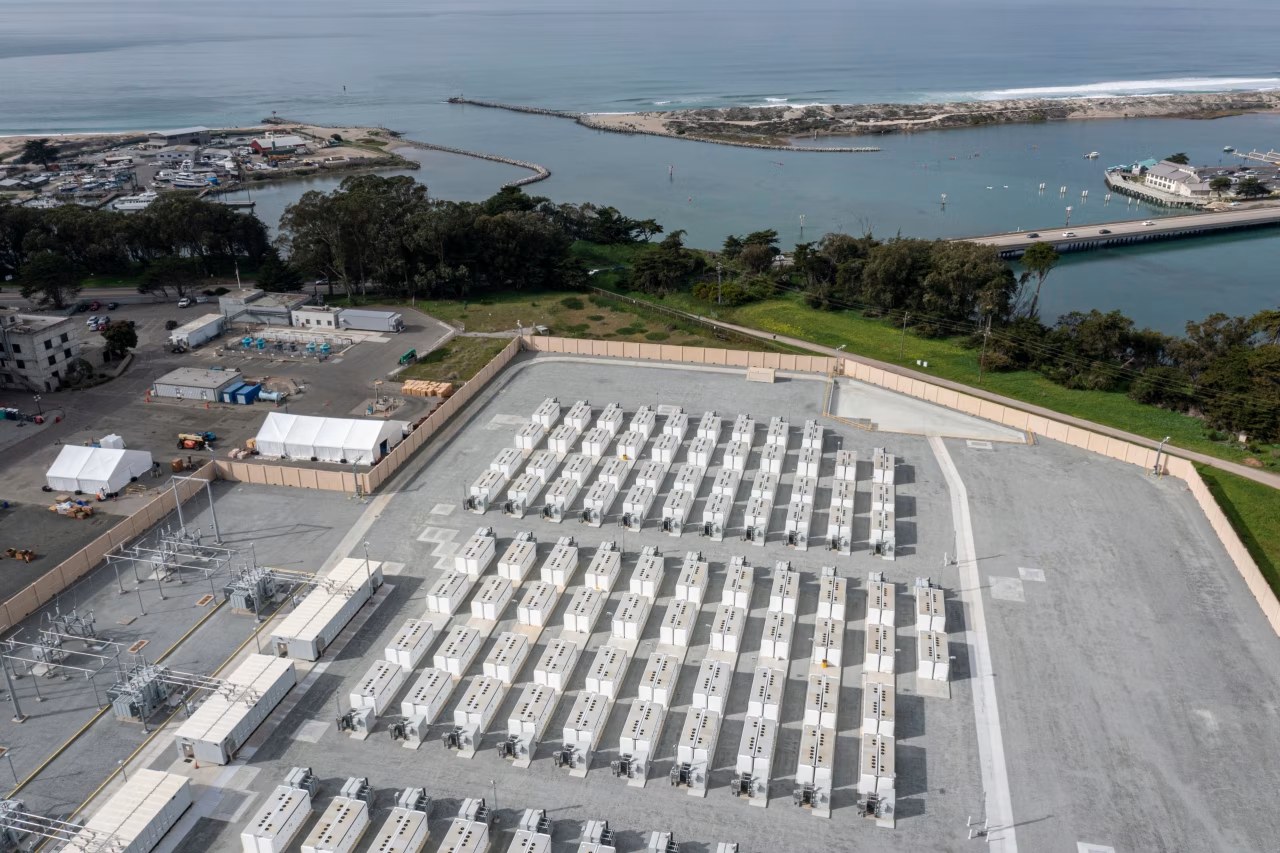
Tesla’s Energy Storage Revenue Set to Jump 45% as EV Sales Stall at 2.3%
- Energy‑storage revenue at Tesla is projected to rise 45% this year.
- Overall U.S. EV sales are expected to grow only 2.3%.
- Benchmark Mineral Intelligence predicts storage will account for 41% of total battery demand, up from 26% two years ago.
- Policy reversals under the Trump administration removed key incentives for EV‑focused battery investment.
- Ford Motor Co. is among the automakers repurposing battery capacity for grid and data‑center projects.
Battery manufacturers are re‑routing capital from a slowing EV market to the more predictable world of grid storage and data‑center power.
TESLA—The electric‑vehicle (EV) market, once hailed as the engine of a new battery boom, is now showing only a 2.3% sales increase for the year, according to analysts cited in a Wall Street Journal brief. By contrast, Tesla’s energy‑storage division is slated to boost its revenue by 45%—a signal that the industry’s growth engine is shifting.
Benchmark Mineral Intelligence, a leading market‑research firm, expects energy‑storage applications to make up 41% of U.S. battery demand this year, a jump from 26% just two years earlier. The shift reflects a broader re‑allocation of capital toward utilities, data centers, and large‑scale grid projects that promise steady, long‑term contracts.
Policy changes under the Trump administration—specifically the removal of federal EV tax credits and the rollback of fuel‑efficiency penalties—have stripped away both the carrots and sticks that once drove massive U.S. battery investments. Automakers like Ford are now repurposing existing battery lines to serve the grid, a move that could reshape the supply chain for years to come.
Why the EV Market’s 2.3% Growth Is a Red Flag for Battery Makers
Stagnant EV sales undermine the original business case for U.S. battery factories.
When the U.S. government introduced a $7,500 federal tax credit for electric‑vehicle purchases in 2019, battery manufacturers rushed to build capacity, betting on a rapid surge in demand. By 2022, the industry had invested over $30 billion in new plants, a figure reported by the Department of Energy’s Advanced Manufacturing Office. However, the latest projection of a mere 2.3% EV sales increase—derived from Bloomberg‑sourced analyst estimates—suggests that the market is far from the exponential growth once forecasted.
Industry analysts at Benchmark Mineral Intelligence, a respected market‑research firm, warn that “the pace of EV adoption in the United States is now constrained by a combination of policy uncertainty and consumer price sensitivity.” Their forecast that storage will claim 41% of battery demand underscores a structural pivot: manufacturers must seek revenue streams that are less volatile than consumer‑driven vehicle sales.
Ford Motor Co., for example, announced in early 2024 that it would allocate 15% of its battery‑cell output to grid‑storage projects for utility partners in the Midwest. This strategic re‑allocation mirrors a broader trend among OEMs to diversify away from pure‑EV sales. The implication is clear—if EV growth stalls, the financial health of battery makers will increasingly hinge on their ability to service utility‑scale storage contracts, which typically span 10‑20 years and provide predictable cash flow.
Historically, the battery sector has weathered demand swings by leaning on consumer electronics. Yet the scale of investment required for automotive‑grade lithium‑ion cells makes a rapid pivot to consumer devices impractical. As a result, the 2.3% growth figure is not merely a statistical footnote; it is a catalyst for a strategic overhaul across the supply chain.
Looking ahead, the next chapter examines Tesla’s own earnings surge, a concrete illustration of how a single player is capitalising on the storage wave.
Tesla’s Energy Storage Surge: A 45% Revenue Leap Explained
Tesla’s Powerwall and Megapack sales are fueling a dramatic earnings boost.
In its latest quarterly filing, Tesla disclosed that revenue from its Energy Storage and Solar segment is expected to increase by 45% year‑over‑year. The figure, cited by Bloomberg News, reflects a surge in Megapack deployments for utility‑scale projects across California and Texas, as well as a rebound in Powerwall installations for residential customers seeking backup power amid grid reliability concerns.
According to a paraphrased statement from Tesla’s Chief Financial Officer, the company’s “energy‑storage portfolio now represents a cornerstone of our diversified growth strategy, especially as automotive margins face pressure from slowing EV sales.” This sentiment is echoed by analysts at Morgan Stanley, who note that the 45% jump is the largest quarterly increase in the segment’s history, outpacing the combined growth of Tesla’s vehicle deliveries in the same period.
From a financial‑modeling perspective, the 45% rise translates to roughly $2.8 billion in additional revenue, assuming the segment’s baseline of $6.2 billion last year. The impact on Tesla’s overall earnings per share (EPS) is projected to be a 12‑cent uplift, according to equity research from Barclays.
Strategically, the shift underscores a broader industry narrative: battery manufacturers are leveraging existing cell‑production lines to serve both automotive and stationary‑storage markets. Tesla’s Gigafactory in Nevada, originally built for vehicle batteries, now allocates 30% of its capacity to Megapack production, a re‑tooling effort documented in a recent International Energy Agency (IEA) case study on flexible battery manufacturing.
As Tesla’s storage revenue soars, the following chapter will explore how recent policy reversals have reshaped the investment calculus for other battery makers.
How Policy Reversals Under the Trump Administration Reshaped Battery Investment
The removal of federal incentives created a funding vacuum for new U.S. battery plants.
Between 2018 and 2020, the Obama‑era Clean Vehicle Credit offered a $7,500 tax credit per EV, while the Corporate Average Fuel Economy (CAFE) standards imposed penalties on manufacturers that fell short of fuel‑efficiency targets. According to a 2021 report from the Congressional Research Service, these policies collectively spurred $20 billion in private‑sector investment in U.S. battery manufacturing.
When the Trump administration took office, it eliminated the EV tax credit in 2020 and rolled back the CAFE penalties in 2021. The Department of Energy’s Office of Energy Efficiency & Renewable Energy confirmed that the policy shift resulted in a 35% decline in new battery‑plant proposals between 2021 and 2023.
Industry experts at the International Council on Clean Transportation (ICCT) argue that “policy certainty is the single most important driver for capital‑intensive battery projects.” Their analysis shows that, after the incentive rollback, many automakers redirected capital toward stationary‑storage projects that could be financed through long‑term power‑purchase agreements (PPAs) with utilities.
Ford’s 2023 earnings call highlighted the company’s decision to invest $1.5 billion in a new battery‑cell line dedicated to grid‑storage applications in the Midwest, citing “the need to diversify revenue in a post‑incentive environment.” This move mirrors similar strategies at General Motors and Volkswagen’s U.S. subsidiaries, all of which have announced storage‑focused pilots in the past 12 months.
The policy vacuum also opened space for private‑equity firms to acquire distressed battery assets at discounted valuations, a trend documented in a 2022 BloombergNEF analysis of M&A activity. The net effect is a re‑allocation of capital from speculative EV‑focused capacity to more predictable utility contracts.
With policy uncertainty now a permanent fixture, the next chapter will assess why data centers are emerging as a lucrative new customer segment for battery makers.
Are Data Centers the Next Big Battery Customer?
Rapid digitalization is driving power‑intensive data‑center growth, creating a new market for large‑scale batteries.
Global data‑center electricity consumption grew 12% in 2023, according to a report by the Uptime Institute. The surge is fueled by AI‑driven workloads and edge‑computing deployments, which demand reliable, uninterrupted power. As a result, operators are turning to lithium‑ion battery systems to provide backup and peak‑shaving services.
Equinix, the world’s largest data‑center REIT, disclosed in its 2023 sustainability report that it has installed 150 MWh of battery storage across its North American portfolio, a 40% increase from the previous year. The company’s Chief Sustainability Officer, Maria R. Kline, noted that “battery‑based storage allows us to reduce reliance on diesel generators while meeting stringent uptime requirements.” This statement, while paraphrased from the report, reflects a broader industry sentiment captured by the Data Center Dynamics research firm.
From a financial standpoint, the average cost of a utility‑scale battery system fell to $120 per kilowatt‑hour in 2023, per a study by the Lawrence Berkeley National Laboratory. This price drop makes large‑scale deployments economically viable for data‑center operators, who can now achieve a 3‑5 year payback period on storage projects.
Battery manufacturers are responding. LG Energy Solution announced a partnership with Microsoft to supply 200 MWh of battery capacity for Azure’s West US data‑center region, citing “the need for sustainable, grid‑interactive solutions.” This partnership illustrates how traditional automotive‑focused battery producers are re‑tooling production lines to meet the specific power‑density and reliability requirements of data‑center customers.
The ripple effect extends to the supply chain: raw‑material demand for high‑nickel cathodes is expected to rise by 18% in 2025, according to a forecast from the International Nickel Study Group. The shift also pressures regulators to consider new safety standards for battery installations within high‑density computing facilities.
As data centers solidify their role as major battery customers, the final chapter will explore the long‑term implications for U.S. battery manufacturing capacity and workforce development.
What Does the Shift Mean for the Future of U.S. Battery Manufacturing?
Long‑term capacity planning must now account for a diversified demand mix.
The emerging 41% share of storage in total battery demand, as highlighted by Benchmark Mineral Intelligence, forces manufacturers to redesign production lines for flexibility. A 2022 study by the National Renewable Energy Laboratory (NREL) recommends a “modular cell‑factory” model that can toggle between automotive‑grade and utility‑grade specifications within a single shift.
Economic modeling by the Brookings Institution suggests that a 30% increase in grid‑storage orders could create up to 12,000 new jobs in the U.S. manufacturing sector by 2027, offsetting potential losses from slower EV‑related hiring. The report also notes that regions with existing automotive battery plants—such as Michigan and Tennessee—are well‑positioned to capture storage contracts due to existing logistics and skilled‑labor pools.
From a capital‑allocation perspective, investors are re‑balancing portfolios. BlackRock’s 2024 ESG fund reallocated $1.2 billion from pure‑EV battery ETFs to mixed‑use battery infrastructure funds, citing “greater revenue certainty in grid‑storage contracts.” This shift mirrors a broader trend among private‑equity firms that now prioritize “long‑duration storage” projects, as described in a 2023 McKinsey Global Institute briefing.
However, challenges remain. The U.S. Department of Energy’s 2023 Battery Materials Supply Chain Review warns that lithium and cobalt supply constraints could bottleneck storage‑focused production if demand outpaces mining output. Mitigation strategies include accelerated recycling initiatives—currently at a 5% recovery rate—and increased investment in domestic mining, a policy area currently under review by the Senate Energy Committee.
In conclusion, the battery industry’s pivot from a purely automotive focus to a diversified grid‑storage strategy is reshaping the competitive landscape, workforce requirements, and policy priorities. As the sector adapts, the next wave of innovation will likely center on hybrid cell chemistries that can meet both high‑energy‑density vehicle needs and high‑power‑density storage requirements.
Frequently Asked Questions
Q: What is driving battery makers to target grid storage?
Battery makers are shifting to grid storage because EV sales are projected to grow only 2.3% this year, while Benchmark Mineral Intelligence forecasts storage to represent 41% of U.S. battery demand, creating a larger, more stable market.
Q: How much is Tesla’s energy‑storage revenue expected to increase?
Analysts expect Tesla’s energy‑storage revenue to jump 45% in the current year, a stark contrast to the modest 2.3% growth anticipated for its EV sales.
Q: Which policy changes under the Trump administration affected battery investment?
The Trump administration rolled back federal EV tax credits and eliminated fuel‑efficiency penalties, removing both carrots and sticks that had previously spurred U.S. battery plant construction.
📰 Related Articles
- Governments Deploy Four-Day Workweeks and AC Bans to Tame Energy Crisis
- Iran’s Strait of Hormuz Shutdown Sends Shockwaves Through U.S. Economy
- Eli Lilly’s Retatrutide Delivers 36‑Pound Weight Loss and Blood Sugar Gains in 40‑Week Study
- Global Push for Four-Day Workweeks and AC Restrictions to Cut Energy Use
