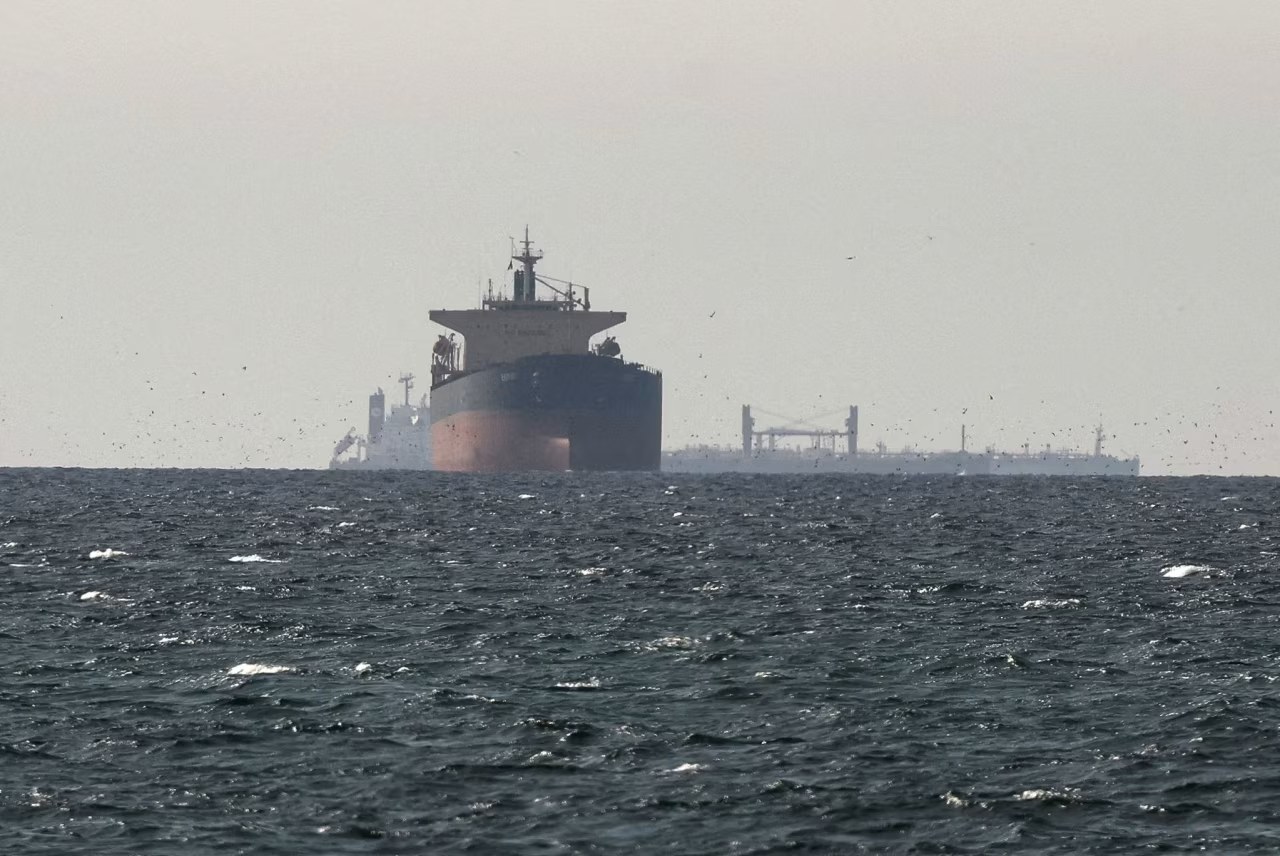
Brent Crude Vaults 9% to $100.46 After Tanker Strikes in Strait of Hormuz
- Brent crude settled at $100.46, its first triple-digit close since 2022.
- Four tankers reported damage in the Strait of Hormuz on Thursday alone.
- Iran’s new supreme leader vowed to keep the chokepoint closed indefinitely.
- President Trump said stopping Tehran’s nuclear drive outweighs oil-price pain.
Energy traders who once priced in days of disruption now confront months of risk
BRENT CRUDE—A single missile salvo at dawn on Thursday flipped the oil market’s script. By the close, Brent crude had soared 9% to $100.46 a barrel, erasing every bearish bet that Gulf supply would normalize within days. Four tankers carrying at least 6 million barrels of crude and products radioed mayday calls after explosions ripped through their hulls inside the 21-mile-wide Strait of Hormuz. Within hours, Iran’s newly installed supreme leader declared the waterway “closed to hostile commerce,” hardening expectations that the disruption will be measured in weeks, not days.
The price surge marks the first time global benchmark Brent has traded above triple digits since the aftermath of Russia’s invasion of Ukraine. Exchange data show volume spiked to a 15-month high as algorithmic funds flipped from net-short to net-long positions in less than 90 minutes. “The market is getting more and more nervous,” Neil Crosby, head of oil analytics at Sparta Commodities, told the Wall Street Journal. “We see not only supply-chain issues from the Hormuz closure, but also growing medium-term implications from all the attacks on infrastructure in the region.”
With about 21 million barrels per day—roughly one-fifth of world consumption—transiting the strait, even a partial shutdown ripples through every refinery slate from Rotterdam to Ruiz. President Trump underscored the geopolitical priority in a brief exchange with reporters: stopping Iran’s nuclear program is a higher imperative than shielding consumers from higher pump prices. The remark effectively grants the rally room to run, analysts say, because it signals Washington will tolerate a sustained risk premium rather than pivot toward de-escalation.
From Days to Months: Traders Recalibrate Gulf Timeline
The speed with which consensus shifted inside trading rooms on Thursday was remarkable. At 9 a.m. London time, most desks still worked under the assumption that the U.S.-Israeli strikes on Iran would echo 2020’s one-off skirmish: a week of saber-rattling, a handful of diverted cargoes, then business as usual. By lunchtime, forwards curves had flipped into steep backwardation through December 2025, pricing in a prolonged deficit.
What changed? First came the imagery: satellite firm Planet Labs captured flames licking from the hull of the 300,000-dwt VLCC Bahra, managed by Bahri, the Saudi national carrier. Within 45 minutes, three more tankers—registered in Panama, the Marshall Islands, and Liberia—reported similar blasts while sailing in the strait’s designated traffic lane. Lloyd’s List Intelligence logged at least 6.2 million barrels of crude and naphtha at immediate risk, equal to France’s daily imports.
Second came the rhetoric. Iranian state media broadcast a statement from Ayatollah Ahmad Jannati, the temporary supreme leader, pledging “permanent closure for hostile commerce” until Tehran secures guarantees of sanctions relief and security for its own energy sites. The specificity of the pledge caught traders off guard; previous threats were vague and quickly walked back.
Backwardation signals scarcity premium lasting into 2025
By the settle, the Brent M1-M6 spread had widened to $6.80 a barrel, the steepest since the 2022 Ukraine invasion, implying that prompt barrels are worth almost 7% more than those delivered six months out. “That curve shape tells you storage is now uneconomic,” explains Louise Dickson, senior oil analyst at Rystad Energy. “Nobody wants to tie up 2 million barrels in floating storage when the market is convinced supply will tighten further.”
The forward curve also underscores a stark shift in time horizons. As recently as Wednesday, money managers held a net-short equivalent of 72 million barrels across ICE Brent and NYMEX WTI, according to CFTC data. By Thursday’s close, commodity index funds had absorbed an estimated 120 million barrels of length, the fastest swing on record. The recalibration matters because it embeds a geopolitical risk premium deep into 2025 refinery budgets, effectively locking consumers into higher diesel and jet-fuel costs even if peace talks emerge.
Neil Crosby at Sparta Commodities notes that the market is now discounting at least a 10% probability that the strait remains impaired for more than six months. “If that scenario materializes, Brent will test the 2008 record high of $147,” he warns. The forward-looking implication: airlines and freight firms will accelerate fuel hedging, pushing spot prices even higher.
How Safe Are the World’s Other Chokepoints?
Closing the Strait of Hormuz does not halt every barrel, but it forces reroutings that add cost, delay, and political friction. The most cited workaround—Saudi Arabia’s 1,200-km Petroline to Yanbu on the Red Sea—can export 5 million b/d, or roughly a quarter of the kingdom’s current output. Yet even that relief valve depends on the Bab el-Mandeb Strait at the Red Sea’s southern mouth, where Houthi drones have already struck three tankers since January.
Meanwhile, the only alternative that bypasses both Hormuz and Bab el-Mandeb is the 1.1 million b/d Sumed pipeline across Egypt, currently running at 80% utilization. Expanding it would take 18–24 months, says energy consultancy FGE. “There is no quick technical fix,” explains Dickson of Rystad. “Every workaround has its own chokepoint.”
The insurance market has already responded. War-risk premiums for a VLCC transiting Hormuz jumped to 5% of cargo value from 0.8% on Wednesday, adding roughly $3.50 a barrel to delivered costs in Asia. If underwriters begin to classify the entire Red Sea as a listed area, as some syndicates at Lloyd’s are debating, rerouting around the Cape of Good Hope would add 19 days and $2.80 a barrel in freight, according to Baltic Exchange data.
IEA strategic stocks cover only 90 days of Hormuz loss
Strategic petroleum reserves (SPR) held by IEA members total about 1.5 billion barrels, enough to offset a full Hormuz outage for roughly 90 days at current flow rates. Yet legal and logistical constraints slow deployment. U.S. SPR sales require 15 days of congressional notification unless the president invokes emergency authority, while European stocks are geographically misaligned—two-thirds are stored inland and must reach coastal refineries via rail or barge.
Moreover, SPR crude is overwhelmingly medium-sour, a grade Asian refiners have limited appetite for after years of shifting toward light sweet barrels from U.S. shale. “You can’t just dump 300 million barrels of sour crude into a refining slate optimized for Eagle Ford light,” says John Kilduff of Again Capital. The mismatch implies SPR releases would cap prices near $95 rather than push them back to pre-crisis levels.
Looking ahead, traders are quietly pricing in a new normal where risk premiums of $8–$12 a barrel persist as long as Iran’s nuclear facilities remain under threat. That calculus embeds gasoline above $4 a gallon in the U.S. and European diesel above €1.70 per liter through the summer driving season—levels historically associated with demand destruction.
Could Prices Retest 2008’s $147 Record?
The last time Brent traded above $140, Chinese demand was growing at double-digit rates and the dollar was weak. Today, the demand picture is flatter—IEA projects 2025 global growth at just 1.1 million b/d—but the supply shock is more acute because spare capacity is thinner. OPEC+ compliance has kept voluntary cuts of 2.2 million b/d in place, while U.S. shale growth is slowing as drillers prioritize shareholder returns over barrels.
Neil Crosby’s modeling at Sparta shows that if the strait stays shut for three months, Brent would need to reach $135 to trigger 1 million b/d of demand destruction in emerging markets, the price-sensitive segment of global consumption. “That’s the valve,” he says. “Prices north of $130 are how you ration supply to the highest-value end users.”
Yet the runway to $147 is not linear. At $115, the White House would face intense political pressure to ban exports and force U.S. Gulf sour barrels into domestic refineries, a move that could shave 1.5 million b/d off global availability and push prices even higher. “Policy responses become procyclical above $110,” warns Helima Croft, head of commodities strategy at RBC Capital Markets.
Macro backdrop limits central-bank buffers
Unlike 2008, when the Fed had room to slash rates, today’s policy rate above 4% leaves little space for stimulus. A sustained oil spike would feed directly into headline inflation, complicating the Federal Reserve’s planned 2025 easing cycle. Euro-area consumers face an even sharper pinch: a €1 per liter rise in retail fuel equates to a 0.6-percentage-point drag on disposable income, according to ECB staff calculations.
Equity markets are already repricing energy-intensive sectors. On Thursday, the Stoxx 600 Travel & Leisure index fell 4.2%, its steepest drop since 2022, while U.S. airline shares slid 6%. If Brent holds above $100 through May, consensus earnings for global airlines could fall 18%, Morgan Stanley estimates.
The forward-looking risk is that triple-digit oil tips the global economy into a stagflationary rut just as central banks hoped to cut rates. “Energy shocks don’t cause recessions on their own,” says Dickson, “but they are the catalyst that exposes balance-sheet fragilities.”
Who Wins and Who Loses in a Triple-Digit World?
High prices are never evenly distributed. Producers with spare capacity—Saudi Arabia, UAE, and Kuwait—earn windfall profits. Rystad estimates that for every $10 increase in Brent, Saudi Aramco’s annual free cash flow rises by $35 billion, enough to fund the kingdom’s entire NEOM megaproject without debt. Meanwhile, nations that import crude but export refined products—India, South Korea, and Taiwan—see margins squeezed as feedstock costs outrun product prices.
Among private-sector players, U.S. shale firms have pledged capital discipline, but at $100 they can hedge 2026 output above $80 and lock in double-digit returns. Diamondback Energy and Pioneer Natural Resources both added 20,000 b/d to their 2025 guidance within hours of Thursday’s rally. “We’re not chasing growth, but at these levels every extra barrel is accretive,” Pioneer CEO Richard Dealy told investors on a hastily arranged conference call.
Downstream, European refiners face the steepest uphill battle. Plants configured to run Urals sour crude must now pay premiums for North Sea grades or rejig units to process more light barrels. ING Bank calculates that for every $1-per-barrel rise in Brent, European refiner margins fall by $0.60, accelerating closures of already-fragile facilities in Germany and France.
Green transition gets a short-term speed bump
Paradoxically, triple-digit crude can slow decarbonization. European policymakers facing voter anger over fuel bills may delay the phase-out of diesel subsidies, while airlines shelve plans to scale back short-haul routes. “High prices make EVs more attractive, but they also make governments more cautious about adding fuel taxes,” explains Croft of RBC.
On the corporate side, oil majors with low-carbon divisions are reallocating cash. BP signaled it may pause offshore wind spending in 2026 to channel surplus cash into shareholder returns and high-margin barrels. Shell is reviewing the pace of its hydrogen hubs in Europe, according to people familiar with the matter.
Looking ahead, the biggest macro loser may be the global consumer. Oxford Economics reckons that if Brent averages $110 in 2025, world GDP growth would be 0.4 percentage points lower, with emerging Asia bearing half the shortfall. The forward-looking takeaway: today’s rally is not just an energy story; it is a growth story that will shape fiscal and monetary choices well into 2026.
Frequently Asked Questions
Q: Why did Brent crude jump above $100?
Brent crude leapt 9% to $100.46 after several tankers were attacked in the Strait of Hormuz, convincing traders that Gulf supply could be impaired for weeks or months.
Q: How much of global oil transits the Strait of Hormuz?
Roughly 21 million barrels per day—about one-fifth of worldwide consumption—pass through the 21-mile-wide strait, making prolonged closure a major inflationary risk.
Q: What did President Trump say about oil prices vs. Iran’s nuclear program?
President Trump stated that preventing Iran from obtaining nuclear weapons is a higher priority than the level of oil prices, signaling U.S. tolerance for continued market tightness.
