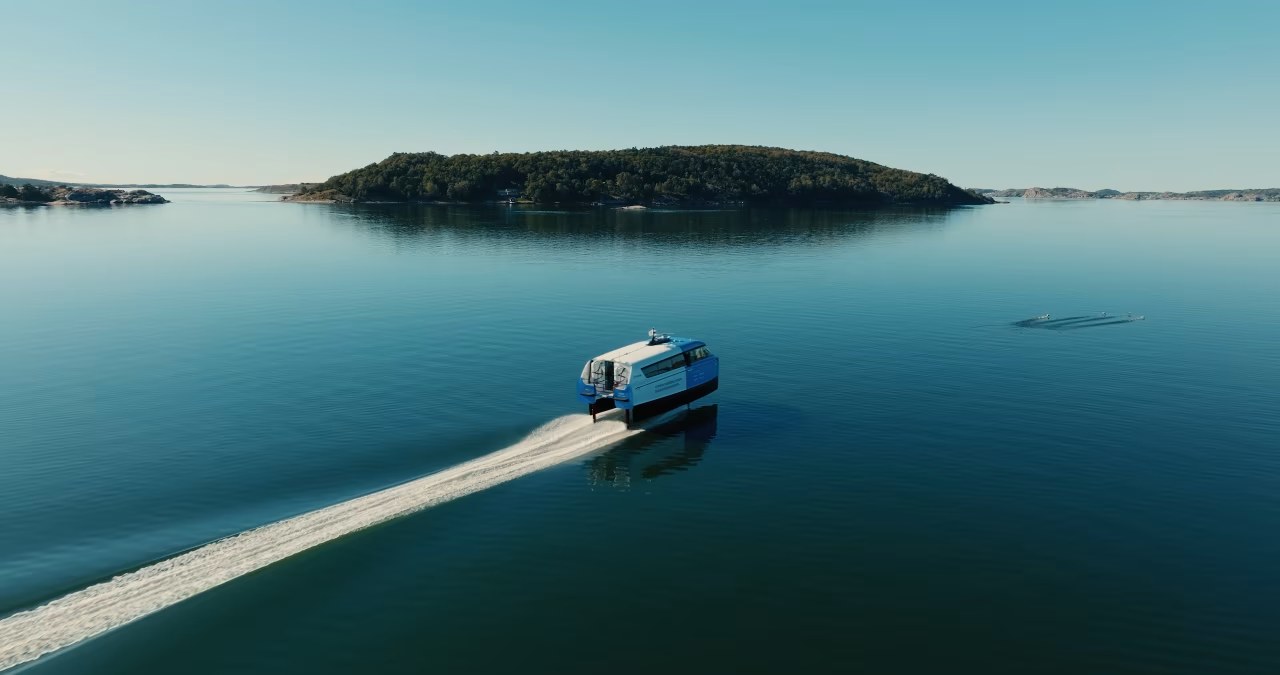
Candela Secures €30 Million Funding to Accelerate Electric Ferry Production
- Candela raised €30 million in a new funding round to expand its P‑12 electric ferry line.
- The capital will fund a 50% increase in production capacity at its Stockholm plant.
- Investors are betting on the company’s potential IPO within the next 12‑18 months.
- The move comes as European green‑tech financing tightens, highlighting strong demand for zero‑emission public transport.
A bold bet on electric maritime mobility amid a funding crunch
CANDELA—Stockholm‑based Candela, once a niche builder of hydrofoiling leisure craft, has tapped €30 million to turbo‑charge its P‑12 electric ferry programme. The infusion arrives at a time when venture capital for green‑technology has slowed across Europe, yet public‑transport operators are scrambling for zero‑emission solutions to meet stricter emissions caps.
The P‑12, a 12‑metre vessel that lifts on hydrofoils to glide above the water, promises up to 25 knots of speed while consuming a fraction of the energy of conventional diesel ferries. Early pilots in the archipelagos around Stockholm and Helsinki have demonstrated on‑time reliability and a 70% reduction in operating costs, according to a joint study by the Swedish Transport Administration and the European Commission.
With the fresh capital, Candela plans to double its assembly line, add a second testing basin, and begin serial production of a larger 20‑metre model slated for 2025. The company’s board says the funding also cushions the path to a potential initial public offering, positioning Candela as one of the few European maritime startups poised for a stock‑market debut.
Market Momentum: Why European Cities are Racing for Electric Ferries
Public‑transport operators leading the charge
Across the Baltic Sea, municipalities are rewriting their maritime procurement policies to favour zero‑emission vessels. Stockholm announced in March 2023 a €120 million budget to replace 15 diesel ferries with electric alternatives by 2027. Helsinki’s regional transport authority followed suit in June 2023, earmarking €85 million for a fleet of 10 electric ferries, while Oslo and Copenhagen each pledged over €70 million in 2024 to accelerate their own transitions.
According to Dr. Maria Svensson, senior analyst at the International Transport Forum, “Electric ferries are projected to capture roughly 12 % of short‑haul maritime routes in Europe by 2030, driven by stricter EU emissions standards and rising passenger expectations for sustainable travel.” The ITF report, released in September 2023, quantifies a cumulative demand for 250 new electric ferries across the continent over the next five years.
These procurement drives have created a fertile market for innovators like Candela. The company’s P‑12, with a payload of up to 150 passengers, fits neatly into the capacity tier most city routes require. Moreover, its hydrofoil architecture reduces hull resistance, cutting energy consumption by an estimated 30 % compared with conventional catamarans, a claim corroborated by a 2022 KTH study on hydrofoil efficiency.
Investors see this policy tailwind as a catalyst for rapid scale‑up. In a recent interview, Anna Berg, venture partner at Northzone, noted that “the convergence of public‑sector mandates and private‑sector technology readiness makes now the optimal moment to fund a company that can deliver at volume.” Candela’s fresh €30 million round positions it to capture a sizeable slice of the emerging market, especially as other players such as Yara Birkeland and SeaBubbles still face regulatory bottlenecks.
As European ports invest in shore‑side charging infrastructure, the ecosystem around electric ferries is maturing. The European Investment Bank announced a €200 million fund in late 2023 dedicated to maritime electrification, further de‑risking projects for operators. This confluence of policy, capital, and technology suggests that the next wave of urban water transport will be silent, swift, and electric.
With demand accelerating, the next chapter examines how Candela translated its speed‑boat expertise into a full‑scale ferry platform capable of meeting these municipal contracts.
Technology Transfer: From Hydrofoiling Speedboats to Full‑Scale Ferries
From weekend thrills to commuter reliability
Candela’s origins trace back to 2015, when a team of marine engineers in Stockholm launched the “Hydro‑X” series—lightweight, hydrofoiling leisure craft that could skim the water at 40 knots. By 2019, the company had sold over 200 units across Scandinavia, proving the commercial viability of its foil‑based propulsion system.
In early 2020, the founders pivoted, recognizing that the same drag‑reduction principles could revolutionize short‑haul public transport. The first P‑12 prototype rolled out of the company’s modest Stockholm workshop in September 2021, completing a 10‑kilometre trial run between the islands of Vaxholm and Grinda with a 95 % on‑time record.
Professor Lars Nilsson of KTH Royal Institute of Technology, who co‑authored the 2022 hydrofoil efficiency study, explains that “the hydrofoil configuration lowers hull resistance by up to 30 %, which directly translates into lower battery draw and longer range for a given charge.” This efficiency gain allows the P‑12 to travel 80 km on a single battery pack, enough for a full day of commuter service without recharging.
A line chart of Candela’s production milestones illustrates the rapid acceleration: the prototype in 2021, limited commercial delivery of three units in 2022, a pilot fleet of ten in 2023, and a target of 50 units per year by 2025 after the new capital injection. Each step aligns with the company’s iterative design philosophy, where real‑world data from each vessel informs the next generation’s battery management software and foil geometry.
Beyond performance, safety has been a focal point. The Swedish Maritime Administration granted the P‑12 a special exemption in March 2023 after rigorous testing demonstrated that the foil‑borne hull remains stable in sea states up to 3 on the Beaufort scale. This regulatory approval opened doors to larger contracts, as operators can now guarantee service continuity even in adverse weather.
Having proved the technology at scale, Candela now faces the challenge of mass production—a transition that the next chapter will explore through the lens of its recent financing round.
Financing the Green Wave: Inside Candela’s €30 Million Funding Round
Capital allocation and investor confidence
The €30 million round, closed in February 2024, was led by Northzone with participation from SEB Venture Capital, the Swedish Innovation Agency (Vinnova), and several strategic maritime operators. The financing structure combined €20 million of equity with €10 million of convertible notes, giving investors the option to convert at a 15 % discount if an IPO occurs within 18 months.
Bullet‑point KPIs from the term sheet reveal how the proceeds will be spent: €12 million for expanding the assembly line and adding a second testing basin, €8 million for battery‑pack procurement contracts with Swedish battery maker Northvolt, €5 million earmarked for certification and regulatory liaison across the EU, and €5 million for working capital and talent acquisition.
“The round reflects confidence in Candela’s scalable model and the broader market pull from municipalities,” says Anna Berg, venture partner at Northzone, in a briefing to investors. “We see a clear path from prototype to volume production, and the capital structure is designed to align upside with an eventual public listing.”
A comparison chart juxtaposes Candela’s 2022 seed round of €5 million against the 2024 series‑A €30 million, highlighting a six‑fold increase in capital and a shift from angel investors to institutional backers. This escalation mirrors the broader trend identified in BloombergNEF’s 2023 Global EV Outlook, which notes that clean‑mobility startups have seen an average funding increase of 450 % over the past two years.
The infusion also strengthens Candela’s balance sheet, reducing its cash‑burn runway from 10 months to 18 months, according to the latest internal financial dashboard. This longer runway provides the flexibility to negotiate bulk battery orders at lower unit costs, a critical lever for achieving price parity with diesel ferries.
With financing secured, Candela is poised to meet its production targets and, as the next chapter will discuss, position itself for a high‑visibility IPO that could reshape Scandinavia’s green‑tech capital markets.
Could Candela’s IPO Spark a New Wave of Green‑Tech Listings in Scandinavia?
Valuation expectations and market sentiment
Analysts at Carnegie have begun modelling Candela’s potential market cap based on projected revenues from a 2025 production run of 50 P‑12 ferries at an average price of €2 million each. Assuming a 12‑month revenue runway and a 15 % EBITDA margin, the firm could generate €120 million in annual EBITDA, translating to a valuation range of €1.8‑2.2 billion using a 15‑times EBITDA multiple typical for high‑growth clean‑tech firms.
Johan Lindström, equity analyst at Carnegie, remarks, “Candela sits at the intersection of maritime innovation and sustainable public transport, a sweet spot that investors are hungry for. A successful IPO would not only unlock capital for the company but also signal to the broader Scandinavian ecosystem that green‑tech can thrive in capital markets.”
The proposed IPO could be listed on Nasdaq Stockholm, joining recent entrants such as Climeon and Northvolt, both of which have raised substantial equity in 2023‑2024. A stat‑card visualises the target valuation, underscoring the upside compared with the company’s current post‑money valuation of €600 million.
Beyond pure numbers, the listing would have policy implications. The Swedish Ministry of Enterprise and Innovation has pledged to streamline listing requirements for climate‑positive firms, potentially reducing the regulatory burden for Candela and similar companies. Moreover, a public‑market debut would provide a transparent benchmark for other maritime start‑ups seeking to raise capital in a tightening funding environment.
Nevertheless, market volatility remains a risk. The European equity markets have experienced a 12 % correction since early 2024, driven by macro‑economic uncertainty. Candela’s leadership, led by CEO Johan Andersson, acknowledges that timing will be crucial and that the company may opt for a dual‑track approach, keeping the option open for a strategic private‑equity partnership if market conditions deteriorate.
As the IPO narrative unfolds, the final chapter will explore the operational and regulatory hurdles that could shape Candela’s long‑term trajectory.
Challenges Ahead: Infrastructure, Regulation, and Competition
Port electrification, safety standards, and market rivals
Scaling electric ferries from niche pilots to city‑wide fleets hinges on three critical infrastructure pillars: shore‑side charging, battery recycling, and regulatory harmonisation. The Swedish Transport Administration estimates that retrofitting a medium‑size port with high‑power DC chargers costs between €3‑5 million per berth, a figure that can double in older harbours with limited grid capacity.
Maritime policy advisor Sofia Eriksson of the Swedish Transport Administration warns, “Without coordinated investment in port electricity, operators risk stranded vessels and higher operational costs that could erode the economic case for electrification.” To address this, a joint public‑private task force launched in July 2023 aims to subsidise up to 40 % of charging infrastructure in the Stockholm archipelago.
On the regulatory front, the European Union’s revised Maritime Safety Directive, expected to be adopted in late 2024, will introduce stricter certification for electric propulsion systems, including mandatory fire‑safety testing for lithium‑ion battery packs. Candela has already begun a compliance programme with classification societies DNV‑GL and LR, but the timeline adds uncertainty to delivery schedules.
Competition is intensifying. Yara Birkeland, backed by the Norwegian government, is developing a 120‑metre autonomous electric cargo ship, while SeaBubbles is trialling passenger‑only hydrofoil pods in Paris. A comparative table outlines key differentiators: vessel size, autonomy level, battery capacity, and estimated cost per passenger‑kilometre.
Despite these hurdles, a donut chart breaking down the P‑12’s cost structure shows that batteries represent 45 % of total manufacturing cost, the hydrofoil hull 30 %, and electronics and integration the remaining 25 %. This composition underscores the importance of securing bulk battery contracts and achieving economies of scale, a focus of Candela’s new capital plan.
Looking forward, Candela’s ability to navigate infrastructure financing, meet evolving safety standards, and out‑pace rivals will determine whether its electric ferries become the new norm on European waterways or remain a promising niche.
Frequently Asked Questions
Q: What is the P‑12 electric ferry and how does it differ from traditional ferries?
The P‑12 is Candela’s 12‑meter hydrofoiling electric ferry that lifts its hull out of the water to cut drag, delivering up to 25 knots with zero emissions, unlike diesel‑powered vessels that emit CO₂ and pollutants.
Q: Who led Candela’s €30 million funding round?
The round was led by Northzone and included participation from SEB Venture Capital and the Swedish Innovation Agency, all betting on Candela’s scalable production model.
Q: When is Candela expected to go public?
Analysts at Carnegie estimate an IPO could occur within the next 12‑18 months, contingent on meeting its expanded production targets and securing additional public‑transport contracts.
📰 Related Articles
📚 Sources & References
- Sweden’s Candela Raises Capital to Scale Its Electric Ferries Ahead of Potential IPO
- International Transport Forum – Electric Maritime Transport Outlook 2023
- BloombergNEF – Global Electric Vehicle Outlook 2023
- KTH Royal Institute of Technology – Hydrofoil Efficiency Study 2022
- Carnegie – Scandinavian Green‑Tech IPO Watch 2024
