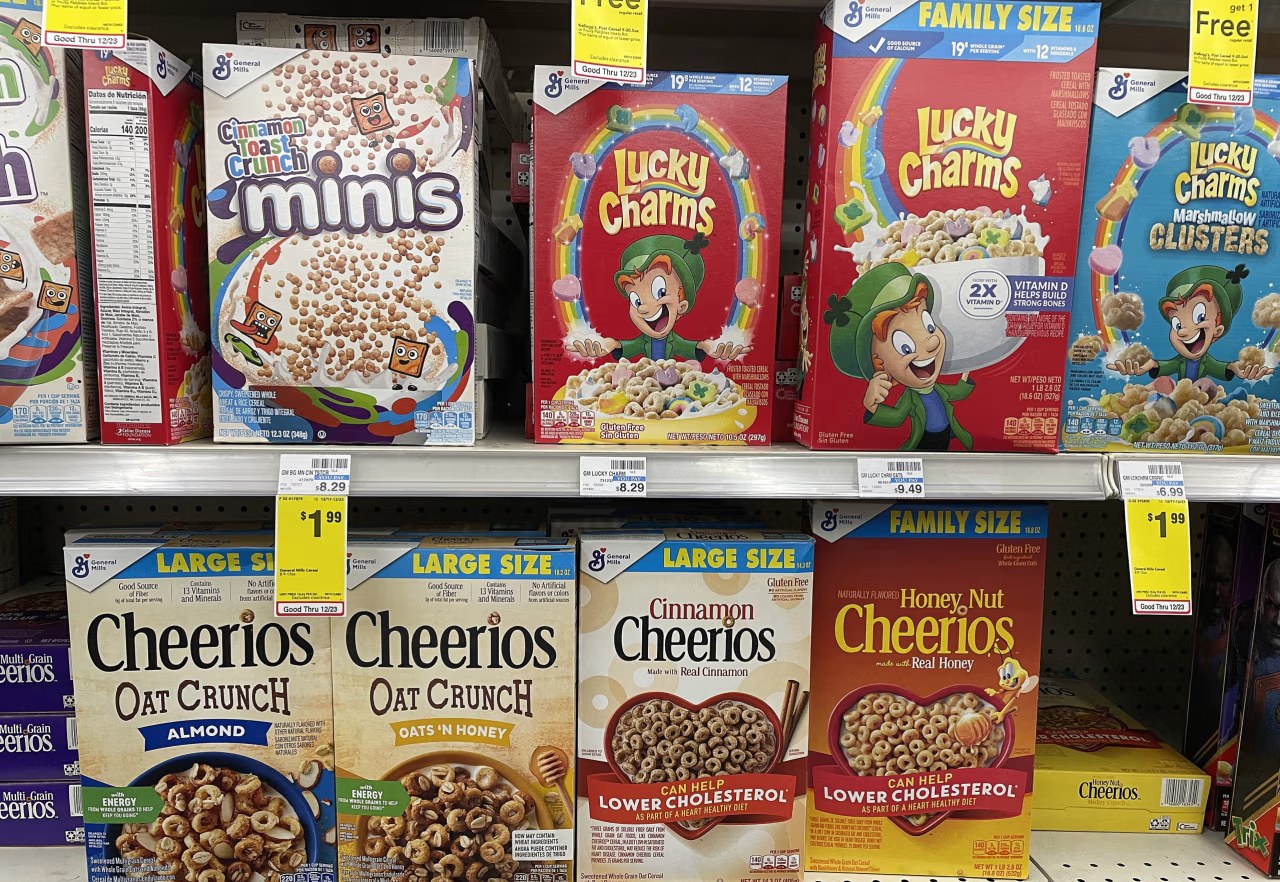
General Mills Falls 1.7% After Q3 Profit Slumps on Turnout Costs
- Operating profit slid double-digits as new-product launch costs and recent divestitures weighed on margin.
- Net sales dipped 1% year-over-year, the third straight quarterly decline, despite list-price increases.
- Executives claim volume is stabilizing and predict positive organic sales growth in fiscal 2025.
- CEO Jeff Harmening says the short-term hit is necessary to fund innovation and regain market share.
Investors are being asked to stomach another weak quarter while management bets on a volume-led rebound.
GENERAL MILLS EARNINGS—General Mills reported a fiscal third-quarter profit and sales slide, underscoring the cost of management’s plan to trade near-term margin for what it hopes will be a durable turnaround in market share and organic growth. Shares of the 157-year-old packaged-foods giant closed down 1.7% as investors absorbed a second consecutive quarterly decline in both top- and bottom-line results.
While price increases implemented throughout last year offset some inflation, volume in key U.S. cereal and snack units continued to shrink, and the company lost the profit contribution from brands it has pruned from the portfolio. Management emphasized that unit trends are now “inflecting” and guided for positive organic sales next fiscal year, but conceded the recovery is coming slower than planned.
“We are willing to take short-term profit pressure to position the business for long-term, sustainable growth,” Chief Executive Jeff Harmening told investors, pointing to stepped-up advertising, innovation pipelines and supply-chain de-complexity efforts. The question is whether shoppers—still pinched by higher food prices—will return to name brands faster than competitors can win them away.
How Deep the Slide Went: Q3 by the Numbers
General Mills’ fiscal third quarter, ended Feb. 25, revealed the steepest profit contraction since the pandemic boom faded. Net sales fell 1% to $4.97 billion, missing the $5.02 billion consensus estimate among analysts surveyed by Visible Alpha. Adjusted operating profit tumbled 12% to $820 million, translating to an operating margin of 16.5%, down roughly 200 basis points from the prior year. Volume alone subtracted three percentage points from the top line, the company disclosed, a slight moderation from the four-point hit in Q2 but still a clear sign that shoppers are walking away from higher price tags.
Margin Pressure From All Sides
Cost of goods rose 3% despite moderating commodity inflation, largely because factory volumes dropped and input hedges rolled off. At the same time, advertising and media spend jumped 13% as the Cheerios maker tried to reignite demand with new gluten-free SKUs and a refreshed “Bring Breakfast to Life” campaign. Divestitures—including the $700 million European dough businesses sold last summer—stripped away an estimated 40 basis points of margin, finance chief Kofi Bruce said on the earnings call.
“The magnitude of the profit decline was larger than we anticipated,” acknowledged Chris Growe, analyst at Stifel, in a note to clients. He trimmed his full-year EPS estimate to $4.05 from $4.20, citing weaker mix and higher reinvestment. Still, he emphasized that inventory levels in U.S. retail channels have normalized after last year’s post-pandemic glut, setting up easier volume comparisons ahead.
Management reaffirmed fiscal-2024 guidance for flat to 1% organic net sales and 4-5% adjusted EPS growth, but conceded the path now skews to the lower end. Investors sent the stock down another 1.7% in after-hours trading, extending its year-to-date under-performance to minus 9% versus a flat S&P 500 consumer staples index.
Looking ahead, executives expect a return to positive organic sales in fiscal 2025, driven by volume recovery, innovation-led market-share gains and lapping last year’s pricing arc. Whether consumers cooperate—and whether private-label competition eases—will determine if the forecast is credible or wishful thinking.
Why Volumes Are Finally Finding a Floor
After six consecutive quarters of unit declines, General Mills says it is seeing the first signs of stabilization. U.S. cereal volumes fell only 2% in Q3, a marked improvement from the 7% drop in Q1, driven by increased merchandising and the launch of Cheerios Zero, a no-added-sugar variant. Pet-food volumes turned slightly positive for the first time in a year, helped by supply-chain improvements that restored on-shelf availability at mass retailers.
Competitive Promotional Gaps Are Closing
Data from NielsenIQ show General Mills’ effective price gap versus private-label cereal narrowed to 18% in February, down from a peak of 24% last summer. “When the gap gets above 20%, households trade down fast,” notes Morningstar analyst Erin Lash. “Bringing it below 20% stabilized unit velocity in March.” Still, volumes remain 6% below pre-pandemic levels, underscoring how much ground the company must reclaim.
International markets tell a similar story. In Brazil, where inflation topped 12% in 2023, Yoki snack volumes declined 5%—half the rate of last year—after localized price packs were introduced. Europe remained weaker, with yogurt volumes down 8% following the Yoplait divestiture, but management said the worst of the volume bleed appears behind them.
Retailers are cooperating. Walmart, General Mills’ largest customer, restored shelf space for family-size Cheerios after a year of de-emphasis. “We’re seeing sequential improvement in velocity per point of distribution,” CFO Kofi Bruce noted. The retailer’s decision to reduce private-label facings by 3% chain-wide this spring plays directly into the company’s rebound thesis.
Executives now predict flat to slightly positive volume in Q4, setting up what they hope is the first chapter of sustainable growth. Whether consumers remain willing to pay branded premiums if inflation resurfaces is the wild card that could derail the narrative.
Which Brands Are Being Dumped—and What’s Taking Their Place
Since 2022, General Mills has shed more than $1.2 billion in annual revenue through divestitures, including the Yoplait yogurt license in Europe, several dough businesses and a raft of regional snack trademarks. The goal: exit slow-growing, low-margin categories and redeploy capital into faster-growing arenas like Mexican snacks, premium pet food and better-for-you cereal extensions.
Big Bets on Pet and Mexican Heritage Brands
The company paid $1.2 billion in 2021 for Tyson Foods’ pet treats business, adding Nudges and True Chews to complement Blue Buffalo. Management says the pet segment now earns double the company-average EBIT margin, helping offset cereal headwinds. In March, General Mills rolled out Blue Buffalo Health Bars with probiotics at PetSmart and Petco, priced 30% above mainstream biscuits but 15% below Hill’s Science Diet.
On the human-food side, the new Que Rica Vida line of Mexican simmer sauces and seasoning kits is being stocked in 6,000 Walmart stores ahead of Cinco de Mayo. Early velocity data show dollar sales per store 40% higher than the company’s prior Old El Paso baseline, according to IRI. “We’re targeting Hispanic households, the fastest-growing demographic in the U.S.,” said Sean Walker, president of North America retail.
Still, the transition isn’t painless. The lost contribution from divested brands shaved about 1.5 percentage points from total sales in Q3, and management expects another 1-point drag in Q4. Investors are giving the company credit for disciplined capital allocation, but the earnings gap won’t close until new products scale and commodity costs moderate.
CEO Jeff Harmening told analysts the portfolio reshaping is “substantially complete,” implying fewer moving parts in 2025. If volume recovery stalls, however, the divestiture discipline could quickly become a headwind with no immediate offset.
Is the Turnaround Timeline Too Optimistic?
Management’s assurance that organic sales will turn positive in fiscal 2025 hinges on three pillars: continued volume recovery, market-share gains from innovation, and easing year-over-year price comparisons. Wall Street is skeptical. Consensus estimates compiled by FactSet show just 1.2% organic growth penciled in, well below the 3-4% historic run-rate the company once delivered.
Macro Clouds Could Throttle Recovery
Consumer confidence remains fragile. The University of Michigan index ticked down in March as gasoline prices rebounded, and grocery inflation is still running near 3%. “If the consumer cracks again, volumes will roll over and all bets are off,” warns Rob Dickerson, senior analyst at Jefferies. Private-label manufacturers are also investing in quality upgrades, narrowing the taste gap that once protected branded players.
Commodity volatility is another wild card. Wheat futures have surged 14% since January on Russian supply concerns, while cocoa prices hit record highs. General Mills typically hedges 6-9 months out, but CFO Kofi Bruce admitted coverage for the second half of fiscal 2025 is “lighter than usual,” exposing EPS to a potential 3-cent headwind if spot prices persist.
Still, some trends favor the company. Retailer inventories are lean, so any uptick in demand should translate quickly to orders. Convenience-store traffic is rising, boosting single-serve snack sales, and the pet-food category continues to outpace human food. If volumes merely stabilize, operating leverage could drive 6-7% EPS growth, according to Bernstein analyst Alexia Howard.
Management has little room for error. After guiding to the lower end of fiscal-2024 ranges, credibility rests on delivering a visibly positive inflection next year. Investors will get an early read in September when first-quarter results are released; any sign that volumes slipped anew would likely send the stock to fresh lows.
What Investors Are Watching Next
With the Q3 print in the rear-view, General Mills must now prove that sequential volume momentum can survive a tougher macro backdrop. Analysts say the next catalysts include June’s fourth-quarter release—where management will formalize fiscal-2025 guidance—and the annual investor day in July, when executives typically unveil multi-year algorithm targets.
Free Cash Flow and Dividend Safety
Free cash flow for the nine months through February totaled $1.6 billion, down 12% year-over-year, but still sufficient to cover $930 million in dividends and $300 million in share repurchases. The payout ratio stands at 57% of adjusted EPS, within management’s 50-60% target band. “We see no risk to the dividend,” notes S&P Global Ratings analyst Bea Chiem, citing the company’s A-minus balance-sheet grade and 2.1× net leverage.
Debt maturities are manageable: $1 billion comes due in 2025, followed by $1.2 billion in 2026. With $4.8 billion in available liquidity, refinancing should not crimp reinvestment plans. Still, credit agencies warn that further large acquisitions are unlikely until leverage drops below 2× EBITDA.
Shareholder returns remain a priority. The board has authorized a $2 billion buyback program through 2026, but management has tapped only 15% of the authorization, preferring to preserve optionality. If organic growth accelerates, excess cash could be redirected toward higher-return internal projects or opportunistic M&A in pet food or Mexican cuisine.
Ultimately, the investment thesis hinges on execution. If volumes turn positive and commodity costs behave, the stock could re-rate toward its 10-year median P/E of 17×. Failure would leave General Mills trading like a low-growth utility, a fate few food companies escape once branded loyalty erodes.
Frequently Asked Questions
Q: What dragged General Mills’ profit lower in Q3?
Heavy spending on new-product launches and the lost margin from recently divested brands outweighed price-led revenue gains, causing operating profit to slide double-digits.
Q: How is General Mills measuring turnaround success?
Management points to sequential volume growth in U.S. cereal, pet-food market-share gains and inventory normalization—metrics it says will translate into positive organic sales next fiscal year.
Q: Will the company raise prices again in 2024?
Executives say further list-price hikes are unlikely; instead they expect volume recovery and brand reinvestment to drive revenue as inflation cools and promotional gaps close.
