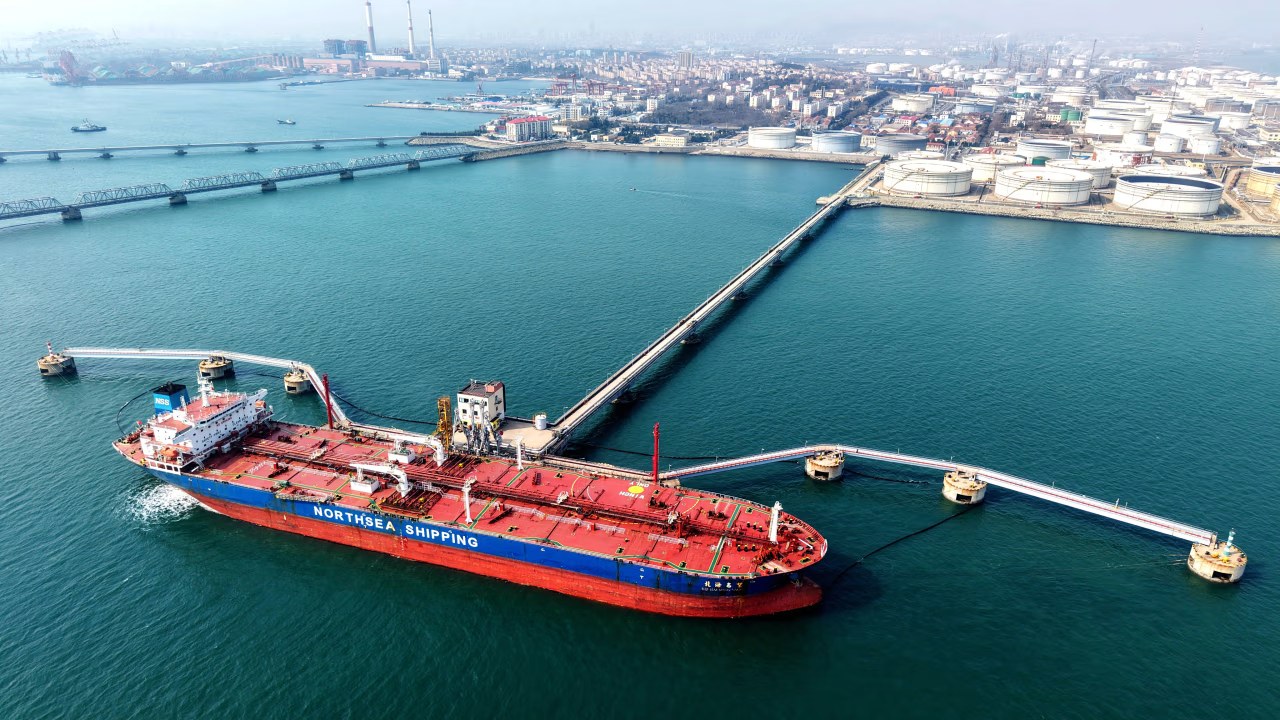
Beijing quietly relies on 1.1 million barrels of Iranian oil a day, a lifeline now in the cross-hairs of the U.S.-Israel campaign against Tehran.
- Iran has shipped China an average 1.1 million b/d of discounted crude during the past three years, worth roughly $55 billion in sanctions-circumventing trade.
- Tehran’s Bandar Abbas port and the Tehran-Mashhad rail corridor serve as Belt-and-Road nodes, anchoring $18 billion of Chinese-built infrastructure.
- An expanded American-Israeli military push risks choking the Persian Gulf chokepoint, forcing Chinese refiners to pay up to $12 per barrel more for replacement cargoes.
- Every $10 rise in Brent prices adds $24 billion to China’s annual import bill, denting GDP growth by an estimated 0.3 percentage points, according to Oxford Economics.
As Washington and Jerusalem intensify strikes on Iranian proxies, Beijing’s strategic hedge in the Middle East faces its gravest test in a decade.
CHINA-IRAN—For more than ten years Iranian crude arrived in Chinese ports under the radar of U.S. sanctions, keeping refineries humming and inflation in check. That opaque lifeline is now in jeopardy as Israeli airstrikes widen and the Pentagon floats a maritime security task-force that could board tankers linked to Iran.
China’s state traders have not published import volumes from Iran since 2020, but tanker-tracking firms such as Vortexa and Kpler show a steady flow of very-large-crude-carriers that load from Kharg Island, transfer at sea off Malaysia, and discharge at Ningbo or Zhoushan as “Malaysian” or “Omani” blends. The calculus is simple: Iranian barrels trade at discounts of $8–$12 per barrel to Brent, saving Chinese independents an estimated $6.6 billion a year.
The stakes go beyond cheap oil. Iran is the western anchor of China’s Belt and Road, a land bridge that lets freight move from Xinjiang through Kazakhstan, across the Caspian, and into Turkey without touching U.S.-controlled sea lanes. Beijing’s $18 billion portfolio in Iranian rail, port and petrochemical projects is the largest Chinese investment cluster in the Middle East after Saudi Arabia’s refining megaplex. A prolonged conflict that shutters the Strait of Hormuz or triggers regime-threatening sanctions would force China to reroute energy flows, raise import costs, and abandon infrastructure it has financed for over a decade.
Iran’s Discounted Crude: China’s Quiet $55 Billion Cushion
Chinese customs classify Iranian barrels as originating in Malaysia or Oman, but satellite imagery leaves little doubt: more than 360 very-large-crude-carriers departed Kharg Island for Chinese ports since January 2021. Applying the observed $8–$12 discount to Brent, analysts at FGE Energy estimate Beijing has saved roughly $6.6 billion a year on feedstock, a margin that keeps teapot refineries in Shandong profitable when Singapore crack margins dip below $4 per barrel.
Those savings translate directly into consumer prices. Oxford Economics calculates that every dollar shaved off the cost of a barrel lowers China’s CPI by 0.7 basis points. Multiply the Iranian discount by 400 million barrels a year and the disinflationary tail-wind equals 0.2 percentage points of CPI, no small matter for a country battling deflationary pressure.
What happens if the U.S. Navy steps up interdictions?
Washington has not intercepted a Chinese-flag tanker since 1996, but the legal architecture exists. Executive Order 13846 authorizes secondary sanctions on any entity that purchases Iranian petroleum. If the U.S. Treasury designated Bank of Kunlun or China Oil & Gas Pipeline Network—the state-owned conduits—Chinese refiners would scramble for replacement barrels. Analysts at S&P Global Commodity Insights say spot demand for West African and U.S. sour grades could push Brent up $10 within a month, adding $24 billion annually to China’s import bill.
Beijing’s counter-move would likely mirror 2018 tactics: route payments through small Afghan or Hong Kong shell companies, insure cargoes domestically, and sail tankers without international P&I clubs. The cost of such opacity, however, is an estimated $2–$3 per barrel premium for freight insurance, eroding half of the Iranian discount.
Forward-looking, China is accelerating its strategic petroleum-reserve fill rate to 19 million barrels a month, the highest since 2020, according to Ursa Space Systems. Yet at 90 days of net imports, China’s SPR coverage still trails the International Energy Agency’s 90-day OECD obligation, leaving the world’s largest crude buyer exposed if Gulf supply is disrupted.
Belt-and-Road Hub: Why Iran Anchors China’s Westward Land Bridge
Geography gives Iran gate-keeping power over the shortest rail corridor between East Asia and Europe. The Tehran-Mashhad line, electrified with Chinese finance, cuts 2,000 kilometers off the maritime route from Shanghai to Rotterdam. State-owned China Civil Engineering Corp. owns a 40-year concession to operate container terminals at Bandar Imam Khomeini and Bandar Abbas, giving Beijing a backdoor to the Caspian and, via the Astara rail ferry, to Russia’s North-South corridor.
Total contract value of Chinese engineering and construction projects in Iran reached $18.2 billion in 2023, according to China’s Ministry of Commerce, second only to Saudi Arabia in the region. Projects include the $1.5 billion Kerman Steel Plant, the $700 million Siraf refinery upgrade, and a $2.1 billion high-speed rail link between Isfahan and Shiraz. All are denominated in yuan and euros, insulating them from dollar sanctions but not from war risk.
Could Israel’s air campaign hit Chinese-built assets?
While Israel has not targeted civilian infrastructure, 2021 strikes on Iranian Revolutionary Guard warehouses at Bandar Imam Khomeini port occurred 300 meters from a Chinese-operated container yard. Insurance underwriters at Lloyd’s have since added a 0.15% war-risk surcharge on cargoes handled there, raising logistics costs for Chinese firms by $12 per twenty-foot-equivalent unit.
More disruptive is the prospect of a U.S. maritime inspection regime that could force COSCO’s 400-container vessels to bypass Iranian ports entirely. China’s Ministry of Transport has already instructed state carriers to draft contingency plans that would reroute West Asian cargo through Jebel Ali in Dubai, adding 1,200 kilometers and five days to voyages, according to a logistics executive at China Merchants Group.
Long-term, Beijing is hedging via the China-Kazakhstan-Caspian route, but the western spur still depends on Iranian rail for the final 300 kilometers to Turkey. If hostilities closed that section, freight would have to sail from Aktau across the Caspian to Baku, then through war-sensitive Armenia, lengthening transit by 12 days and raising cost per container by $1,100.
The strategic takeaway is that any U.S.-Israel campaign that degrades Iran’s transport nodes would fracture the only continuous overland belt China has built to circumvent American sea power, forcing Beijing either to double down on Iranian reconstruction or accept higher dependence on maritime chokepoints it cannot control.
Diplomatic Tightrope: Why Beijing Walks a Fine Line Between Riyadh and Tehran
China’s March 2023 détente brokered between Iran and Saudi Arabia crowned Beijing’s image as honest mediator, yet the balancing act has become perilous. Saudi Aramco and China’s Norinco are building a $12.2 billion refinery in Panjin that is designed to run 400,000 b/d of Saudi heavy crude. Any perception that China is shielding Tehran militarily could jeopardize financing for the project, which is backed by Saudi fund Public Investment Fund to the tune of $5 billion.
Meanwhile, the U.S. is pressing Gulf allies to join the proposed Gulf Maritime Guardian Force, an initiative that would require Saudi and Emirati navies to interdict Iranian tankers. A senior Gulf official told Reuters that Riyadh expects China to use its leverage to curb Iranian drone supplies to Yemen’s Houthis; failure to deliver could push Saudi Arabia closer to the U.S. security umbrella and reduce Chinese access to downstream projects.
What leverage does China actually wield over Iran?
China buys 82% of Iran’s seaborne oil exports, giving Beijing crude-market leverage but not military sway. Iranian Foreign Minister Hossein Amir-Abdollahian publicly thanked China for “standing against unilateral sanctions,” yet privately Tehran bristles at Beijing’s refusal to transfer advanced air-defense systems, according to diplomats familiar with the talks.
Beijing’s most potent card is economic: withholding the roughly $4 billion annual oil payments that fund Iran’s budget. Yet cutting off Tehran would spike global oil prices and hurt Chinese motorists, a trade-off Communist Party cadres call “using poison to fight poison.”
The dilemma intensifies as Washington prepares fresh secondary sanctions on Chinese banks. U.S. Deputy Treasury Secretary Wally Adeyemo told the Senate Banking Committee that “no country’s banks will be off-limits if they facilitate Iranian oil.” Analysts at Eurasia Group assign a 35% probability that Kunlun Bank or Bank of China’s Singapore branch could be sanctioned by 2025, forcing China to either escalate financial counter-measures or quietly trim Iranian purchases.
Looking ahead, Beijing’s immediate priority is to keep both Gulf oil and Iranian discounts flowing while avoiding overt military entanglement. Expect more yuan-denominated barter deals, private insurance syndicates, and rhetorical calls for “dialogue,” but no decisive tilt toward Tehran that would endanger China’s far larger economic stake with Gulf Arabs.
Economic Fallout: Could a Gulf War Knock 0.3 Points Off China’s GDP?
Modeling by Oxford Economics shows that a $20 spike in Brent crude—well within the range if Iranian supply is disrupted—would raise China’s import bill by $48 billion annually, shaving 0.3 percentage points off GDP growth. The mechanics are straightforward: every $1 increase in oil lifts China’s import price index by 0.9 basis points, widens the current-account deficit by $3.2 billion, and forces the People’s Bank of China to choose between tolerating higher inflation or raising interest rates at a time when property developers are already fragile.
Consumer inflation would feel the pinch fastest. Gasoline prices in China are formula-linked to Brent; a $20 rise would push retail fuel to 9.5 yuan per liter, surpassing 2014 highs and eroding rural household disposable income by 1.2%, according to a National Development and Reform Commission study. Electric-vehicle adoption may cushion demand, but only 35% of rural households own EVs, leaving the majority exposed.
Which Chinese provinces are most vulnerable?
Shandong, home to China’s independent teapot refineries, sources 46% of its crude from Iran and Iraq. A prolonged disruption would idle 1.2 million b/d of refining capacity, cutting provincial industrial output by 3%, according to local government estimates. Liaoning, where PetroChina’s Dalian refinery runs 260,000 b/d of Iranian heavy, faces similar risk.
Export competitiveness also suffers. Textile and plastics clusters in Zhejiang and Guangdong rely on discounted Iranian feedstock for petrochemical inputs; a $20 oil rise raises production costs by 6%, wiping out the 4% profit margin that exporters earn on basic plastic goods.
Beijing’s fiscal response would likely include tapping the strategic petroleum reserve, subsidizing refiners, and accelerating coal-to-chemical projects to replace naphtha. Yet Oxford Economics warns these measures can only offset half the shock, leaving a net drag of 0.15 percentage points on GDP.
Global spillovers compound the hit. A Gulf conflict that sends Brent above $100 would suppress European demand for Chinese goods, cutting export growth by 2% and adding another 0.1 percentage-point drag on GDP. In total, a sustained war could trim China’s 2025 growth to 4.2% from the government’s target of 5%, enough to cost two million urban jobs.
What’s Next for Beijing: Yuan-for-Oil Barter, SPR Stockpiling, or Quiet Retreat?
Beijing’s playbook is already visible in the numbers: China has raised its strategic petroleum-reserve fill rate to 19 million barrels a month, the fastest since 2020, according to Ursa satellite data. Simultaneously, the People’s Bank of China has signed yuan-clearance agreements with the UAE and Qatar, laying groundwork to settle Gulf oil in renminbi if dollar sanctions tighten.
Yet the most radical option—openly flouting U.S. sanctions—remains unlikely. Chinese banks hold $2.3 trillion in dollar-denominated assets; even a 10% freeze would dwarf the value of Iranian oil savings. Instead, Beijing is expected to deepen the yuan-for-oil barter system tested in 2022, when CNOOC paid Iran 20 billion yuan ($2.9 billion) for six months of crude via a Kunlun Bank escrow. The transaction bypassed SWIFT, used Dubai-based insurers, and sailed under the U.S. radar.
Will China supply Iran with weapons?
U.S. intelligence officials told the Financial Times that Beijing has so far rejected Tehran’s requests for advanced air-defense systems, fearing Israeli retaliation against Chinese technicians stationed at Iranian ports. Yet China has quietly supplied Iran with high-resolution satellite imagery and dual-use fiber-optic gyroscopes, components that enhance ballistic-missile accuracy.
The red line for Washington is lethal aid. If China crossed it, the U.S. could blacklist CNOOC or Sinochem, cutting them off from dollar financing. Eurasia Group assigns a 15% probability to such sanctions in 2024, rising to 35% if Iranian proxies kill American servicemen in Syria or Jordan.
Looking ahead, expect Beijing to adopt a “boil the frog” strategy: incrementally expand yuan settlements, insure more tankers through domestic syndicates, and build extra storage tanks in Hainan capable of holding 60 million barrels—enough to cover 45 days of Iranian supply disruption. The goal is to keep Iranian oil flowing without provoking a dollar-centered financial rupture that would derail China’s own fragile recovery.
If war closes the Strait, China would likely invoke force-majeure clauses, reduce Iranian intake by 30%, and replace barrels with spot cargoes from Brazil and Guyana at a $6–$8 premium. The strategic partnership survives, but the era of mega-discounts ends—pushing Chinese inflation higher and narrowing the current-account surplus Beijing relies on to stabilize the yuan.
Frequently Asked Questions
Q: How much Iranian oil does China import daily?
Customs data show China has taken 1.1–1.4 million barrels per day of Iranian crude shipped via third-country tankers, worth roughly $55 billion in sanctions-side-stepping trade since 2021.
Q: Why is Iran vital to the Belt and Road Initiative?
Iran sits on the shortest overland corridor linking China’s western provinces to Europe; Beijing has poured $18 billion into Iranian rail, port and petrochemical projects that bypass the Strait of Hormuz.
Q: What U.S.-Israel actions threaten China’s interests?
Escalating Israeli airstrikes on Iranian proxies and new U.S. maritime interdiction drills threaten to close the Persian Gulf route, spiking freight insurance and forcing China to reroute oil at extra cost.
