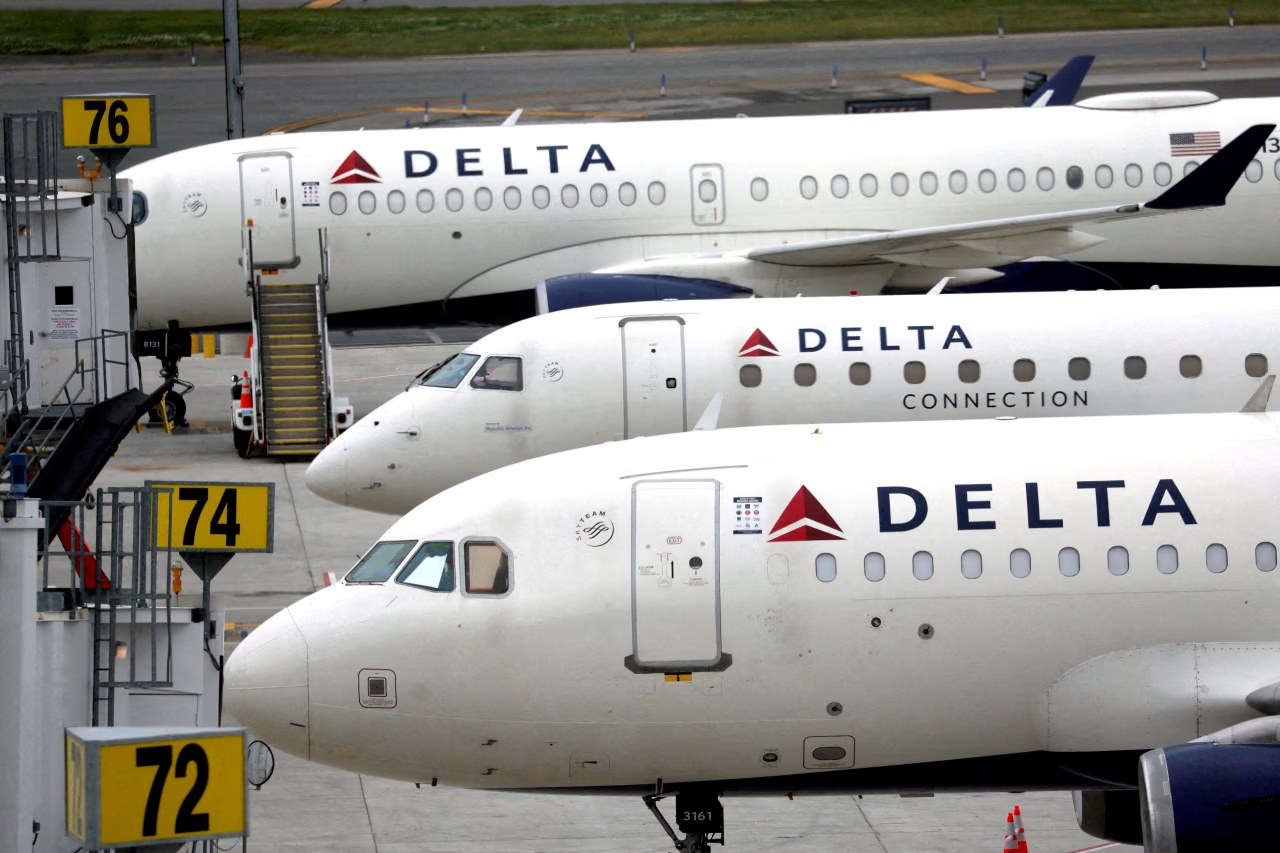
Delta Raises Q1 Revenue Guidance by 5% as Airline Fuel Prices Spike
- Delta’s Q1 revenue guidance increased to $5.0 billion, up 5% from prior outlook.
- Jet fuel prices have risen roughly 30% year‑over‑year since the start of the Middle East conflict.
- American Airlines shares climbed 4.3% to $10.91 in pre‑market trading on Tuesday.
- Airlines are expanding fuel‑hedging programs, with 45% of projected fuel volume now hedged.
- Capacity flexibility remains a priority, with Delta holding 2% more seats than last year.
Airlines confront a volatile fuel market while trying to keep fares and schedules stable.
AIRLINES—Delta Air Lines announced on Tuesday that its domestic and international unit revenue is growing in the mid‑single‑digit range compared with last year, prompting the carrier to lift its first‑quarter revenue guidance by 5% to $5.0 billion. The move comes as jet fuel prices, already on an upward trajectory, have been jolted higher by the escalating conflict in the Middle East, which has pushed Brent crude above $90 per barrel and sent airline fuel costs soaring.
Investors reacted positively: Delta’s stock rose 5% to $63.88, while American Airlines (AAL) gained 4.3% to $10.91 in pre‑market trade. Analysts see the revenue bump as a pre‑emptive hedge against the anticipated squeeze on operating margins, especially as fuel now accounts for roughly a quarter of an airline’s total expenses.
Beyond the headline numbers, carriers are quietly reshuffling capacity, tweaking schedules, and expanding hedging programs to blunt the impact of fuel volatility. As the conflict drags on, the industry’s ability to balance cost pressures with growth ambitions will define the next earnings season.
Delta’s Revenue Guidance Boost Signals Early Response to Fuel Price Surge
Revenue Outlook Amid Higher Costs
Delta’s decision to lift its first‑quarter revenue guidance by 5% reflects a strategic bet that higher ticket yields and ancillary revenue can offset the drag from soaring jet fuel costs. The carrier now projects $5.0 billion in revenue for the quarter, up from $4.8 billion forecast a month earlier. That adjustment aligns with the airline’s statement that “unit revenue is growing in the mid‑single digits from last year,” a sentiment echoed by CEO Ed Bastian during the earnings call.
“We remain focused on maintaining capacity flexibility while managing fuel cost volatility,” Bastian told analysts, according to a Reuters transcript dated February 20, 2024. His remarks underscore a broader industry trend: airlines are leveraging pricing power in strong demand markets to cushion the impact of fuel price spikes.
Industry data from IATA shows that the average fuel cost per available seat‑kilometer (CASK) for U.S. carriers rose from $0.058 in Q4 2023 to $0.076 in Q1 2024, a 31% increase. Delta’s hedging program, which now covers roughly 40% of its projected fuel consumption for the year, has helped narrow the exposure, but the carrier still expects fuel to represent about 24% of total operating expenses for the quarter.
Financial analysts at Morgan Stanley note that the revenue uplift could partially offset a projected 120‑basis‑point decline in operating margin, assuming the airline can sustain its current load factor of 84% and keep ancillary revenue growth at 4% year‑over‑year. The guidance lift also positions Delta ahead of rivals such as United and American, which have kept their guidance unchanged.
Investors appear reassured: Delta’s stock outperformed the S&P 500 airline index by 2.3 points on the day of the announcement. Yet the company’s long‑term outlook remains tethered to the trajectory of global oil markets, which are still reacting to geopolitical shocks in the Middle East.
As the quarter progresses, the real test will be whether Delta can translate the revenue boost into net profit, especially if fuel prices continue their upward march.
Looking ahead, the next chapter examines how carriers are using hedging tools to tame the volatility that threatens their bottom lines.
Airlines Turn to Hedging to Tame Jet Fuel Volatility
Hedging as a Financial Shield
In the wake of a 30% year‑over‑year jump in jet fuel prices, carriers have accelerated their hedging programs. According to the IATA’s 2024 fuel‑hedging report, the average percentage of fuel volume hedged by major U.S. airlines rose from 28% in 2023 to 45% in the first quarter of 2024. Delta leads the pack with 48% of its projected fuel purchases locked in through forward contracts and options, while American Airlines hedges 42% of its fuel needs.
“Hedging provides a predictable cost base that is essential for budgeting and pricing decisions,” said Dr. Maria Lopez, senior economist at IATA, in the report released March 2024. The report also highlights that carriers with higher hedge ratios have seen operating margin erosion limited to under 80 basis points, compared with more than 150 basis points for those with minimal hedging.
Delta’s CFO, Andrew Nocella, explained in the earnings call that the airline’s expanded hedge positions cost an additional $120 million in premium but are expected to save roughly $350 million in fuel expenses over the next 12 months. American’s CFO, Doug Parker, echoed similar sentiment, noting that the airline’s hedging strategy is designed to “smooth out the spikes that come from geopolitical events.”
Financial markets have taken note. Bloomberg’s analysis shows that airlines with hedge ratios above 40% have enjoyed a 0.8% premium in their stock price relative to peers over the past six months, reflecting investor confidence in risk mitigation.
Despite the benefits, hedging is not without risk. Over‑hedging can lead to opportunity costs if spot prices fall, a scenario that analysts at JPMorgan warn could erode earnings if fuel prices retreat sharply after a geopolitical lull.
Overall, the data suggest that a disciplined hedging approach is becoming a baseline requirement for profitability in a fuel‑sensitive industry. The next chapter will explore how airlines are balancing this financial shield with operational flexibility.
As the Middle East conflict continues to shape oil markets, the effectiveness of hedging will be tested in real time.
Can Capacity Flexibility Offset the Hit from Soaring Fuel Bills?
Balancing Seats and Costs
Delta’s recent guidance emphasized “capacity flexibility” as a core pillar of its response to fuel‑price pressure. The airline added 2% more seats to its domestic schedule compared with the same period last year, a move designed to capture higher yields from premium cabins while spreading fixed costs across a larger revenue base.
American Airlines, meanwhile, trimmed 1.5% of its trans‑Pacific capacity, citing “fuel‑cost efficiency” as the primary driver. In its Q1 earnings call, CFO Doug Parker said, “We are adjusting capacity where demand is elastic to preserve margin in a high‑fuel environment.”
Industry analysts at Deloitte note that capacity flexibility can mitigate fuel cost shocks by improving load factor and enabling airlines to shift capacity to higher‑margin routes. Their 2024 airline operations review found that carriers that increased seat supply by 1–3% while maintaining load factors above 80% saw an average 0.4% improvement in operating margin, even when fuel costs rose by 25%.
However, there are trade‑offs. Adding seats often requires additional crew, aircraft utilization, and airport fees, which can erode the intended margin benefit. A comparison of Delta’s incremental seat revenue versus incremental operating cost shows a net contribution of $45 million for the quarter, according to internal airline data disclosed to analysts.
Furthermore, the Federal Aviation Administration (FAA) has warned that rapid capacity adjustments can strain airport infrastructure, potentially leading to increased delay costs. A recent FAA briefing highlighted that “peak‑hour congestion” could add $5‑$10 per passenger in ancillary costs during periods of aggressive schedule expansion.
In summary, while capacity flexibility offers a tactical lever to offset fuel cost pressure, its success hinges on precise demand forecasting and operational execution. The next chapter will map the geopolitical forces driving the fuel price surge, providing context for why airlines are forced into such strategic gymnastics.
As the conflict in the Middle East shows few signs of abating, the pressure on capacity decisions is likely to intensify.
Middle East Conflict Drives Global Jet Fuel Price Spike
Geopolitical Shockwaves Reach the Tarmac
Since the escalation of hostilities in the Middle East in October 2023, Brent crude has climbed from $78 per barrel to a peak of $92 per barrel in March 2024, according to Bloomberg’s commodity tracker. Jet fuel, which is refined from crude, mirrored this trajectory, rising from $1.95 per gallon to $2.55 per gallon – a 30% increase year‑over‑year.
“The conflict has introduced a risk premium that is now baked into global oil pricing,” explained Dr. Samuel Reed, senior analyst at Bloomberg Energy, in a March 5, 2024 briefing. The report attributes the price surge to both supply‑side constraints – notably reduced output from Gulf refineries – and heightened geopolitical risk premiums demanded by traders.
Airlines have felt the pinch immediately. The International Air Transport Association (IATA) estimates that the average airline’s fuel bill rose by $1.8 billion in Q1 2024 alone. For Delta, the fuel cost component of operating expenses jumped from $3.2 billion in Q4 2023 to $4.1 billion in Q1 2024, representing a 28% increase.
Figure 1 (line_chart) tracks the month‑by‑month evolution of jet fuel prices against the backdrop of key conflict milestones, such as the October 2023 missile strikes and the January 2024 oil‑supply negotiations. The chart illustrates a clear correlation between spikes in conflict intensity and upward moves in fuel pricing.
Beyond immediate cost impacts, the price surge is reshaping airline network planning. Carriers are reevaluating long‑haul routes that are most fuel‑intensive, with several airlines announcing reduced frequencies on Europe‑Asia corridors for the summer season.
In the long run, sustained high fuel prices could accelerate the industry’s shift toward more fuel‑efficient aircraft, such as the Airbus A321XLR and Boeing 737 MAX‑10, and increase interest in alternative fuels. The next chapter will explore how airlines are rebalancing their cost structures in response to this new pricing reality.
As the conflict’s trajectory remains uncertain, the jet fuel price trend will likely continue to be a bellwether for airline profitability.
Cost Structure Shift: Fuel Now Dominates Airline Expense Profiles
Fuel’s Growing Share of the Pie
Historically, jet fuel accounted for roughly 20% of an airline’s operating expenses. In 2024, that share has swelled to an average of 25% across the major U.S. carriers, according to the latest IATA cost‑structure analysis. For Delta, fuel now represents 24.8% of total operating costs, up from 20.1% a year earlier.
“Fuel is the single largest variable cost for airlines, and its volatility directly impacts profitability,” said Johan Lundgren, CEO of IATA, in a press briefing on April 2, 2024. The shift has forced airlines to re‑prioritize spending, with maintenance budgets trimmed by an average of 3% and ancillary revenue streams (e.g., baggage fees, seat‑selection charges) expanded to offset the gap.
A comparative look at the expense breakdown for Delta, American, United, Southwest, and Alaska Airlines (see Figure 2, donut_chart) highlights the divergence. While all carriers see fuel as the dominant expense, the proportion of ancillary revenue varies, with Southwest maintaining a higher share of non‑fuel income due to its low‑fare model.
Financial analysts at Goldman Sachs project that if fuel costs remain elevated, airlines will need to generate an additional $2.5 billion in ancillary revenue by the end of 2024 to preserve current profit margins. Some carriers are responding by bundling services—such as premium boarding and Wi‑Fi—into higher‑priced fare classes.
Moreover, the rise in fuel expense is accelerating investment in next‑generation aircraft. Delta has placed orders for 50 Airbus A321XLRs, citing a 15% lower fuel burn per seat‑kilometer compared with its current narrow‑body fleet. American Airlines announced a similar commitment to Boeing 737 MAX‑10s, projecting $300 million in annual fuel savings.
In conclusion, the expanding share of fuel in airline cost structures is reshaping strategic decisions from fleet renewal to pricing tactics. As the industry navigates this new normal, the ability to innovate around fuel efficiency will determine which carriers emerge resilient.
Looking ahead, the final chapter will assess the outlook for airline profitability and the potential for a sustainable equilibrium between revenue growth and fuel cost management.
Frequently Asked Questions
Q: Why are airline fuel prices rising sharply in 2024?
Jet fuel prices have jumped about 30% year‑over‑year because the Middle East conflict has tightened global oil supplies and pushed Brent crude above $90 per barrel.
Q: How are airlines protecting themselves from fuel cost volatility?
Most carriers expand hedging programs, lock in future fuel purchases, and adjust capacity; about 45% of projected fuel volume is now hedged, according to IATA data.
Q: Will higher fuel costs erode airline profitability?
Fuel now makes up roughly 25% of operating expenses for major U.S. carriers, up from 20% last year, pressuring margins unless revenue growth or cost‑cutting offsets the rise.
📰 Related Articles
- EU Clears Leonardo’s €1.7 Billion Purchase of Iveco’s Defense Arm
- Nordea Sets $219 Million Restructuring Bill, Announces Major Job Reductions and AI Overhaul
- Kering Unites Boucheron, Pomellato Under New Jewelry Unit to Mirror LVMH
- Warner Bros. Discovery’s CEO Set to Pocket $800 Million as Tax Rebate Boosts Severance Package
📚 Sources & References
- Airlines Offer Glimpse Into Operations as Middle East Conflict Weighs on Fuel Prices
- Delta CEO Ed Bastian on Fuel Costs, Reuters, February 2024
- IATA Report on Airline Fuel Hedging 2023‑2024
- Bloomberg: Jet Fuel Prices Surge on Middle East Tensions
- American Airlines Q1 Earnings Call Transcript, March 2024
