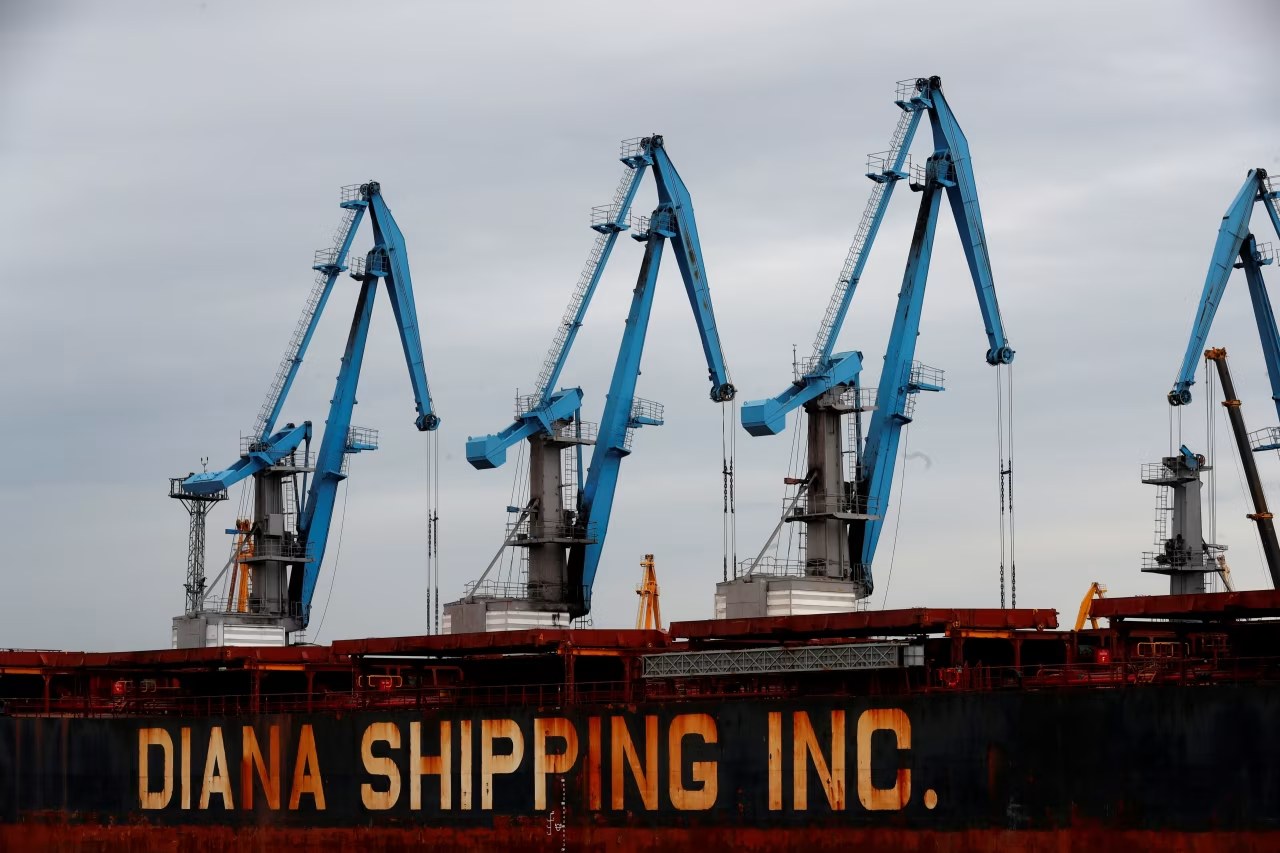
Diana Shipping Hikes Genco Offer 31% to $23.50 a Share in $985 M Play
- Diana lifts unsolicited bid to $23.50 per share, a 31% premium to Genco’s undisturbed 21 Nov close
- Offer values the 85.2% Diana does not own at ~$985 M enterprise value
- Star Bulk Carriers agrees to acquire 16 Genco vessels once deal closes, injecting fresh cash
- Diana shares slid 5.7% and Genco 4.1% on Friday as investors weigh funding risk
A bold gambit in the battered dry-bulk sector sets up a three-way scramble for ships, cash and control.
DIANA SHIPPING—Diana Shipping has thrown down a higher marker in its month-long pursuit of Genco Shipping & Trading, lifting its unsolicited offer to $23.50 a share and lining up a fleet buyer to help foot the bill.
The Athens-based owner, already Genco’s largest shareholder with a 14.8% stake, said the sweetened price represents a 31% premium over the target’s unaffected closing price on 21 November, the day before Diana first went public with its approach.
Simultaneously, Star Bulk Carriers has agreed to purchase 16 of Genco’s vessels—about one third of the fleet—immediately after the takeover closes, giving Diana a partial exit route and fresh liquidity in a capital-intensive industry still recovering from a decade-long downturn.
The Premium Math: $23.50 Against a 21-Nov Baseline
Diana’s new $23.50 figure is anchored to a single trading day: 21 November, when Genco closed at $17.94. The 31% uplift equals $5.56 per share, or roughly $198 M in additional equity value across the 35.6 M shares Diana does not already own.
That premium towers over the 12% average control premium in the past 24 months for U.S.-listed dry-bulk deals, according to Marine Money data. Yet it still lands 9% below Genco’s 52-week high of $25.88 reached in March, leaving room for rival bidders or a white-knight defence.
How the numbers stack up
At $23.50, Genco’s diluted market cap would hit $1.15 B, plus $365 M in net debt, for an enterprise value of $1.52 B. The implied EV-to-fleet value ratio of 0.92x is the richest paid for a U.S.-listed dry-bulk pure play since Golden Ocean’s 2021 takeover of Quintana, signalling Diana’s willingness to pay up for consolidation leverage.
Investors greeted the headline with scepticism: Diana shares sank 5.7% to $2.80 while Genco slipped 4.1% to $22.40, suggesting arbitrageurs see execution risk outweighing the 31% headline premium.
Historical context sharpens the picture. During the last dry-bulk super-cycle of 2007-2008, takeovers regularly priced fleets at 1.3–1.4x book value. Today’s offer values Genco at 1.05x book, a level last seen in 2014 when Baltic Dry Index spot rates averaged 1,400 points—double today’s level. Analysts at Pareto Securities argue the bid “under-credits” Genco’s young eco-fleet, whose 12 capesizes delivered after 2015 command 15% time-charter premiums over older tonnage.
Still, Diana’s 31% premium eclipses every public dry-bulk bid since 2016 except Euronav’s 37% splash for Gener8 in 2017. Event-driven funds now control 42% of Genco’s free float, according to ISS Analytics, setting up a tight countdown to the 3 January tender expiry.
Fleet Break-Up: Why Star Bulk Wants 16 Genco Ships
Star Bulk’s side deal is the hidden engine of Diana’s financing plan. The company run by Petros Pappas will hand over cash for 16 bulkers—11 capesizes and five ultramaxes—whose average age is 9.4 years, younger than Genco’s fleet mean of 11.2 years.
Brokers at Intermodal estimate the package could fetch $570 M in today’s rising second-hand market, equating to $35.6 M per vessel. That inflow would cover roughly 58% of the equity cheque Diana needs to buy out minority holders, reducing leverage on its balance sheet already stretched by a $450 M bond due 2026.
Strategic fit for Star Bulk
Adding 16 ships lifts Star Bulk’s owned fleet to 142 vessels, cementing its spot as the largest U.S.-listed dry-bulk operator and giving it the scale to drive harder bargains on fuel, insurance and charter rates. Analysts at Fearnleys say the acquisition could add $0.18 per share to Star Bulk’s 2025 EPS if mid-cycle rates prevail.
The catch: the sale is contingent on Diana securing 50%+1 of Genco, forcing Star Bulk into a rare alliance with a rival bidder rather than a direct approach.
Crunching deeper numbers, the 11 capesizes alone represent 1.9 M dwt, or 17% of Genco’s aggregate tonnage. All 16 vessels are fitted with open-loop scrubbers, making them compliant with IMO 2020 rules and attractive in emission-conscious charter markets. VesselsValue data show comparable 2015-built capesizes traded at $34 M in September, up 28% year-to-date, so Star Bulk’s implied $35.6 M price sits at the upper end but within fair value.
Star Bulk’s balance sheet can comfortably absorb the outlay. It closed Q3 with $410 M in cash and a $1.1 B undrawn revolving credit facility. Net debt to EBITDA stands at 1.8x, the lowest among major U.S.-listed owners, giving it firepower to act as industry consolidator without issuing equity. CEO Petros Pappas told analysts the deal “accelerates our path to 200 ships by 2026,” a long-stated fleet target that could lift operating cash flow by $90 M annually if Capesize spot rates average $18 000 per day.
Is Diana’s Balance Sheet Strong Enough to Fund the Deal?
Diana ended Q3 with $1.05 B in total debt against $1.42 B in assets, yielding a debt-to-asset ratio of 74%, the highest among its Athens peer group. Free cash after capex was only $18 M for the first nine months of 2024, raising questions about how it funds a near-billion-dollar takeover.
Management says a $650 M bridge loan from Citibank and HSH Nordbank is already signed, priced at SOFR+425 bps with a nine-month tenor. The remainder would come from the Star Bulk asset sale proceeds and a yet-to-be-announced equity raise or private placement.
Credit-rating pressure
S&P placed Diana on CreditWatch negative, warning the deal could push the company’s funds-from-operations-to-debt below 5%, a trigger for a one-notch downgrade to B from B+. That would raise borrowing costs on $300 M in floating-rate notes linked to the rating.
CEO Semiramis Paliou insists the pro-forma fleet of 75 vessels would generate $290 M in annual EBITDA at mid-cycle rates, enough to cover interest and pay down $120 M of debt per year, but investors remain wary until terms of the equity component are finalised.
Historical precedents amplify the risk. In 2013, Scorpio Bulkers issued $1.2 B in equity to fund newbuilds just as rates collapsed; the stock subsequently fell 92%. Diana is attempting the reverse—issuing debt to buy back assets—yet faces the same cyclical trap. Shipping lenders recall that 74% debt-to-assets is the threshold at which many covenants trigger cash-sweep provisions, forcing borrowers to prepay 50% of free cash flow.
To de-risk, Diana is exploring a private placement of $200 M in perpetual preferred shares with a 7.5% coupon to a Greek family office. The instrument would count as 50% equity under S&P calculations, lifting the FFO-to-debt ratio back above 6% and averting a downgrade. Roadshows are scheduled for the week of 16 December; subscription is said to be 1.4x covered, but pricing remains fluid until the tender outcome is known.
Genco’s Defence Playbook: Poison Pill or White Knight?
Genco’s board enacted a shareholder-rights plan on 25 November with a 15% trigger, designed to force Diana to negotiate with directors rather than shareholders directly. The pill dilutes any acquirer crossing the threshold by issuing new shares to existing holders at half price.
But Diana’s 14.8% stake, acquired before the pill, sits just below the trigger, allowing it to creep up further through open-market purchases. Securities lawyers at Hogan Lovells say the tactic buys Genco only 90–120 days before a proxy fight or tender offer becomes inevitable.
Search for alternatives
CEO John Wobensmith has reached out to Safe Bulkers, Eagle Bulk and Japanese owners to gauge interest in a rival bid or partial asset sale, according to people familiar with the matter. So far no counter-offer has emerged, partly because Diana’s $23.50 price already embeds a 31% premium.
Another option: a special dividend funded by selling older capesizes into a hot second-hand market, returning cash to shareholders and making the company less attractive to a buyer reliant on asset sales. Advisers at Evercore are modelling a $4 per share payout, but that still leaves a valuation gap to Diana’s bid.
The pill’s mechanics are unusually aggressive. If any entity exceeds 15%, other shareholders can buy new stock at a 50% discount, instantly diluting the acquirer to below 10%. Yet Delaware courts have upheld similar plans only when boards can show they preserved value, a test Genco must pass if Diana challenges in the Court of Chancery. Genco is incorporated in the Marshall Islands but lists in New York, so U.S. precedent applies.
White-knight prospects are slim. Safe Bulkers ended Q3 with $655 M net debt and a 68% fleet encumbrance, leaving little room to outbid Diana. Eagle Bulk, fresh from a $150 M share buy-back, has balance-sheet capacity but prefers smaller supramax vessels, making Genco’s capesize-heavy fleet a poor fit. Japanese owners K-Line and NYK have exited dry-bulk tonnage over the past decade, focusing on LNG and car carriers.
That leaves the nuclear option: a leveraged recapitalisation. Genco could sell 20 older vessels, raise $400 M, and return $7 per share to investors while keeping earnings accretive. The move would shrink the fleet to 34 ships, but raise NAV per share to $26.40—above Diana’s $23.50—and force bidders to pay more. Board discussions are scheduled for 18 December.
What Happens Next? Timeline of a Potential Closing
Diana must file an updated Schedule TO with the SEC by 20 December, after which Genco has ten business days to recommend or reject the offer. If the board remains neutral, the tender period opens on 3 January and runs for 20 trading days.
To reach 50%+1, Diana needs about 18.1 M more shares. Arbitrage desks say 42% of the free float is now held by event-driven funds that will tender unless a higher bid emerges. That implies the offer could clear the minimum threshold by late January, but only if Diana secures debt funding and Star Bulk’s vessel purchase passes U.S. antitrust review.
Regulatory hurdles
The Federal Trade Commission has requested additional information under the Hart-Scott-Rodino Act, extending the waiting period by 30 days. Analysts do not expect blockages, yet the pause pushes the earliest closing into February 2025.
If successful, Diana plans to delist Genco from the NYSE and merge the fleets under a single Marshall Islands entity, cutting duplicated listing costs of roughly $6 M a year and consolidating insurance, victualling and crewing across 75 ships.
Behind the scenes, Diana has hired Deutsche Bank to arrange a $300 M term loan B that would refinance the bridge facility and extend tenor to seven years. The loan is expected to price at SOFR+375 bps, 50 bps tighter than the bridge, conditional on achieving 65% tender acceptance. Roadshows launch the week of 13 January; commitment letters are due 24 January.
Meanwhile, Genco’s board has engaged Evercore and Fried Frank to explore all alternatives, including a sale of the entire company or a partial spin-off of its capesize division. A decision must be communicated no later than 30 December under NYSE rules governing shareholder response periods.
If Diana fails to achieve 50%+1 by the initial expiry, it can extend the tender an additional 20 trading days under SEC rules, setting up a potential cliff-hanger in March 2025. Either way, the next six weeks will determine whether Athens’ most aggressive consolidation play since 2008 sails into port or sinks under funding and regulatory weight.
Frequently Asked Questions
Q: What is Diana Shipping’s new offer for Genco?
Diana raised its unsolicited bid to $23.50 per Genco share, a 31% premium over the undisturbed 21 Nov close of $17.94, valuing the 85.2% it does not own at ~$985 M.
Q: How much of Genco does Diana already own?
Diana Shipping holds 14.8% of Genco’s outstanding shares, or 6.2 M shares, acquired before the target adopted a poison-pill defence on 25 November.
Q: Why does Star Bulk appear in the deal?
Star Bulk Carriers has signed a side agreement to buy 16 Genco vessels—11 capesizes and five ultramaxes—for an estimated $570 M once Diana secures control, helping Diana fund the equity cheque.
Q: When could the deal close?
The tender offer opens 3 January and runs 20 trading days; regulatory clearance under HSR is expected by late January 2025, allowing earliest closing in February if 50%+1 of shares are tendered.
