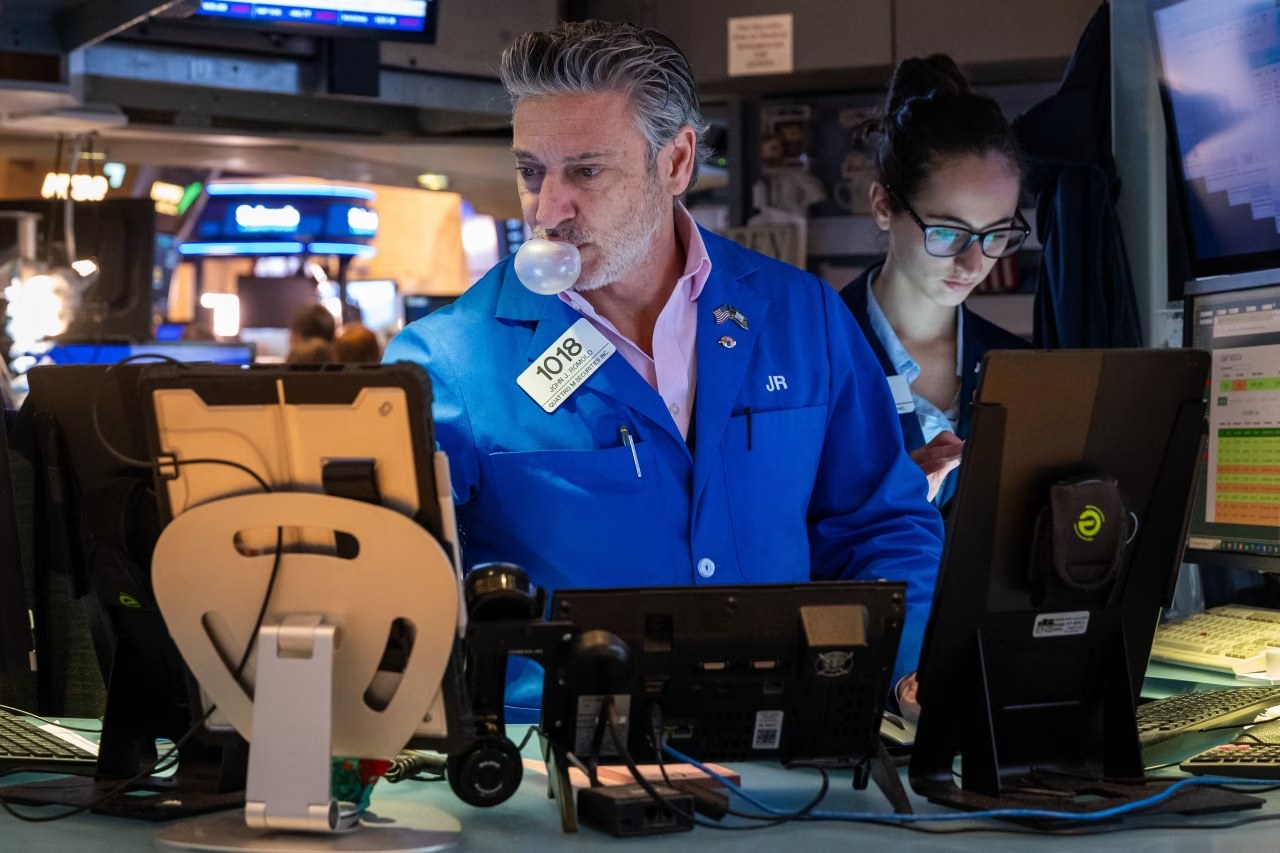
Dow Jones Plunges More Than 10% From February Peak, Officially Entering Correction Territory
- The Dow Jones Industrial Average has fallen over 10% from its February high, meeting the technical definition of a market correction.
- The S&P 500 is now on track for its worst monthly performance since 2022, underscoring the depth of the current selloff.
- Thursday’s sharp decline extended losses from the prior session as investors recalibrated expectations amid fading hopes for a near-term cease-fire.
- Market breadth deteriorated across sectors, with energy and consumer discretionary names leading declines.
Investors confront a rapid reversal of fortune after weeks of relative calm
DOW JONES—U.S. equities extended their slide on Thursday, pushing the Dow Jones Industrial Average decisively into correction territory as risk appetite evaporated across global markets. The blue-chip benchmark now sits more than 10% below its February peak, a swift reversal that wipes out months of gains in a matter of sessions.
The broader S&P 500 fared no better. The index is now poised for its steepest monthly drop since 2022, a milestone that signals how quickly sentiment has soured after a period of record-setting calm. With no single catalyst, traders pointed to a confluence of geopolitical jitters, sticky inflation prints, and diminishing odds of an imminent cease-fire as reasons for the risk-off tone.
Volatility surged in tandem. The Cboe VIX, Wall Street’s so-called fear gauge, leapt above 22 for the first time since late 2023, reflecting a market repricing that caught many positioning for continued stability off guard.
From Record Run to Technical Correction in Under a Month
The speed of the Dow’s retreat has stunned even seasoned traders. The index closed at an all-time high in mid-February, buoyed by resilient consumer data and enthusiasm around artificial-intelligence capital spending. Barely three weeks later, the same gauge has shed more than 4,000 points, erasing the year’s gains and then some.
Market historians note that corrections occurring within 30 days of a peak are relatively rare. Data compiled by S&P Dow Jones Indices show only 12 such instances since 1950, the most recent during the 2018 fourth-quarter rout. Liz Ann Sonders, chief investment strategist at Charles Schwab, emphasizes that velocity matters: “Fast, fierce corrections often reflect algorithmic selling rather than fundamental deterioration, but they can still inflict technical damage that takes time to repair.”
Thursday’s session saw the Dow finish down 1.9%, bringing its decline from the February intraday high to 10.4%. The last time the index flirted with correction levels was October 2023, when a bond-market scare sent yields spiraling. That episode lasted only seven trading days before dip-buying emerged. Whether history repeats will hinge on upcoming inflation figures and Federal Reserve guidance.
Why 10% matters more than 9%
Behavioral-finance research shows that the 10% threshold carries outsized psychological weight. Once breached, headlines proclaim a “correction,” prompting pre-programmed selling from model-driven funds that track volatility-targeting rules. According to Nomura Securities, roughly $80 billion in systematic equity exposure sits atop the 10% trigger, enough to amplify moves in either direction.
Retail investors, meanwhile, appear less rattled—for now. Data from Vanda Research show net buying of U.S. equities by individual traders every day this week, a contrarian signal that has historically marked short-term bottoms. The caveat: sustained outflows from equity mutual funds and ETFs can lag headline indexes by several weeks, meaning the full retail reaction may still be ahead.
What comes next could depend less on economic data and more on positioning. Goldman Sachs’ prime-services desk calculates that hedge-fund leverage has fallen to the 35th percentile of its five-year range, suggesting managers have already trimmed exposure. If earnings season delivers upside surprises, the combination of light positioning and negative sentiment can fuel a violent snap-back rally.
S&P 500 on Pace for Worst Month Since 2022
While the Dow grabs headlines, the S&P 500’s month-to-date slide of 8.7% underscores how widespread the damage has become. The benchmark has fallen in 14 of the past 16 sessions, a streak last observed during the 2022 bear market that shaved 25% off the index. Every sector except utilities now trades in negative territory for March.
Technology and consumer discretionary—last year’s leadership engines—have flipped to laggards. Nvidia, Meta, and Amazon have each tumbled more than 12% this month, erasing a combined $600 billion in market value. The equal-weighted S&P 500, which strips out the megacap influence, has actually fared worse, down 9.4%, indicating that weakness extends beyond the headline names.
Strategists at Bank of America note that when the index posts a monthly loss exceeding 8%, forward returns over the next 12 months have been positive 73% of the time since 1950, with a median gain of 12%. The rub: those stats include periods when the economy was already in recession, a scenario some economists say can’t be ruled out if credit conditions tighten further.
Options markets flash caution
Implied volatility has exploded across tenors. One-month at-the-money S&P options now price an annualized volatility of 22%, up from 13% at the start of the month. That repricing has lifted the cost of portfolio insurance, with put spreads on the SPDR S&P 500 ETF trading at their richest levels since last May. Flow-tracker SpotGamma warns that dealer hedging of short-dated options could amplify intraday swings, particularly around month-end rebalancing.
Corporate buybacks, traditionally a $5 billion-per-week support pillar, are entering a blackout period ahead of first-quarter earnings. J.P. Morgan estimates that buyback authorizations could shrink 15% year-over-year if management teams grow cautious on margins, removing another layer of demand at a delicate moment.
Sentiment surveys reflect the gloom. The American Association of Individual Investors’ bull-bear spread plunged to -32, the lowest since September 2022. Extreme pessimism often coincides with tradable lows, yet the read-through is murky when macro fundamentals are deteriorating. Investors now await next week’s core-PCE deflator, the Fed’s preferred inflation gauge, for clues on whether the central bank still intends to cut rates later this year.
Is the Selling Driven by Fundamentals or Forced Positioning?
Sharp drawdowns inevitably spark debate: are markets pricing in new economic reality, or are they simply caught in a leverage unwind? Current evidence points to both. Economic surprises have turned negative, with the Citi U.S. macro surprise index at its lowest level since July 2023. Meanwhile, NYSE margin debt hit a record in February, creating a tinderbox for forced selling once momentum shifted.
Julian Emanuel, senior managing director at Evercore ISI, argues that the macro backdrop is not yet dire enough to justify a 10% decline. “Earnings revisions are flat, not falling. Jobless claims remain subdued. What changed is positioning—hedge funds entered March net long at 92nd percentile since 2010,” he wrote in a note. When crowded trades reverse, price action can outrun fundamentals.
Supporting this view, breadth indicators have crashed faster than during the 2022 bear market. Only 15% of S&P 500 members trade above their 50-day moving average, a reading that in the past has coincided with intermediate bottoms within four to six weeks. Yet bottoms can precede rallies only if liquidity conditions stabilize, a big if with the Fed still shrinking its balance sheet by $95 billion per month.
Credit markets hold the key
Equity investors are watching high-yield spreads for signs of contagion. The option-adjusted spread on the Bloomberg U.S. corporate high-yield index has widened to 4.2 percentage points from 3.1 percentage points at the start of March. While still below the 5% threshold that historically triggers Fed concern, the velocity of the move has equity strategists on edge.
Karen Karniol-Tambour, co-CIO at Bridgewater Associates, cautions that asset markets are interconnected. “When stocks fall fast, credit tightens, which feeds back into growth expectations. That loop can become self-fulfilling if policymakers stay on the sidelines,” she told clients this week. Karniol-Tambour notes that the Fed’s reverse-repo facility has drained $2 trillion of excess liquidity since 2022, leaving less cushion for risk assets.
History offers mixed comfort. In 2018, a similar combo of rate hikes and quantitative tightening produced a 20% peak-to-trough decline in the S&P 500, yet the economy avoided recession. In 2001 and 2007, equity selloffs preceded downturns by several quarters. The difference, says Emanuel, lies in credit availability: “When banks curb lending, recessions follow. So far, senior-loan-officer surveys show only modest tightening.”
What History Says Happens After a 10% Dow Drop
Since 1950, the Dow has undergone 37 separate corrections, including Thursday’s. The median depth is 13.3%, implying the current slide could have further to run if it matches the historical norm. More important for investors is what follows. Data compiled by CFRA Research show that one year after crossing the 10% threshold, the Dow was higher 70% of the time, with an average gain of 9.8%.
Recovery velocity varies by macro regime. When corrections occurred outside of recessions, the index recouped its losses in a median of four months. Inside recessions, the median stretched to 14 months. Sam Stovall, chief investment strategist at CFRA, notes that the absence of a profits downturn is critical. “Earnings growth is still positive today. That tilts odds toward a quicker rebound,” he said.
Sector leadership typically rotates after corrections. Defensive groups—utilities, consumer staples, healthcare—outperform during the first three months of recovery, while cyclicals lag. Once confidence returns, growth styles reclaim dominance. Investors who bought the 2022 low were rewarded: the Dow surged 22% over the subsequent 12 months, led by industrials and financials.
International context matters
Global bourses offer a preview. Japan’s Nikkei 225 entered correction last week and has since stabilized, while Europe’s STOXX 600 is down 8% month-to-date. Currency dynamics add complexity: a strengthening dollar has hampered emerging-market equities, sending the MSCI EM index to a four-month low. Divergent central-bank policies could amplify volatility if the Fed delays cuts while the ECB and PBoC ease.
Geopolitical risk remains elevated. Oil prices have climbed 7% this month despite the equity rout, a combination that in the past has pressured consumer spending. Strategists at Capital Economics estimate that every $10 increase in Brent crude shaves 0.3 percentage points off U.S. GDP growth over 12 months. With Brent hovering near $90 a barrel, that headwind could compound equity-driven tightening in financial conditions.
Bottom line: corrections are normal features of equity markets, occurring roughly once every 24 months. What makes this episode feel jarring is the absence of one since 2022. Investors who stayed fully invested through all 37 prior corrections earned an annualized total return of 7.4%, versus 5.1% for those who missed the subsequent six-month rally, according to BofA Securities. Timing the turn is perilous; maintaining diversified exposure has historically paid off.
Where Professional Investors Are Placing Bets Now
Volatility creates opportunity—at least for investors with dry powder. Hedge funds have rotated into defensive sectors, lifting utilities weighting to a five-year high, while slashing tech exposure to the lowest since 2016, per Goldman Sachs’ prime-book data. Long-short spreads indicate conviction that energy and industrials will outperform consumer discretionary, a bet that historically pays off when oil prices stay elevated.
Private-equity firms are circling beaten-up public assets. KKR disclosed this week that it added $1.2 billion to listed infrastructure names, arguing that regulated utilities now trade at 20% discounts to private-market appraisals. Similarly, Brookfield Asset Management filed to raise a $5 billion opportunistic credit fund targeting leveraged loans that trade below 90 cents on the dollar, a level last seen in 2020.
Fixed-income investors are also front-running a Fed pivot. Net inflows to long-duration Treasury ETFs hit $7.3 billion over the past week, the fastest pace since Silicon Valley Bank’s collapse. The 10-year yield has fallen 35 basis points in March, its steepest monthly drop since late 2022, as traders price in two rate cuts by year-end despite Fed pushback.
Active vs. passive debate intensifies
Corrections often expose the fragility of crowded passive strategies. Factor ETFs that overweight momentum and low-volatility have underperformed the equal-weight S&P 500 by 250 basis points this month, according to Bloomberg Intelligence. The divergence has rekindled calls for active management, especially as dispersion among single stocks surges to the highest level since 2021.
Yet fees remain a hurdle. The average large-cap active mutual fund charges 0.7%, while the SPDR S&P 500 ETF costs 0.09%. Over 10 years, that gap compounds to roughly 12% of terminal value, a headwind many allocators deem too steep. Instead, advisers are tilting toward actively managed ETFs, which blend low costs with discretionary stock-picking. Assets in such funds have doubled since 2022, to $420 billion.
Looking ahead, most strategists expect range-bound trading until clarity emerges on inflation and geopolitics. Binky Chadha, chief strategist at Deutsche Bank, models a 4,800 year-end target for the S&P 500—implying 11% upside from Thursday’s close—contingent on earnings growth of 8% and a Fed that cuts by 75 basis points. If either assumption falters, fair-value estimates reset lower, extending the correction into a third quarter.
Frequently Asked Questions
Q: What defines a stock-market correction?
A correction is a decline of 10% or more from a recent high. The Dow Jones Industrial Average has now fallen over 10% from its February peak, meeting the technical definition.
Q: How does the current selloff compare to 2022?
The S&P 500 is on pace for its worst monthly drop since 2022, signaling that investor sentiment has deteriorated at the fastest clip in two years.
Q: Does entering correction mean a bear market is next?
Not necessarily. While corrections are declines of 10%–19%, bear markets require a 20% fall. History shows many corrections reverse before reaching that threshold.
