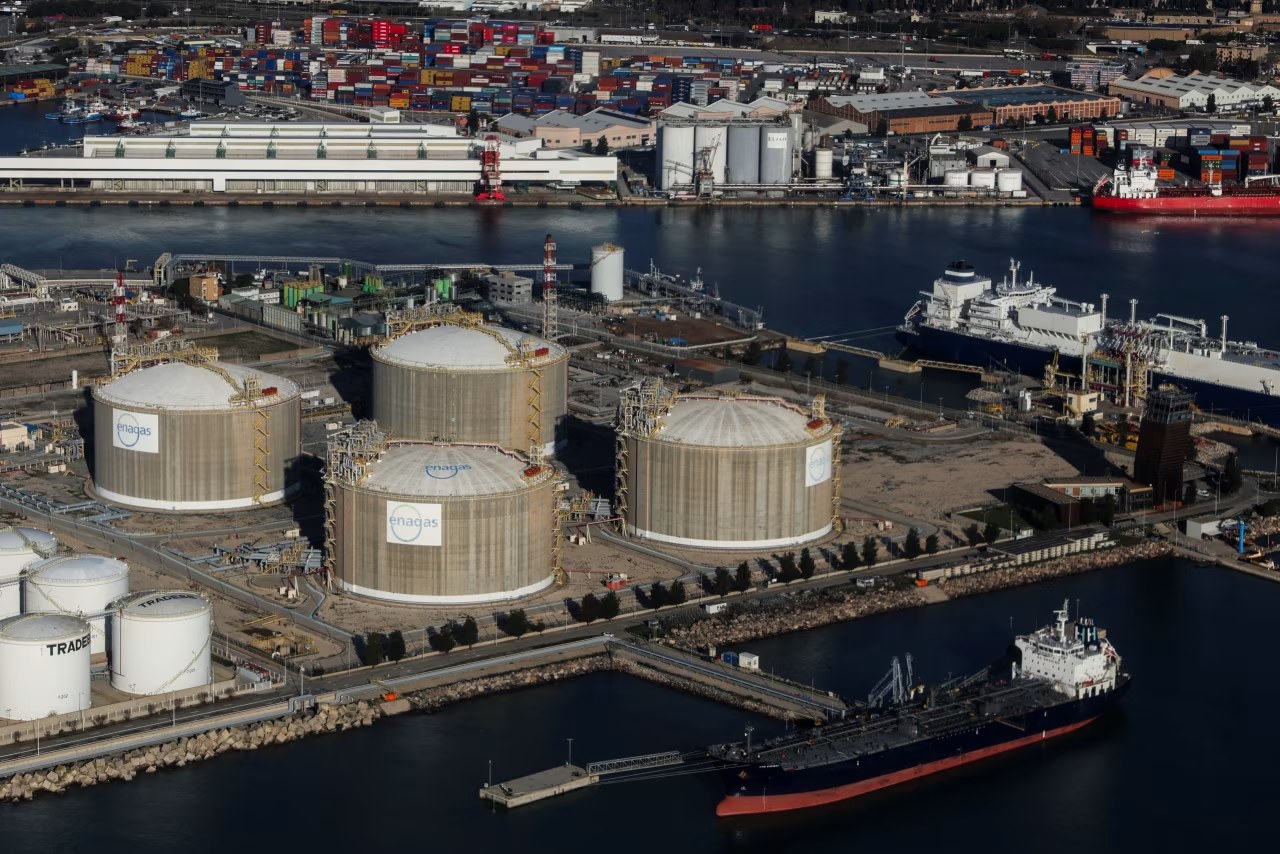
Enagas rallies 27% in 2024 after Spain guarantees 2027-32 hydrogen-pipeline returns
- CNMC draft decree promises regulated remuneration for gas-grid hydrogen upgrades through 2032.
- Enagas stock leapt 13% to €16.62, its highest close since December 2023.
- Grid operator plans to adapt 600 km of existing pipes for 100% green-hydrogen flow.
- Analysts see €3bn capex pipeline protected by predictable 6-7% regulated returns.
Madrid’s policy U-turn turns legacy gas monopoly into Europe’s newest hydrogen play
ENAGAS—Madrid—Spain’s stock-market star this week is not a tech unicorn but a 50-year-old gas-grid operator. Enagas shares surged to a two-year peak after the country’s competition watchdog unveiled a remuneration framework that will pay owners of repurposed hydrogen pipelines a regulated return from 2027 through 2032. Investors rewarded the company with a 13% intraday jump, pushing year-to-date gains to 27% and valuing the former utility at roughly €4.1 billion.
The proposed rules, released by the Comisión Nacional de los Mercados y la Competencia (CNMC), end two years of policy limbo that had left Europe’s most ambitious hydrogen-ready grid strategy without a revenue model. Under the draft, any section of Spain’s 11,000 km high-pressure network certified to carry 100% hydrogen will qualify for the same regulated asset base (RAB) formula that already underpins electricity and methane infrastructure.
Market reaction was immediate: volume on the Madrid bourse topped 6.5 million shares, triple the 30-day average, while the company’s 2029 green bond tightened 11 basis points. Analysts at Bernstein called the framework “the missing piece that converts optionality into earnings visibility,” lifting their sum-of-the-parts valuation by 18% to €18 per share.
How Spain Created Europe’s First Regulated Hydrogen-Pipeline Revenue Stream
Until last week, hydrogen developers across Europe had to rely on merchant markets, government grants or offtake agreements that expire within a decade. Spain’s CNMC broke that pattern by folding hydrogen pipelines into the same regulated-asset regime that has underwritten gas and electricity grids since 1998. The draft circular, now open for industry consultation, sets a five-year regulatory horizon—2027 to 2032—during which owners of retrofitted pipes will earn a pre-tax weighted average cost of capital (WACC) of 6.1% on the regulated asset base, plus annual CPI indexation.
“This is the first explicit, multiyear tariff for 100% hydrogen networks anywhere in the EU,” says Ana María Jaramillo, senior infrastructure analyst at S&P Global Commodity Insights. “It de-risks the business model and will lower the cost of capital for sponsors like Enagas from around 9% to the mid-single digits.”
Inside the numbers: 600 km of pipes, €3bn capex and 6.1% regulated returns
Enagas chief executive Arturo Gonzalo told analysts in May that the company has identified 600 km of high-pressure lines—linking industrial clusters in Asturias, Cantabria and Valencia—that can be cost-effectively converted to hydrogen service by replacing compressors, valves and seals. Management pegs the price tag at roughly €3 billion between 2025 and 2030, a figure that now qualifies for regulated remuneration rather than volatile market rates.
The framework also resolves a long-standing regulatory asymmetry: while Spain’s electricity grid earns a regulated return on new interconnectors, hydrogen projects had no equivalent mechanism, forcing developers to rely on European Innovation Fund grants or bilateral contracts. By guaranteeing cost recovery plus 6-7% returns, Madrid effectively turns hydrogen infrastructure into a bond-like utility asset, attracting pension funds and infrastructure funds that had balked at volume risk.
Yet the policy shift is not without controversy. Environmental group Ecologistas en Acción warns that guaranteed returns could incentivise overbuilding. “We need to ensure these pipes actually carry green hydrogen, not grey or blue gas rebranded,” says coordinator Sara Muñoz. The CNMC responded that only pipelines certified for 100% renewable hydrogen will qualify, and operators must meet minimum utilisation thresholds or face clawbacks.
For investors, the key takeaway is predictability. Bernstein estimates the new tariff adds €2.3 per share to Enagas’s net asset value, equivalent to a 16% uplift, while Morgan Stanley lifts its 2028 EBITDA forecast by 12%. Both brokers highlight that Spain’s approach could become a template for Germany, Italy and the Netherlands, each drafting similar hydrogen-network regulations before 2025.
From Gas Dinosaur to Green Backbone: Enagas’s Strategic Pivot
Founded in 1972 to transport Algerian methane across the Pyrenees, Enagas spent five decades as a defensive dividend play tied to declining Spanish gas demand. That narrative flipped in 2020 when Madrid adopted a national hydrogen roadmap targeting 4 GW of electrolysis capacity by 2030. Management saw an opening: reuse 70% of existing steel pipes instead of building from scratch, cutting capex per kilometre by 45%.
The company’s first mover advantage is scale. Spain operates Europe’s most fragmented pipeline network—11,000 km versus 7,800 km in Italy—yet 85% of mains are ≤20 years old and rated for 100-bar pressure, sufficient for hydrogen blending. Enagas already spent €140 million on feasibility studies, digital twins and material testing with Norway’s DNV, data now embedded in the CNMC consultation.
Case study: the €200m Cantabrian corridor that will carry 350,000 tonnes of green H₂
The most advanced project is the so-called Cantabrian corridor, a 200km section linking the port of Gijón to inland industrial users including ArcelorMittal’s steel mill and Repsol’s petrochemical complex. Gonzalo says the line will be ready for 100% hydrogen by 2027, moving 350,000 tonnes annually—equivalent to 10% of Spain’s 2030 target—and will earn the new regulated tariff from day one.
Investment bankers describe the pivot as “utility judo”: turning a stranded gas asset into a growth platform. “Every euro of capex now attracts regulated equity rather than merchant risk,” says Ignacio Sánchez, utilities analyst at Santander. “That transforms valuation multiples from 6-7x EV/EBITDA to 9-10x, in line with European electricity grids.”
Still, execution risks loom. Hydrogen embrittlement requires replacing certain vintage steel grades, while compressor retrofits add €1.2 million per kilometre. Enagas must also secure supply agreements with developers of the 11 GW of wind and solar projects slated for Asturias and Castilla y León. Yet investors appear willing to underwrite the gamble: the company’s green bond issued last November was 3.5x oversubscribed, pricing at 95 basis points over mid-swaps.
Looking ahead, management guides for regulated hydrogen assets to represent 25% of the company’s RAB by 2030, up from zero today. If achieved, Bernstein estimates group EBITDA could reach €1.8 billion by 2032 versus €1.3 billion in 2023, even as legacy gas transmission revenue declines 2% annually.
What the 27% Rally Signals About Europe’s Next Infrastructure Arms Race
Enagas’s 27% year-to-date surge outpaces every major European utility except Greece’s Mytilineos, signalling that investors are rotating from renewable developers to regulated grid enablers. The STOXX Europe 600 Utilities index is flat in 2024, but hydrogen-exposed network owners—Italy’s Snam, Germany’s OGE and Spain’s Enagas—trade at an average 12% premium to their five-year mean EV/RAB multiple.
“We’re witnessing a repricing of infrastructure assets that can monetise the energy transition without volume risk,” says Mark Lewis, head of climate research at Andurand Capital. “Regulated hydrogen pipelines are the new electricity super-grids.”
Comparative valuations: Enagas trades at 1.4x RAB vs 1.7x for Snam and 1.9x for OGE
Despite the rally, Enagas still changes hands at a discount to European peers, a gap bulls argue will close once the CNMC circular is finalised in September. Snam, which operates 42,000 km of Italian pipelines, already earns a 7.1% regulated return on hydrogen-ready projects, while Germany’s OGE is lobbying Berlin for similar treatment under the forthcoming Hydrogen Network Development Plan.
The valuation differential also reflects country risk. Spain’s left-wing coalition government has a history of retroactive regulatory cuts, most notably in 2013 when it slashed solar subsidies, wiping €8 billion off equity values. Investors want assurance that hydrogen tariffs cannot be clawed back if the political winds shift. The CNMC has sought to pre-empt this by embedding the 6.1% WACC in multiyear tariff periods, mirroring the stability mechanism used for electricity grids since 2013.
Meanwhile, project developers are racing to secure grid connections. Iberdrola, Cepsa and Sweden’s Vattenfall have already requested 2.8 GW of electrolyser capacity along the Cantabrian and Mediterranean corridors, according to grid data compiled by Rystad Energy. If half of those projects reach final investment decision, Enagas could add €1.2 billion of regulated assets by 2028, lifting its allowed return on equity (ROE) above 11%.
The bigger picture is a continental scramble to build hydrogen backbone before 2030, when EU regulation requires member states to integrate renewable gas targets into national energy plans. Morgan Stanley estimates that Europe will need 40,000 km of new or repurposed hydrogen pipelines by 2040, costing €80-120 billion. Spain, with its abundant solar resource and under-utilised gas grid, aims to capture 20% of that market, turning Enagas from a domestic utility into an export platform.
Will Regulated Tariffs Be Enough to Cover the €3bn Conversion Bill?
Management pegs the bill for converting 600 km of pipelines and associated compressor stations at €3 billion over five years, a figure that equals the company’s current market capitalisation. While the CNMC guarantees cost recovery, the cash-flow timing mismatch is stark: Enagas must spend €600 million annually before tariffs kick in during 2027. Credit-rating agencies have already placed the issuer on negative outlook, citing rising net-debt-to-RAB ratios.
“The key question is whether Enagas can fund the rollout without breaching its self-imposed 65% gearing ceiling,” says María Castaño, senior credit analyst at Fitch. “If project delays push spending beyond 2027, free cash flow turns negative and dividend sustainability comes under pressure.”
Funding mix: 60% debt, 30% equity-like instruments, 10% EU grants
CFO José Antonio De Las Heras told investors in June that the company will tap three sources: €1.8 billion of investment-grade bonds, €900 million of hybrid securities that count as 50% equity under agency methodology, and €300 million from the EU Connecting Europe Facility once the corridors are designated Projects of Common Interest. The latter tranche is expected to cover 20% of the Cantabrian corridor, effectively reducing regulated capex and boosting allowed returns.
Enagas has already secured €600 million of undrawn revolving credit, priced at 90 basis points over Euribor, and plans a €500 million green hybrid in Q4 2024. Bankers say demand is robust, but pricing has widened 35 basis points since the European Central Bank restarted rate hikes. Any delay in tariff finalisation could push spreads further, raising the nominal cost of capital above the CNMC’s 6.1% real WACC.
Operational leverage cuts both ways. On the upside, every €100 million of EU grant translates into a 40-basis-point uplift in project IRR because it reduces the regulated asset base on which the return is calculated. On the downside, cost overruns on compressor retrofits—a chronic issue in Italy’s Snam network—cannot be passed through to tariffs until the next regulatory review in 2032.
Bottom line: investors are betting that the certainty of regulated cash flows outweighs the funding gap, but the margin for error is thin. If Enagas sticks to budget and EU grants arrive on time, 2027 free cash flow could turn positive at €250 million, supporting a 5% dividend yield. If not, the company may be forced into a €1 billion rights issue, diluting the same shareholders who just enjoyed a 27% rally.
What Investors Should Watch Next: Final Tariffs, EU Designation and Supply Deals
The CNMC consultation closes 15 September, with final tariffs expected by December. Analysts see a 70% probability of no material change to the 6.1% WACC, but scope exists for tougher efficiency targets or higher clawback thresholds. A parallel process at Brussels will decide whether the Cantabrian and Mediterranean corridors qualify as Projects of Common Interest (PCI), unlocking an extra €300 million of EU grants and fast-track permitting.
“PCI status is binary,” says Giles Farmer, European infrastructure analyst at Barclays. “It won’t alter the regulated return, but it de-risks construction timelines and improves bankability for sponsors.”
Three near-term catalysts that could move the share price by ±15%
First, any upward revision to the WACC—possible if Spanish sovereign yields stay above 3.5%—would add €0.8 per share to NAV according to Santander. Conversely, a cut to 5.5% would shave €1.2 per share and likely trigger a 10% sell-off. Second, Enagas must finalise hydrogen-supply agreements with Iberdrola and Cepsa before year-end; failure to secure 60% of pipeline capacity would undermine utilisation assumptions baked into the tariff model. Third, the company’s 2025-29 strategic plan is due in February: if management lifts the hydrogen RAB target above 25%, consensus EPS for 2028 could rise 8-10%.
Beyond Spain, investors are watching whether Germany’s BNetzA and Italy’s ARERA copy the CNMC model in their respective hydrogen-network consultations due 1Q 2025. A pan-European regulated asset base would create a bigger investable universe and reduce the political-discount applied to Spanish utilities. Until then, Enagas remains a liquid proxy for a policy experiment that could redefine Europe’s energy-transition infrastructure playbook.
Frequently Asked Questions
Q: What triggered the 13% single-day spike in Enagas shares?
Spain’s CNMC released draft rules guaranteeing regulated returns for firms that repurpose gas pipes to carry 100% hydrogen between 2027-2032, turning Enagas into a growth story.
Q: How high did the stock climb and what record did it break?
Shares touched €16.62, the strongest level since December 2023, extending 2024 gains to 27% and valuing the former utility at roughly €4.1 billion.
Q: Which pipelines are eligible for the new hydrogen incentives?
Spain’s 11,000 km high-pressure network can qualify if technical upgrades—compressor stations, steel coatings—meet 100% H₂ purity standards certified before 2027.
