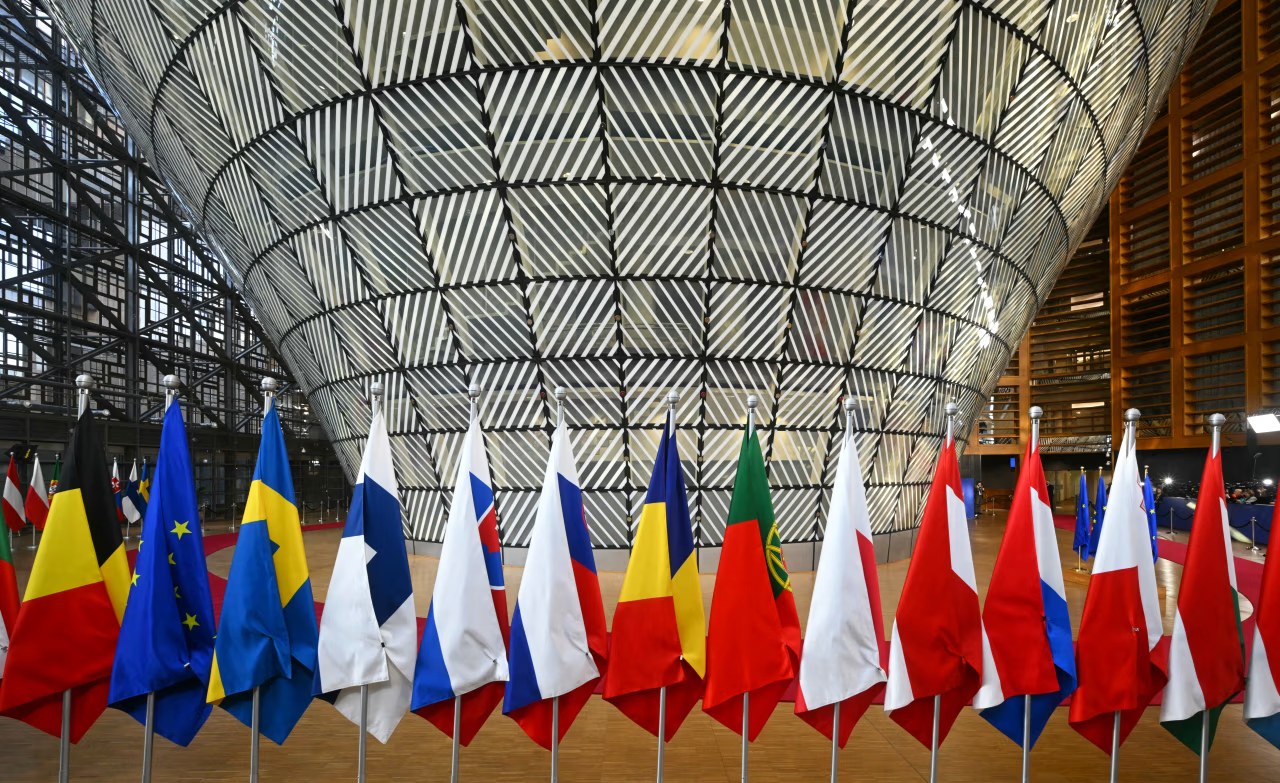
0 NATO allies join U.S. plan to guard oil through Iran’s Strait of Hormuz
- Washington now shoulders the full naval cost of protecting one-fifth of world oil supply.
- European capitals cite legal and political risk, opting for a separate EU observation mission.
- Proposal to charge Gulf exporters a per-barrel toll echoes Panama and Suez canal models.
- Shift could recalibrate trans-Atlantic burden-sharing long after current Iran flare-up fades.
Who pays when the world’s energy artery is under threat?
STRAIT OF HORMUZ—When the Trump administration asked allies to help escort tankers past Iranian speedboats in the Strait of Hormuz, the answer from Berlin, Paris and Madrid was a polite but firm “no.” The rebuff leaves the United States alone in shouldering a security bill that analysts peg at roughly $1 million per destroyer per day—without any mechanism to recoup the expense from the very oil exporters whose revenues depend on open sea lanes.
The refusal is more than a diplomatic slight. It exposes a structural fault line in Western security architecture: the expectation that U.S. taxpayers will subsidize global commerce while European powers—highly dependent on Middle Eastern crude—free-ride on American hard power.
As one NATO diplomat told the Wall Street Journal, “We prefer our ships not become targets in someone else’s confrontation.” The comment captures the strategic mood: allies want the oil, not the fight.
The Anatomy of a Strait That Moves 21 Million Barrels a Day
Just 21 nautical miles wide at its narrowest pinch, the Strait of Hormuz is less a geographic curiosity than the planet’s economic jugular. Roughly 21 million barrels of crude and condensate pass through its shipping lanes every 24 hours, according to the U.S. Energy Information Administration—more than the daily consumption of the United States and European Union combined.
Because the waterway is technically high seas, no toll authority exists akin to the Panama Canal Authority or Egypt’s Suez Canal Authority. That vacuum leaves the U.S. Navy’s Fifth Fleet, headquartered 150 miles south in Bahrain, as the default guarantor of free flow since the 1980s Tanker War between Iran and Iraq.
Why Europe’s hesitation matters
Germany imports 34 percent of its crude via Hormuz, France 27 percent, and Spain 15 percent, Eurostat data show. Yet when Washington floated a coalition—dubbed Operation Sentinel—in summer 2019, not a single EU member volunteered a frigate. Instead, European capitals launched their own, modest surveillance effort, the French-led European Maritime Awareness mission, confined to intelligence sharing rather than escort duty.
‘The European public has little appetite for another Middle Eastern entanglement,’ explains Dr. Sarah Raine, senior fellow at the International Institute for Strategic Studies. ‘But the economic exposure is asymmetric: Europe needs the oil, America needs the alliance—creating precisely the moral hazard the U.S. now confronts.’
The stand-off underscores a paradox: the more vital the choke point, the less institutionalized the cost-sharing. No treaty obliges consumer nations to contribute ships or cash, leaving Washington to self-fund a public good that benefits China, India and the EU alike.
Could a Canal-Style Toll Transform U.S. Cost Recovery?
The Panama Canal charges oceangoing vessels up to $375,000 per transit, generating $2.6 billion in annual revenue that funds dredging, lock maintenance and security. Egypt’s Suez Canal nets about $8 billion a year, with very large crude carriers paying north of $500,000 for a single southbound passage.
President Trump’s suggestion to impose a per-barrel ‘safe-passage fee’ on Gulf exporters aims to replicate that model. A levy of just 25 cents per barrel would raise $1.9 billion annually—enough to offset the Pentagon’s estimated $1.3 billion yearly cost of Hormuz patrols, according to calculations by the Center for Strategic and Budgetary Assessments.
Legal and political hurdles
Unlike Panama or Suez, Hormuz is not sovereign territory where a coastal state can unilaterally set terms. Any U.S. toll would require consent of Oman or Iran—neither of which is forthcoming—or rest on murky maritime-law arguments about ‘user pays’ for convoy protection.
‘You can’t simply declare a toll on international waters,’ notes Professor Steven Haines, a maritime-law scholar at the University of Greenwich. ‘Without UN sanction or regional agreement, such a fee would be viewed as a blockade, potentially triggering Article 2(4) of the UN Charter on the use of force.’
Still, precedent exists: the U.S. Navy’s 2009–15 Maritime Security Patrol off Somalia was partially reimbursed by a shipping industry levy that funded private armed guards. Replicating that template would require Gulf producers—Saudi Arabia, Iraq, Kuwait, UAE, Iran—to voluntarily contribute, a diplomatic lift Washington has yet to achieve.
Why NATO Allies Walked Away From Operation Sentinel
When U.S. Central Command requested allied frigates in July 2019, the British Royal Navy had already seized an Iranian tanker near Gibraltar, triggering Tehran’s tit-for-tat capture of the UK-flagged Stena Impero. European capitals concluded that flying the U.S. flag in convoys risked becoming co-belligerents in any future clash.
Germany’s Social-Democrat-led coalition conditioned participation on Iran’s consent—diplomatically impossible—while France pushed for a European-only mission with rules of engagement limited to observation. Spain, fearing retaliation against its Repsol tankers, declined outright.
The cost of abandonment
‘The allied refusal shifted the entire risk calculus onto the U.S. Navy,’ notes Admiral (ret.) James Foggo, former commander of U.S. Naval Forces Europe. ‘We went from a multinational deterrent to a unilateral tripwire overnight.’
Pentagon data show the Fifth Fleet expended $1.1 billion in extra fuel, maintenance and hazard pay between August 2019 and February 2020, a figure the Congressional Budget Office projects will top $2 billion if current force levels persist through 2025.
Meanwhile, EU navies’ parallel mission—Operation AGENOR—operates on a shoestring €4 million budget, covering only aerial reconnaissance and intelligence fusion, not escort duties. The mismatch underscores a growing trans-Atlantic divergence: Washington views Hormuz security as core to global stability; Europe treats it as an optional crisis-management exercise.
What a Unilateral U.S. Patrol Means for Global Oil Prices
Insurance underwriters at the London market added a so-called ‘Hormuz premium’ of 60 cents per barrel to voyage policies after the Stena Impero incident, according to data from the Baltic Exchange. While modest, the surcharge ripples through benchmark Brent futures, adding an estimated $4.5 billion annually to global fuel costs.
Energy economists at Oxford Economics model that a single mine strike disabling a very large crude carrier (VLCC) inside the strait would spike Brent by $8–10 per barrel within a week, shaving 0.3 percentage points off global GDP growth over the following year.
Market reliance on U.S. deterrence
‘Traders price in the assumption that the U.S. Navy will keep the strait open,’ says Dr. Bassam Fattouh, director of the Oxford Institute for Energy Studies. ‘Remove that assumption and the risk premium jumps from cents to dollars per barrel overnight.’
Paradoxically, Gulf producers—chiefly Saudi Arabia and UAE—have invested $15 billion in alternative pipelines (East-West Petroline and Habshan-Fujairah) that bypass Hormuz for 30 percent of their exports. Yet Asian buyers China, India, Japan and South Korea still import 65 percent of Gulf crude via the strait, leaving global markets hostage to U.S. naval stamina.
Is a User-Pays Gulf Security Compact Inevitable?
Washington’s long-term plan, outlined in a classified 2021 State Department briefing leaked to Reuters, envisions a Gulf Security Compact modeled on the 1991 Gulf War coalition funding—where Kuwait, Saudi Arabia, Japan and Germany reimbursed the U.S. $36 billion of the $61 billion war cost.
Under the compact, Gulf exporters would contribute to a new International Maritime Security Fund, administered by the U.S. Fifth Fleet, proportional to their barrels transiting Hormuz. Japan and South Korea—net importers—would pay a smaller levy, while European nations refusing naval assets would face higher premiums.
Diplomatic headwinds
Riyadh publicly supports cost-sharing but insists on joint command, something the Pentagon resists. Meanwhile, Tehran warns any toll regime will be treated as an act of economic warfare, raising the specter of retaliatory mine-laying or drone strikes.
Yet the fiscal logic is inexorable: the Congressional Budget Office projects the U.S. Navy will spend $18 billion over the next decade policing Hormuz if current burden-sharing persists. With bipartisan majorities in both houses backing ‘recoupment’ language in the 2024 National Defense Authorization Act, a per-barrel fee—whether voluntary or enforced—may be only a crisis away from reality.
Frequently Asked Questions
Q: Why did European allies refuse to join the U.S. naval mission in the Strait of Hormuz?
They fear being drawn into a potential U.S.–Iran conflict and prefer to keep trade lanes neutral, leaving Washington to shoulder both the security burden and the bill.
Q: How much oil flows through the Strait of Hormuz daily?
Roughly 21 million barrels—about one-fifth of global consumption—making it the world’s most critical energy choke point.
Q: Could the U.S. impose tolls like the Panama or Suez canals?
Legally complex: those waterways have treaty-based authorities; Hormuz is open sea, so any U.S. fee would require Gulf exporters’ consent or risk retaliation.
Q: Which NATO members declined participation?
Germany, France and Spain publicly distanced themselves, opting for an EU-led observation mission rather than direct escort duties under U.S. command.
