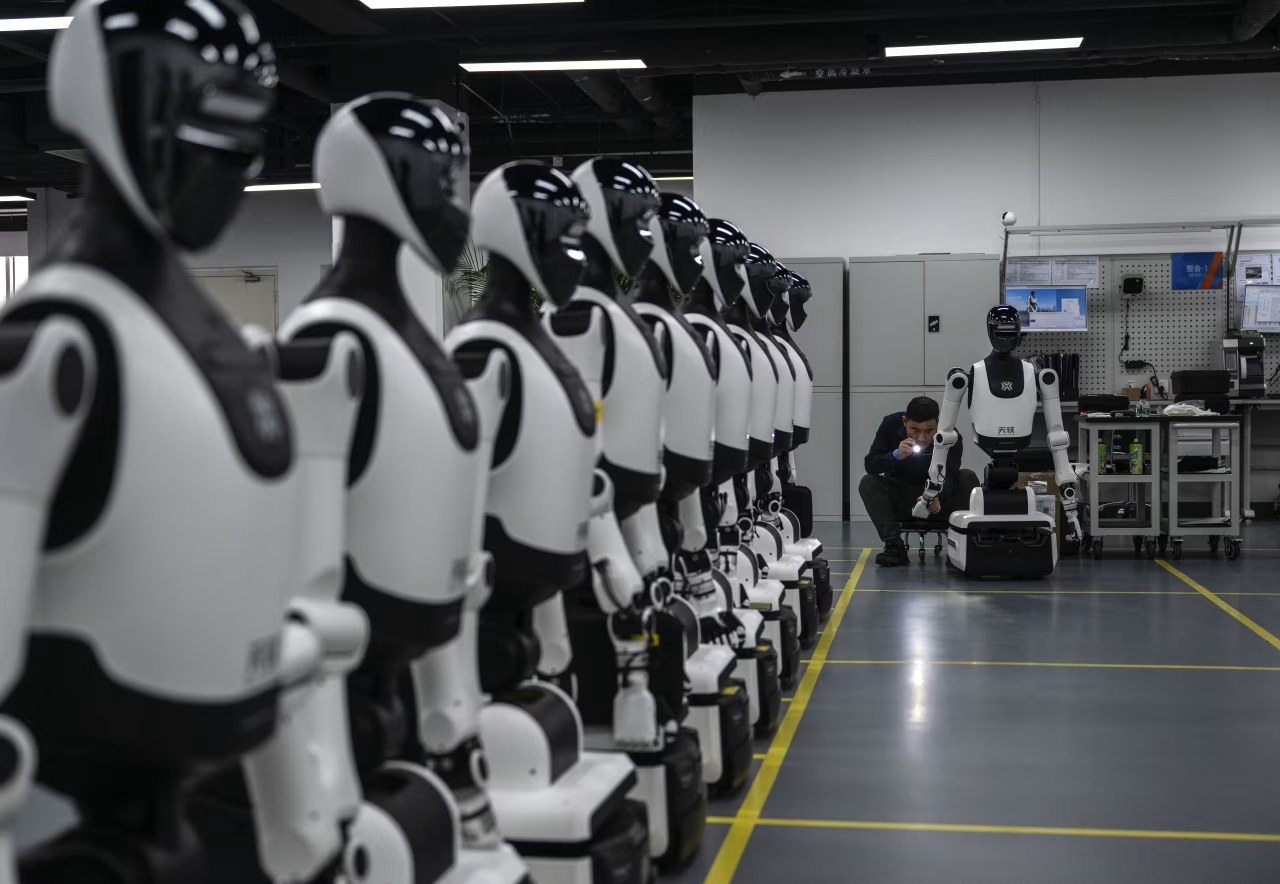
U.S. AI Capital Surges While Europe Writes Rules: Who Will Own the Next Industrial Revolution?
- U.S. artificial-intelligence capital spending is already large enough to rival consumer spending as a GDP engine.
- European Commission regulatory drafts could add up to 17 new compliance obligations for general-purpose AI models.
- Only three European start-ups rank among the world’s top 100 AI unicorns, down from five in 2022.
- The White House Council of Economic Advisers warns of a second “Great Divergence” between AI leaders and laggards.
Brussels may be protecting consumers, but it is also ceding economic ground to Beijing and Silicon Valley.
AI INVESTMENT—Artificial intelligence is no longer a laboratory curiosity; it is a line item in America’s GDP accounts. According to the White House Council of Economic Advisers, AI-related capital expenditure has become so sizeable that it is challenging consumer spending as the single biggest contributor to quarterly growth. The report, titled “Artificial Intelligence and the Great Divergence,” argues that nations which fail to channel similar resources risk a second great divergence—this time measured not in steam engines but in compute clusters.
Europe, by contrast, is writing rules first and writing checks later. Drafts of the EU’s forthcoming AI Act impose risk-tiered obligations that can require large “foundation” models to undergo third-party audits, share proprietary training data with regulators, and maintain human oversight teams whose hiring mandates alone could run into the thousands. Venture investors say the compliance burden is already steering growth-stage capital toward jurisdictions with clearer liability horizons.
The stakes extend beyond balance sheets. If AI becomes the primary driver of productivity gains, regions that delay adoption could see slower wage growth, smaller tax bases and diminished geopolitical leverage. Europe’s choice is therefore binary: either accelerate investment to match its own rhetoric on “digital sovereignty,” or watch the United States and China decide the default standards for everything from voice recognition to military logistics.
The Industrial Revolution Parallel That Keeps Economists Awake
Economic historians still cite the first Great Divergence as the moment when Western Europe and North America leapt ahead of China and India. Between 1820 and 1870, the United Kingdom alone raised its share of world industrial output from 12 % to 20 % while Qing China’s share fell from 33 % to 20 %. The decisive variable was not coal or colonies but the speed with which capital markets funded steam, steel and railways.
The White House report explicitly borrows that framing. It warns that AI is today’s general-purpose technology, akin to the steam engine, and that the countries first able to diffuse it economy-wide will collect persistent rents. A single large language model, trained once, can be replicated at near-zero marginal cost, creating winner-take-most network effects that compound faster than 19th-century rail networks.
Europe’s current trajectory mirrors the laggards of the first divergence. In 2023, EU firms invested roughly €110 billion in all forms of software and databases, according to Eurostat. By contrast, U.S. non-financial companies poured $420 billion into “information processing equipment and software” in the same 12-month span, Bureau of Economic Analysis tables show. While the categories are not perfectly aligned, the order-of-magnitude gap illustrates why Brussels now frets about “digital strategic dependencies.”
Reinhard Busse, head of health-care management at Technical University Berlin, argues that the divergence is already visible in hospital productivity. “U.S. centres that deployed AI-based imaging in 2021 now report 30 % faster radiology workflows,” he said. “German hospitals using legacy systems have seen no statistically significant throughput gains.” The lesson, Busse adds, is that regulatory caution has real opportunity costs measured in patient waiting lists and diagnostic accuracy.
Capital follows confidence
Confidence, in turn, follows clarity of rules. Until Europe offers both, its share of global AI capital formation will keep shrinking.
Why EU Start-ups Are Incorporating in Delaware, Not Dublin
When Stability AI, the London-based developer of Stable Diffusion, raised a $101 million seed round in 2022, it quietly re-domiciled its holding company in Wilmington, Delaware. Founders cited “predictable fiduciary standards” and “less prescriptive disclosure regimes” than those looming in the EU. The move is part of a wider pattern: venture capitalists say more than 60 % of European generative-AI start-ups now choose U.S. parent entities, up from 35 % in 2020.
The shift matters because incorporation geography determines where intellectual property is booked, where tax is paid and, crucially, where future capital rounds are deployed. A study by Index Ventures found that every $1 of U.S. VC money attracted by a Delaware entity yields, on average, $1.70 in follow-on funding from American limited partners. The multiplier for EU parent companies is only $1.10.
The EU AI Act amplifies the imbalance. Draft language requires “high-risk” systems to maintain a minimum 10 % human oversight ratio, mandate cybersecurity certifications unique to the bloc, and expose executives to personal fines of up to 2 % of global turnover. “That liability profile is a venture death sentence,” said Yvonne Cagle, a partner at Berlin-based Earlybird. “Founders can’t price tail-risk when they don’t even know which regulator will enforce it.”
Brussels officials counter that trust is a competitive advantage. “We want AI that is safe by design,” said Dragos Tudorache, the European Parliament’s lead negotiator on the file. Yet even he concedes that “regulation without innovation is just red tape.” The Parliament’s own impact assessment estimates compliance costs for a mid-sized AI firm at €350,000 in the first year, plus recurring audits of €150,000 annually—figures that dwarf seed-stage software budgets.
Capital flight accelerates
Each new clause tightens the funnel through which European talent must pass to reach global scale. Many now bypass it altogether.
Can Europe Close the Gap Without Cutting Red Tape?
Closing the AI investment gap will require more than venture capital; it demands sovereign-scale compute, data and patience. The U.S. CHIPS and Science Act allocates $52 billion in direct subsidies for fabrication plants, plus a 25 % investment-tax credit for semiconductor equipment. China’s National Integrated Circuit Industry Investment Fund is reportedly raising another $40 billion round. Europe’s response—€15 billion under the EU Chips Act—looks modest by comparison.
Yet money alone is not the binding constraint. Europe’s share of global super-computing capacity has actually risen to 24 %, thanks to the €1.2 billion EuroHPC joint undertaking. The bottleneck is access for start-ups. Only 8 % of available super-computing cycles were allocated to SMEs in 2023, according to the European Centre for Medium-Range Weather Forecasts, which manages several machines. By contrast, U.S. Department of Energy labs must award 20 % of cycles to commercial users under the CHIPS Act.
Regulatory clarity could unlock private capital faster than subsidies. When France introduced a simplified “AI sandbox” in 2021, domestic venture investment in machine-learning firms jumped 60 % within 12 months, France Digitale data show. The sandbox exempts pilot projects from certain labour-law provisions and allows algorithmic decision-making in non-critical use cases without prior authorisation. “It proved that legal certainty moves the needle more than cash grants,” said Cédric O, France’s former digital minister.
Whether Brussels can replicate the French experiment at continental scale remains open. The Commission’s forthcoming AI Act does include a sandbox clause, but it is limited to two years and caps participation at 150 firms. Given that Europe hosts an estimated 1,300 AI start-ups, the ceiling may be reached within months, re-creating the backlog it was designed to eliminate.
Scale matters
Without a bigger runway, Europe’s sandbox risks becoming another photo-op rather than a launchpad.
What a Second Great Divergence Would Mean for Wages and Security
If the first Great Divergence is any guide, the income gap between AI leaders and laggards could widen for decades. Economic historian Robert Allen estimates that British real wages rose 300 % between 1820 and 1860, while Qing China saw zero net growth. The mechanism was productivity: steam-powered factories raised output per worker faster than wages, generating surplus capital for further investment.
AI creates a similar dynamic. McKinsey modeling suggests generative AI could add €1.2 trillion to European GDP by 2030 if fully deployed, but only €300 billion under current adoption curves. The difference—€900 billion—approximates the combined annual output of Austria and Belgium. Failure to capture that value implies not just slower wage growth but a permanent shrinkage of Europe’s tax base just as aging populations drive pension liabilities higher.
National security adds another layer. U.S. defense officials already embed AI in predictive maintenance for the F-35 fleet, cutting downtime 20 %. NATO planners worry that European forces reliant on legacy logistics software could not interoperate at similar tempo. “AI is becoming the grammar of modern warfare,” said Federico Borsari of the Center for European Policy Analysis. “If Europe can’t speak it, deterrence is eroded.”
Labour unions counter that speed must not override fairness. Germany’s IG Metall union demands co-determination rights over algorithmic scheduling, citing Amazon warehouse metrics that increased injury rates 14 % during peak periods. Balancing competitiveness with worker protection will determine whether AI divergence is seen as technocratic inevitability or political failure.
Security and equity collide
Whichever narrative prevails, the window for simultaneous growth and fairness is narrowing with every quarter of capital flight.
A Way Forward: Three Policies That Could Reverse the Slide
Reversing Europe’s AI slide requires policy levers that match the scale and speed of private capital. First, expand regulatory sandboxes from 150 to 1,500 firms and make participation portable across member states. Estonia’s digital embassy model—where a domestic regulator can certify firms for EU-wide market access—offers a template that cuts duplication costs by 40 %, according to the country’s Economy Ministry.
Second, create a European Data Utility that pools anonymised industrial data under a single governance framework. Germany’s Gaia-X project already hosts 450 petabytes of manufacturing data but remains fragmented among 320 separate clouds. A unified utility could lower entry costs for AI developers by an estimated 30 %, Fraunhofer Institute researchers calculate, while preserving GDPR-level privacy.
Third, match U.S. and Chinese capital intensity through a European Sovereign Tech Fund, capitalised at €50 billion and empowered to take equity stakes in strategic AI firms. The European Investment Bank already runs a €3 billion venture programme; scaling it by an order of magnitude would narrow the yearly investment gap without distorting competition, provided exit timelines mirror private markets.
Crucially, each measure must be enacted in the next 18 months. Venture capital operates on fund cycles; once European founders incorporate in Delaware and raise dollar-denominated rounds, they rarely repatriate. “Path dependency sets in after Series B,” said Jeannette zu Fürstenberg, managing director of La Famiglia VC. Policymakers who miss the current cycle will find themselves lobbying foreign boards rather than nurturing domestic ones.
Time is short
Whether Brussels opts for incremental tweaks or a coordinated sprint will decide if Europe helps write the next chapter of the digital economy or merely footnotes it.
Frequently Asked Questions
Q: How much is the U.S. spending on AI infrastructure?
While the White House report does not give a single figure, it notes AI-related capital expenditure is now large enough to move the overall GDP growth needle, a scale Europe has yet to match.
Q: What is the ‘Great Divergence’ in AI?
Economists use the term to describe a potential split between nations that rapidly deploy AI technology and those that delay, echoing the 19th-century divide between industrial and non-industrial economies.
Q: Why does the EU trail in AI investment?
Brussels emphasises pre-emptive regulation and privacy protection, which investors say slows approvals and raises compliance costs, deterring the scale of spending seen in the United States or China.
