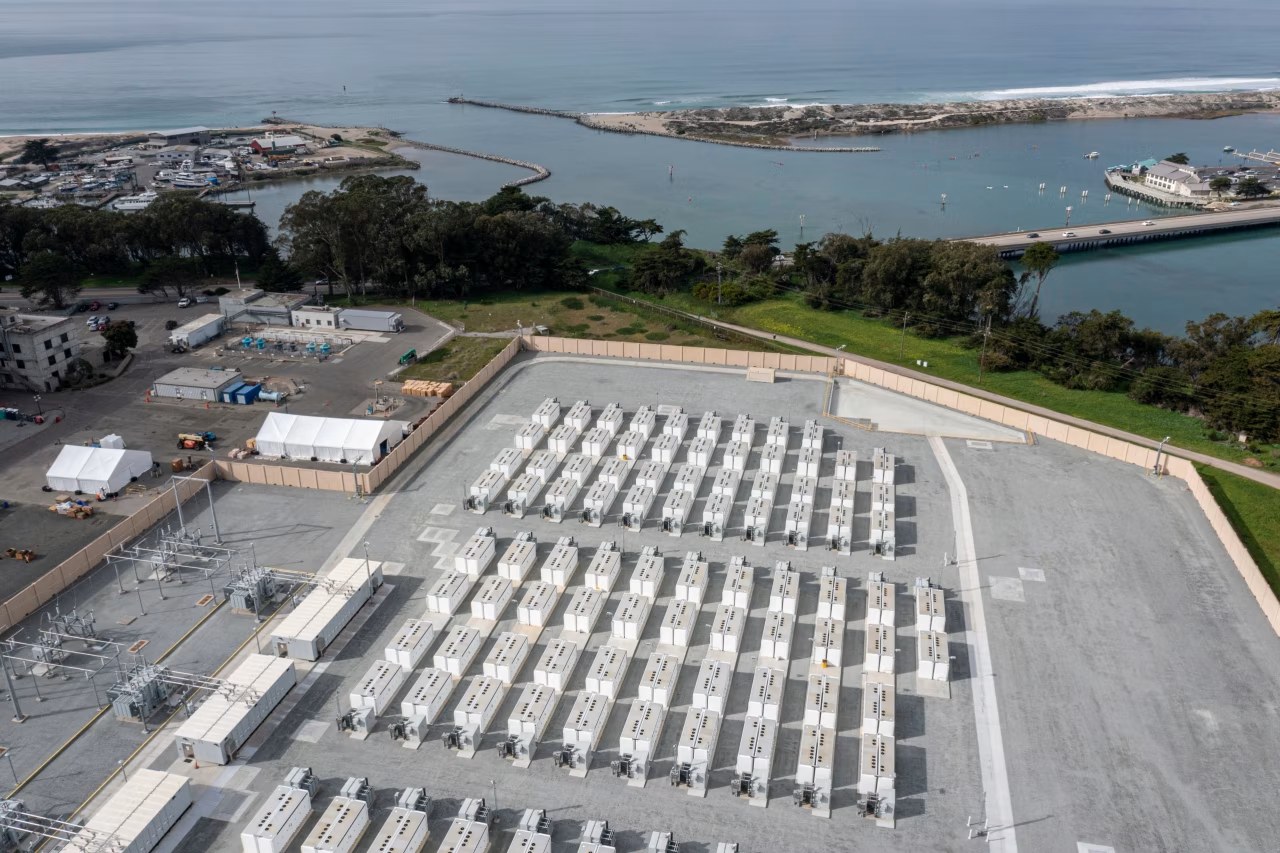
Tesla’s Grid-Battery Revenue to Jump 45% as EV Sales Crawl at 2.3%
- Tesla’s energy-storage division is forecast to grow revenue 45 % in 2025 while its EV deliveries expand just 2.3 %, according to Wall Street analysts.
- Stationary batteries are projected to absorb 41 % of total U.S. battery demand this year, up from 26 % two years ago, Benchmark Mineral Intelligence data show.
- Ford and other cell manufacturers are reallocating U.S. production lines from car packs to utility and data-center storage systems.
- The pivot follows the Trump administration’s rollback of EV purchase incentives and stricter fuel-economy penalties.
America’s battery-industrial complex is quietly re-wiring itself for the grid
EV BATTERIES—Few investors noticed when Tesla buried a single line in its third-quarter update: energy-storage deployments hit 6.9 GWh, a quarterly record. The disclosure, overshadowed by slower Model 3 demand, signaled a strategic inflection that is now rippling across the entire U.S. battery supply chain. With electric-vehicle growth stalling—analysts forecast only 2.3 % sales growth this year—cell makers are rushing to redeploy capacity into higher-margin stationary storage, a market turbo-charged by data-center build-outs and renewable-power mandates.
The numbers are stark. Two years ago, lithium-ion batteries destined for utilities and server farms represented barely a quarter of domestic demand. This year, consultancy Benchmark Mineral Intelligence expects that share to leap to 41 %, equating to roughly 50 GWh of cells—enough to power 4.5 million homes. Tesla, Ford, LG Energy Solution and a clutch of Korean and Japanese producers are already shifting production schedules, retraining workers and renegotiating supply contracts to capture the new revenue.
For policymakers who lavished billions on EV manufacturing incentives, the pivot underscores how quickly market forces can outrun industrial strategy. It also raises a fresh question: can the storage boom offset looming overcapacity in automotive cell production without triggering a glut in the grid segment?
From Cars to Cubes: Why the EV Slowdown Forced a Battery Reckoning
America’s battery sector spent the past five years in sprint mode. Between 2020 and 2023, manufacturers announced more than 1,000 GWh of new U.S. cell-making capacity, lured by the Biden administration’s Inflation Reduction Act credits and state-level EV mandates. Then reality intervened. Higher interest rates pushed monthly EV loan payments beyond the comfort zone of mass-market buyers, while a political swing in Washington stripped $7,500 consumer rebates from many models. The result: EV penetration has flat-lined at around 8 % of new-vehicle sales, well below the 15 % forecasters once penciled in for 2025.
Capacity utilization in EV cell plants has fallen below 50 %, according to Benchmark Mineral Intelligence.
That idle machinery is costly. A typical 10 GWh gigafactory burns through $150 million in fixed costs annually whether it runs at 20 % or 80 % utilization, says Caspar Rawles, chief data officer at Benchmark. “Producers suddenly need new outlets for cells that were purpose-built for 200-mile-range cars,” he notes. Stationary storage offers an attractive outlet because pack design is less constrained by weight and space, allowing manufacturers to use older chemistries and even cells that fail automotive grade-A testing.
The economic logic is compelling. A lithium-iron-phosphate (LFP) cell that fetches $80/kWh in a Ford Mustang Mach-E can earn $110–$120/kWh when bolted into a Tesla Megapack container, according to a February note from BNP Paribas Exane. Gross margins on stationary projects routinely exceed 20 %, double the current auto-pack level. For Ford, which posted a $4.7 billion loss on its EV line last year, the math is irresistible: redirecting one of its three U.S. assembly plants to stationary modules could add $600 million in annual EBITDA with minimal retooling, the bank estimates.
The shift is already visible on the factory floor. At Ford’s $5.8 billion Blue Oval Battery Park in Michigan, production lines originally slated for the F-150 Lightning now assemble 3.5 MWh racks for Duke Energy and Southern California Edison. Ford energy-services chief Jim Davis told analysts the company will “double stationary output every six months through 2026,” a timeline that implies 15 GWh of grid-bound capacity—enough to power 1.3 million homes for four hours.
Yet the pivot is not without geopolitical friction. Chinese producers such as CATL and BYD dominate global stationary supply, controlling roughly 60 % of the market for containerized systems. U.S. trade rules impose a 25 % tariff on most Chinese cells, but developers can still import cheaper turnkey batteries from Vietnam and Thailand, undercutting domestic factories. “Washington wanted an EV supply chain; it may get a storage glut instead,” says Emily Krebs, a supply-chain analyst at S&P Global Commodity Insights. How quickly American producers can scale—and at what cost—will determine whether the grid boom becomes a durable profit center or merely a temporary sponge for excess capacity.
Tesla’s Quiet Cash Cow: Energy Storage Outruns Car Sales
Tesla rarely breaks out financials for its energy division, but when it did last October the numbers startled even longtime followers. The unit generated $6.1 billion in revenue during the trailing four quarters, up 54 % year-over-year, while automotive sales rose just 7 %. More importantly, gross margin topped 24 %—a figure legacy carmakers struggle to achieve on internal-combustion SUVs, let alone electric sedans. Analysts at Morgan Stanley now value Tesla Energy at $120 billion, or roughly one-quarter of the company’s enterprise value.
Tesla deployed a record 6.9 GWh of Megapacks in Q3, enough to power every hospital in Texas for a day.
The surge is rooted in a single product: the Megapack XL, a 4 MWh container that sells for roughly $450,000 before installation. Each unit contains about 2,600 LFP cells, commodity chemistry that Tesla can source from multiple vendors. Because the packs are stationary, Tesla can accept cells with slightly lower energy density or cycle life—parts that might be rejected by the Fremont car line. That flexibility slashes input costs by 8–10 %, according to a teardown by German engineering firm Hofer Powertrain.
Demand is coming from an unlikely coalition. Data-center developers are racing to add backup power as AI workloads strain grids in Virginia, Ohio and Oregon. Equinix, the world’s largest colocation provider, signed a 1.2 GWh supply contract with Tesla in December, replacing diesel generators at five facilities. Utilities are equally hungry: California regulators approved 14.6 GWh of battery storage contracts last year to offset the closure of gas plants, with Tesla capturing 38 % of the awards. “We are effectively a virtual power plant company that happens to make cars,” chief financial officer Vaibhav Taneja told investors in January.
Production is scaling quickly. Tesla’s Lathrop, California, Megafactory now churns out 60 Megapacks per week, up from 25 in early 2023. A second plant under construction in Shanghai will add 40 GWh of capacity—enough to meet one-third of global stationary demand by 2027, according to Wood Mackenzie. The expansion will also localize supply chains, sidestepping U.S. tariffs on Chinese components and keeping Tesla’s cost per kWh below $110, a level Deutsche Bank calls “near-impossible to match for European rivals.”
Yet Tesla’s dominance is not pre-ordained. CATL has begun shipping its 5 MWh Tener containers at $380,000 apiece, 15 % cheaper than Megapacks, and offers 10-year degradation warranties that exceed Tesla’s. Start-ups such as Form Energy are commercializing iron-air batteries that promise 100-hour duration—far beyond lithium’s four-hour sweet spot. For now, Tesla’s brand recognition and integrated software give it an edge, but the next wave of grid contracts will be won on price and duration, not sleek design. Whether Elon Musk’s team can keep growing 45 % annually will depend on how aggressively it sacrifices margin to defend share.
Data Centers and AI Workloads Spark a New Demand Curve
The artificial-intelligence boom is rewriting the rules of electricity demand. A single Chat-GPT query consumes roughly ten times the energy of a Google search, and hyperscale operators are adding GPUs at a pace that doubles power density every 18 months. Uptime Institute estimates that new AI-ready facilities require 50–70 MW of firm backup power—equivalent to a small industrial city—creating an unprecedented market for four-hour lithium-ion systems.
Hyperscale operators signed 4.8 GWh of battery-storage contracts in 2024, triple the 2022 level.
Amazon Web Services alone has budgeted $35 billion for data-center expansion this year, with at least $2 billion earmarked for “resiliency infrastructure,” code for batteries and associated switchgear. Microsoft’s sustainability team told Citi analysts that every new 100 MW campus now includes 30 MWh of lithium storage to qualify for clean-energy tax credits and to shave peak-demand charges that can exceed $100 per kWh during Texas summers. “Batteries are becoming as critical to data centers as chillers,” says Jabez Tan, head of research at Structure Research.
Utilities are welcoming the trend because it aligns with their own capacity constraints. Grid-scale storage additions hit 15.4 GW in 2024, a record, yet interconnection queues remain clogged for new gas turbines. Fast-ramping batteries sited inside data-center campuses ease congestion without requiring new transmission. In Virginia’s Loudoun County—home to 70 % of the world’s internet traffic—Dominion Energy has approved 13 behind-the-meter battery projects totaling 450 MWh, all paired to server farms. The utility credits the systems with delaying a $200 million substation upgrade by four years.
The economics hinge on a practice known as peak-shaving. Data centers typically pay demand charges based on their highest 15-minute interval each month. A 50 MW facility can cut that peak by 10 MW using a 40 MWh battery, saving up to $600,000 per month, according to modeling by engineering firm Burns & McDonnell. With installed costs for four-hour lithium systems falling below $450/kWh, payback periods have shrunk to 3.5 years—well inside the five-year depreciation window most CFOs require.
Yet the marriage of batteries and bytes is not frictionless. Lithium cells degrade faster when cycled multiple times per day, a regimen common in AI facilities that train models at night when power prices plunge. Thermal runaway remains a concern: a single Megapack fire at a Microsoft facility in San Jose last June took 150 firefighters to contain. Insurers have responded with higher premiums, adding $15–$20/kWh to lifetime costs. And supply-chain managers must now forecast cobalt and lithium demand not just from Detroit automakers but from Silicon Valley cloud giants whose procurement cycles are measured in weeks, not model years. Still, with AI electricity demand forecast to rise 30 % annually through 2030, battery makers see data centers as the rare growth vertical that can absorb gigawatt-hours of cells without waiting for federal subsidies.
Can Grid-Scale Storage Absorb the Coming Battery Glut?
Global lithium-ion cell manufacturing capacity reached 2.8 TWh in 2024, yet demand—including EVs, phones and grids—totaled only 1.9 TWh, leaving a 900 GWh gap that Benchmark Mineral Intelligence calls “the largest overhang in battery history.” The surplus is concentrated in China, where CATL and BYD alone added 600 GWh of new lines last year, much of it subsidized by provincial governments anxious to secure industrial employment.
U.S. tariffs of 25 % on Chinese cells provide only partial insulation; third-country trans-shipment is surging.
American developers imported 12 GWh of Vietnamese-assembled batteries in 2024, up from 1.3 GWh in 2022, according to Customs data compiled by law firm Husch Blackwell. The units qualify for domestic-content bonuses under the Inflation Reduction Act because final assembly occurs in Ho Chi Minh City, even though the cells originate in Chinese-owned gigafactories across the border. “It’s the solar-panel dodge all over again,” says trade attorney Shayne Henderson, referring to circumvention practices that allowed Asian solar makers to bypass U.S. duties.
Price signals are already flashing. Average lithium-ion cell prices fell to $89/kWh in January, down 14 % year-over-year and the lowest level since BloombergNEF began tracking in 2010. Korean producers Samsung SDI and SK On have responded by idling 30 % of U.S. capacity, according to local union reports. European makers face an even tougher calculus: Northvolt recently postponed its Quebec cathode plant, citing “market softness,” while BASF froze plans for a German recycling facility.
Yet grid developers see opportunity. NextEra Energy has tendered for 2.5 GWh of batteries to be delivered in 2026 at a target price below $80/kWh—levels unthinkable two years ago. Independent power producer Vistra has added 400 MWh of storage at its Oakland facility, taking advantage of cheap cells to boost duration from two hours to four without new interconnection. “Oversupply is painful for manufacturers but a gift for utilities,” says Jim Robb, CEO of grid operator ISO-New England.
The long-term risk is technological substitution. Iron-air, sodium-ion and flow batteries promise longer duration at even lower cost, though all remain pre-commercial. If lithium-ion prices stay depressed, venture funding for those alternatives could dry up, locking grids into four-hour systems just as renewables plus long-duration storage becomes the favored pathway for 100 % clean-energy targets. For now, battery makers are betting that data-center and utility demand will mop up excess supply faster than new chemistries can scale. Whether that wager pays off will determine if the current pivot becomes a durable profit engine or merely a brief detour on the road to overcapacity.
Policy Uncertainty Clouds the Next Phase of Growth
Battery makers may have found a lifeline in grid storage, but Washington is hardly a stable partner. The Trump administration’s repeal of EV tax credits removed a key demand pillar, and proposed auto rules would freeze fuel-economy standards through 2030, further eroding electric-vehicle uptake. While standalone storage retains a 30 % investment tax credit (ITC) through 2032, lawmakers from coal-producing states are lobbying to tie the subsidy to on-site fossil generation, a move analysts say could slash deployments by 40 %.
A draft House bill would cap the storage ITC at $150 million annually, ending the current uncapped program.
State-level policy is equally fluid. California’s once-ambitious target of 11.5 GW of storage by 2030 has already been met—five years early—prompting regulators to debate whether to raise the mandate or allow the market to coast. Texas, which added more grid batteries than any other state last year, has no renewable portfolio standard, meaning future growth hinges on volatile power-price spreads rather than long-term contracts. “We’re one bad policy headline away from a 30 % demand haircut,” says Ric O’Connell, executive director of GridLab.
Trade policy adds another layer of risk. The Biden administration is weighing tariffs on Vietnamese and Thai battery packs, a move that could raise U.S. prices by 12–15 %, according to consultancy ClearView Energy Partners. Simultaneously, Commerce Department anti-circumvention investigations could retroactively impose duties on $3.2 billion of imports, chilling project finance. Lenders are responding by requiring 20 % contingency reserves, raising weighted-average cost of capital for storage projects by 150 basis points, estimates credit-rating agency Moody’s.
Labor costs are rising too. The Inflation Reduction Act’s domestic-content bonus equals an extra 10 % tax credit, but only if 40 % of battery value—including critical minerals—is mined or processed in the U.S. or free-trade partners. Meeting the threshold adds $18–$22/kWh to production costs, eroding the competitive edge that low Asian cell prices currently provide. Ford’s new Tennessee plant, designed to satisfy the rule, is now $900 million over budget and a year behind schedule, according to supplier documents reviewed by Argus Media.
Despite the headwinds, most analysts expect grid-storage deployments to grow at a 25 % compound annual rate through 2030, propelled by renewable mandates and corporate clean-energy procurement. Yet the pace is highly sensitive to policy. Wood Mackenzie modeled a scenario in which federal incentives are removed and state mandates plateau; the result is a 60 % drop in annual additions by 2027, pushing several U.S. cell makers into negative cash flow. For an industry that just pivoted away from EVs, the next chapter hinges less on chemistry than on the whims of legislators and regulators still grappling with how to balance decarbonization, trade enforcement and industrial competitiveness.
Frequently Asked Questions
Q: Why are battery makers shifting away from EVs?
Sluggish EV sales—projected at only 2.3 % growth this year—plus the rollback of federal purchase incentives have eroded auto-related demand, prompting producers to redeploy capacity toward higher-margin utility and data-center storage projects.
Q: How big is the energy-storage opportunity?
Benchmark Mineral Intelligence forecasts that stationary storage will claim 41 % of total U.S. battery demand in 2025, up from 26 % two years earlier, translating into gigawatt-hours of new contracts for suppliers such as Tesla, Ford and LG Energy Solution.
Q: Which companies are leading the pivot?
Tesla’s energy-storage division is expected to grow revenue 45 % this year; Ford is repurposing EV-pack lines for utility projects; and Korean and Japanese cell makers are reallocating U.S. factory output to server-rack and grid-scale batteries.
